
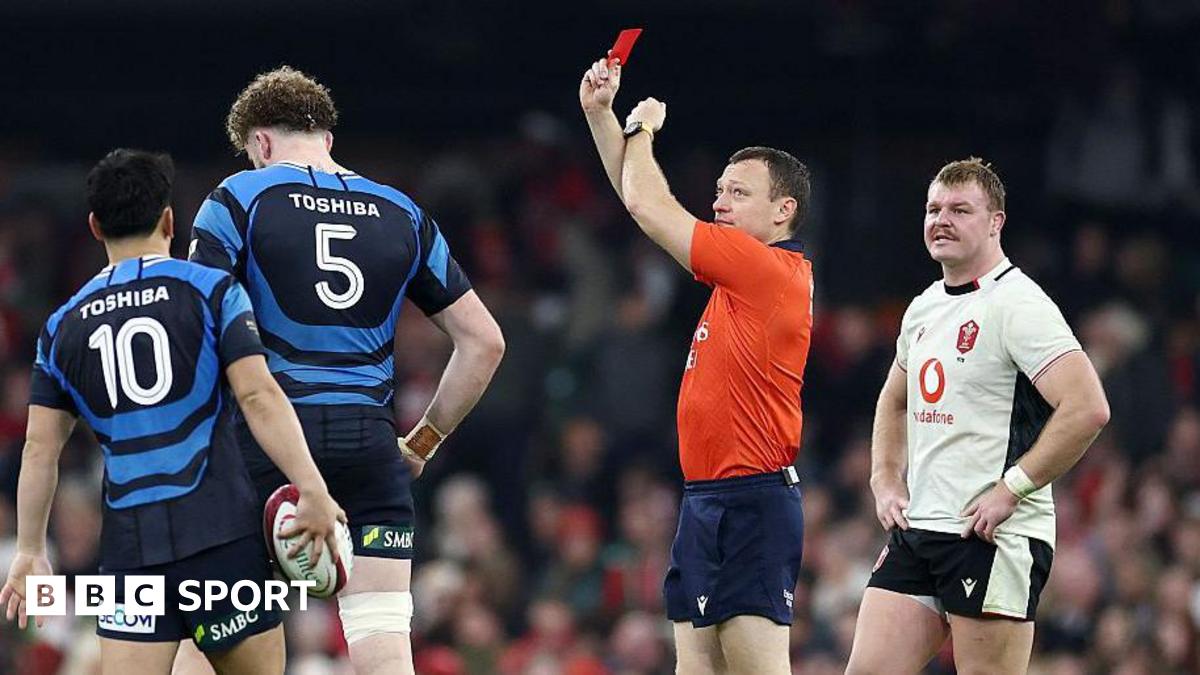
Six Nations referees have vowed to achieve “greater consistency” around officiating of foul play in this year’s tournament after a spate of controversial incidents in the autumn.
The November internationals were dogged by varying interpretations of what constitutes a red card, yellow card, and 20-minute red card.
Among the many incidents, South Africa’s Franco Mostert was given a permanent red for a dangerous tackle against France, which was rescinded, while Ireland’s Tadgh Beirne also had a 20-minute red card overturned.
On the eve of this year’s Six Nations, World Rugby have clarified that full red cards will be reserved for “acts of thuggery”, with 20-minute reds given for “technical offences” for example in the tackle.
The game’s governing body have admitted there was an “inconsistency of application” during the November window and have worked with the referees since then to improve the handling of foul play.
The 20-minute red cards were introduced as a way of sanctioning players without overly influencing the outcome and spectacle of a match.
The player who receives a 20-minute red card cannot return to the field of play, but can be replaced by another player after 20 minutes.
The on-field referee will initially give a yellow card, with the foul play review officer or “bunker official” making the call whether it should be upgraded.
Making head contact in the tackle and dangerous challenges in the air are offences which meet the threshold for a 20-minute red card.
“The 20-minute red card is for when a player gets it wrong in the tackle, an upright tackle, those kind of type of instances in the game,” explained top referee Angus Gardner.
“The foul play review officer is the person who makes a decision whether the yellow card is upgraded to 20 minutes.”
Gardner has also clarified that while permanent red cards can still be given for egregious acts of foul play, they can only be given by the on-pitch referee and cannot be given by the bunker official.
A permanent red card will be give for offences such as kicking, stamping, punching, making contact with the eye or deliberately targeting lower limbs in the ruck.