
International rugby players aren’t always global stars – there’s plenty of grass-roots players representing their nations
There are levels to the game. We know that in club rugby the pyramid is clearly defined in the UK, but what you might not know more about is the sliding scale of international rugby union. While the likes of Maro Itoje can make millions by racking up over 100 England caps, some of us are dipping into our own pockets to make a dream reality.
I say us as – thanks to my late Granny being born and growing up there – I have two caps for Jamaica, playing away against the Bahamas and Mexico. Avid readers of the mag will have gleaned this from previous features, but it inspired me to dig further into the world of the international game below the professional level.
Read more: How to watch Gallagher PREM action wherever you are
Believe it or not, there could be internationals at your local club wherever you are. Ordinary-looking folk achieving extraordinary things and often having to go to extraordinary lengths to do so.
“Rugby is a very small sport in Finland and there’s not too much funding,” explains Thomas Finell. “We have some sponsors and we operate on a very small budget. Players pay for training camps and Internationals. Right now, it’s about €100 a camp for the weekend and a game would be from €100 to €300.”
“I’ve estimated that I would have paid roughly €500 per game over the years, including training camps. When you play 70 games that’s a lot of money, but it’s given me memories and experiences I couldn’t buy. It’s an investment in myself.”
That’s over £30,000 to play for your country over the last 22 years or so. Finell, now a fly-half but initially a full-back, was lured to a rugby training session by a friend who suggested it would suit him much better than the basketball he played at the time.
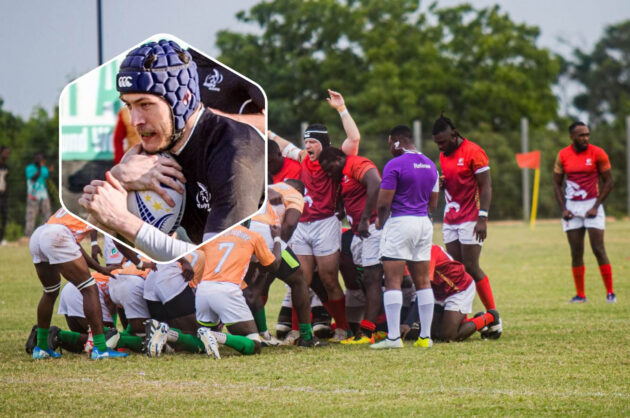
Thomas Finell is a Finnish legend in rugby union (Laura Helminen)
“I came to those first practices with basketball shoes on and it had rained, so the grass was pretty slippery and I was just sliding all over the place. I wouldn’t call it rugby today, what we were doing that afternoon!”
In 2003, he was invited to a national team training camp but failed to make the side. That rejection fuelled him and Finell won his first two caps against Israel and Norway in France the following year. A huge moment.
“My first language is Swedish – there’s a small Swedish-speaking population in Finland. I was nervous for my first International and as we were going through the tunnel, I realised I couldn’t remember the Finnish words for the anthem. I ended up singing it with the Swedish words. After that first game, I made sure I learnt the Finnish words!”
Scoring a try on debut and winning in Moldova, some 30 places higher than Finland in the world rankings at the time, rank highly in Finell’s highlights. Now 42, even he admits he will have to assess whether he can keep going after this year’s games.
Over time he has seen the game grow from a handful of clubs who often didn’t have enough players for 15-a-side games to now where there are 15 to 20 clubs with women and juniors playing. Some journey.
The Scandinavian weather means rugby is limited to ten games a season in the summer in Finland, but Finell spent a season in Holland where he won the Dutch championship with Gooi in 2012-13. While on holiday, Finell—who works in HR—has turned out for Diss in East Anglia.
Finell is a great example of homegrown talent shining and Finland have had to rely on that since its most famous business moved away from selling phones.
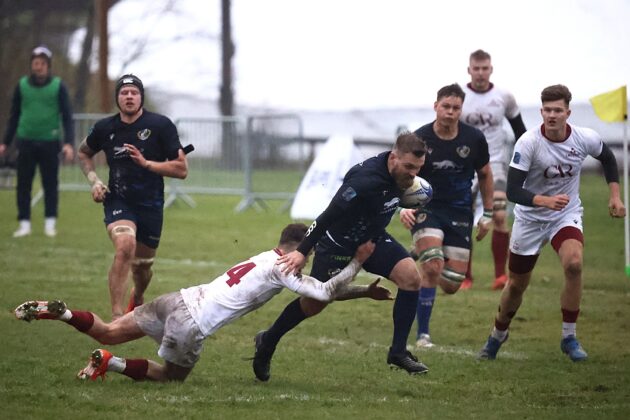
Finell on the charge against Latvia (Thomas Finell is a Finnish legend in rugby union (Laura Helminen)
“When I started, teams relied heavily on expats. It used to be Nokia or ‘wives and partners’ that brought people in. Now Nokia isn’t there in that capacity, so most teams are mainly Finnish people who learned the game in Finland. The refereeing and knowledge of the laws are improving rapidly.”
While the World Cup might be “quite far in the future”, Finland are pushing to progress within the Rugby Europe structures. They aren’t the only side on that path.
Peter Morris, 30, never really considered playing rugby for Austria, where his mother is from, but after a year abroad in Munich, he soon found himself kicking goals in Internationals. Morris, who studied history and economics at Durham, wanted to get his level of German—which he grew up speaking at home in London—up to scratch.
After initially thinking he might have a go at something a bit more German like handball, living near to the rugby pitches drew him to München Rugby Football Club.
“The head of the club there in Munich was an Austrian guy who had, I think, played for the national team previously. So once they found out that I held a passport, they were quite keen to get me in touch with someone from the Federation.”
“Rugby out there is quite a small world. So once I was in at the Munich level, it was quite easy to set up a trial in Austria.”
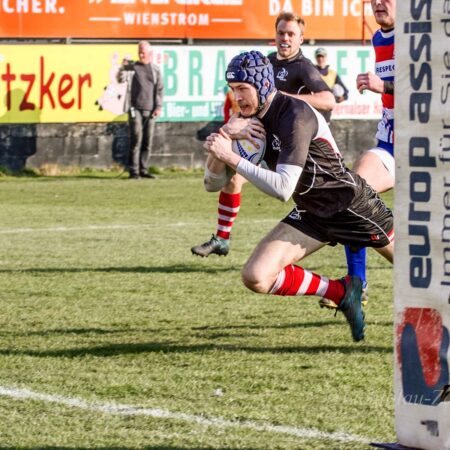
Peter Morris scores for Austria, where his mother is from
His opportunity didn’t materialise until he was back in the UK for his final year of studies in the North-East. As a prospective player, there was no funding available to get him out to Vienna, but luckily Morris received some financial support from Hatfield College, even if he did go from Manchester to Bratislava to save the pennies.
“It was a transition period for the union; they had a brand-new coach whose first session was that camp. I was thrown into the deep end and started at ten against Serbia two or three weeks later which was daunting! It was amazing. I don’t think I’ve ever been more nervous before anything. The whole build-up to it.”
“We play in a very cool, old football stadium and they got tons of fans watching and at that time the state broadcaster was still showing it on TV. It was a bit overwhelming. Once I’d done that there was no looking back.”
A narrow win after a few easy kicks at goal got Morris off to a flyer, even if he had to navigate Austrian liquors and schnapps at a lively post-match function. He went on to play 11 or 12 games and but for Covid and concussions it could have been a good few more.
As is often the case at this level, Morris never received an actual physical cap. “I got a tie but they’ve now brought an actual cap in. But as I was in the change-over period with coaches/president, there were a few of us that missed out.”
Sevens becoming an Olympic sport from Rio 2016 did wonders for the coffers of many emerging nations, Austria included.
“I always had my travel covered and one of the boys would put you up, it builds camaraderie. There’s no bells and whistles but that’s not why you’re doing it.”
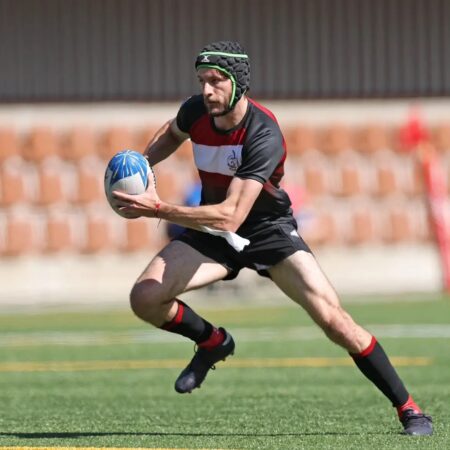
Concussion curtailed Morris’s Rugby Austria career
It’s for the romance of Cyprus away in 25-degree heat or the hardship of travelling to Norway in November to lose 6-3. Morris’s highlight was beating Slovenia in the final play and while he admits that limited time together hampered any chance of a more technical game plan, it was a very physical Test arena.
“I was technically good and playing three or four times a week at Durham, so I’d be one of the better ball players. But physically I was pretty broken.”
Another man who learnt his rugby in the UK before starring on foreign shores is train driver Frank Sackey. Born to Ghanaian parents, Sackey, 31, was in the London Scottish Academy when he got a message off the Ghana captain offering an opportunity.
“Me and one other guy from Scottish got flown out for a training camp and then played in the Rugby Africa Cup Sevens in Uganda in 2017,” he tells us.
Then followed the Rugby Africa Bronze Cup in 15s. Wins over Rwanda (57-0) and Mauritius (23-17) saw Ghana win that and while things went well in the games, Sackey’s lack of familiarity with the Ghanaian anthem was exposed.
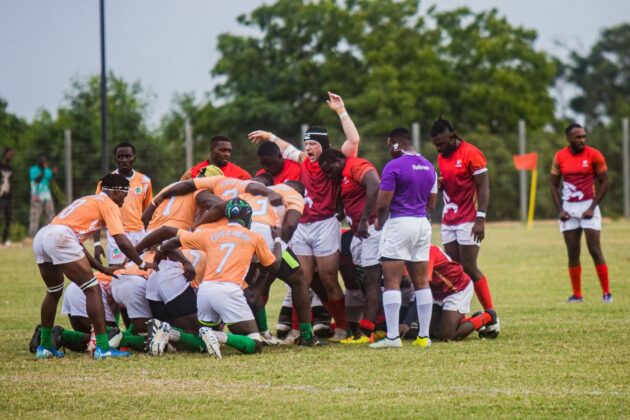
Frank Sackey packs down at No 8 for Ghana (Reality Images)
“After the game, the president of Ghana rugby whispered in my ear, ‘You need to learn the national anthem, mate’.”
A wake-up call! It’s not unusual for there to be a mix of languages in teams with expats but the diversity of the spoken word in Ghana saw team talks having to be translated live.
“A big mix of players from a big mix of regions. Most overlap in English but it’s like pidgin English, so not quite the same as home.”
The fitness buy-in for a sevens camp was also a bit different for Sackey, who plays for Eton Manor at level six, when the shifts of his boyhood dream job allow.
“I got off the plane when I first arrived, got straight to the stadium and did 50 shuttle runs.”
Rugby now has a purpose-built stadium in Accra and the World Cup in 2031 is the ultimate aim. Occasionally you can snare a couple of caps without even qualifying for a nation.
Ben Carswell was working for PwC on a three-year secondment in Caracas when he joined Arcos Rugby Club. A relaxed attitude to rules saw him play No 8 for Venezuela in two defeats to Argentina (147-7) and Uruguay (97-7) in Chile back in 2004.
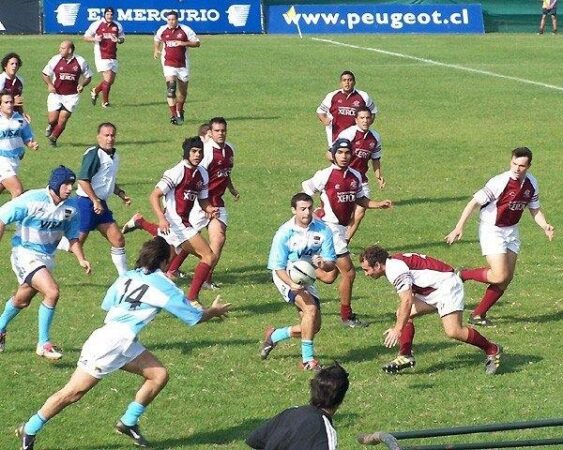
Ben Carswell (far right) tracks back for his adopted nation Venezuela against Argentina in 2004
Carswell swapped shirts with Manuel Contepomi, brother of Felipe, and faced Uruguayans who had played England’s World Cup winners the year before. Not bad for a chartered accountant who usually played in the front row for Rosslyn Park’s seconds.
“I was the only ringer but it was great,” he says. “Venezuela is a party nation if ever there was one. We owned the dance floor after the tournament. It’s a beautiful country with beautiful people – a few I keep in touch with.”
Stories, memories and people that are special. That’s what this international rugby is about.
This article first appeared in the May 2026 issue of Rugby World Magazine (321)
Download the digital edition of Rugby World straight to your tablet or subscribe to the print edition to get the magazine delivered to your door.