
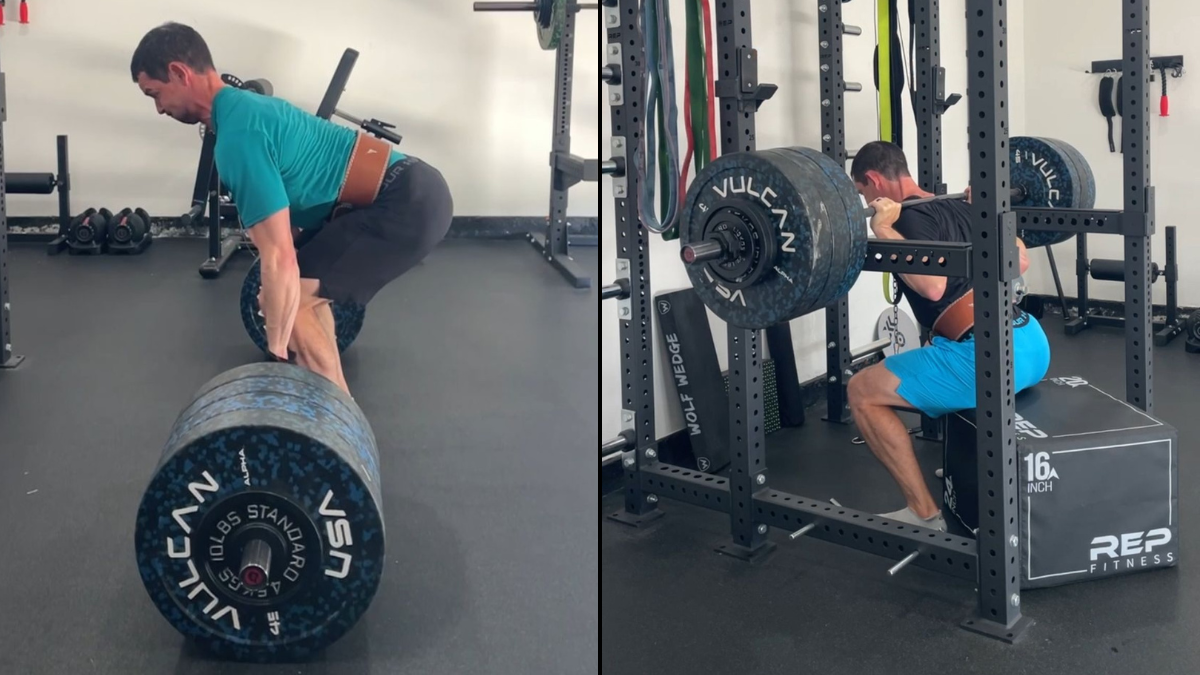
7. How Heavy Should I Lift?
Finding the Right Starting Weight
This applies to the vast majority of exercises. Choose a weight you are sure you can lift for five reps. Perform five reps, and based on how it feels, add a little more weight, still being confident you can do five reps. Repeat this a couple more times and you will find a weight that is of moderate difficulty for five reps.
A good weight to stop at is one that you lifted for five reps, and if you absolutely had to, you maybe could have lifted for seven or eight. This is about three reps in reserve and a nice intensity level to start with.
If you are a complete beginner, go even easier for the first few sessions. Finishing each set with three or four reps left in the tank is fine. It is better to start too light and progress gradually than to overdo it early and stall or get hurt.
If you are new to training, you will get stronger quickly. The goal from here is to add very small weight increments in each workout until you cannot. In the next sections I will explain this method, and another progression method, in more detail.
Simple Linear Progression
For this example, let’s imagine you have determined that 95 lbs for 5 reps is an appropriate starting weight on the bench press. You successfully complete 3 sets of 5 reps with this weight and feel like there was room for a little more weight.
Perfect. Next session, add a small amount of weight, maybe 5 lbs, so you’re up to 100 lbs. If you can still complete three sets of five, increase again the following session to 105 lbs. These small, steady jumps might not sound like much, but they add up quickly. That’s progressive overload in action.
In simple terms for linear progression:
- Use a weight that allows 3 sets of 5 reps.
- If it feels easy, add a small amount of weight in the next session.
- Keep increasing gradually until 3 sets of 5 reps is right at your limit.
- Whenever possible, add another small increment.
You will reach a point where 5-pound, and even 2.5-pound, jumps from session to session are too big. When exactly this happens will depend on the exercise and your training experience.
Adding 5 lbs to a 200 lb load is a much smaller percentage increase than adding 5 lbs to a 50 lb load, and will be sustainable for much longer. It’s a good idea to think about weight increases in percentages rather than absolute amounts. Increasing a dumbbell lift from 20 lbs to 25 lbs feels much harder than increasing a barbell lift from 200 lbs to 205 lbs. It’s the same 5 lb increase, but a completely different relative increase.
Double Progression Method
You will eventually reach a point where you hit a plateau with the linear progression method outlined above. This is completely normal. Strength increases slow down drastically after the first few months of training. When this happens, the double progression method is an excellent option.
- Start with a weight you can lift for 3 sets of 5.
- Stay with that weight until you can do 3 sets of 8. This may take many sessions.
- Once you can complete 3 sets of 8 reps, increase the weight so that in your next session you are back to 3 sets of 5 reps with a heavier load than before.
- Keep repeating this process.
This method gives you more time to stimulate the adaptations necessary to go up in weight, which becomes increasingly important as progress slows down.
The key with both methods is that there is a clear plan and intent to gradually increase the weight you are using.
Why We Need Progressive Overload
The ability to use more load over time is what proves you are stimulating adaptation.
Gradually adding load over time, is the best proof that you are stimulating strength adaptations.
This ties in with why tracking your training is so important. The Fit For Golf App prescribes crystal clear instructions on exactly what to do in each workout, and makes it simple to record the weight used and reps completed for each set. The progress section allows you to monitor your strength (and club head speed progression) over various time periods.
If the numbers aren’t moving up over time, that’s feedback that something needs to change. Or, you may be at a point where you are just happy to maintain, that’s OK too.
How Strong Is Strong Enough?
Another common question that comes up is: Do I ever reach a point where I should stop trying to get stronger?
For almost all golfers, the answer is no. The vast majority are nowhere near their true strength potential and will benefit from further increases in strength. In general, we need to set higher strength standards for golfers (and non-golfers) who are interested in maximizing performance and longevity.
For most golfers, more strength will almost always be desirable for better speed potential and greater resilience to fatigue and injury. We also need to remember that the higher we can raise our strength peak, the more we have in reserve as we get older. The goal is to raise the peak and slow the decline.
As long as you are increasing strength patiently and progressively, and not “number chasing,” your muscles, tendons, and connective tissues adapt extremely well to the stresses applied. The small risk of an occasional strain or minor injury is massively outweighed by the long-term benefits of being stronger — both for golf performance and overall health.
Research consistently shows that properly performed strength training has a lower injury rate than almost every other sport, including golf itself. Strength-training-related injuries can almost always be traced back to training errors — insufficient warm-ups, too rapid an increase in training loads, trying to squeeze out “one more rep” when technique has broken down, or ignoring early signs that something isn’t feeling right.
There will come a time when progress slows, and you may only make small increases over long periods. Or you may be training hard and simply maintaining. That is completely normal once you are years into your training. By that stage, you will have already transformed your physical capabilities, and maintaining those levels is an enormous advantage for golf performance and long-term health.
Strength Standards for Golfers
A very common question is “what’s a good strength level in ________ exercise”? That’s a difficulty question to answer based on many variables, and every time I try to provide guidelines, someone isn’t happy!
I have tried to provide some benchmarks in the table below, that you can work towards. Note how I said work towards, I am not saying you should feel bad or aren’t doing a good job if you can’t reach them now!
It’s important to note that these standards reflect results from actual strength training (covered later), not simply exercising with weights. There’s a big difference. These numbers assume structured, progressive, very high effort, training designed to make you stronger over time.
How long it takes to reach each level depends on your starting point, training consistency, and how well you apply the fundamentals. As a rough guide:
• Solid: Typically achievable within about 6 months of consistent, progressive training, two to three times per week.
• Strong: Usually reached after 12–24 months of steady, well-structured strength training. You can get here, but you must strive for progressive overload. There must be a good plan in place that you stick with, and you must try hard!
• Very Strong: Reflects roughly 2+ years of dedicated, progressive training with minimal long breaks. This level requires making strength training a big priority in your life, it’s not for everyone. It doesn’t just happen from “showing up and working out”, which is what many, even consistent trainees do.
There’s a wide range in how individuals respond to training. Genetics, age, muscle fiber makeup, recovery ability, and previous experience all play a part. Some people will make rapid progress, others will take longer, but everyone can make significant improvements if they train with purpose and consistency.
Hitting the “Strong” range across most lifts is a great target for golfers who train consistently.
In regards to the relative to bodyweight numbers, If you’re carrying 20, 30, or 50 lbs of extra body fat, these relative strength levels may seem high. They’re well within reach for reasonably lean, well-trained people.
Getting body fat down, and strength levels up is great goal for most people. and will of course make these standards more attainable.
These aren’t rules or requirements — they’re reference points to help you see where your training stands and where you might still have room to improve.
If you fall below the standards, don’t worry. With 1–2 years of well-structured strength training, your strength levels can be completely transformed, at any age.
The table below represents 5RMs — the most weight you can successfully lift for 5 repetitions with good form.
← Swipe to view the whole table →
| Exercise | Level | Male | Female | Male 60+ | Female 60+ |
| Squat (to breaking parallel) | Solid | 1.0×BW | 0.8×BW | 0.8×BW | 0.7×BW |
| Strong | 1.5×BW | 1.2×BW | 1.2×BW | 1.0×BW | |
| Very Strong | 1.75×BW | 1.4×BW | 1.3×BW | 1.2×BW | |
| Barbell Split Squat | Solid | 0.8×BW | 0.7×BW | 0.65×BW | 0.6×BW |
| Strong | 1.1×BW | 0.9×BW | 0.85×BW | 0.75×BW | |
| Very Strong | 1.3×BW | 1.05×BW | 0.95×BW | 0.85×BW | |
| Hex Bar Deadlift | Solid | 1.25×BW | 1.0×BW | 1.0×BW | 0.9×BW |
| Strong | 1.75×BW | 1.4×BW | 1.4×BW | 1.2×BW | |
| Very Strong | 2.0×BW | 1.7×BW | 1.6×BW | 1.4×BW | |
| RDL | Solid | 1.1×BW | 0.9×BW | 0.9×BW | 0.8×BW |
| Strong | 1.6×BW | 1.3×BW | 1.2×BW | 1.1×BW | |
| Very Strong | 1.9×BW | 1.5×BW | 1.4×BW | 1.2×BW | |
| Bench Press | Solid | 0.75×BW | 0.5×BW | 0.6×BW | 0.5×BW |
| Strong | 1.0×BW | 0.7×BW | 0.8×BW | 0.65×BW | |
| Very Strong | 1.25×BW | 0.85×BW | 0.9×BW | 0.75×BW | |
| Pull-Up | Solid | 1 rep @ BW | 1 band-assist rep | 1 band-assist rep | 1 band-assist rep |
| Strong | 5 reps @ BW | 2–3 reps @ BW | 1–2 reps @ BW | 1 rep @ BW | |
| Very Strong | 5 reps @ 1.2×BW | 5 reps @ BW | 3 reps @ BW | 2–3 reps @ BW | |
| Single-Arm Row (DB) | Solid | 0.3×BW | 0.22×BW | 0.27×BW | 0.2×BW |
| Strong | 0.4×BW | 0.3×BW | 0.36×BW | 0.27×BW | |
| Very Strong | 0.5×BW | 0.4×BW | 0.45×BW | 0.36×BW |
Key Takeaways for “How Heavy Should I Lift?”
- Heavy is relative. Start light, focus on good technique, and add small amounts of weight over time.
- Track your training. If the numbers aren’t increasing, you’re maintaining, not improving.
- Progressive overload drives every long-term gain in strength.
- You won’t get “too strong.” The goal isn’t to lift the heaviest weights possible — it’s to increase what your body can do so every swing you make has more potential behind it.
Adjustments for Different Times of Season
Off Season
The off season is when you should strive to stimulate adaptations. This is the time to turn the hose on full blast. Train hard enough and often enough to actually create change.
You have more time away from competition and rounds of golf, so fatigue isn’t as big a concern. That means you can handle more total work and recover from it. Focus on increasing strength, and the size of your Type II muscle fibers, and setting up your body for the season ahead.
When golfers go through this phase properly, they see the biggest improvements in strength, body composition, and long-term power potential.
This is also a great time to try and move the needle with swing speed training.
In Season
Once the season starts, priorities shift. Scores come first. Fatigue and soreness from the gym has to stay low so you can play and practice effectively.
The goal here is simple: maintain what you’ve built, and if possible, continue improving slightly. The good news is that maintaining strength is really easy.
Even two short sessions per week, with a few heavy sets, is enough to hold onto almost everything you built in the off season. You don’t need a lot of volume, you just need to keep the stimulus present.
This is a key part of how I help the PGA Tour players I work with. Managing all the different stressors and making sure things are in order. Scores are the priority.
The biggest change to in season training is NOT a reduction in weight, it is a reduction in training volume. This is primarily done by reducing the number of sets per session, and potentially the frequency of sessions. Moving from 3 sessions per week to 2 sessions per week is a viable option.
Done appropriately, in-season strength training keeps the body strong, durable, and better able to handle travel, practice, and tournament golf. It’s also critical for maintaining muscle mass and club head speed all through the season.
Many golfers, even at the professional level, skimp on strength training in season. This results in a steady decline in power levels as the season goes on, and means they are back to square one each off season. Ideally you want to at least maintain in season, so you are climbing to a higher level each off season, not just trying to get back to where you were the previous year.
Adjustments for Different Populations
Seniors
Age is less relevant than level of physical conditioning. You could have two seniors of the same age, one training to a high level for 50 years, and another completely out of shape and just beginning strength training. Completely different scenarios, which is why creating programs solely based on age is nonsensical. I do love working with both cases though!
The two examples above are on either end of the spectrum. There’s a wide middle ground that most (not all) seniors fall into. For this demographic, the Seniors Program on the Fit For Golf App is perfect. This program follows the same philosophy I instill in all of my programs, while taking into account the need for a more gentle starting point.
Most people are far too conservative with their training goals. The research shows clearly that older adults can make huge strength gains when they train properly, and it’s NOT dangerous.
Start lighter, focus on technique and control, then increase gradually. Within a few months, you’ll be able to handle far more than you thought possible, and your body will feel the difference both on and off the course.
I am 77 years of age and have been using the Fit For Golf App for 3 years. I have lost close to 70lbs, my strength levels have increased, and my handicap has reduced from 16 to 8.
Paul Brumley, 77, 8 hcp
Females
There are no major differences in strength training for males and females. Both can follow the exact same program.
In general, there is a strength difference between males and females, mostly because males tend to have more total muscle mass. On average, males have about 40–60% more upper body strength and 25–30% more lower body strength. This is mainly due to greater total lean mass, not differences in muscle quality or how muscles respond to training. Females also tend to carry a higher proportion of their total muscle in the lower body compared to the upper body. This reduced upper body strength is a huge training opportunity. Few things help female golfers more than developing upper body strength. (Miller et al., 1993; Janssen et al., 2000).
Women can expect the same relative increases in muscle size and strength from training as men. When training is matched for effort, volume, and frequency, the percentage improvements are very similar. Men often gain more total mass simply because they start with more muscle, but the relative progress is the same. (Roberts et al., 2020; Grgic et al., 2022).
Females can often perform more reps with the same percentage of 1RM compared to men, and tend to recover faster between sets and sessions. This is partly explained by a slightly higher proportion of slow-twitch fibers and greater fatigue resistance. (Hunter, 2016; Fulco et al., 1999).
None of this changes the overall training guidelines. The same principles apply. Train hard, progressively overload, recover, and repeat.
Finally, to clear up one of the biggest myths, you will not get too muscular. Lifting heavy will not make you “bulky.” Gaining large amounts of muscle requires a significant calorie surplus and years of consistent, high-volume training. Strength training will make you stronger, more athletic, and more resilient. The benefits for bone health, tendon strength, and long-term wellbeing are enormous. (Phillips, 2014).
I have been using the Fit For Golf App for two years. I have made progress in overall strength, power and club head speed. My golf also got better. When I started Fit for Golf I had a handicap of 16. It’s now down to 12.
Susanne, 61, 12 hcp
Juniors
Strength training is absolutely beneficial and safe for juniors of all ages. Traditional strength training is not where I would place a lot of attention for juniors, however. This is a time when maximising speed, coordination, and building competency in as many different movement patterns as possible will be hugely beneficial.
Juniors should sprint, jump, throw, and hit all different kinds of balls as hard as they can. Playing different sports is ideal, but even basic activities at home go a long way. On top of these sports activities, general play like climbing, tumbling, wrestling etc is all fantastic.
Through the teenage years, as puberty kicks in, strength increases come quickly. This is when introducing some more structured strength training makes most sense, but it should not come at the expense of what is listed above.
The main priorities are:
• Keep it fun and avoid burnout.
• Build coordination and speed.
• Encourage a wide range of activities, without forcing them.
In terms of “golf specificity”, the younger, the better for developing a swing that prioritises club head speed. Get them a radar, teach them what club head speed and ball speed are, and make it fun to track progress. They’ll figure out the rest on their own.
What About Sport Specific Training?
Most of what’s called “golf-specific training” is nonsense. It’s usually prescribed by people who don’t understand how physiology underpins performance. They get caught up in movement pattern similarity and ignore, or don’t understand, the need to actually stimulate adaptation.
There’s no such thing as “golf strength.” Strength is a product of the physiology in our muscles and nervous system. These same muscles and nervous system are what produce force in any activity we carry out. Our specific skill and movement mechanics in the sporting task, in our case, the golf swing, is what determines how well our strength is transferred, not whether the exercises we used to develop this strength are “golf specific” or not. When you are trying to swing a club at high speed, you’re relying on the adaptations you stimulated in training, not what the exercise looked like.
The vast majority of high level athletes in rotational sports train almost identically, because the adaptations we’re targeting happen at a basic physiological level. Track and field throwers, baseball hitters and pitchers, hockey players, hurlers – these athletes often display enormous potential for club head speed without ever having practiced golf, never mind performing “golf-specific” exercises in their training. They’re powerful because their neuromuscular systems have been developed to produce force quickly, both through their physical training and sports practice.
Now, is there a middle ground? Of course. Some exercises that resemble the golf swing can be highly effective, and I include them in Fit For Golf Programs. The key is that these exercises must still stimulate adaptation in the nervous system or muscles, otherwise there is no training effect, and you would be better off simply practicing your swing.
Sure, you can develop some swing feels in the gym, but there’s a strong chance you are using time poorly and neither improve your swing nor develop physically.
The vast majority of golfers, even those who’ve exercised with weights for years, still have massive room for progress with basic, structured, progressive strength training. This is what delivers real physiological adaptation — the kind that moves the needle.
So yes, there’s a place for “sport-specific exercises”, but they are a very small piece of a quality strength training program. The biggest transformation for most golfers will come from getting much stronger, while simultaneously working on swing mechanics and speed training.
Swing mechanics and practicing swinging fast are where the golfer develops the ability to transfer their physiological capabilities to their swing.
Get brutally strong → develop great swing mechanics through intense practice → do targeted speed training.
That’s the combination that builds real performance.