
9. Common Mistakes
The biggest mistakes I see in speed training are too much too soon, insufficient warm-ups, and not trusting the process.
Too Much Too Soon
It’s common for golfers to get a burst of enthusiasm when they begin speed training. This can lead to them doing way too many swings relative to what’s needed for progress, and more importantly, what they are physically prepared for. In this scenario the golfer doesn’t make any more progress than they started with a more moderate volume, but must deal with a much higher amount of fatigue and increased injury risk.
In all aspects of physical training it is more sensible to start on the conservative side and slowly build up. It’s much easier to add little amounts over time rather than overdo it early.
A mismanagement of speed training volume and frequency is the biggest reason for injuries during swing speed training. The next biggest issue is not warming up thoroughly enough.
Insufficient Warm-Up
Adequately warming up is essential for reducing the risk of injury and performing at your best on that given day. A full and thorough warm-up before speed training is non negotiable. Do not skip it or cut it short. If you are pressed for time, cut down on the number of swings you make in the speed training session, do not skimp the warm-up!
In the Swing Speed Training section of the Fit For Golf App, there is an option to be guided through a warm-up before you begin. I always choose Dynamic Warm-Up #1, which after memorising takes about 8 minutes. I then perform a lot of swings with my driver (or stack), progressing from slow to medium to fast. A simple way to do this is 3 sets of 5 swings. With 60 seconds or so between sets. A slow set, a medium set, and a fast set.
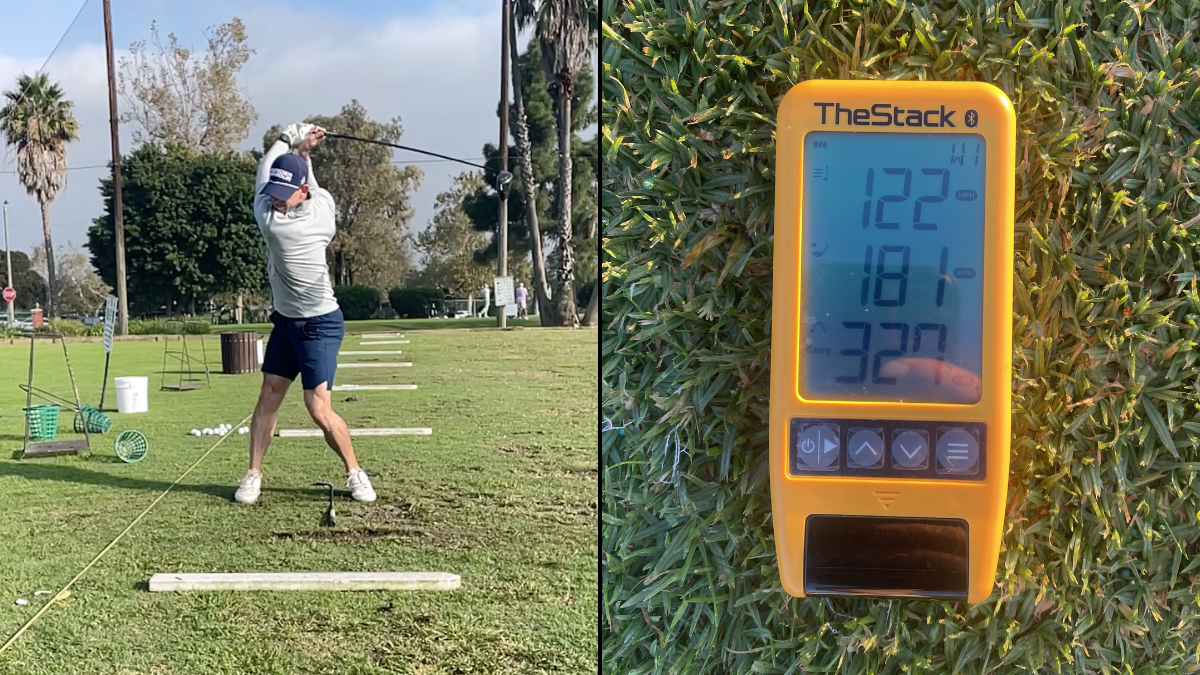
This “Pump Drill” shown above is a favourite of mine to do in warm-ups. I do this for 3 sets of 5 instead of “normal swings”. It’s a good warm-up and speed drill and they flow a bit better than breaking up swings, as I transition from the follow through of one swing into the “first pump” for the next swing.
You should have a little bit of a sweat going and feel noticeably warmer by the end of this process. A good sign you’re adequately warmed up for your speed training is that your first few balls in the session are almost as fast as the peak speeds you hit in the session. If there is a big gap, or you clearly improve throughout the session, it’s a sign you weren’t fully warmed-up.
Inserting your speed training at the end of or during a range session is a practical way to ensure you are well warmed-up without needing to go through the whole warm-up process just to speed train. There is a sweet spot of being well warmed-up but also not fatigued. You will need to judge this for yourself.
If I’m in a “speed training block” where I’m really trying to make progress with speed, I tend to do speed only sessions. I go through dynamic warm-up #1, 3-4 sets of 5 swings of the pump drill trying to get faster on each set, and then hit approximately 30-40 balls. This is time consuming and would easily take me an hour. I typically do this 2 x week in the winter months.
On the contrary if I’m in a period where I’m more focused on maximising my practice time to sharpen up on course scores, I might not want to devote 1-2 hours a week solely to speed training. In this scenario, I would just hit about 10 drivers at the end of each practice session, which adds almost zero time.
Not Trusting the Process
People start working on speed, maybe change their mechanics or intent, and in the early stages their dispersion gets worse. They hit some shots they’re not used to. Because of that, they back off and decide speed training isn’t for them.
In my experience, most players who stick with it and train sensibly see really good outcomes. You’ll have some messy sessions along the way, but the long term gains are worth it.
A good example of someone who came through this experience is a golfer named Rory McIlroy. (I have not worked with Rory or have any inside info, I am purely going from what is readily available online).
In September 2020 Bryson DeChambeau won the US Open at Winged Foot by six shots. During the 2019-2020 season, Bryson averaged 125.00mph club head speed. This increased to a 132.25mph in the 2020-2021 season, a whopping 132mph of club head speed. A whopping 14mph increase from the 2018-2019 season, and the highest ever club head speed recorded for a PGA Tour season, by a wide margin. His speed gains and results were receiving a lot of attention!
Rory lost about 2mph of club head speed during the COVID break. At the time, based on his social media activity, he was focusing a lot on Pelton workouts, and seemed to have lost quite a bit of mass. In the 2019-20 season, Rory averaged 118.88mph club head, 30th place in the PGA Tour rankings, which is a very unusual position for him. In the following 2020-21 season, he gained 4mph, averaging 122.87mph, and moving up to 9th in the club head speed rankings.
In March of that season Rory shot 79-75 to miss the cut at the Player’s Championship and spoke about how he felt working on speed, which he increased by 4mph, had hurt his swing.
He discusses it in minutes 1-4 of this video.
This video was about 6 months after he said he started working on speed. Quite a short period of time for an already extremely fast player to gain 4mph and feel comfortable using it.
So, did Rory cut back on his speed and start swinging slower? Absolutely not! In fact 4 years on, Rory is swinging faster than he was at the time he made this video!
Based on the statistics since then, it seems he has kept working on it, and got through the initial struggles. In the 2024 season Rory averaged 123.6mph club head speed, and in the 2025 season he averaged 123.33mph. This put him 6th and 12th in the PGA Tour club head speed rankings.
From following the social media accounts of the PGA Tour & DP Tour who regularly show Rory on the range hitting over 190mph ball speed and 127mph club head speed I am confident he continues working on his speed.
Something also very evident over this time frame is how much mass Rory has gained. I estimate he has gained about 15-20lbs, with a decent proportion of it being lean tissue. I have no doubt that developing a bigger and more powerful frame made Rory’s desire for a certain club head speed more attainable with mechanics he is comfortable playing with.