
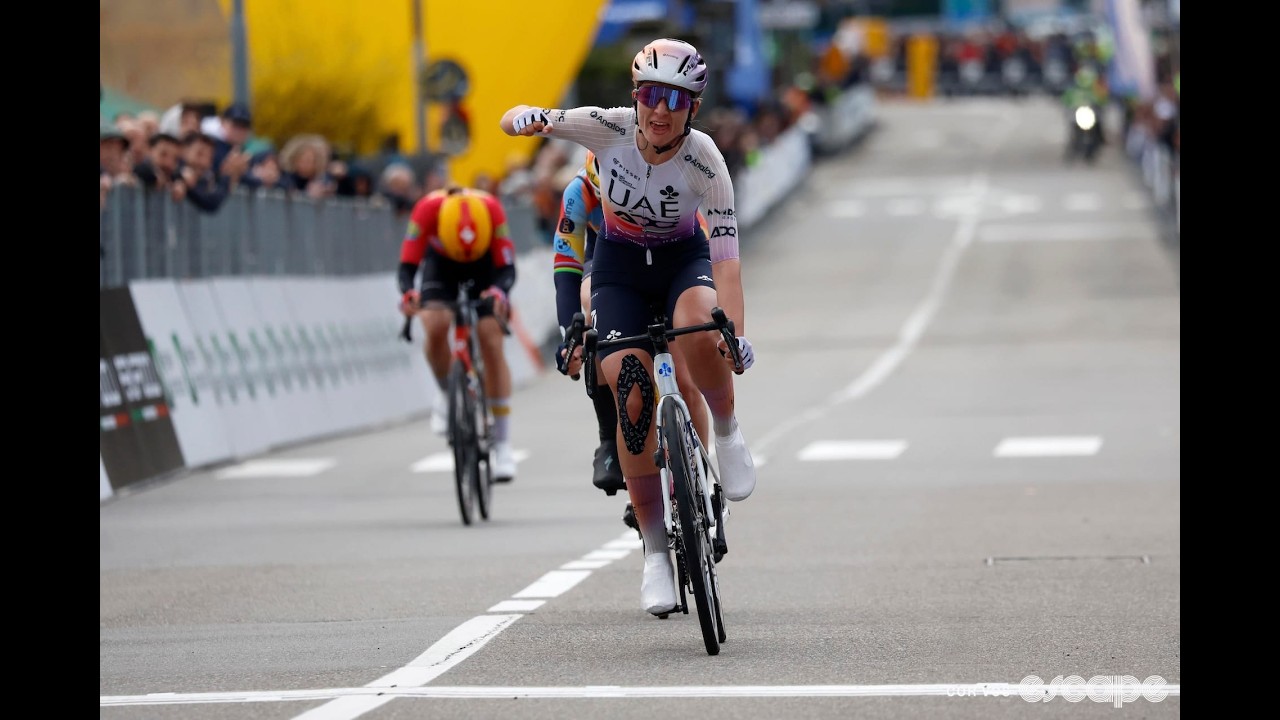
A race of attrition on the shores of Lake Maggiore delivers a first WorldTour victory for the Dutch powerhouse as her team controls every kilometre of a tactical, demanding classic
TROFEO ALFREDO BINDA — COMUNE DI CITTIGLIO
Luino to Cittiglio, Italy — 152.7 km — March 15, 2026
There are days in professional cycling when a team is so thoroughly in command that the only question remaining is which of their riders will take the prize. Sunday’s 27th Trofeo Alfredo Binda — Comune di Cittiglio was one of those days, and UAE Team ADQ the team doing the commanding. In the end it was Karlijn Swinkels, a rider not even pencilled in as the plan A, who crossed the finish line first in Cittiglio to claim her debut WorldTour victory in a race that has graced the Women’s WorldTour calendar since its inception in 2016.
The 152.7-kilometer race between Luino and Cittiglio — already shortened by nearly ten kilometres after overnight snow made the first classified climb at Masciago Primo impassable — played out as a slow-building demolition derby across five punishing finishing circuits on the hills above Lake Maggiore. By the time the dust settled on the final ascent of Orino, Swinkels had outsprinted Anna van der Breggen and a gutted Mie Bjørndal Ottestad in a charged three-woman finish, while the chasing group arrived 47 seconds in arrears, having never found the legs to close what had looked, at various points, like a bridgeable gap.
A MODIFIED COURSE, AN UNMODIFIED AMBITION
Race morning brought cold air and wet roads to the north Italian lakeside. Organisers confirmed the route change early: the Masciago Primo climb, which would have come after 29 kilometres, was cut from the parcours following snow accumulation overnight. The peloton would still face more than 2,300 metres of vertical gain across the five closing circuits, each 17.6 kilometres long and containing two climbs — the short, sharp ramp at Casale and the 4-kilometre ascent to Orino at 433 metres, featuring ramps of 10 percent and tight hairpin bends. Anyone expecting an easier day because of the shortened route was quickly disabused of that notion.
The field rolled out of Luino at 1:00 p.m. local time, 137 women signed on for what would prove to be one of the oldest races on the Women’s WorldTour calendar. The Trofeo Binda, first held in 1974, holds a particular distinction: it is the longest-running race in women’s top-tier cycling, having joined the World Cup in 2008 and the Women’s WorldTour at its founding in 2016. To win here is to add your name to a list that includes Marianne Vos, Kasia Niewiadoma, Elisa Longo Borghini, and the recently retired Lizzie Deignan. Today, one more name would be added.
THE BREAK, THE BUILD, THE BLOWUP
For the first hundred kilometres, the race followed a familiar script. Early attempts at establishing a breakaway came to nothing on the nervous roads, the peloton unwilling to cede control. It was Hannah Ludwig of Cofidis who eventually succeeded, slipping clear with around 106 kilometres remaining and building a lead of just under two minutes as the peloton settled into a rhythm behind her. The German rider, a strong climber and a versatile racer, made herself at home out front as UAE Team ADQ sat on the front of the bunch, content to manage the gap rather than chase in earnest.
Ludwig’s advantage remained relatively stable — around one minute 30 to one minute 45 — as the race ticked through its early closing circuits. The pace, though, was already high, the average sitting north of 41 kilometres per hour despite the damp conditions. By the time the race entered its final two laps, the bunch had been reduced to a compact, nervous group of fewer than 20 riders, and Ludwig’s adventure was nearing its end.
With 35 kilometres remaining, the mood shifted. UAE were now setting a punishing tempo, Mavi García putting her head down and her legs to work at the front of a reduced peloton. Riejanne Markus of Lidl-Trek lit the touch paper, and suddenly it was attack after attack. Elisa Longo Borghini — a two-time winner of this race, a local in every meaningful sense, and the team’s headline act — went on the offensive, drawing Kasia Niewiadoma, Noemi Rüegg of EF Education-Oatly, and Puck Pieterse of Fenix-Premier Tech with her. The move nearly stuck but the group came back together over the top.
SD Worx-Protime, Visma-Lease a Bike, Human Powered Health, and Picnic-PostNL all tried their luck in the frantic kilometres that followed. World champion Magdaleine Vallieres of EF Education-Oatly took her turn on the descent. Nothing stuck. The race was coiling itself tighter and tighter.
UAE SPRING THE TRAP
With 22 kilometres remaining, Eleonora Gasparrini made her move. The UAE rider accelerated clear on the approach to the Casale climb, drawing six riders with her: teammates Karlijn Swinkels and Silvia Persico, Anna van der Breggen of SD Worx-Protime, Pfeiffer Georgi of Picnic-PostNL — who had won the junior race on this course earlier in her career — and Norway’s Mie Bjørndal Ottestad of UNO-X Mobility. The gap opened to 17 seconds at 15 kilometres to go.
It was, on the face of it, a problematic situation for UAE. They had three cards to play, there was little incentive to do the bidding of their rivals. Van der Breggen, meanwhile, was doing exactly what Anna van der Breggen does: working hard, keeping the pace high, serving her team’s interests — in this case, protecting Lotte Kopecky and Blanka Vas behind.
What followed on the penultimate ascent of Casale was a swift and brutal reorganisation. Persico and Gasparrini, despite being the architects of the move, were shed from the group. Georgi, too, began to struggle. By the time the road tilted toward Orino for the final ascent, the lead group had been whittled to four: Swinkels, Van der Breggen, Georgi, and Ottestad. With 11 kilometres remaining, Swinkels had gone to sit in, either marking Van der Breggen or protecting Longo Borghini’s interests behind. The tactical chess match was reaching its most complex phase.
THE CLIMB THAT DECIDED EVERYTHING
Georgi was dropped from the front group as the road bit in earnest on Orino. Three riders remained: Swinkels, Van der Breggen, and Ottestad, with a gap of around 35 seconds over the Kopecky-Vas group behind. Van der Breggen, a rider of unmatched tactical intelligence and race-reading ability, was unrelenting on the climb. She attacked one kilometre from the summit. Ottestad began to crack. Swinkels, hanging on, was forced to the front by Van der Breggen as the gradient eased — a move that forced the Dutch rider to do exactly the work she preferred not to do.
Over the top with 7.5 kilometres remaining, Van der Breggen went deep into her poker face. The gap was 48 seconds. The logic of the situation dictated cooperation — sprint from three and let the fastest legs decide. Van der Breggen, however, showed no interest in expediting that outcome, refusing to come through as Swinkels sat up. It was a mind game as much as a road race.
Behind, on the descent, Marianne Vos attacked the chase group but was covered by Longo Borghini. Ottestad, showing extraordinary courage for a rider who had already emptied herself on the climb, attacked the leading trio at four kilometres to go — a defiant, gutsy lurch for glory that briefly reshuffled the cards. It was never going to be enough.
THE SPRINT, THE VICTORY, THE REWARD
Van der Breggen never came through. Swinkels wound it up, and when the sprint opened, the UAE rider had too much. Ottestad, who had given everything and then some, had nothing left for the finish and crossed third. The chasing group arrived 47 seconds later, Blanka Vas leading them home, Lotte Kopecky rolling in seventh.
For Swinkels, it was an emotional and significant arrival. This was her first WorldTour victory — a result that validated not just her own considerable abilities but the depth of an UAE Team ADQ squad that is quietly becoming one of the most formidable in the women’s peloton. It was also her second win of a young 2026 season, having already taken victory at the Trofeo Binissalem-Andratx in Mallorca.
“I was supposed to be waiting for the final sprint. But then we had this occasion where we attack with the three of us — with Silvia and Gaspa — and they kept pulling for me. I felt quite confident on the climb but then I got a bit nervous because in the final, Anna didn’t pull. In the sprint I felt quite confident but also a little nervous because I really wanted to finish the good teamwork off, because the girls worked really hard for me and believed in me today.” Karlijn Swinkels, race winner
UAE’S STATEMENT PERFORMANCE
If the win was Swinkels’, the performance belonged to UAE Team ADQ as a whole. They placed three riders in the penultimate selection, four of their six in the top 20, and controlled the race from start to finish. Eleonora Gasparrini and Silvia Persico celebrated with their teammate at the finish line — women who had driven themselves into the ground in service of a victory they handed to a teammate with grace and confidence.
The transformation of UAE Team ADQ in recent seasons has been one of the stories of the women’s peloton. Since Elisa Longo Borghini joined the squad, the team has gained both a marquee name and, it appears, a culture of depth and tactical sophistication. The Italian veteran, a double winner of this very race in 2013 and 2021, did not take the prize today — but she was central to making it possible.
For SD Worx-Protime, it was another race that slipped through their fingers. Van der Breggen rode brilliantly and intelligently, but the tactical read that the race would come down to a sprint from the break — and that she might not be the fastest wheel to back — proved costly. Kopecky, finishing seventh, and Vas, leading the chasers home, underlined the team’s firepower. It is a squad built to win in multiple ways. Today was not their day.
Mie Bjørndal Ottestad deserves special mention. The Norwegian, riding for UNO-X Mobility, exemplified her team’s growing confidence and aggression with a performance of rare courage. She drove the move, stayed in the front group longer than anyone had a right to expect, attacked four kilometres from the line when the move made little sense by the numbers, and crossed the line third having ridden herself almost to a standstill. It was the kind of performance that announces a rider to a wider audience.
HISTORY AND HERITAGE IN CITTIGLIO
Trofeo Alfredo Binda, named after the Cittiglio-born champion who won the Giro d’Italia five times between 1925 and 1933 — a record he shares with Fausto Coppi and Eddy Merckx — has earned its place as the most historic race on the Women’s WorldTour calendar. First held in 1974, it staged its 53rd edition today, the only gap in the record coming in 2020 during the pandemic.
Previous winners in the field today included Shirin van Anrooij, who won the 2023 edition, Marianne Vos — who holds four victories here alongside Maria Canins — Kasia Niewiadoma, and Longo Borghini. None of them added to their tallies. Instead, a new name joins the honour roll: Karlijn Swinkels, winner of the 2026 Trofeo Alfredo Binda, and a rider who may well be back for more.
RESULTS — 2026 TROFEO ALFREDO BINDA — COMUNE DI CITTIGLIO
| Pos. | Rider | Team | Time |
| 1 | Karlijn Swinkels | UAE Team ADQ | 3:53:17 |
| 2 | Anna van der Breggen | SD Worx-Protime | s.t. |
| 3 | Mie Bjørndal Ottestad | UNO-X Mobility | +0:03 |
| 4 | Blanka Vas | SD Worx-Protime | +0:47 |
| 5 | Letizia Borghesi | AG Insurance-Soudal Team | s.t. |
| 6 | Marianne Vos | Visma-Lease a Bike | s.t. |
| 7 | Lotte Kopecky | SD Worx-Protime | s.t. |
| 8 | Noemi Rüegg | EF Education-Oatly | s.t. |
| 9 | Célia Gery | FDJ United-SUEZ | s.t. |
| 10 | Shirin van Anrooij | Lidl-Trek | s.t. |
(Visited 13 times, 3 visits today)