
Buy The Art of Batting here:
Nine innings, zero runs.
That was wicketkeeper Seymour Clark in first-class cricket. He played five games in 1930 for Somerset. In an attempt to make him score a run, Essex spinner Peter Smith delivered a ball that bounced twice. And yet, Clark was out bowled. This was with a new bat Clark had bought for the season. All he wanted was one professional run, and sadly, in his first season, he couldn’t get a cracker. His best efforts were the two 0 not outs. For most keepers, not scoring a run would be the end of their career.
But Clark’s keeping skills were rated very highly. Next season, he was offered another contract. In the end, he decided to go back and work his safe and secure job at the Great Western Railway.
When we made the old weird T20 XI video, we had Clark as one of the nearest neighbours for the wicketkeeping slot. Partly as a gag, as specialist T20 keepers almost do not exist.
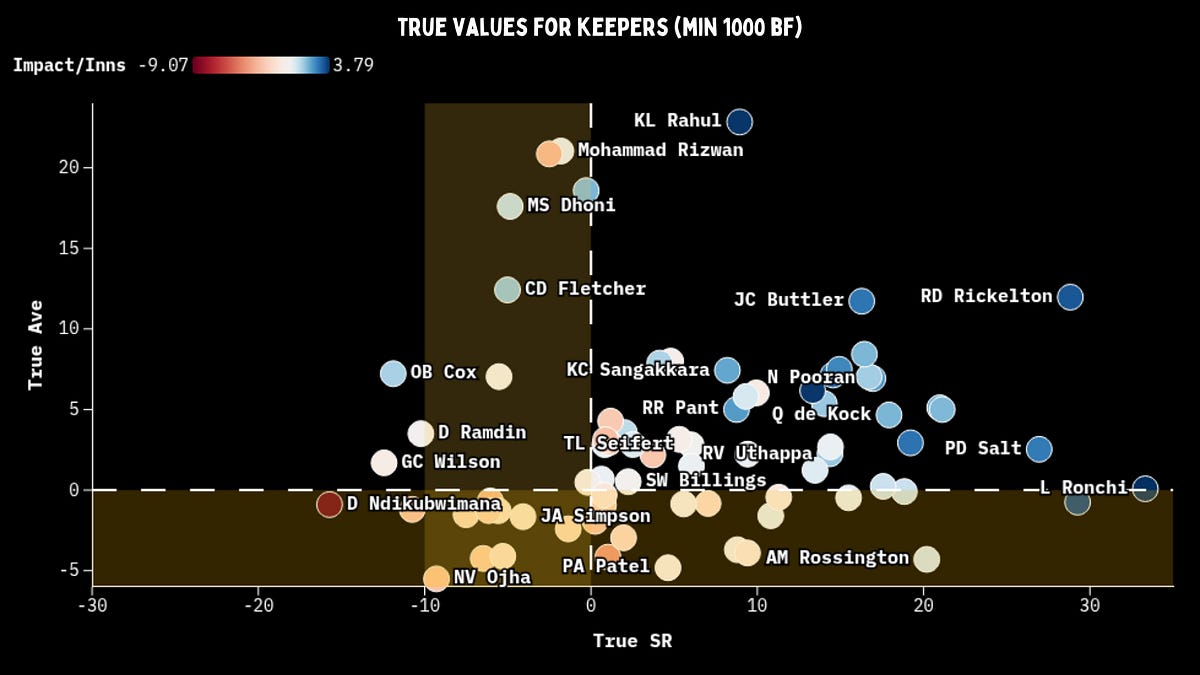
Well, perhaps except late-career MS Dhoni, who has faced only 7.6 balls per innings in the impact sub era.
Yes, he can still whack the quicks at the death in his short cameos. But like Clark, he’s still an elite wicketkeeper – see the Shubman Gill stumping in the 2023 final – and he was the captain when they won the title that year.
In Test cricket, even the best batting keepers are usually slotted in the lower order as the workload is obviously much higher. But in the shortest format, we see them everywhere in the batting lineup – attacking openers, middle-order spin nappers and gun finishers. Sometimes, they’re not even required to keep wickets as both franchise and international teams can have multiple options.
There are players who love to keep because it gives them their freedom. Others prefer to only have one specialist job. We have seen from first-class keepers that overall, there is almost no impact. But for each player, it can be wildly different.
Who are the players who need the gloves, and who should ditch them for more runs?
***
Luke Ronchi started innings like someone had lit him on fire, and he only had a few minutes to score. His former Islamabad United analyst Hassan Cheema once told me it was almost all nerves. But no one scored as fast as him in the first five balls.
Playing domestic cricket for Western Australia, he was touted to be Adam Gilchrist’s successor. And he ended his career taking over from Brendon McCullum for New Zealand. He qualified for two teams, and somehow found himself understudy for both.
His career didn’t quite match his talent, especially internationally. But in T20s, he was a beast. He is number one on impact, changing the predicted score by 3.79 runs per innings. There are a couple of caveats though – along with his underwhelming T20I career, he did not play much in the IPL after an early failure. The league moved on, but he was better as he got older.
Gilchrist himself wasn’t too bad at T20s either, despite playing the majority of it after his prime. Another player of that prototype is Phil Salt, who doesn’t make a huge amount of runs but does it very, very quickly.
And Ryan Rickelton is fascinating, as in a short time he’s done great work, but also because he’s a much better batter with the gloves on. It’s not even that his roles change drastically, as he’s predominantly a top-order player either way.
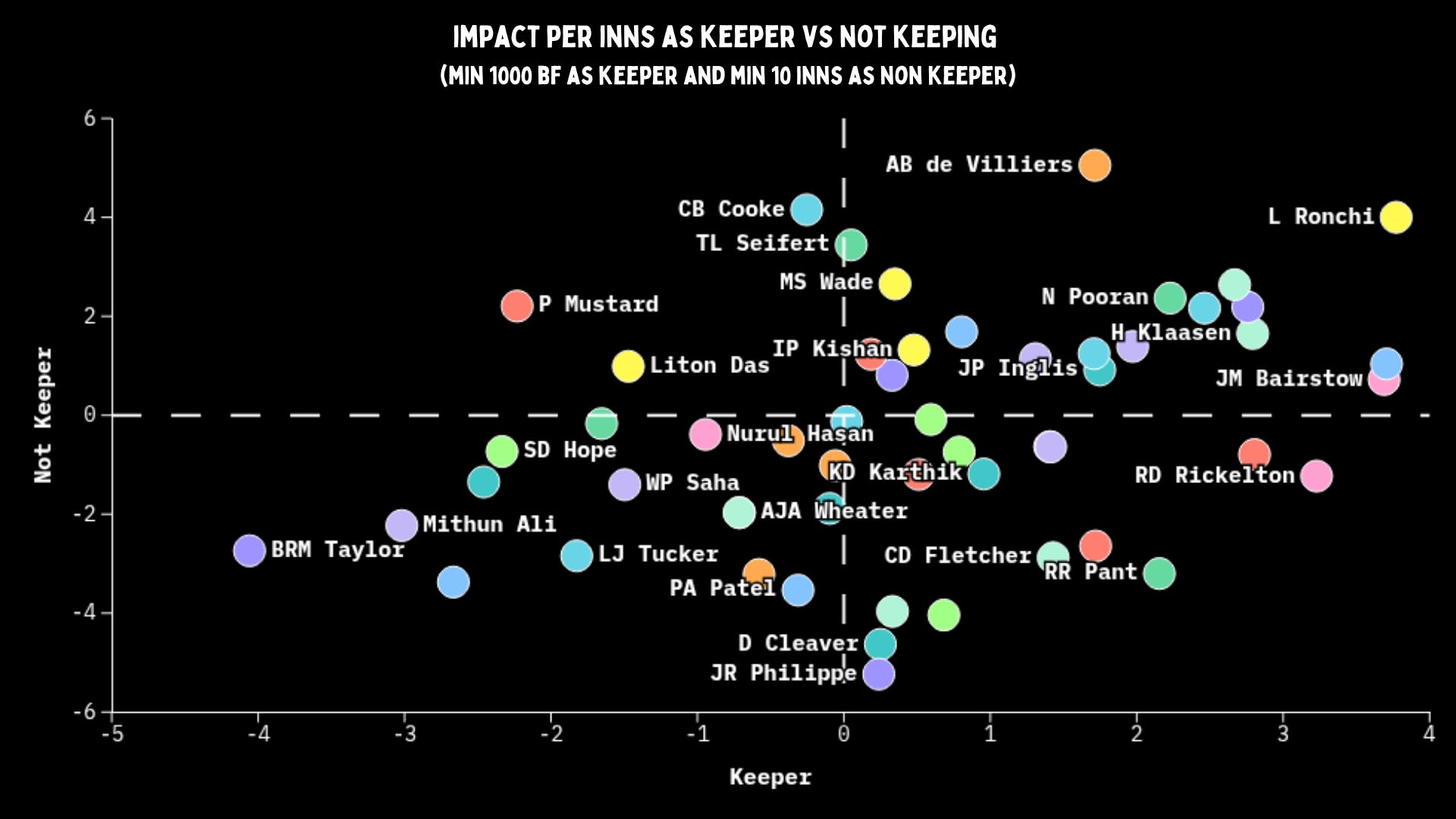
Some of that is because he didn’t have a lot of success in the Mzansi Super League back in 2018 and 2019, when he mostly wasn’t keeping wicket. In fact, his first SA20 season in 2023 was also similar. But a lot of his top level T20 cricket around the world has come since 2024, and he’s 29 right now, so that could just be him in peak batting ages. Because when he doesn’t have the gloves now, he’s still smashing them.
One reason looking at keepers by gloves on and off is tough is when you use them: most players keep to get into the side, prove they are good with the bat, and ditch them in their prime. So of course they will make more runs than they would have if still keeping.
There are lots of different types of batting styles. And some players will change. Around the KL Rahul section you have a host of anchors, even including Dhoni, who we are in the middle of rebranding as a finishing anchor. But he was not really that when he started. So roles change, and so does the output.
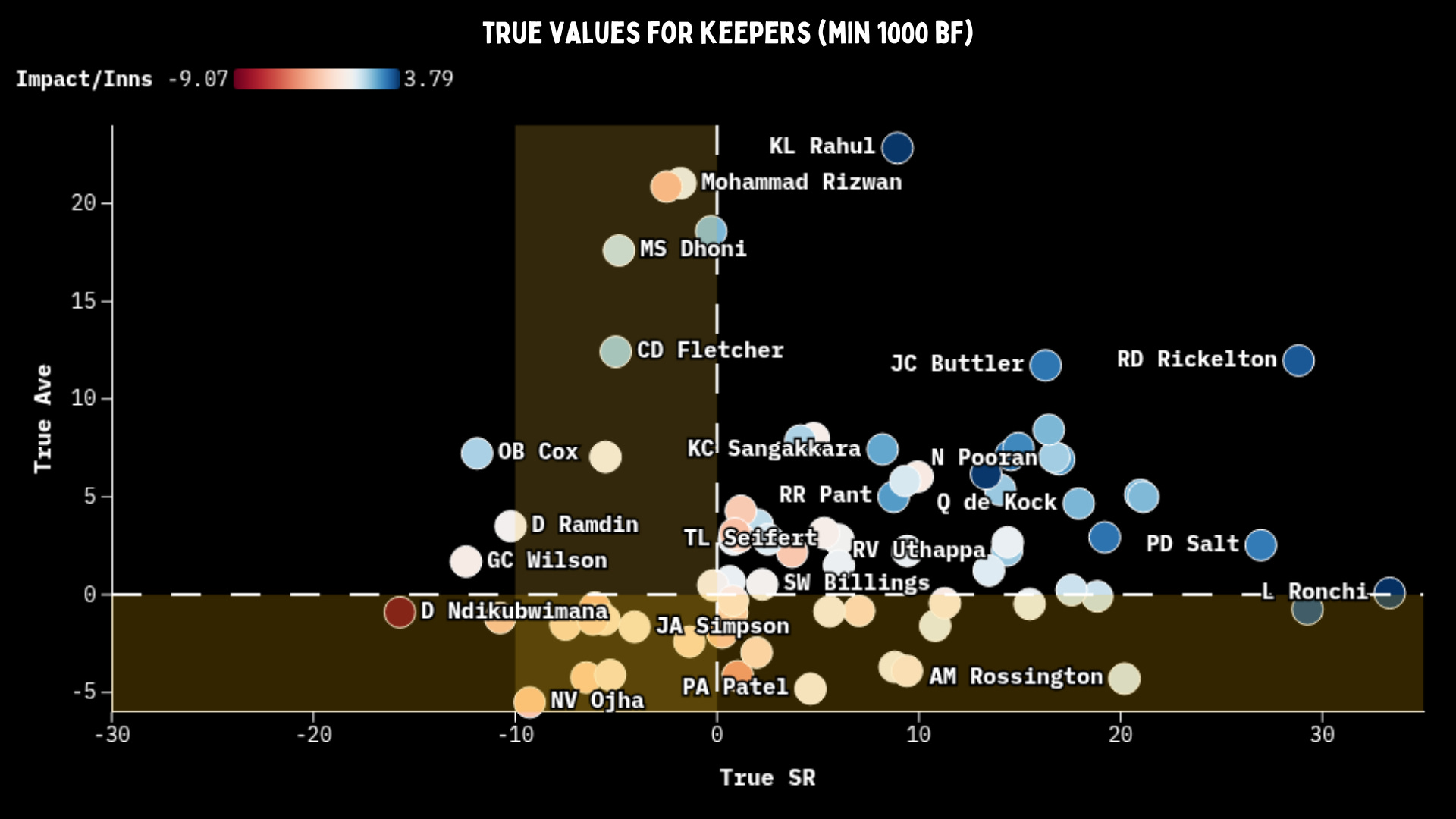
But one of the more interesting stories might be that Kumar Sangakkara and Rishabh Pant basically have the same true strike rate. One is the finished article, and Pant is still in development as a T20 player. So his output will continue to change.