
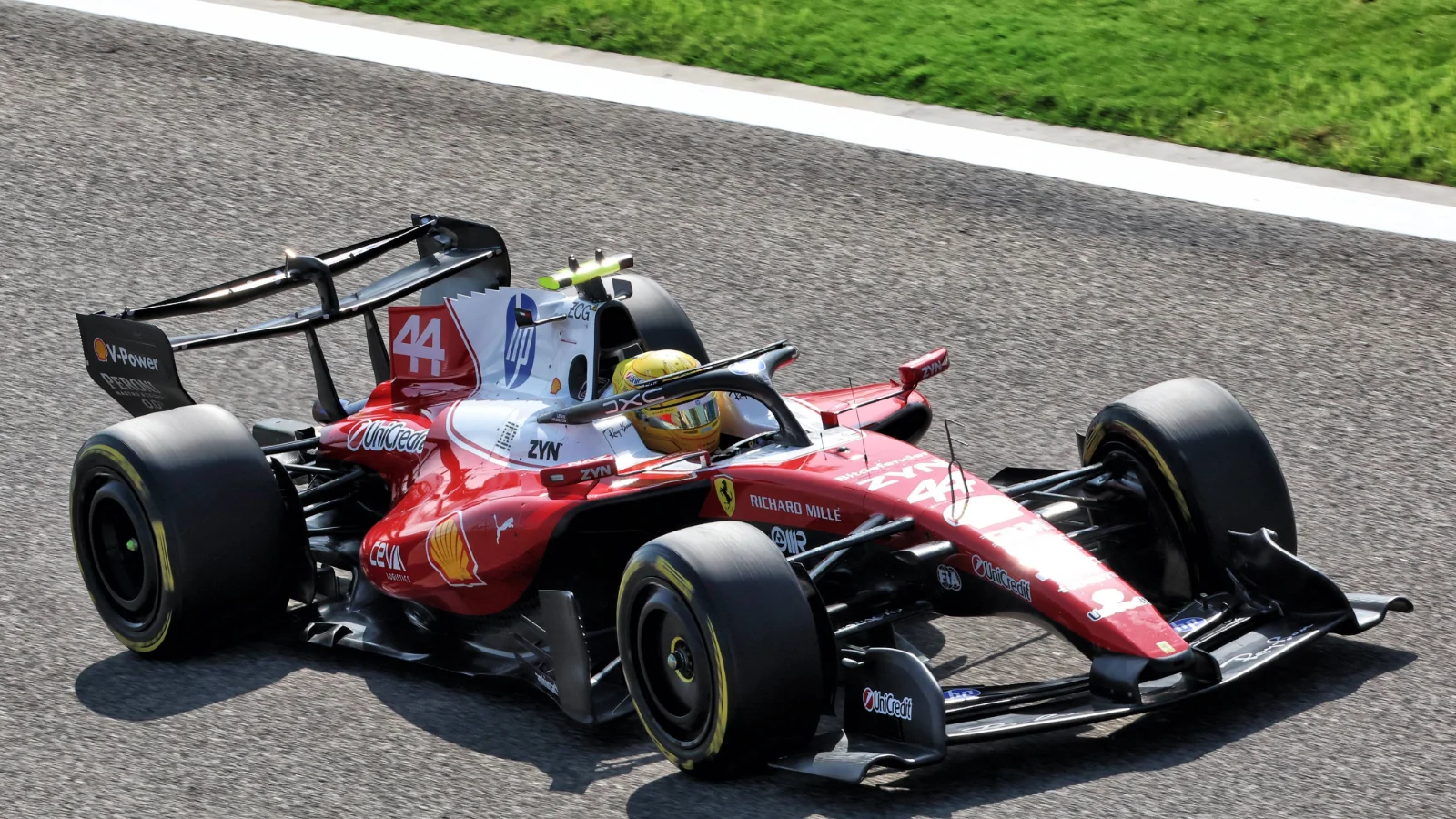
Ferrari has confirmed via Lewis Hamilton that its unique rear wing, trialled in pre-season testing, will make its first proper appearance at this weekend’s Formula 1 Chinese Grand Prix. Motorsport Week has the details on how it may – or is supposed to – work.
Debuted on Day Two of Week Two of Bahrain testing, the ‘flip wing’ was put into action as Lewis Hamilton drifted in and out of the ‘active aero’ zones.
The whole paddock collectively raised its eyebrows as if it were entering a Roger Moore impersonator contest. Moving in the most unusual way compared to that of all other 10 cars, the scarlet machine got its fair share of additional attention.
Hamilton pulled in after five laps, after effectively completing one proper push lap. A number of the Ferrari crew subsequently stood in front of its garage in a line resembling the defensive wall of a free-kick, and when it was whipped off and hidden out of sight like a child’s first bike on Christmas Eve.
Since then, it’s all been up in the air, as little talk of the wing has been forthcoming from the team, nor did it arrive in Melbourne for Round 1.
But on Thursday morning, Hamilton confirmed the wing, now affectionately known by its new colloquial identity – the ‘macarena’ wing – will see some action in Shanghai.
It will be the first real litmus test for the wing, despite Hamilton saying its five-lap cameo last month was “all the running needed with it”.
Regardless of whether it works or not, it has certainly had people talking, including the Scuderia’s former race engineer, Rob Smedley, who exclusively told Motorsport Week:
“One of the things that makes me most addicted to Formula 1 is the innovation and the lateral thinking outside of the box. We talked about the compression ratio thing with Mercedes, the rear wing with Ferrari is equally as powerful and innovative.
“It’s good to see that and when see it, you think ‘yeah OK, why didn’t I think of that?’ And whether or not it’s worth performance, sometimes, when to the casual observer, or the observer outside of a team. you know things look to be dramatic.
“The small effects in terms of car performance [can] all add up, so you do them, but sometimes it’s something that looks like dramatic isn’t so dramatic in terms of performance, and I would suggest it’s probably the case with the with the Ferrari rear wing.
“Like everything in F1. there’s a compromise and a trade-off, but definitely it’s good to see them innovate and it’s good to see.”
How Ferrari innovation works on the wider design of the SF-26
The rear wing is an engineering marvel and a sign of ingenuity, not words associated with Ferrari in recent years. The “flow turning device” as its known, is located on the bottom of wing assembly itself with an aggressive upward angle.
This design is no accident; it directs exhaust gases to the rear wing while also aiding the sensitive air exiting the diffuser. But rarely does engineering car design act as the sole component, and this new rear wing is no exception. Instead, it is designed to work alongside an extended diffuser, effectively elongating the airflow, substantially increasing downforce, something teams are searching aggressively for following the move away from ground-effect cars.
Of course, all teams want and need results from their engineering efforts, with Ferrari getting a clear result as a consequence of their uniquely designed differential and driveshafts. Ferrari has pulled off a masterstroke here, placing the diffuser much further back than its rivals, allowing for aerodynamic gains from the bodywork itself.
This design is of course not without risk. Angled components can cause vibrations that can lead to failure. Take a look at Aston Martin: its engine is suffering from extreme vibrations that it it is quite literally shaking itself to pieces.
An angled driveshaft is one of the riskiest design choices a team can make, given its prominence and importance within the power unit. The linkages need to be iron-clad to prevent a disaster, something Ferrari has nailed.
Angling the driveshaft as part of the wider picture involving the rear wing also has another critical benefit: no teams can copy this, without fundamental redesign of the entire transmission system.
What Ferrari has created is, in a way, a repeat of the exhaust blowing phenomenon seen in the early 2010s. Exhaust gases were directed over the rear diffuser, resulting in a pleasing screech from the V8 engines used at the time.
However, instead of being directed over the diffuser only, Ferrari can now channel them on the lower part of the rear wing. This has boosted downforce significantly on the SF-26.
So the next question is an obvious one – how does the rear wing move fully upside down to get the benefit of the diffuser and exhaust gases? Ferrari has chosen to create a much bigger slot gap than rivals (though still within the regulations) for airflow, and to severely reduce drag. This is designed for straight-line mode only.
In normal mode, however, the upper part of the wing has a smaller surface area, leading the benefit of air pressure being applied both above and below: generating yet more precious downforce for the SF-26.
When flipped into “Macarena” mode, the smaller surface area creates more space than a conventional flap seen on rival cars.
The proof will be in the pudding when Hamilton and Charles Leclerc take the SF-26 to the track in free practice in Shanghai on Friday morning.
READ MORE – Lewis Hamilton confirms major Ferrari F1 change for Chinese GP