
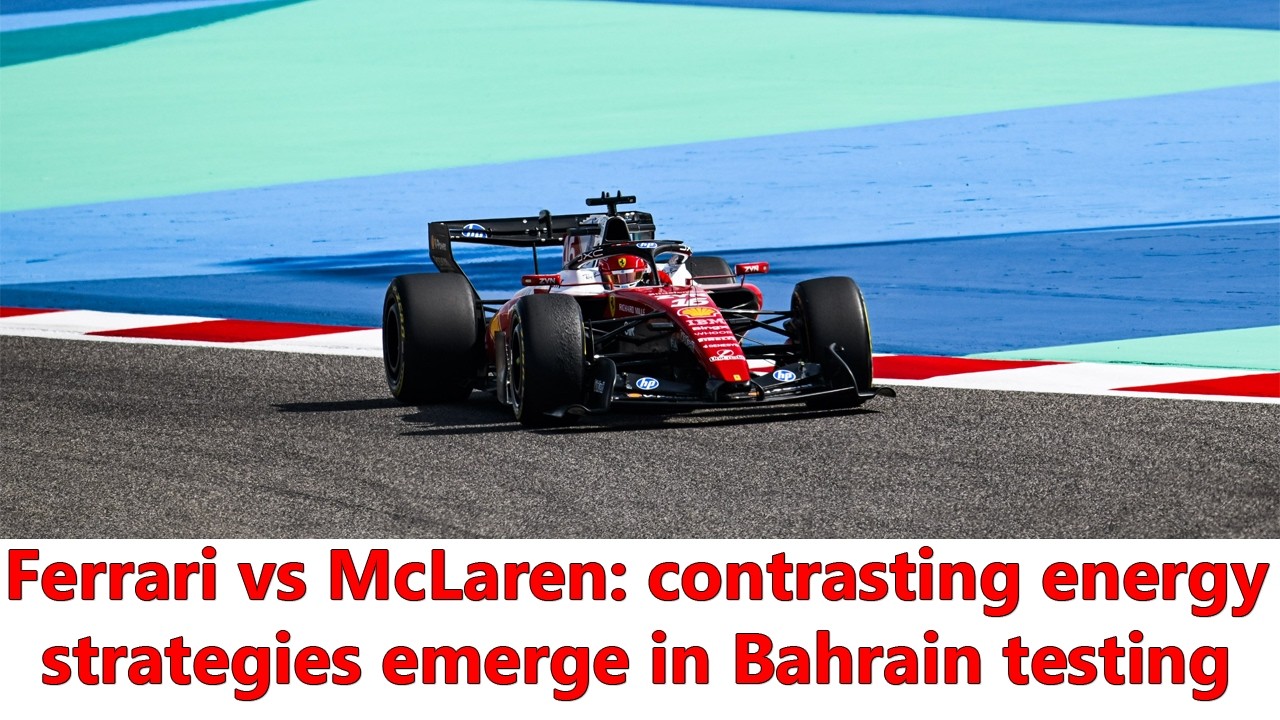
McLaren and Ferrari: Energy philosophies compared in Bahrain testing
The second day of Formula 1 testing at the Sakhir circuit is delivering some fascinating technical insights into what could become one of the defining rivalries of the 2026 F1 season. Ferrari and McLaren, both expected to fight at the front under the new regulations, are already showing clear differences — not just in lap times, but in philosophy.
For now, Charles Leclerc has set the benchmark with the Ferrari SF-26, stopping the clock at 1:34.273. Meanwhile, Lando Norris has combined solid pace with impressive consistency over longer runs in the McLaren MCL40. However, it is through detailed telemetry analysis that the most significant contrasts between the two teams truly emerge.
Ferrari improves balance, McLaren focuses on race pace
Ferrari appears to have made tangible progress in terms of car balance. Compared to the previous day, the SF-26 allowed Charles Leclerc to push more aggressively, even in the most demanding conditions, when track temperatures climbed significantly.
The Monegasque driver’s reference lap points to a car that is more stable and predictable — a crucial characteristic when extracting maximum performance in qualifying simulations. The improved front-end confidence and overall balance suggest that Ferrari is refining its package to optimize peak performance over a single lap.
Lando Norris, for his part, posted a competitive time, though still some margin away from Charles Leclerc. Tire compound differences played a role: Lando Norris ran on the harder C1 compound, while the Monegasque set his best time on the softer C3.
It is in race pace, however, that McLaren truly reveals its strengths. Telemetry data clearly indicates heavier fuel loads during long runs, and the MCL40 demonstrates strong consistency and reliability in tire management. This is a significant signal for race conditions, where maintaining performance over a stint can ultimately decide the outcome.
McLaren vs Ferrari: Two schools of thought in hybrid energy deployment
The most intriguing aspect of the comparison lies in hybrid system management. Ferrari and McLaren have adopted contrasting strategies for energy deployment, highlighting two distinct technical philosophies under the 2026 power unit framework.
The Ferrari SF-26 concentrates its energy release along the main straight, leveraging active aerodynamics to maximize top speed. The car then recovers energy aggressively under braking into Turn 4, one of the heaviest braking zones at Sakhir. This approach prioritizes straight-line performance and sharp energy harvesting at key deceleration points.
By contrast, the McLaren MCL40 favors a more progressive and distributed energy recovery strategy. The British team appears to spread harvesting more evenly across the lap before concentrating deployment in the acceleration zone leading to the final corner — a section where a clean exit is critical for overall lap time.
Two approaches, two different interpretations of how to extract performance from the new 2026 power units and aerodynamic packages. One focuses on maximizing peak speed and aggressive recovery phases; the other emphasizes balance, traction and sustained efficiency.
It will ultimately be the track — and the opening races of the season — that determine which philosophy proves more effective. Assuming, of course, that both teams do not eventually converge toward a similar solution as development progresses.

Let other Scuderia Fans know about us


