INDIAN WELLS – The most celebrated rivalry in contemporary tennis was not available on finals Sunday at the BNP Paribas Open. Daniil Medvedev snuffed out that possibility by resurfacing as his former cephalopod self and confounding Carlos Alcaraz in the semifinals to earn a slot against Jannik Sinner.
It did not go the gangly Russian’s way as Sinner prevailed in two tiebreakers, never facing a single break point, to win the last big hardcourt title he was missing.
But while there would be no Sincaraz sequel in the California desert, another stirring rivalry ably filled the time and space as Aryna Sabalenka and Elena Rybakina leaned into their latest duel with the women’s title at stake.
The WTA has been short on transcendent mano a mano material for too many years while the Big Three and their successors have taken men’s rivalries to new heights.
But Sabalenka and Rybakina already have created something special, routinely pushing each other to the limit with big titles on the line. Sunday’s match in brutal 96-degree heat might have been their most compelling work yet, and it even had a surprise twist at the finish.
Sabalenka, so prone to cracking in tight finals in the last two seasons, came perilously close to more of the same only to save a match point with a backhand bolt in the third-set tiebreaker.
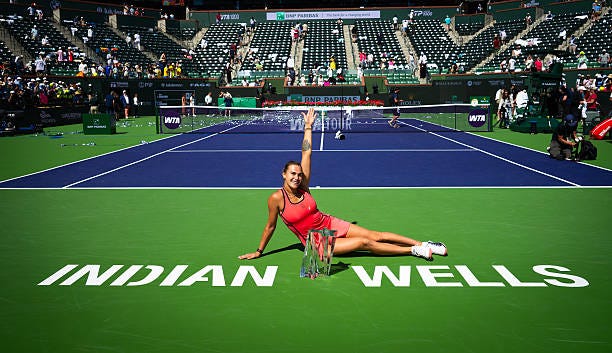
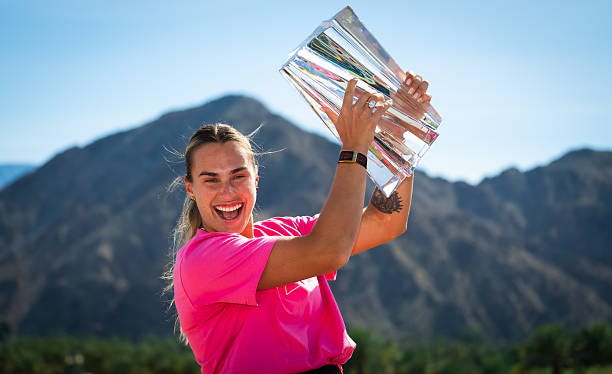
Two points later, she sealed the deal 3-6, 6-3, 7-6 (6) with her last clutch serve of the afternoon and was soon showing off the shiny singles trophy, her new puppy and her new sparkling engagement ring after recently saying sim to Brazilian businessman Georgios Frangulis.
“What a week!” she said. “I will definitely remember it for the rest of my life. This is truly tennis paradise, and I’m always happy to come here. Thank God I finally got this trophy.”
In 2023, after Rybakina beat her to win the title in Indian Wells, Sabalenka mischievously stuck out her tongue at Rybakina during her victory speech. When Rybakina said it was the first time it had gone her way against Sabalenka in a final, Sabalenka leaned over and said into the microphone: “I’ll make sure it was the last one!”
It has not worked out that way. Rybakina went on to beat her in their next three finals, including the year-end championships last season and at the Australian Open in January.
Coming into Sunday, Sabalenka’s head-to-head lead was down to 8-7 and Rybakina, with her supreme serve and baseline power, was on a roll, winning 12 straight against top 10 opposition.
But tennis, as Alcaraz’s upset defeat here made clear, can still spring a surprise.
At the 37-minute mark, it looked like this final might become a rout. Rybakina led by a set and an early break that ended with a Sabalenka double fault. But the match was, in fact, just beginning. It had nearly two hours more to run with the only shade on the hardcourt provided by the combatants’ shadows and the umbrellas on the changeovers.
“I think the sun was pretty strong, and I would say that it hit me in the second set quite a lot,” said Rybakina, who left the court to change after dominating the first set. “I really couldn’t push much. I was trying to give myself time. I left after the first set because I needed some cool air.”
But Sabalenka also kept the pressure on, closing out the second set and taking the lead in the third with some phenomenal serving under duress, including sliced second-serve aces and flat bolts into the corners.
Their rivalry is not a contrast in playing styles: both are pure power players who have rarely met a groundstroke or return they are not content to crush. Both are used to dictating and controlling outcomes. The match, as the saying goes, is usually on their racket, but neither can consistently overwhelm the other in this matchup.
There are subtle differences: I would take Rybakina’s forehand over Sabalenka’s and would take Sabalenka’s backhand over Rybakina’s. Sabalenka is clearly the better mover and has developed defter touch and a more complete tennis tool kit. Rybakina is effective moving forward but vulnerable laterally, The challenge is prying away the initiative once she takes command of a point.
But the real contrast is in their personalities: Sabalenka, restrained by her standards on Sunday, is an expressive extrovert with a tiger tattoo who shrieks on contact, marks her miscues with exasperation and eye rolls and celebrates her key winners with roars. Rybakina is cool and quiet, a smooth-flowing river to Sabalenka’s rumbling shorebreak. She is much more difficult to read and yet has just as much fire in her strokes.
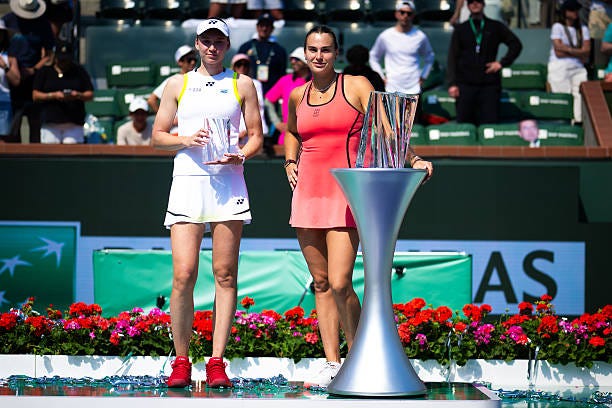
These two champions have a closer connection than you might expect.
“I would say that she’s the kindest one on tour,” Sabalenka said. “We have been playing for so long and so many matches, and honestly, I really enjoy it, even though I lost so many them and really painful ones. But still I enjoy it because it means that the final is gonna be a show. It’s gonna be great tennis, great level, and it’s gonna be a fight, which is great for people to watch and also for me to become a better player.”
Resilience was required on Sunday. Sabalenka, who was raining down big-point aces and service winners for much of the final set, faltered when she served for the title at 5-4. She then failed to convert any of her five break points with Rybakina serving at 5-5.
On a different day, Sabalenka might have blown a gasket then and there, but this time, she held at love and focused on the decisive tiebreaker.
Rybakina led 5-3 with the serve but it was soon 5-5, the match dead even after two and a half hours. Rybakina earned a championship point with a backhand winner down the line off a short hop, and then fired her fastest serve of the day at 121 miles per hour. But Sabalenka, who has studied Rybakina’s tendencies, was leaning the right way and punched the return back in play and answered Rybakina’s quck retort with a full-force backhand winner crosscourt.
It was a spectacular, gutsy shot, and it was now 6-6 with the crowd aflutter on the changeover. On the next point, Rybakina smacked an approach shot after a first serve and was met with a fully ripped forehand at her body that she volleyed just long.
Championship point Sabalenka, and the Belarusian was not about to hold back, slicing a first serve down the T that the lunging Rybakina returned long with her forehand to end one of the better finals of any season.
“Roulette,” Rybakina said.
When the wheel stopped spinning, Sabalenka’s four-match losing streak in three-set finals was over after losses to Madison Keys, Mirra Andreeva, Coco Gauff and Rybakina.
“I am so tired of losing these big finals.” Sabalenka said. “I mean don’t get me wrong, players were playing incredible tennis but still I managed to fight through and to get my opportunity, and I didn’t use it so many times.”
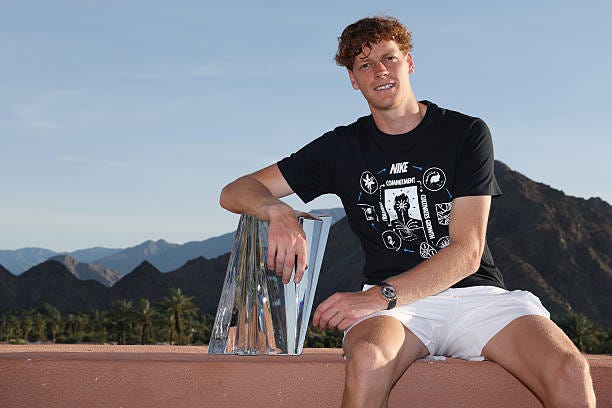
She is an Indian Wells singles champ at last, and so is Sinner. The first set could not have been closer against Medvedev, coming down to the first and only minibreak in the tiebreaker at 6-6 when Medvedev put a running forehand long. In the second-set tiebreaker, Medvedev took a 4-0 lead only to lose the next seven points.
Neither man could break the other in the quick conditions on Sunday, but Sinner’s first serve was the shot of the match. He won 43 of 47 points with it: 91 percent to Medvedev’s 77 percent on his own first serve.
“He’s serving phenomenal,” Medvedev said. “It’s super tough to read. It’s super tough to return, even when you read it.”
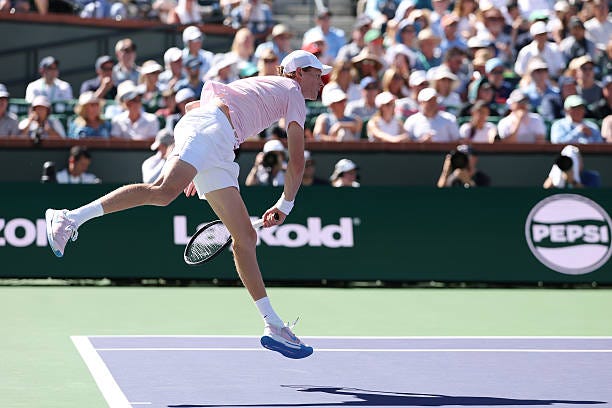
At age 24, Sinner has won all six Masters 1000s on hardcourts as well as the Australian Open and US Open, the two majors played on hardcourts, along with the last two ATP Finals, which are played on an indoor hardcourt.
So much for his stuttering start to the season and those disquieting losses to Novak Djokovic in Australia and to Jakub Mensik in Doha. Sinner’s decision paid off to come to Indian Wells early to train with Darren Cahill and his team. Sinner did not drop a set and after cramping in the heat in Australia this year, he looked on Sunday like a man raised in the Sahara instead of the cool splendor of the Italian Dolomites.
“It was warm, but it was not humid, so it makes a big difference,” he said when I asked about the weather. “But look, I have been here a week before the tournament started. It was very similar conditions to today. We put in very long days of practice. I felt very well prepared, so I was not having big issues with the weather and with the heat, which is very positive for me. It’s all part of the process we are trying to do and becoming the best possible athlete.”
His racket-head speed and quickness to the ball were again sights to behold, and though Medvedev knocked off one of the New Two, he could not go where only Djokovic has gone and defeat Alcaraz and Sinner in the same event.
“It’s a sweet and bitter feeling,” Medvedev told me. “Because to beat Carlos yesterday, it feels like (winning) the tournament, especially for me. I lost a lot against him, but that’s not the reality. There is a final to play. I had my opportunity, small opportunity in the first set. A bit bigger opportunity in the tiebreak in the second set. But at the same time, I was hanging by not big margins in the whole set.”
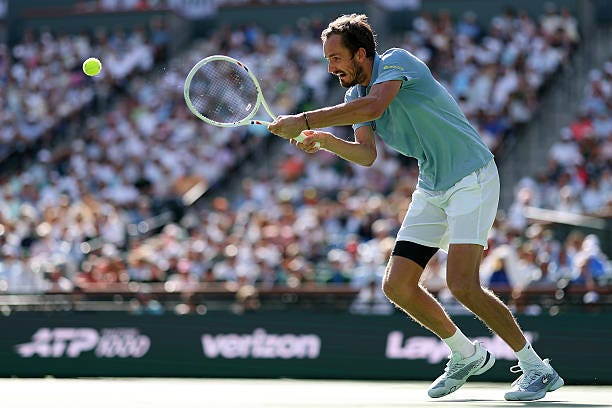
His serving and baseline play, particularly off the backhand wing, are real cause for optimism, however. At age 30, the former No. 1 and US Open champion is resurgent and back in the top 10 and could provide the men’s game with a welcome bit of variety up in Alcaraz’s and Sinner’s rare air.
“I do believe that tennis needs him,” Sinner said. “He has a very unique style of playing. Seeing him back at this level, it’s great.”
All the better, to be sure, when you win both tiebreakers.
On to Miami and then to the clay, where Sinner has a score to settle in Paris. But that’s a story for May, not for March.
CC