
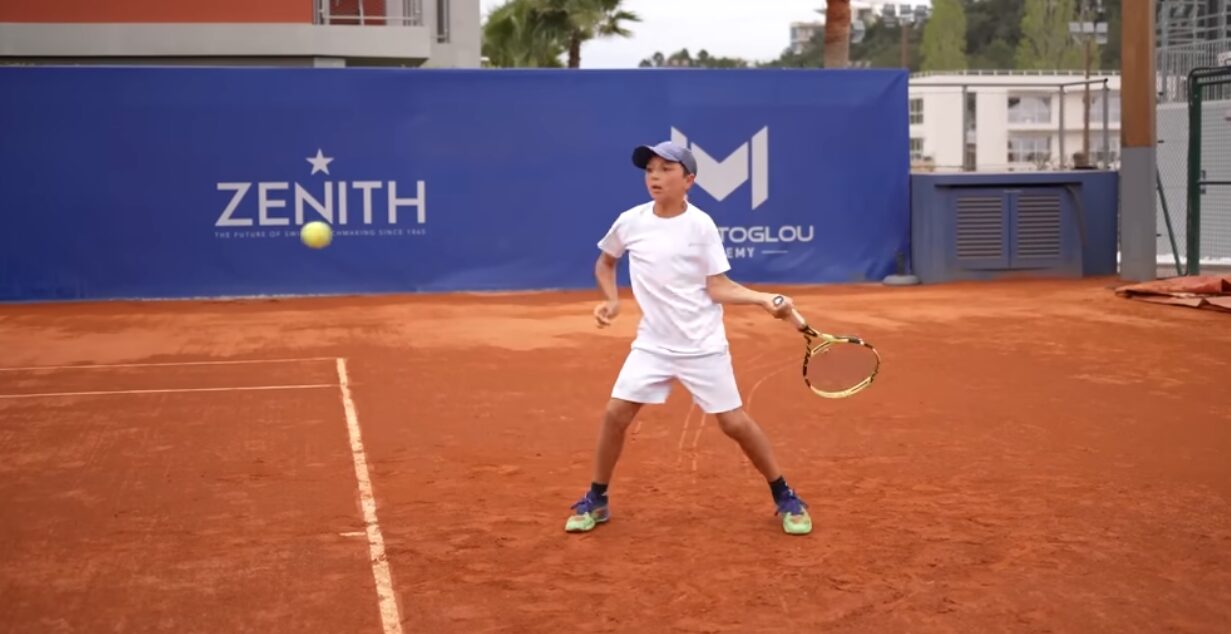
In a sport built of tradition, where the forehand–backhand combination has been standard since the game’s inception, a 15-year-old from Florida is challenging a lot of what we thought we knew about tennis. Below an introduction to Teodor “Teo” Davidov, the young talent who doesn’t hit backhands.
At just 15 years old, Davidov has already earned ATP points, defeated ranked professionals and showed that his unconventional approach can win matches at increasingly higher levels.
Teodor Davidov’s racquet
Teodor Davidov’s racquet is a Yonex VCORE 100 2023. There might be a different racquet underneath the paint, but he used to use the Babolat Pure Aero 100, so switching to the VCORE 100 makes some sense. As you might know, new Yonex VCOREs released earlier this year.
Looking at Davidov’s racquet, it would be an educated guess that he strings it with Yonex Polytour Strike in the mains and Polytour Pro in the crosses. If you have more information about Davidov’s racquet, please comment below or reach out to @tennsinerdinsta on Instagram.
The Player Without a Backhand
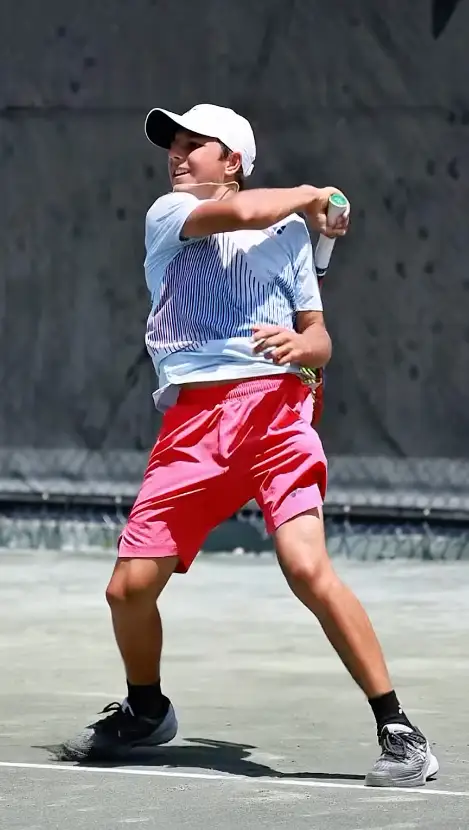
Teodor Davidov has become one of the most talked-about young talents in tennis, not just for his results, but for how he achieves them. Instead of the conventional forehand and backhand, Davidov plays with two forehands, seamlessly switching his racket between hands depending on which side the ball comes to.
“People who have never seen me play in real life often criticize my playing style,” Davidov said. “However, everyone who watches me play tells me to keep doing what I’m doing.”
And the results are backing him up. First by winning tournaments like the 2021 U12 Eddie Herr and the 2024 Le Petits As de Tarbes (doubles). In February 2026, Davidov achieved a major milestone: earning his first ATP ranking points at the ITF M15 Naples tournament in Florida, becoming one of the youngest players of his generation to enter the professional rankings.
From Bulgaria to Bradenton
Born in Sofia, Bulgaria on August 26, 2010, Davidov moved to the United States with his family when he was just 18 months old. His tennis journey began very early, at two and a half years old, swinging at a ball his father had hung from the ceiling on a string.
The family first settled in Denver, Colorado, before making a strategic move to Bradenton, Florida when Teo was around 11. He currently trains at ProWorld Tennis Academy in Delray Beach.
How the Two-Forehand Style Emerged
The unconventional playing style didn’t start as a revolutionary plan. It evolved organically from a coordination drill suggested by his father and coach, Kalin Davidov.
“It was my father’s idea,” Teo explained. “My father first wanted to improve my coordination but noticed that my left-handed forehand wasn’t so bad. So, we started training him more and more.”
What began at age 8 as bilateral coordination training gradually developed into a complete playing system. By the time Davidov was competing seriously in junior tennis, the two-forehand approach had become his signature.
“If you learn to play tennis with two hands at a young age, it doesn’t have to be that difficult if you have good coordination.”
Hoy, en videos random: al ambidiestro Teo Davidov (12) le dijeron que no tenía reves—tiene reves de derecho, de zurdo, a una mano, a dos, ambas derechas, ambos saques. El tenista indescifrable. pic.twitter.com/u9g7Khvc9S
— Marcos Zugasti (@marcos_z) March 25, 2023
Watching Davidov play is different… Both hands grip the racket in a semi-Western grip, always ready. When the ball comes to his right side, he releases his left hand and hits a right-handed forehand. When it comes to his left, he releases his right hand and strikes a left-handed forehand.
The transition is so seamless that it’s become pure muscle memory. Davidov determines which hand to use just before his opponent makes contact with the ball, reading the direction and adjusting instinctively.
Davidov also serves with both hands, alternating between right-handed and left-handed serves depending on the tactical situation. This can really be an advantage as it’s hard to find a rhythm in the returns as the opponent.
The Tactical Advantage
Against Davidov, conventional tennis patterns disappear. Most players instinctively target their opponent’s backhand side, knowing it’s typically the weaker wing. But Davidov has no weak wing.
This creates unique tactical challenges for opponents:
- No obvious target: Both wings are equally dangerous
- Unpredictable angles: Ability to create sharp crosscourts from either side
- Mental disruption: Players must abandon ingrained patterns
- Symmetrical court coverage: Equal reach and power on both sides
Will it work at the highest level?
Not everyone is convinced the two-forehand approach will work at the highest levels. Critics point to the faster pace of professional tennis, questioning whether Davidov will have time to switch hands against 130+ mph serves and 100+ mph groundstrokes.
Dutch former pro Robin Haase commented: “It has many advantages, but the more you can do, the more choices you have. And the more choices you have, the more you start thinking. And when you start thinking, you make mistakes.”
But those who’ve watched Davidov play in person tell a different story. Coaches and trainers are consistently impressed by how naturally the switching occurs.
GREAT OFFERS ON TENNIS PRODUCTS
Don’t miss our new deals and discounts for some of our favorite tennis products!
Good discounts on new racquets, strings, bags, apparel or other tools and services such as coaching or training equipment.
The Big Question: Can It Work Professionally?
This is the question everyone asks. Can a two-forehand style succeed at the ATP level?
Arguments for:
- Eliminates traditional weakness (backhand)
- Creates tactical confusion for opponents, especially on serves
- Both wings are equally developed
- No grip changes needed
- Unique angles and court coverage
Arguments against:
- Less time to switch hands at pro pace
- More decisions to make, potential overthinking
- Unprecedented at top levels
- Unknown durability over five-set matches
The Future
Teodor Davidov represents something rare in modern tennis: genuine innovation. Whether his two-forehand approach ultimately succeeds at the ATP level remains to be seen.
Is he the future of tennis? Perhaps not. But he’s already proven that tennis has more than one path to success. It will surely be interesting to see how this works at a higher level on te tour.
Follow Teodor Davidov:
Website: teodavidov.com
Born: August 26, 2010 (Sofia, Bulgaria)
Base: United States
Plays: Ambidextrous (two forehands)
Coach: Kalin Davidov (father)