
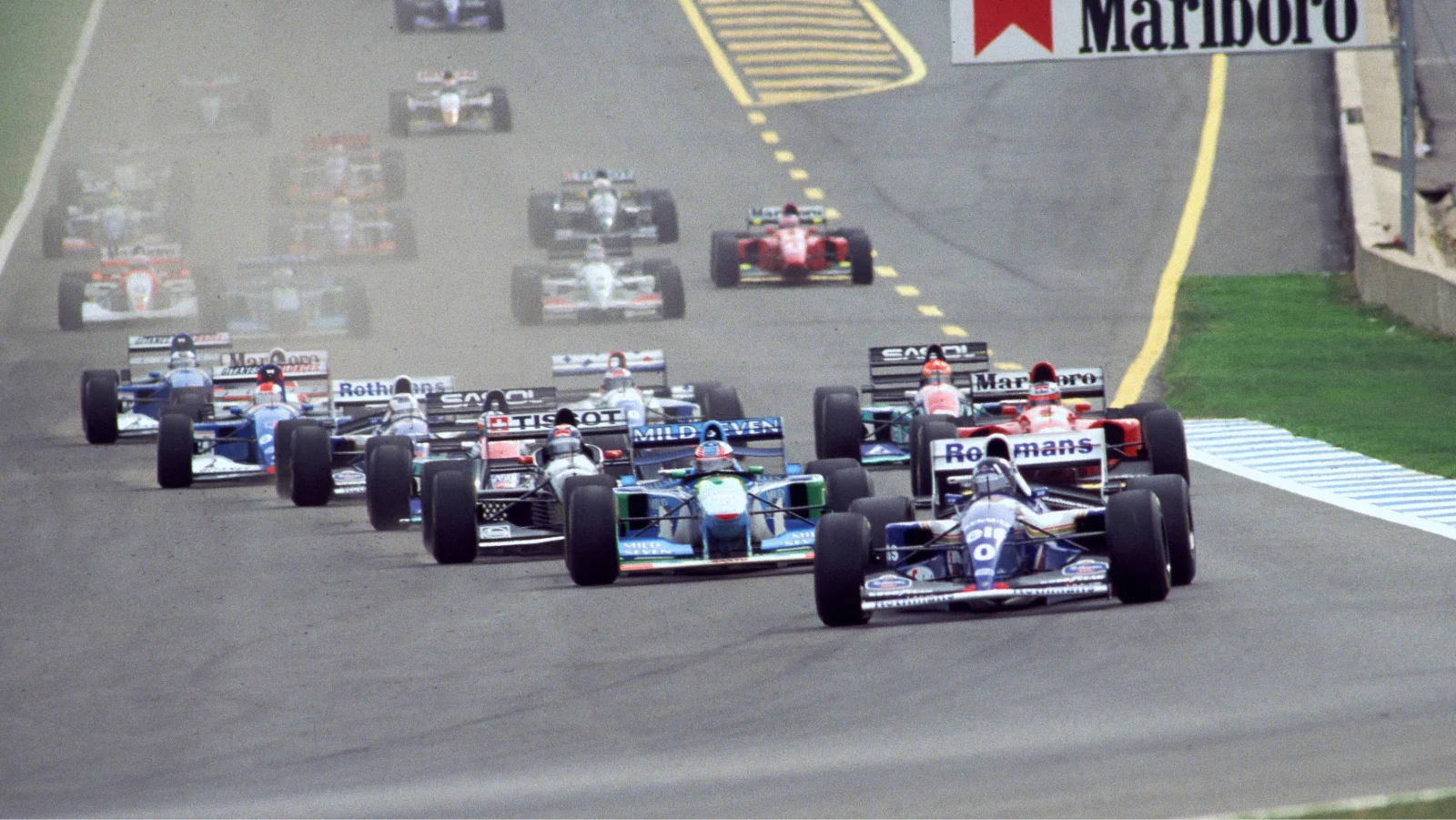
With an enforced break for Formula 1 now upon us, a look back at some of the sport’s iconic and beautiful cars is in order, starting off with those that graced the grid in 1994.
The 1994 season remains one of the most incident-filled, tragic and politically marred seasons in F1 history.
Aside from their basic design, they were almost glorified go-karts with a V10 or V12 engine bunged in the back. And how glorious it looked and sounded. Ear defenders did little to protect your ears at lights out in 1994. Many drivers and paddock insiders remember the early to mid-1990s with reverence; they were the last breed of cars that separated the men from the boys.
It acted as the last year of downright dangerous cars– cockpits exposed to the shoulder while manually wrestling of the car, reaching outrageous speeds while running millimetres to the ground, and no safety features to prevent parts flying off the car and striking the driver.
All of these issues would lead to the death of Ayrton Senna, and a fundamental overhaul of driver safety. A lasting legacy of his passing, almost every safety feature on today’s F1 cars [minus the halo] can be traced back to that fateful weekend at Imola in 1994. Crash tests, cockpit protection and the plank [which continues to catch out teams today] were mostly introduced during the season.
One thing 1994 did deliver on, however, was truly beautiful, iconic and evocative F1 cars, which deserve a callout 32 years after they last raced. Beauty is always in the eyes of the beholder, but for this list, we looked at several categories: impact on aero philosophy on the chassis, colour and evocativeness of the livery, and, when applicable, how memorable it is for reasons of controversy or poor performance.
Benetton B194
To call this car controversial is a bit like calling cake a nice snack – the two go hand in hand. The B194 won the driver’s championship with Michael Schumacher taking the honours in dubious circumstances that would warrant its own feature.
Legal issues followed this car more than a deranged fan at a popstar concert; Benetton was unable to escape constant scrutiny. Schumacher was disqualified for excessive plank wear in Spa, was at risk from bring thrown out of the championship after a fuel fire in Germany following the deliberate removal of a safety filter from the refuelling rig, and had allegations of launch control beleaguer it all season.
Nicknamed “Option 13”, it was found deep within the software programs for the car, but could never be proved as being used, despite Schumacher’s frequent, nigh on perfect starts.
One thing that could not be disputed however was the car’s looks. Benetton was known for its unique liveries, 1994 demonstrating it had hit the big leagues. A stunning combination of blue and green, rivals and lapped cars had no issue in identifying a then young Schumacher coming up behind them.
A Ford V8 powered this piece of F1 history, the blue logo area then wrapping around the rest of the car to complement the green-adorned sidepods and bodywork. A second shade of blue covered the engine cover and both wings to showcase title sponsor Mild Seven, the rear of the car covered with the iconic Benetton colours of green, red and yellow.
The aero philosophy became second nature to Benetton, to the point that the front wing seen on the B194 influenced, at least in looks, all future Benetton’s until 1999.
The combination of Schumacher and Ford led to six wins in the opening seven races that year, totalling nine victories in 16 races. Regardless of its flaws, it remains one of F1’s most-requested historic cars, with frequent demos in recent years.
Williams FW16
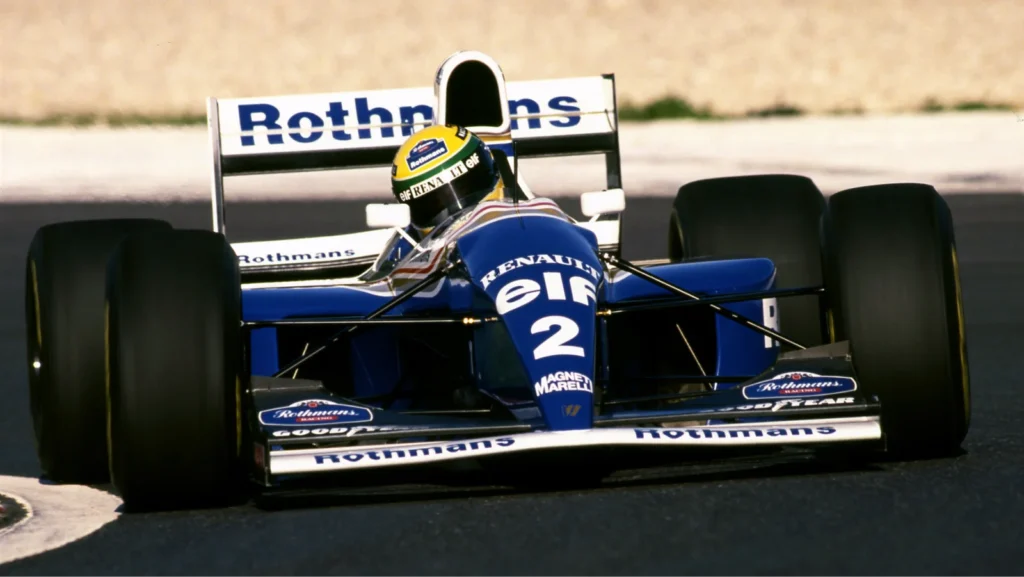
The Williams FW16 has the truly awful honour of being the final car that Ayrton Senna drove. It is a piece of F1 history that few actively wish to remember. It is, however, the car that won the 1994 Constructors’ Championship thanks to the efforts of Damon Hill, David Coulthard and Nigel Mansell.
The cause of Senna’s fatal crash has never been fully revealed or understood, with several theories existing. The most common is a failure of the FW16’s steering column, which had developed fatigue over the opening two races, sending the legendary Brazilian hurtling towards a concrete barrier at full speed, a part of the car penetrating his helmet and killing him.
Hill took over the mantle of team leader and took the fight to Schumacher and Benetton. A heavily revised FW16B debuted later in the season His wins in Silverstone, and Japan in particular remain two of the Englishman’s most evocative wins. 7 wins in 16 races sealed the title for the team.
It seems almost unsavoury to include this car on a list of beautiful cars, but it is one of F1’s most iconic cars and liveries. Featuring the classic blue and white colours of Williams, the Grove team had a new sponsor in tobacco brand Rothmans, with a dark blue chassis contrasted by white wings.
The car was clean, featuring a triangular nosecone at the end of an aero philosophy that looked fantastic, but warranted a replacement car due to handling issues. The distinctive V shape cockpit gave the rest of the car a seamless feeling of transition, as the cockpit moulded beautifully to the engine cover. Renault’s V10 was a symphony of high-pitched aggression. Add the unusual number 0 [given to the lead driver when the previous has retired from the sport, therefore retiring the coveted number 1], and the FW16 fully deserves its place in the annals of beautiful cars.
Ferrari 412T1
Ferrari was in a nadir situation of political instability and incompetence prior to 1994. Jean Todt had been brought in from a successful stint at Peugeot Sport the previous season to clean up the mess of management factions and discord. 1994 was the year of his Ferrari, when politics no longer penetrated the garage.
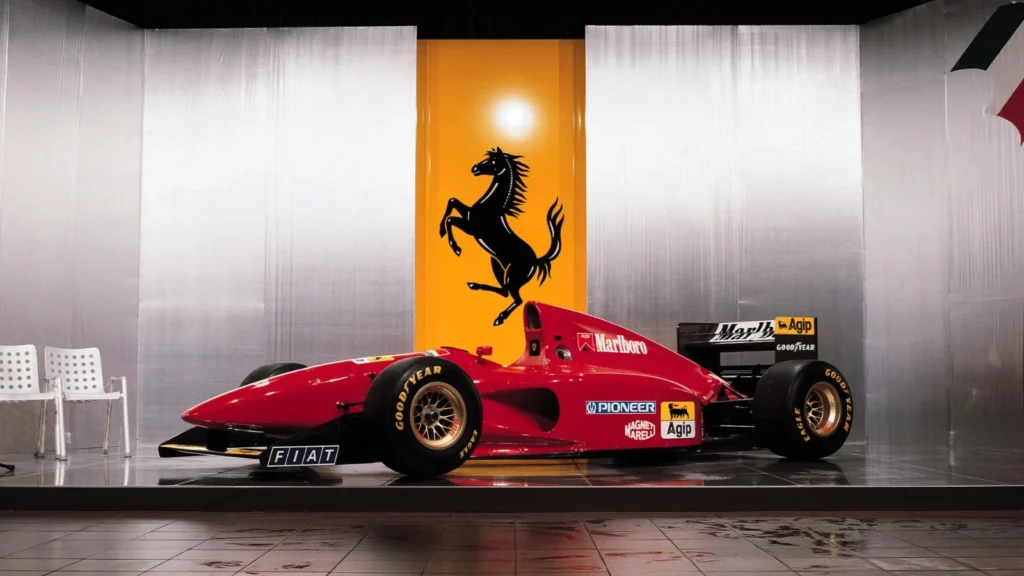
But ways of working inside Ferrari itself? That would take time to upgrade. As a result, reliability remained utterly woeful, but car design took a big leap forward for the 1994 season with the 412T1. Gerhard Berger ended a winless streak for the Scuderia going back to 1990 with the 412T1, taking a hugely popular win at Hockenheim.
The 412T1 was very much a new car, the team moving away from its disastrous 1993 counterpart. Bigger is not always better in F1 [look at the double-decker bus designs of the last generation of ground-effect cars], but in the case of the 412T1, bigger sidepods with cooling vents coupled with tighter rear packaging added angles of beauty. The results were a John Barnard-designed car capable of big upsets later in the season.
The signature Ferrari red covered the chassis, the front wings a dramatic black. Marlboro was still very much entrenched with McLaren in 1994, but the tobacco giant was soon to be synonymous with the Scuderia, appearing on the rear wing and on the engine cover in a subtle yet dominant placement.
The equally most beautiful aspect of the 412T1 is without question its engine. The last of the V12 monsters, few sounds can make one’s hair neck hair stand up on end, or give you goosebumps on your arms like the Tipo 043, the second engine the team used during 1994. Every gear shift sounded like a boxer punching a rival, while a downshift equated to a fighter jet landing on top of you. At full speed, the sensation of the ground moving, and pitch of the engine is indescribable.
While not controversial or particularly noteworthy in terms of stats, the 412T1 remains one of F1’s most beautiful cars for its soundtrack, simple design and, of course, the evocative Ferrari red.
McLaren Peugeot MP4/9
Everyone loves an underdog in F1, particularly when they defy the odds and beat the established odds. This is not one of those stories. McLaren had produced an underdog capable of winning in 1993 with the Ford-powered MP4/8, still believed by many to be one of McLaren’s best, hindered by an underpowered but competent engine.
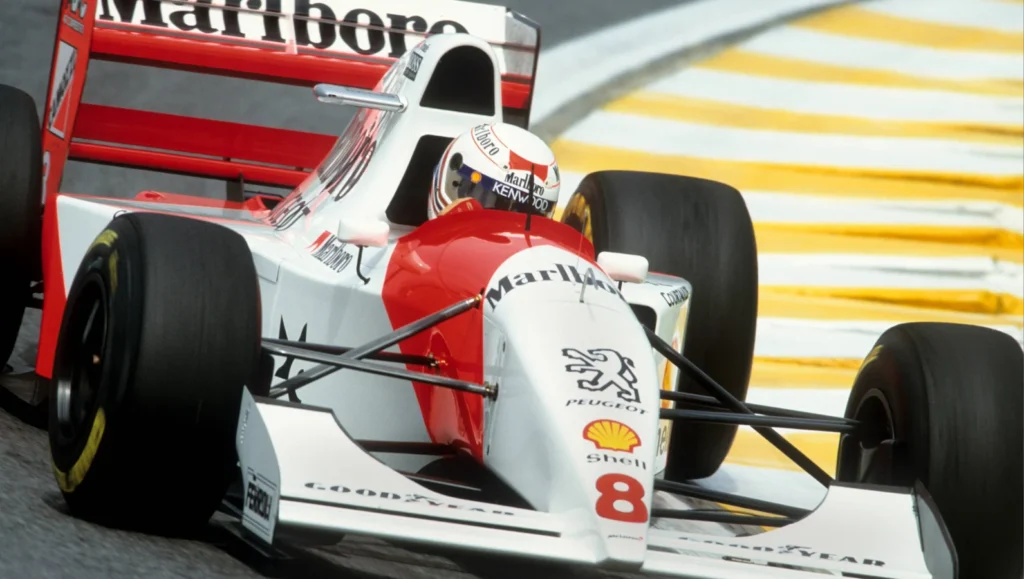
The Peugeot-powered MP4/9 of 1994 took this to a whole new level, which was much worse. Alain Prost, dumped by Williams, test-drove the car at Estoril and walked away, citing that he could not win the championship in it. Ouch.
So, it was left to Mika Hakkinen and Martin Brundle to do battle in the MP4/9, a car which Martin Brundle freely admits sent his career into freefall. It also marked the first time in 22 years.
The A4 and A6 engines were underpowered and, more importantly, unreliable, nicknamed the “Hand Grenade”. Prone to spectacular failures, it cost both drivers podiums, and they never had a shot at victory. But it did produce results when it wasn’t exploding. Eight podiums across the year is not a bad stat for a manufacturer in its inaugural year, but the partnership was deemed a failure.
That said, the MP4/9 itself was a piece of art. An evolution of the MP4/8, it featured a low-slung nose and wider, distinctive sidepods to cool the larger Peugeot engine. The iconic white and red Marlboro livery once again stood out from the crowd, even if fans had to look a little lower down the order to see it. Peugeot had a prime spot underneath the Marlboro logo, adding to the humiliation whenever its engines blew.
Even the squared bargeboards, an eyesore on other cars integrated seamlessly into the design. The MP4/9’s simple design and pleasing engine note make the MP4/9 one of the most stunning cars on the grid from that season.
Footwork FA15
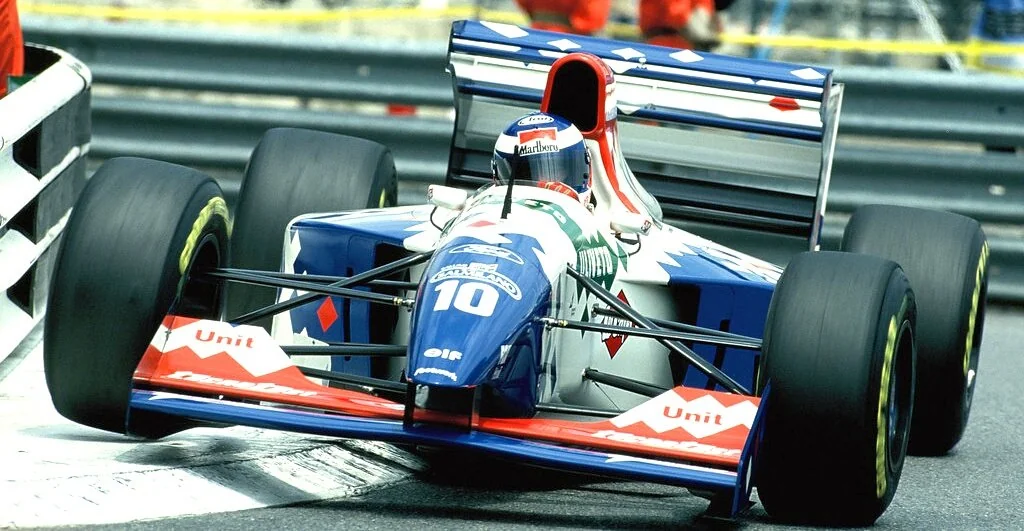
Launched at a murky Silverstone in the off-season, the weather summarised Footwork’s position and standing on the grid. It was present, but you had to know where to find it. A harsh analogy, but a fair one.
1994 presented a new challenge for Footwork, as its car would be devoid of major sponsors, so had to get creative with its livery. This was far from an unusual problem in the 1990s for the lower teams, but Footwork created something truly unique as its solution.
While not a major player for points, it could still spring a surprise or two. Drivers Christian Fittipaldi finished fourth twice, while Gianni Morbidelli secured one fifth-place finish, enough to rouse spirits during an underfunded campaign.
Featuring a white-and-blue patchwork quilt-style livery, it masked the absence of major sponsors, except for the white Technotest logo just above the airbox. This meant the car’s aero philosophy was on full display, featuring lightly sculpted sidepods and almost invisible L-shaped bargeboards.
The car, while not in the same league as the others on the list, still looked fantastic out on the circuit, powered by a dependable but highly unreliable Ford V8, resulting in a total of 19 retirements.
To finish fourth twice in the 1990s as an underfunded team is no mean feat, and to do it in a car as good-looking as the Footwork was an achievement.
Simtek S941
The final car on this list has a history as tragic as the first. Roland Ratzenberger died the day before Senna at Imola in this car, the aftermath being broadcast live on TV. The car’s front wing failed, sending the car at flat-out speeds towards a concrete wall on the approach to Tosa. It remains a blight in the sport’s history.
But this was not the only high-speed crash for the S941. Andrea Montermini, replacing the Austrian in Barcelona, suffered a huge impact during practice in Barcelona on the pit straight. Lucky to walk away with a broken left heel and a broken right foot, the accident highlighted just how dangerous F1 had become with cars omitting the driver aids they were designed to run with.
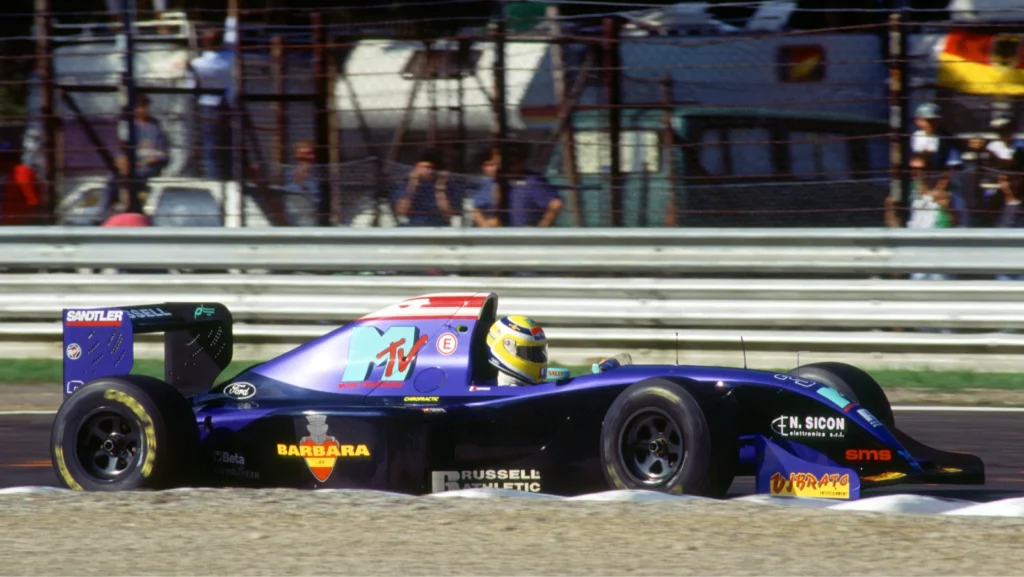
The car’s difficult birth, caused by financial constraints, led to engineering brilliance from renowned designer Nick Worth. The Briton designed the S941 using Computational Fluid Dynamics (CFD), before most of the car was built. While CFD is now standard across all teams, with entire offices dedicated to it, back in 1994 it was revolutionary.
But revolutionary does not always result in speed; this is proven by the case of the S941. It started 1994 at the back, though comfortably faster than the woeful Pacific outfit that failed to qualify for a race past round eight.
But for a car as radically designed as the S941, attracting sponsors was surprisingly easy. The blue livery had MTV plastered all over the engine cover, with a healthy number of smaller sponsors dotted around the car, significantly aiding its quest to be aesthetically pleasing and unique.
Whereas McLaren and Williams featured low noses, the Simtek one looked far more dramatic, with an almost vertical swoop down to the endplates. Boxed sidepods allowed for clean airflow to the rear wing and diffuser. While overweight, it was a competent car, and easily stood out amongst its peers for the right reasons.