
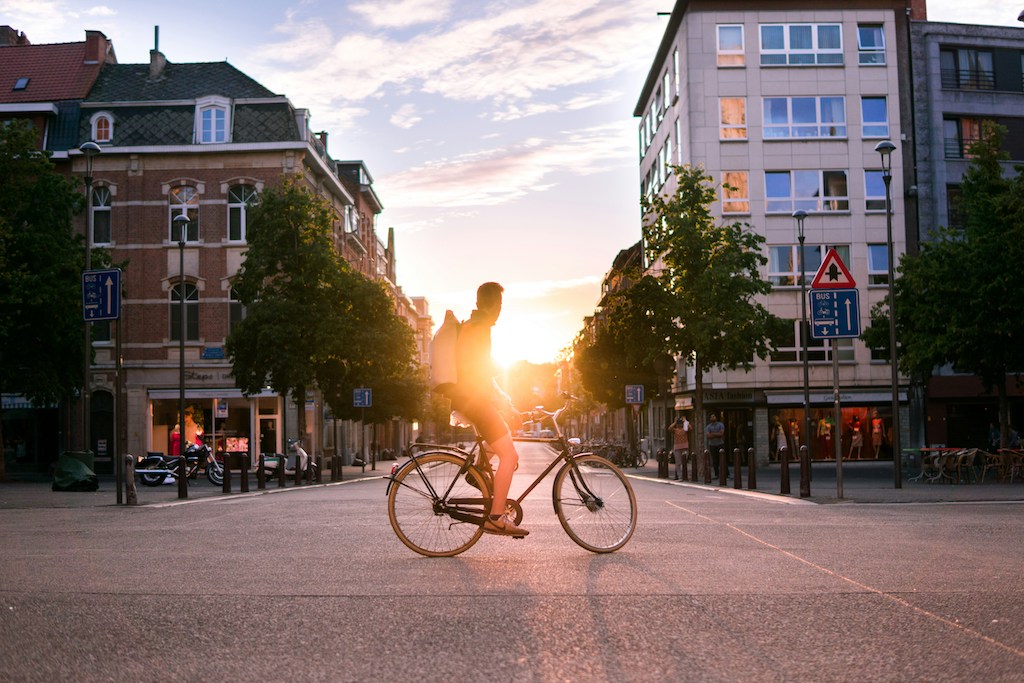
The cost of living is skyrocketing and time is at a premium, and that’s why more and more people are taking a look at car-light and car-free lifestyles.
For more than a century, the private automobile has been sold as freedom. Cities were reshaped around it, suburbs stretched outward because of it, and daily life became organized around traffic, parking, fuel prices, insurance renewals, and the low-grade stress of sitting still while going nowhere fast. That story is not just starting to crack, it’s falling apart.
Across North America and beyond, more people are experimenting with going car-light (owning a car but using it sparingly) or car-free (ditching it altogether). Rising costs are part of the equation, but so are shifting values: climate anxiety, burnout, a desire for healthier routines, and a growing frustration with cities designed almost exclusively for vehicles rather than people.
The cost of driving one vehicle for a year in America was $12,000 in 2025 and rising fast.
Going car-light isn’t about ideology. For many, it starts accidentally: a new job closer to home, a move to a denser neighborhood, a bike bought “just for weekends” that slowly becomes a daily tool. What often surprises people is not what they lose by driving less—but what they gain.
A recent online discussion started by asking a deceptively simple question: What is the best thing about giving up your car, or going car-light? The responses poured in by the dozens, and together they form a vivid, sometimes funny, sometimes deeply personal portrait of life beyond the driver’s seat.
What emerges isn’t a single benefit, but a constellation of them—financial, physical, mental, social, and sensory. And for many respondents, once they experienced those gains, there was no going back.
More Money Than You Expect—and Faster Than You Think
If there’s one near-universal answer, it’s money. Not in abstract “saving for retirement” terms, but in immediate, tangible relief.
“No car payments, no gas, no expensive repairs,” one commenter wrote bluntly. Another summed it up even more simply: “Mo money!”
Several people reported saving hundreds or even thousands of dollars per month once car payments, insurance, fuel, parking, and maintenance were gone. One rider calculated that keeping their annual transportation costs under $1,000 was equivalent to a $5.77-per-hour raise. Another noted that ditching a car made it possible to afford rent in an expensive city while living on a fixed income.
What stood out wasn’t just the savings, but the mental freedom that came with them. People talked about no longer worrying about surprise breakdowns, inspections, expiring registrations, or the creeping dread of a dashboard warning light. As one commenter put it, car ownership felt like a constant background task list—one that simply vanished when the car did.
Health Gains That Sneak Up on You
Many riders admitted they didn’t start bike commuting for fitness. It just happened to come along for the ride.
Weight loss stories appeared again and again: 40 pounds gone without trying, 50 pounds down over time, stronger legs, bigger lungs, firmer butts (a surprisingly popular metric). But just as common were comments about mental health.
Riding to work became a daily reset—a built-in transition between home and office that driving never provided. Several people described their commute as meditative, a chance to wake up in the morning and decompress in the evening. Stress that once followed them home dissolved somewhere between the bike lane and the front door.
One rider summed it up perfectly: you can have a commute that spikes your blood pressure and cortisol levels—or one that quietly makes you healthier while getting you where you need to go.
A car-light lifestyle offers a freedom against which cars cannot compare
Time Feels Different Without Traffic
One of the most underrated benefits, according to the thread, is predictability. Bike commutes tend to take the same amount of time, every day. No gridlock, no accidents backing things up, no last-minute parking hunts.
“Traffic? I don’t know her,” one commenter joked.
Several riders pointed out that even when cycling wasn’t the absolute fastest option, it felt faster—because it was active, engaging, and free of frustration. Others noted the simple pleasure of pulling up directly to the front door of their destination, rather than circling blocks or feeding parking meters.
You Notice the World Again
One of the most poetic themes to emerge from the discussion was how much more people noticed once they stopped driving everywhere.
Bike commuters talked about blooming lilac bushes, mountain laurels, urban wildlife, sunrises over lakes, and the small, human moments that cars tend to erase. On a bike, it’s easy to stop for a photo, admire a strange lawn decoration, or exchange a few words with a neighbour.
Several people mentioned forming friendships simply by seeing the same faces along their route: other cyclists, dog walkers, parents biking kids to daycare. One commenter captured it neatly: being in a car separates you from the world; being on a bike puts you back into it.

Bicycle commuters in New York City
Freedom, Redefined
For all the practical benefits, many riders struggled to explain the best part without resorting to one word: joy.
Cycling felt like being a kid again. It felt efficient, quiet, and deeply satisfying. It replaced the boredom and irritation of driving with movement, air, and agency. Even bad weather didn’t always ruin the experience—some admitted they felt genuinely sad on the days they had to drive instead.
That’s not to say it was all romantic. A handful of commenters were honest about the downsides: cold mornings, maintenance days, close passes from careless drivers. But even those voices often concluded that the trade-off was worth it—and that bike maintenance, for all its quirks, still paled in comparison to the cost and complexity of cars.
Car-Light, Not Car-Blind
Interestingly, many riders emphasized that this wasn’t an all-or-nothing lifestyle. Some kept a car for weekend trips, rural visits, or hauling large items. Others used trains, transit, rentals, or car-share when cycling didn’t make sense.
The point wasn’t purity—it was choice. Owning a car no longer meant defaulting to it.
And once people experienced what daily life could feel like without constant driving, they became fiercely protective of it. As one long-time car-free rider wrote, celebrating a decade without a vehicle: “They’ll have to pry these handlebars out of my cold, dead hands.”
The Takeaway
Ask a group of bike commuters what they love most about going car-light or car-free, and you don’t get a single answer—you get a chorus.
More money. Better health. Less stress. Stronger communities. A deeper connection to place. And perhaps most shocking of all: almost no one said they missed traffic, parking, or gas stations.
Want some practical tips for making the switch? Read this article.
North Americans were raised to believe that freedom comes with four wheels and a monthly payment, but times are changing.