
The simplicity of the standard tennis court allows even the most rudimentary of spaces to feel orderly. Even if you’re looking at a public court you have to wake up at 6 am to queue for, or a worse-for-the-wear home court that’s been neglected for far too long, the elegance of those 11 simple lines remains.
Some architects prefer a design that’s in harmony with the orderliness of the court, not an antidote to it. Hector Barroso is one such architect, having designed the grounds for a private tennis club in Los Cabos, Mexico in 2018. Using rammed earth, the design mimics the landscape of its region, the fact that it is literally crafted from the earth allowing for a natural alignment. The overall design hasn’t yet been fully realized, but several of Barroso’s elements are completed at the property, including a sunken stadium with a court at its center, one of the property’s centerpieces. “What I’m interested in is empty spaces, the ‘calzadas’ as we call them, and how the position of the architecture around it gives scale and sense to those negative spaces,” Barroso tells Racquet. In one stroke, the sense of quiet borrowed from the surrounding landscape offers a sense of momentary tranquility to players before they pick up their racquets.
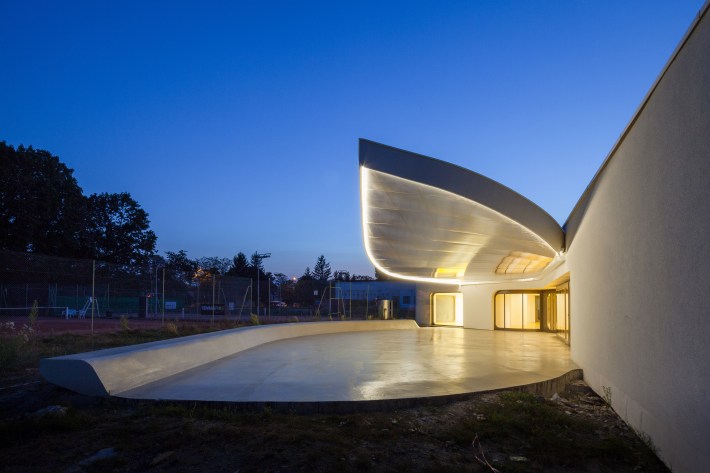
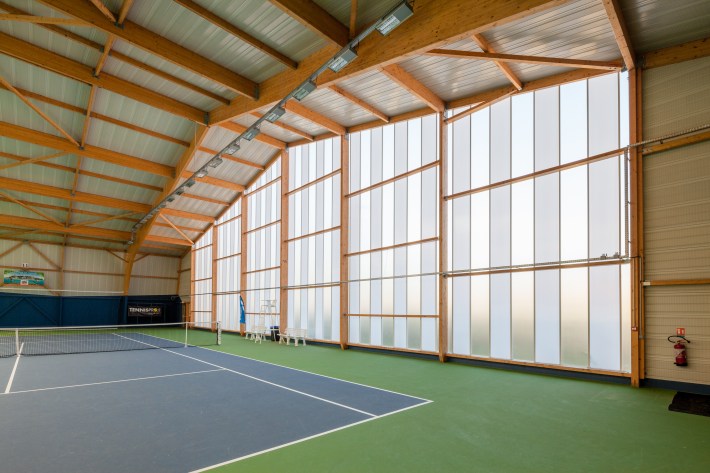
mirror the energy of the players.
For some, the rationality of a tennis court is an invitation to provide a counterpoint. While Wimbledon may be known for its strong sense of tradition, the structure of the Hopkins Architecture-designed All England Lawn Tennis Club is rather playful, with a wavy timber roof that’s supported by steel beams and raking props. If those props seem to evoke the prongs of a racquet’s shaft, that’s by design. “The very original concept was to make the roof from timber like an architectural version of a Dunlop Maxply racquet,” Hopkins Architects principal architect Mike Taylor told Dezeen in 2023, the year the building was completed.
In Indonesia, Fffaaarrr found the middle ground when they designed a space that is half coffee shop, half tennis club homebase. Terracotta walls enclose the plum-colored court on three sides, with the other side lined by stands that are nestled under a building overhang. While relatively simple, it has a level of conviviality not immediately implied by the more minimalist designs.
Paul Le Quernec’s effervescent design for a tennis club in Strasbourg, France was intended to mirror the energy of the players. The halfway-deconstructivist structure features broad curves, pushing people through the public areas and over to the courts, with the parachute-like ceiling presiding over a gradient yellow floor being one particularly memorable section. In this context, the arrival at the tennis courts feels like a sigh of relief—delivered from the funky shapeliness (and relative low ceiling) of the communal zones and into the double-height breathability of the courts.
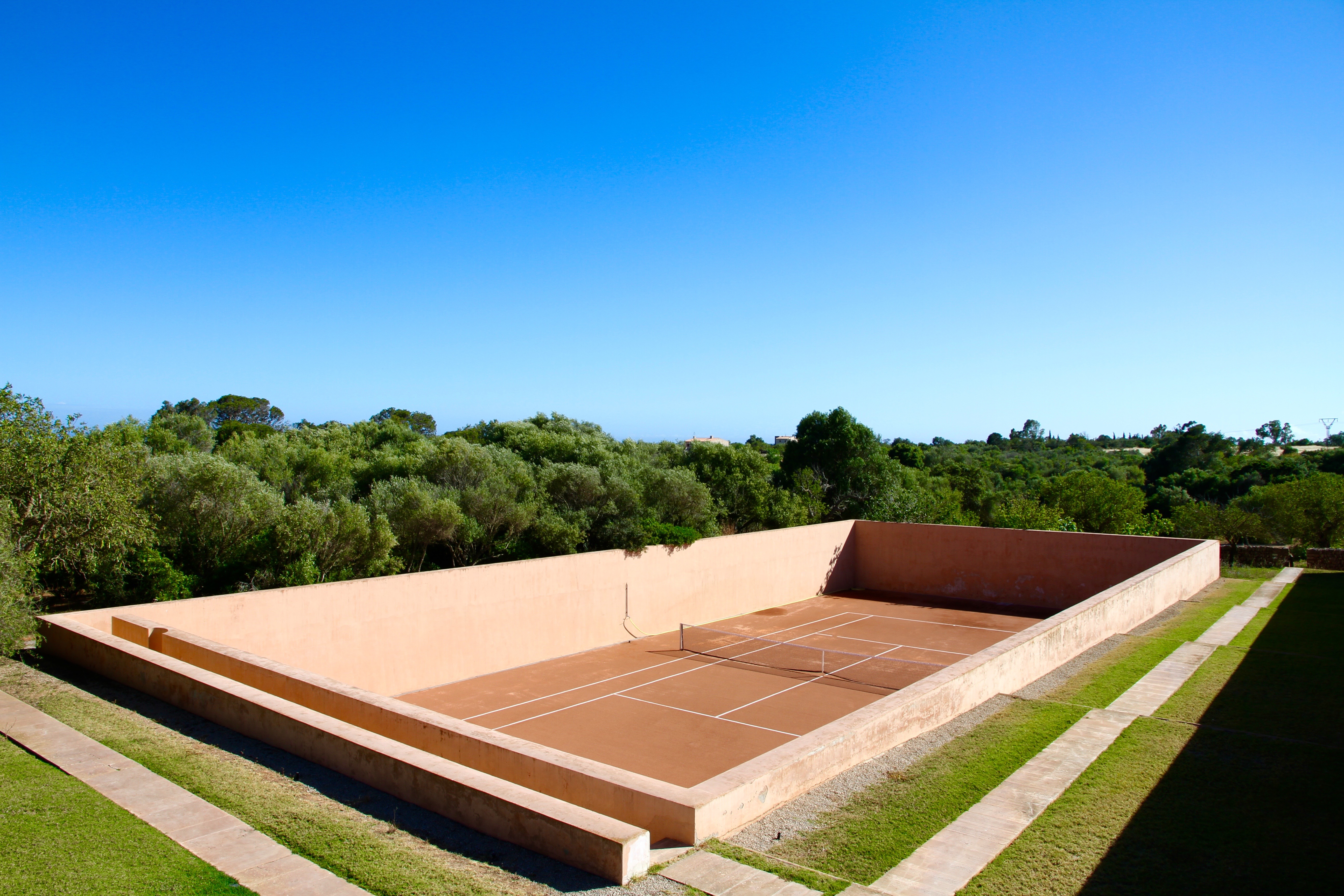
The sunken tennis court at the Neuendorf House, a residential property in Southern Mallorca designed by Claudio Silvestrin and John Pawson in the ’80s, takes its cue from the austerity of standardized dimensions. After following a dusty pink concrete pathway—the same tone and material as the rest of the property—players are ushered down to a court that’s been inserted into the earth. Here, the surrounding world is barely visible; there’s nothing to focus on but the clay court.

And in Accra, Ghana, the Backyard Community Club by Glenn DeRoche uses a simple material palette of prefabricated rammed-earth panels for the structure and clay for the court itself. This is given a sense of ornamentation, though, by the subtle manipulation of sunlight: triangular cutouts in the rammed-earth walls surrounding the court usher daylight in and create a sense of connectedness with the broader community, rather than simply being a walled garden. “I’m obsessed with light and darkness, and how darkness allows us to appreciate light,” Deroche told Racquet in 2025. “So we designed this panel that was moving in two directions; it tapers in one plane and then it angles in another.”
In every case, constraint begets expansiveness; right angles widen and narrow; lines extend and curve. The final touch: players and their watchers round out the space, genuflecting in these 36×78 foot cathedrals to sport.
Rachel Davies is the author of the design newsletter Personal Space and the Contributing Editor at Dwell. Their work has appeared in Architectural Digest, Curbed, and Prune, among other publications.