
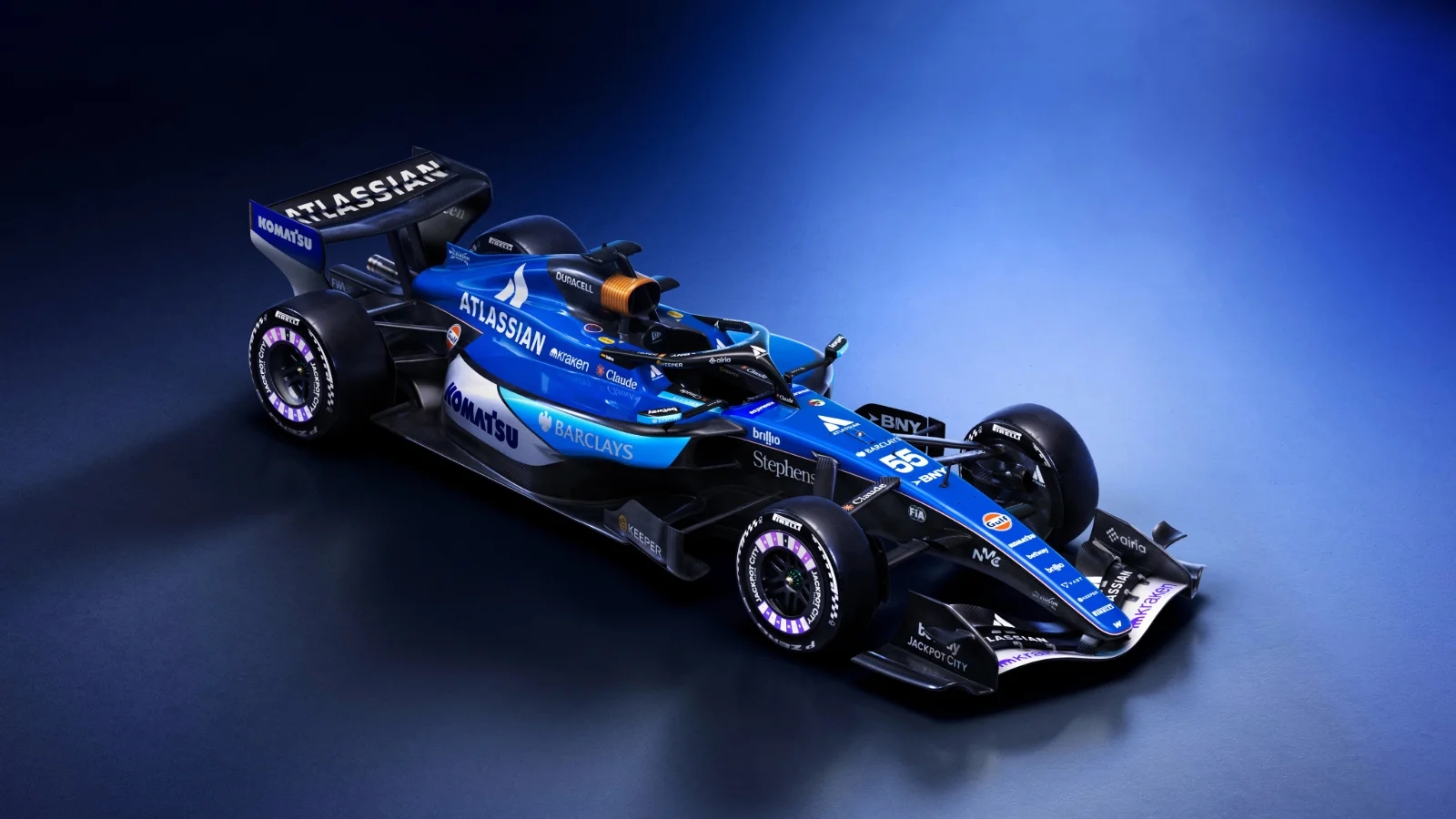
Williams has gone down with the design route for the front-end of its 2026 Formula 1 challenger; the FW48, that Red Bull perfected with the RB19.
After an unexpected delay that meant the Grove-based team had to sit out the private shakedown at Barcelona, the FW48 finally hit the track at Silverstone, earlier this week.
Williams failed to ready the FW48 for the shakedown at the Circuit de Barcelona-Catalunya after reportedly having failed the FIA’s mandated crash tests amid rumours of battling an overweight car.
Apprehensions regarding the latter were laid to rest during the car’s official livery launch but the event itself roused more questions than it settled answers.
Fans and the media alike spotted an anomaly with the digital renders – the FW48 seemingly had no suspension rods.
That said, pictures emerging from the team’s own private shakedown at the Northamptonshire-based race-track have finally delivered a clearer picture regarding Carlos Sainz and Alex Albon’s 2026 challenger.
The Red Bull-inspired front suspension layout Williams has adopted
Williams seem to have gone against the grain in terms of its suspension setup, opting to go for a front pull rod and rear push rod layout as opposed to the dual push rod suspension adopted by most of its rivals for F1’s latest era.
Interestingly, the inherent geometry of the front suspension layout beckons a call back to the highly dominant RB19 driven by Max Verstappen en route to his third-consecutive World Championship in 2023.
The upper triangle of the front suspension is aggressively inclined, leading to enhanced stability under braking.
This anti-dive feature, that essentially stops the front-end from excessively ‘diving’ down under braking, was introduced by the Milton-Keynes-based team on its 2023 car.
One cannot blame Williams for taking inspiration given the RB19 won a staggering 21 out of 22 races that year making it statistically the most winningest F1 car of all time.
What other novelties were discovered on Williams’ FW48?
Another striking feature of the FW48, and arguably the most important front-end appendage in this technical era, is its front wing.
A scooping arch, the front wing looks to create nifty deflections in the lower part of its profile aiding airflow towards the chassis and the rear-end.
Other than that, it would appear that Williams has taken a textbook approach to the rest of the outer-bodywork. This shouldn’t come as a surprise as the team would be prioritising logging data and mileage over ‘innovative’ aero gains at the moment.
Two pre-season tests, at the Bahrain International Circuit, are yet to be run in February before the season-opening Australian Grand Prix in March, and the team will have enough opportunities to revamp its package to bring it up to competition spec.
As things stand, it would appear that team, after having missed a substantial three days of running in Spain, is eager to get the FW48 on track for systems checks and correlation of its package with the 2026 Mercedes power units.
READ MORE – GALLERY: Williams unveils new livery for F1 2026