
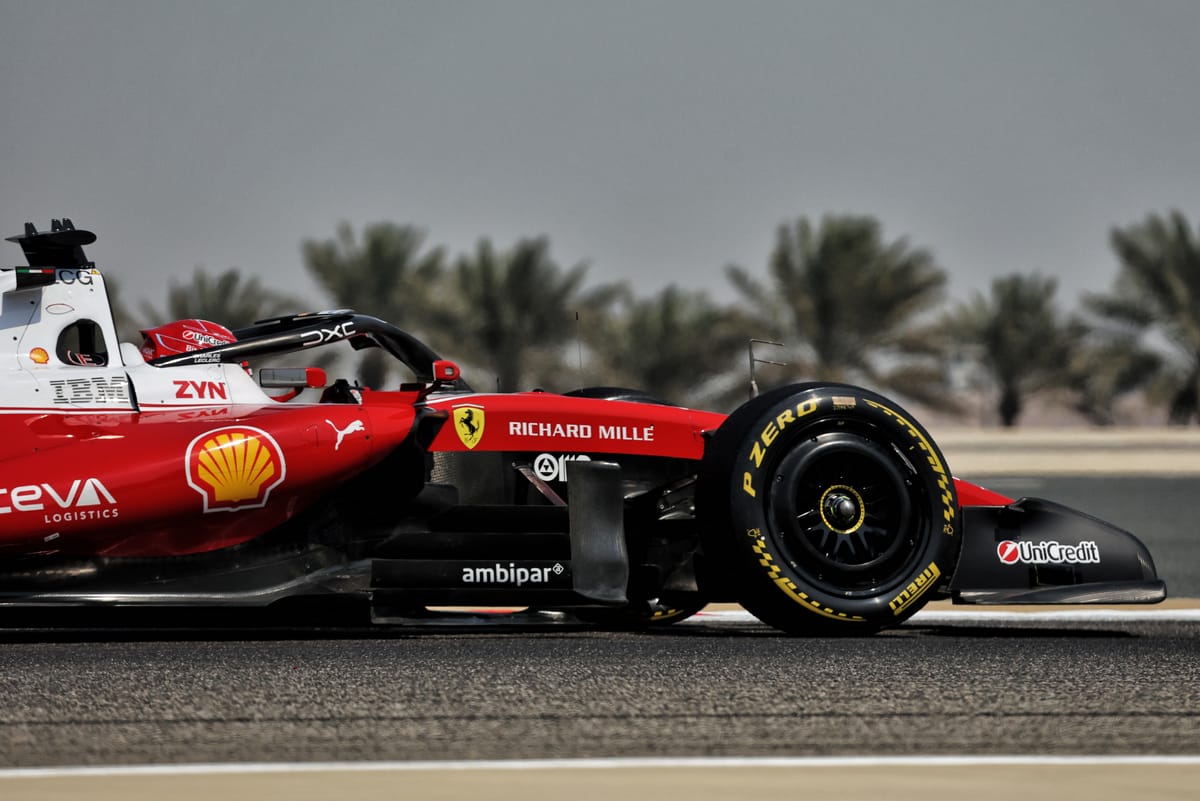
‘Super clipping’ has become one of the key phrases of Formula 1’s 2026 season build-up.
Having been off many people’s radar prior to the new cars hitting the track, super clipping has become not only paddock parlance but could end up being a defining element in the competitive battle.
That is because it has fast become a favoured tool for teams in their fight to harvest power for the energy-starved 2026 cars.
Amid talks of tweaks to the F1 rules to try to smooth out some early headaches, there is a chance that super clipping could become even more attractive to do.
Essentially, super clipping is when the cars harvest energy while on full throttle, usually at the end of straights or through high-speed corners. It takes the energy that would go to the rear wheels and the MGU-K instead harvests it, for deployment later in the lap.
Here we take a look a detailed look at what super clipping is and why it is set to become such a big battleground.
Flat-out energy recovery
It has long been known that F1’s shift to cars with a roughly 50/50 power split between the internal combustion engine and the battery would result in them becoming energy-starved.
This meant a big performance push in trying to harvest as much as possible with the MGU-K over each lap.
Recovering energy in F1 is nothing new, and the tactics that were used during the previous rules era are still in play now.
The now larger MGU-K can harvest a maximum of 350kW that is allowed under the regulations from braking, and from the rear axle when the car is in lift and coast mode.
But other options have also proved to be attractive, based on the MGU-K harvesting energy when the car is accelerating too.
This can happen in corners, when drivers will be on partial throttle and the car settings will allow the MGU-K to harvest some of the energy that is being produced by the engine rather than let it be used to power the rear wheels.
But this tactic has been taken a step further with super clipping, which is when the MGU-K is put into harvest mode when the driver is on full throttle.
The rules allow harvesting at 250kW in this way, with the tactic being deployed at the end of straights and even in high-speed corners.
While good for recovering energy, it does mean that some of the power that would normally go to the rear wheels is instead harvested by the MGU-K, which means a reduction in top speed.
It was the use of super clipping in Bahrain’s highest-speed corner, Turn 12, which dropped top speeds by around 30km/h (21mph) – from 267km/h (166mph) to 233km/h (145mph) – in early running, that prompted Fernando Alonso’s quip about the Aston Martin team chef now being able to drive F1 cars.
While super clipping only allows a maximum of 250kW of recovery, it has proved so attractive for teams at the end of straights because of how it interacts with active aero.
With drivers being on full throttle when super clipping kicks in, it means the front and rear wings stay in straight mode – so there is minimal drag, which is good for top speed.
If drivers switch to lift and coast, it may harvest at 350kW for the period they are doing it, but it means their wings go to high-drag corner mode – and that can prove costly for straightline speed and ultimately laptime.
A push for change
The debate that teams have between going for super clipping or lift and coast at the end of straights has become one that is not just about performance, but that revolves around safety, too.
McLaren team principal Andrea Stella has been quite animated about the risks that can be posed by drivers suddenly coming off the throttle to lift and coast towards the end of straights, potentially catching out anyone running very close behind them.
From his perspective, efforts should be made to deter teams from being tempted to chase the 350kW on offer from lift and coast.
He thinks the best way to do this is to increase what can be on offer from super clipping, which reduces speed in a much more progressive way without any unexpected deceleration.
Stella thinks it would make sense to lift the limit on recovery during super clipping from 250kW to the maximum 350kW.
As part of ongoing discussions with the FIA about potential solutions to early-season problems, McLaren trialled some super clipping at the 350kW limit during last week’s second Bahrain test.
The data from that running will now be analysed by the FIA to see if it brings benefits that justify a change to the rules.
Stella said: “It will ultimately be up to the FIA to decide whether they introduce it or not. We successfully tested it and we are happy.”
But any call from the FIA on altering the super clipping gains would likely have implications on the competitive picture – because it will help any manufacturer that has been struggling to harvest as much energy.
The FIA is already weighing up whether to reduce the maximum deployment from its current 350kW limit.
Offering less power to be deployed, to either 250kW or even 200kW, would mean the batteries would last longer over a lap – so already reducing the risks of big energy starvation.
If such a move comes at the same time as a shift to allow 350kW from super clipping, then the whole equation of energy management could be dramatically shifted.
Suddenly, teams that were marginal in terms of how much energy they could harvest against their need for deployment would find themselves in a better situation where things are tipped more in their favour.
This could prove costly for any manufacturer that had done a better job in terms of its energy management.
The consequences of a change to make super clipping more powerful are therefore bigger than they initially appear – and this is why the FIA wants to wait before rushing into a change of direction.
And that may require analysis over a run of early-season races before deciding what, if anything, needs change.
As the FIA’s single-seater director Nikolas Tombazis explained: “We will see where we are.
“We will calibrate our systems and there are ways to react for the racing side.
“If necessary, we will present the proposals to the teams and to the PU [power unit] manufacturers and we will take the decision for the best of the sport. This is a marathon, not a sprint.”
The outcome of that decision will dictate which route teams prefer to take to charge their batteries.
But one thing is for certain: super clipping is here to stay.