
[Editor’s Note: This article originally appeared in the February 2001 issue of Grassroots Motorsports.]
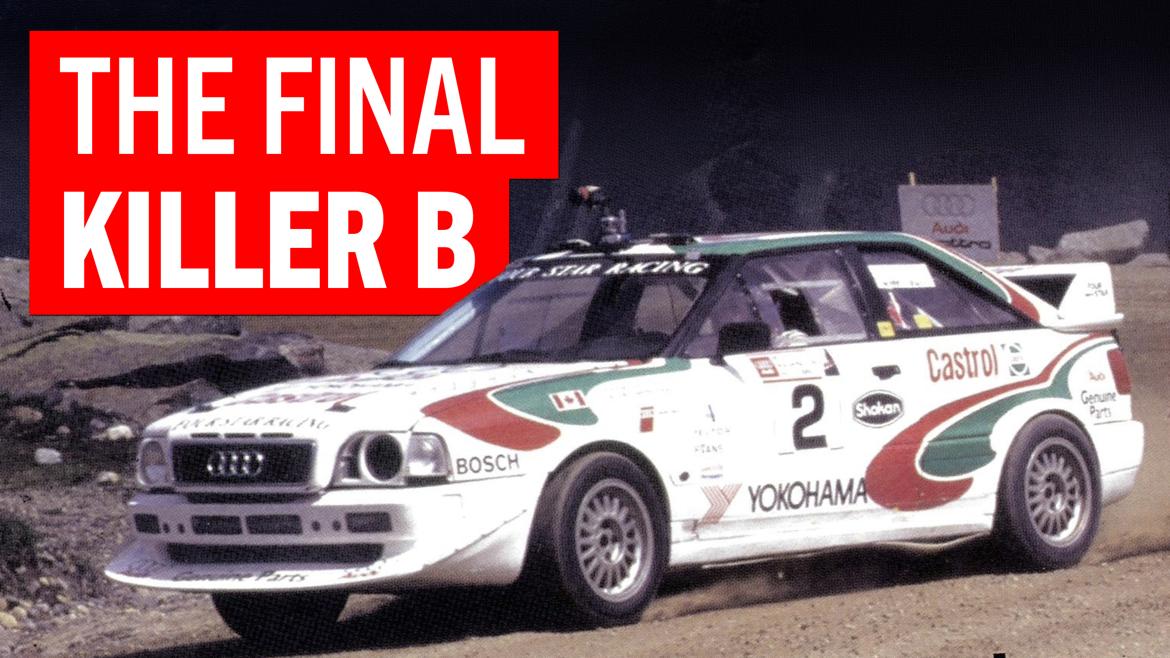
There is just one Group B supercar still in regular competition in the world, and it is perhaps the most winning rally car in history. Sixteen years after the golden era of Group B rally racing, Frank and Dan Sprongl’s Group B Audi Quattro …
Intimidation Factor
What Frank Sprongl loves most about his Group B Audi is its ability to intimidate. “First there is the reputation for dominance in the rally world,” says Sprongl. “It looks like an aggressive machine that means serious business. And it sounds like something fierce is coming down the roadthe five cylinders give it a distinctive, refined tone. There’s no mjstaking it’s an Audi.”
But it is the flames blasting out of the exhaust pipe that puts everyone on notice-and it happens whenever Sprongl shifts or decelerates. Going from full throttle to partial throttle restricts the amount of air going into the combustion chamber, resulting in an excess of fuel. The unburned fuel is pumped into the hot exhaust manifold, where it ignites and blows out through the turbo and tailpipe like a fire-breathing dragon. “The flames are cool,” says Sprongl, “especially when racing at night. The flash lights up the woods.”
Sprongl adds th.a! you just can’t beat the reliability of the car. “It’s built like an army tank. The structural rigidity and mechanical components are superb. It’s hard to break this car.”
The Dream Car
Now 33 years old, Sprongl started rallying at 18. The following year, he got an opportunity to see a Group B Audi A2 up close, and his life was never the same. With his brother Dan, he bought an Audi Coupe Quattro street car and converted it for rallying at their performance shop, Four Star Motorsports, located in Georgetown, Ontario, one of the largest rally shops in North America.
The car won many championships from 1990 through 1992 before they decided to upgrade to the ultimate rally machine: a full Group B Audi. The S2 shell was prepared at Four Star Motorsports, the engine was a Lehmann original, and the drivetrain, transmission and suspension were Audi Sport. The car debuted at the end of 1993 and instantly dominated the rally scene.
“The contrast between the Coupe Quattro and the A2 Lehmann engine was night and day,”say Sprongl. “There was a mind-boggling difference in acceleration and top speed. It accelerated faster than I could shift. The first time I drove the car. my knees were shaking and I couldn’t get out of the seat. It was such an adrenaline rush. Now I’m used to the sheer acceleration and braking ability; I could use more horsepower.”
Super Lehmann Engine
“This engine was 115 percent developed,” says Sprongl, adding that it has so much power and torque it digs trenches off the starting line and slams his head back against the seat. “The 10-valve is a beautiful engine: all the bugs were worked out. It requires minimal service:· Maintenance includes changing the oil after each rally, checking the plugs and rotor cap every three rallies, changing the turbo twice a year, and checking the timing belt once a year.
Lehmann not only designed and built the A2 engine, but he still performs all major repairs for the team. “We never have to worry about the engine,” says Sprongl. “We send it to Liechtenstein when there’s a problem, and when we get it back, we simply bolt it in and hook it up. We only have to check the oil. water and turbo pressure. The engine arrived sealed; we don’t know exactly what he did, but we’re sure it will run perfectly.” Before Lehmann sends an engine to a customer, he checks it on the dyno.
Lehmann’s six-person shop is known for exacting detail work, from mapping the ECU computer, to working with special factories across Europe to custom fabricate parts such as pistons. connecting rods, cam shafts and crank shafts. “It’s expensive, but I’m sure these pans are the best in the world,” said Heinz Lehmann, adding that not a single engine part is the same as in the production street car version.
Rare Engine Parts
Some of the parts for this rare competition engine have become very difficult to get, such as the aluminum engine block.”I always tell the Sprongls that if they crash the engine, we’re going to have a big problem,” says Lehmann.
According to Lehmann, there were a minimum of 200 A2 engines built to qualify for race homologation, and so far his shop has rebuilt about 160 of them. Museums and private collectors own most of these; only a fe11 are now entered in competitions.
The engine management system is basic. controlling airflow, ·temperature and timing. It is preset at Lehmann’s shop and dyno tested with the engine. The rev limiter is also preset at 8200 rpm and is not adjustable.
The engine is cooled by the large volume of oil in the dry sump lubrication system with an enormous oil cooler in the rear spoiler, and by a high-efficiency stock radiator. The air for the engine is cooled by a turbo intercooler that is five times larger than the stock unit. The engine exhaust system features mandrel-bent, three-inch pipe for high flow.
The Power Advantage
The sheer power of the engine is a real advantage in rally, according to Sprongl. “If you enter a corner too hot, you can downshift and get away with going through at full throttle; in a lower horsepower car, you’d slide off the road. Or, if you’re not sure what a corner does and take a low-risk approach by braking, you can use the power of the car to blast out of the corner and make up the time you lost.”
Sprongl says the car never strains on steep pitches, and he doesn’t have to shift down. “It has no barrier in acceleration; if you hit the rev limiter and have room on the road, you can go up another gear.” 1-1-o_wever, he added that if you’re not careful, accelerating in the wrong spot can put you into the weeds.
‘Torque is actually more important than horsepower in rallying,” says Sprongl, “especially at low rpm. I don’t have to be in the right gear out of a corner; the torque pulls me out and helps acceleration. The car never bogs down in sand, mud or snow.”
The Audi Sport competition gearbox is a vital ingredient in the power equation. It has a short gear ratio with a top speed of 120 mph. The close gear ratios means Sprongl loses very few rpm during shifting. With the hydraulic-activated clutch triggered by a button on the shifter, he eliminates the foot action delay and saves valuable time with every gear change. “It shifts as fast as I can pull the shifter,” he explains. The lightweight, cross-drilled flywheel allows the engine to rev up more quickly; it connects to a single-plate competition clutch.
Designed for Abuse
The car’s suspension is built for battle, according to Sprongl. “I can go over anything at any speed; I don’t back off over the rough stuff. We ignore the cautions in the route book to a certain extent. We have no problem hitting jumps flat out. It allows us to make up time on competitors where they have to back off.”
The bulletproof suspension is made of steel, including strut, spring and shock housings, although a separate lightweight aluminum suspension is used for hillclimbs. Extra-strength tubular control arms hold the struts in place. Spherical rod ends are used throughout to eliminate flex in the parts; there are only 14 rubber bushings and mounts in the car. “With the solid mounts you feel the engine vibrations, but the faster you go, the smoother the ride,” says Sprongl.
Not much of the suspension is adjustable on the Quattro. The spring rate is changed only for winter rallies to be more forgiving. Fully-threaded struts enable raising or lowering the car by a few inches for road conditions. Adjustable sliders on the control arms allow camber adjustments. Sprongl selects spring rates and shock valving from the Audi Spon product line.
Loose Handling
Sprongl likes the car to handle loose, and sets the toe, camber and ride height accordingly. “I want to ensure that if I come over a crest and the road unexpectedly changes direction, I can easily rotate the back end of the car around.”
He explained that when he first got the car, the rear wing pushed down the back and picked up the front end when accelerating, which made the car understeer. He added the front spoiler for front-end down force that neutralizes the car’s handling.
The car features a competition power steering pump directly driven off the camshaft, an Audi Sport steering rack, and a smaller steering wheel to quicken steering. A collapsible steering column was added for safety.
The brake system includes dual master cylinders, four-pot aluminum alloy calipers and 280mm vented discs. The brake bias is adjustable front to back only on the brake pedal assembly, not inside the car like many rally cars. “I want to concentrate on driving and avoiding errors, not playing with the brake bias.” says Sprongl. Power and traction are transmitted through Yokohama tires.
Rigid Bodv Design
The shell was designed for little body flex, with a triangulated roll cage welded to the body at 30 to 40 points. The roll cage ties to the front and rear suspension, rear di fferential mounts, and the front and rear strut towers. “A stiff car handles better, with more control, balance and stability,” Sprongl explains.
To withstand the road abuse, metal reinforcement was added to critical mounting points for the suspension and engine; the transmission tunnel was doubled, and custom brackets were made to bolt the engine, transmission and rear differential directly to the chassis, as opposed to sitting on a subframe.
To protect against the rock shower under the car, Kevlar shielding covers the rear differential, part of the rear drive shafts, and the outer CY boots and joints. High-density plastic protects the half shafts, lower control arms and floor; a metal plate protects the rear brake discs and calipers; a 10mm Kevlar skid plate protects the engine and transmission.
The shell is fully seam welded and lightened wherever possible. Composite panels are used for the hood, rear hatch, front fenders and front bumper. Windows are Lexan except for the windshield.
Reliable Systems
Quick-release half shafts provide easy repairs between rally stages; the half shafts, as well as the prop shafts and axles, are all Audi Cornp.
The fuel system consists of a 22-gallon tank plus two fuel filters, pumps and pickups. “It’s a gas pig,” says Sprongl, adding that fuel economy is all relative to turbo boost. He typically gets about five miles per gallon during a race, and 15 to 18 mpg transiting on the highway.
The electrical system includes a stock battery, competition alternator, and a single belt running the alternator. Easy-access aircraft circuit breakers and relays were installed to avoid changing fuses on night stages. A removable pod with six auxiliary lights illuminates the tree-lined courses at night,
The dash has been simplified with critical gauges only: tachometer, boost, oil temperature, water temperature, oil pressure, amp/volts and fuel gauge. Racing seats and safety equipment round out the interior.
Upgrading Performance
To improve his aging Quattro, Sprongl would love a six-speed sequential competition gearbox for quicker shifting with an adjustable center differential. “Some top cars have viscous couplings in an active center differential which enables use of the hand brake in hairpin corners,” explains Sprongl. “The Audi has no center differential. If I locked the rear wheels, the engine would stall because of the direct output.”
Other upgrades on Sprongl’s wish list include an anti-lag system to eliminate turbo lag and loss of boost pressure when shifting, current suspension technology with two- to threeway adjustable dampening, traction control, more efficient brakes, and an updated shell.
“Of course, the ultimate would be an Audi 20-valve motor with 750 horsepower, full anti-lag and the six-speed sequential gearbox with active differentials, but that would require a few hundred thousand dollars,” explains Sprongl. “The motor alone is over $ I 00,000.” But in all motorsports, sponsorship money dictates upgrades. Team sponsors in 2000 included Yokohama, Bosch, Peltor Intercoms and Loctite.
“I love the prestige, the reliability, the raw power and the ruggedness of the Quattro,” says Sprongl, “but to some extent, feel like I’m running a car out of the Flintstone era. Nothing can compete in acceleration and straight-aways, but I lose time in the bumps and tight, twisty sections. Suspension and handling technology has evolved dramatically, and quick handling is the key to success on fast-changing rally roads. In addition, the new rally motors are designed differently-the setup between horsepower and torque is different. with high torque at lower rpm to pull you out of the corners.”
Since the Group B Quattro is becoming more outdated technology-wise, the team has decided that 2000 will be the last year of full competition for the famous fire-breathing car. It is the final chapter in the Group B era. “Nothing will compare to the Audi Quattro, it will just be different,” says Sprongl. He plans to use it for special events and for the Mt. Washington Hillclimb. “The brute power is perfect for that race,” the course record-holder said with a smile.