
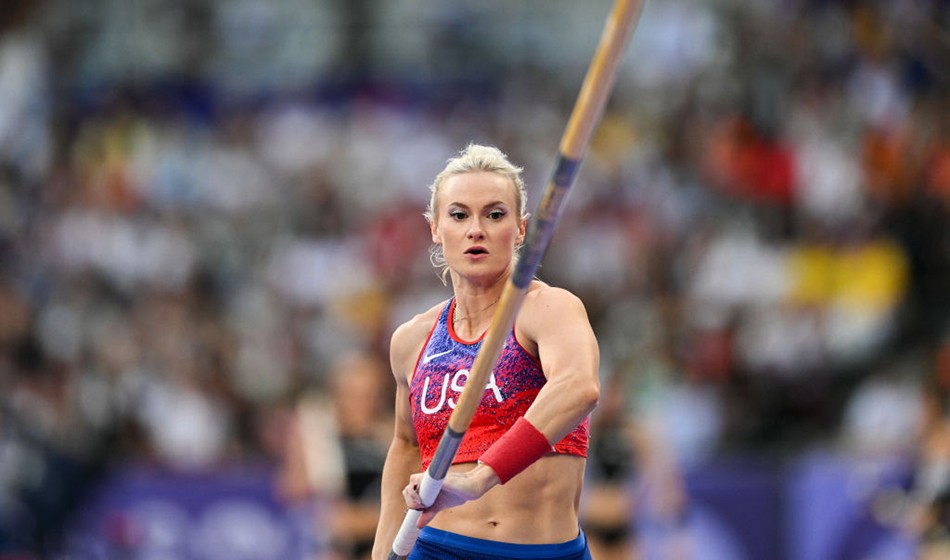
We chat to the most dominant female pole vaulter of the decade, about why she doesn’t feel that way, the changes that have brought her happiness and why she thinks she still has more to give.
Mondo Duplantis has completely transformed the art of pole vaulting. With his serial record-breaking and gold medal winning performances, the American-born Swede is undoubtedly the dominant force in the event on the men’s side.
His exploits have deservedly made headlines, but they have also somewhat overshadowed Katie Moon’s impressive accumulation of honours in the women’s event. The American picked up a pole in training again just last month, having not touched one “since September” – the end point of another successful season in which she secured her third consecutive world title (the first woman to achieve that feat in her event), adding to a list of honours that also features Olympic gold in 2021 and silver from Paris two years ago.
The 34-year-old has begun 2026 from a place of contentment. After those 2024 Olympics, she moved from her previous training base of Atlanta to Tulsa in 2024 to be with her husband Hugo, who is a rowing coach at the University of Tulsa.
She is still coached by Brad Walker, but remotely, and enjoyment is at the forefront of her mind as she plots the year ahead.
What’s your assessment of 2025?
It was quite possibly my favourite year of my career to date. Just everything about it was what I’ve always wanted my career to be. I was living with my husband full-time for the first time, training away from my coach but using my coach’s training plan.
Most of my career has had such a negative stress and anxiety to it and a fear and I just didn’t have any of that. It was fun. It was laidback, but still very exciting and I still wanted it. From beginning to end it was just everything that I would have hoped this career would have been sooner. Looking back, it probably still needed that urgency and the stress to get me to this point and appreciate it more.
It was a busy year with 15 events and eight wins, including the world championships and the Diamond League final.
With how long the season was, it made sense to throw more competitions in. It didn’t feel like that many, though, because they were spaced out a bit more strategically. I think that was key to staying healthy and staying motivated. I will say there was a period in the middle where I struggled a little bit more than I usually do. There were a couple meets in there where I only jumped, I think, my opening bar so there was a little bit of just scrapping, just figuring some things out. Thankfully we had the time to do that.
Do you now accept that you are the best female pole vaulter of this decade? You have won three world championships and an Olympic gold.
It’s hard for me to accept that and something that helps me to stay motivated is that I don’t feel that way. I guess I can’t argue with the stats, but it just feels very surreal because when you think of somebody that has a title like that or is that good, you think of Mondo, who wins everything and is larger than life, and I just don’t feel that way. I go through my struggles throughout the season and I feel very “normal” if that is the right word. It is a weird thing to say, but I appreciate that. I guess the stats would say you’re right and that’s pretty cool.
How do you train now compared to when you were younger?
We have kept my training pretty consistent throughout the years but this year is looking a little different as a whole because we ramped up much more slowly. I restarted in November with just an easy roll in. The first week was no running, a bike workout for endurance, ergo workout for endurance, body weight exercises – push-ups, body weight squats, lunges, things like that. Then some endurance running, but maybe not as much volume as we’ve had in the past. We’re really focusing on the prehab things for my Achilles and just making sure things stay nice and healthy. And so I think we’re just having a much slower ramp up into the 2026 season. I don’t know how that will go because I haven’t done it before. But what I will say is that when I’ve trusted in Brad’s training every year it has always gone well. I really feel like he knows what he’s doing.
How much have you changed technically over the years?
Quite a bit. My jump still has a lot of what it was before I worked with Brad. But when I was younger – and I want to try and explain this without getting too pole vault technical – I just wasn’t vaulting very efficiently. I was fast on the runway but, in the pole vault, if you slow it down, [ideally] you see both arms are straight up overhead to open up the pole, to bend the pole. The body then comes through, goes upside down and [the pole] tosses the athlete.
Well, one of my arms would just collapse right at take-off and, no matter how much speed you have, that is limiting to what size of pole you can get on. The stiffer the pole is, the higher it’s going to toss you if you can open it up. It’s like a coiled spring and, the stiffer that spring is, if you can push it down, the faster and more explosive it’s going to return. The same goes with poles, so I was limiting myself as to what size of pole I could get on.
As well as that I was always a bit afraid. It’s a very scary way to pole vault and I didn’t know how to think and how to focus and what to tell myself to do on the runway. I would just run down, throw my hands up and hope for the best and rely purely on adrenaline.
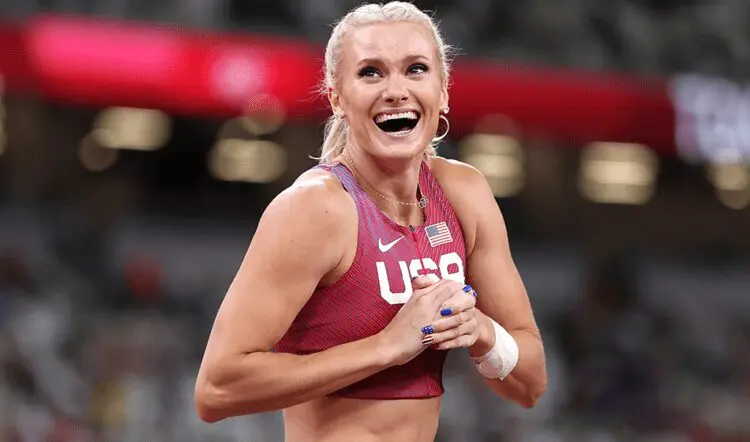
Brad tackled my insecurities on the runway and simplified it. We just worked on drills and, when I got to a point where I wasn’t afraid of it, then I could actually try to do what he was telling me to do and open up the pole and just charge through aggressively instead of leaning back and being hesitant. The easiest way to explain it is that I just became more confident and more aggressive in the last few steps into take-off and therefore taking that speed that I generated throughout the run into the jump, the way you should.
There’s still a lot in my jump that I think coaches wouldn’t necessarily teach their athletes. I definitely have some elements to my jump that are not perfect. I still don’t have the best take-off from a textbook standpoint, but it’s so much better than it was. I think we’re marrying what my body naturally wants to do and is good at – and getting closer to what “perfection” is.
Your personal best is 4.95m from 2021. What would it take to get the magic five-metre mark?
It’s there. I feel like physically it just comes down to getting on the right pole on the right day in the right conditions and I think it’s not far off. There’s really nothing that I have to necessarily change to make that happen – it’s just that the higher the bar gets, the closer to perfect you have to be. But I do feel like I’m physically capable of jumping five metres plus.
Now, granted, the later I get into my career, [the chances of it happening are] getting less and less – I know that – so, who knows? Maybe this season, all that potential will have gone away, but in previous years, I’ve definitely had the potential.
In Tokyo, had Sandi cleared that 4.90m bar [she was second with 4.85m] then maybe we’d both have cleared 4.95m and gone to five metres. It’s the same with the Paris Olympics, when the stand broke. I truly don’t know that the results would have played out any differently in terms of places, but I definitely think we all could have jumped higher.
I think having a competitor still in at 4.90m plus just elevates the rest of the playing field, too. That’s no dig at anybody, that’s just championships. Once you’re getting into 4.90m plus territory and those really high bars, I think there’s a couple of different factors. At the end of the day, I do feel like physically I am capable of that, but everything has to line up.