
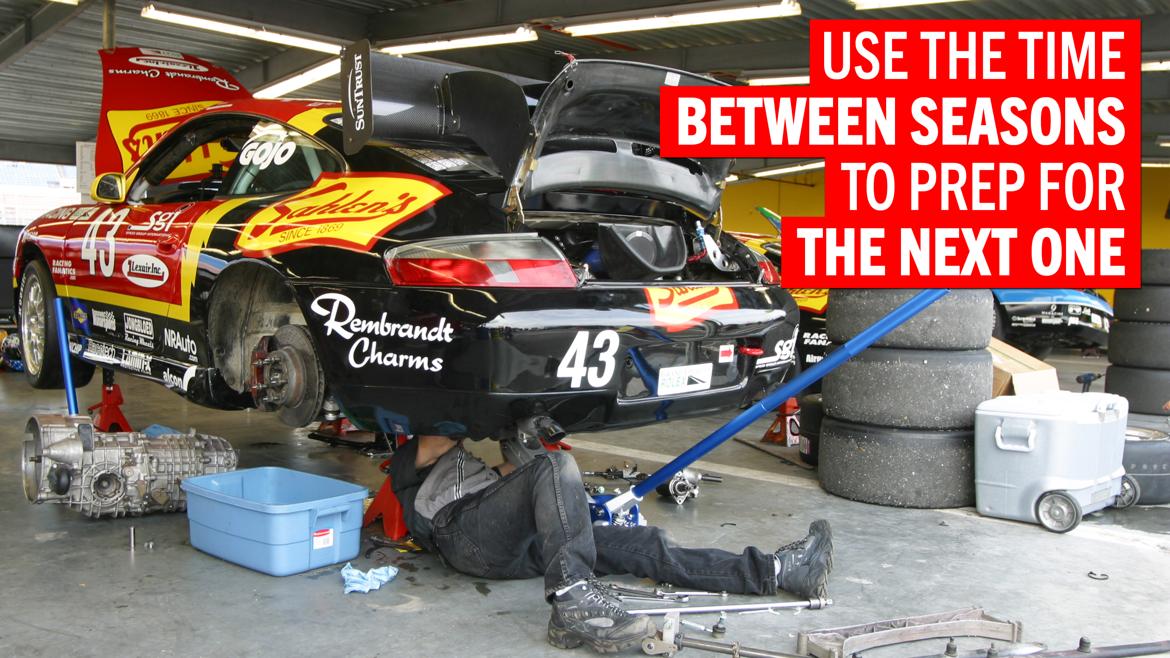
[Editor’s Note: This article originally appeared in the February 2005 issue of Grassroots Motorsports. Text has been left as it originally appeared in print.]
As soon as one racing season ends, the next one begins; the only way to stop the cycle is to get out. So unless you’re ready to toss in the towel, the off-season is when …
Have a Solid Method
Before we get into what parts you should look at developing on a race car, it’s more important to look at what methodology you use to develop that car.
The parts that are of the highest priority to develop can vary from car to car, but the method you use in development shouldn’t change from car to car, or even budget to budget. One of the reasons our team has been able to win four-straight Grand-Am Cup championships has been because we have looked at every part of the car from every developmental angle. Never accept that there isn’t a better way to do something.
Although | crewed on my dad’s race car since | was old enough to clean wheels, it wasn’t until 1995 that | first began driving with a 1985 Volkswagen Golf. The first thing | learned in developing a car is that you should get and also listen to advice from people you trust before investing your bank account in a new trick piece.
During the first off-season that | had that Volkswagen, | removed the stock springs from the front and replaced them with a 200 lbs./in. aftermarket coil-over setup. Had | heeded the advice of the elders on my team at the time, who told me | was crazy for putting stiffer springs on a car that was to race at Nelson Ledges, | would have saved a lot of time, effort and money.
While the $300 | spent to do the conversion doesn’t seem like a lot to me now, at that time it was a third of my budget for a full season. | was excited to get to the track the next year and smoke the other competitors—only to find out that | had spent the majority of my budget on a part that made me a second slower. Worse yet, | had to cut the shock towers to do the conversion, so there was no going back. After a full season of frustration and rattled dental fillings, | had learned lesson number one.
The second thing | have learned about developing a car is that the chassis dyno is your friend when it comes to developing power. We have used traditional engine dynos in the past to determine how a part works, but you need a lot of time and money to go this route. The chassis dyno is much less expensive; as a bonus, it tests the engine inside the car, exactly how it will be mounted during the race.
We are currently looking at different headers for our Rolex GT car. We have tried a couple in the past that were supposed to make substantial power gains; after looking at them on a chassis dyno, we simply didn’t see an upward movement in any part of the power curve. We are going to try several more during this off-season in hopes of either more power or a broader powerband.
The next point is an easy one to forget: When the guy on the other end of the phone line tells you his part will make you an additional 10 horsepower, remember he is trying to sell you something. He is a salesman. So, as much as you want to believe that his part will make you go quicker, try to somehow confirm the pitch before you invest your hard-earned money.
Sometimes the salesman will be able to provide the names of other people who use his product, while other times he will claim that his customers don’t want anyone to know that they’re using his part. Adding to the confusion is the fact that some snake oil products actually work, while others simply don’t. There isn’t a clear-cut way to determine if the salesperson is actually telling the truth or not; sometimes the only way to find out is to make the plunge and buy the part.
Once you have decided that you have a new idea that will make your car faster, you have to make sure you are actually correct. We recently purchased a car whose previous owner had spent double the vehicle’s value in aftermarket parts. We ran the car against one of our nearly stock Grand-Am Cup cars only to find that the aftermarket pieces actually slowed the car.
So the previous owner was not only going slower, but had actually spent a lot of money to do so. If you invest the money in an aftermarket part, do a back-to-back test to make sure you went forward and not backward. Dynos are the best place to test an engine part, and being on a track is the only way to know if a suspension, braking or aero piece worked any better.
If you have the resources available to involve experts in your development, be sure to do so. For 2005, the Rolex GT-class cars will be allowed to have a front splitter. Rather than trying to invent a splitter that we think would be effective, we enlisted the services of Crawford Race Cars, makers of the Crawford Daytona Prototype cars and provider of aero parts to NASCAR teams. We called on them to develop a splitter for us that we knew would be effective.
If you have the money to get the right guy to develop your part, don’t shortchange yourself by getting it done cheaply. It takes a lot of money to go racing. A little bit of investment up front may make the whole experience more enjoyable for you.
There also may be the opportunity to involve your suppliers in finding solutions at an affordable cost. The Rolex cars are allowed driver-adjustable anti-roll bars next season. While our crew guys would love to try to figure out how to engineer this ourselves, our friends over at HRPWorld.com have been a tremendous help in this area. Thanks to their years of Trans-Am car building experience, they are able to provide us with solutions and ideas to how to solve our problem.
Have a Plan of Attack
Now you know what methodology to go through when developing a car, but what pieces should you develop first? The American mentality is to plug more power into it, but in the road racing application, that plan doesn’t work.
The first thing to look at on a car is weight. First, look at ways to remove unsprung rotating mass. If your car is carrying more weight than required by the rules, look at solutions: Can the standard body parts be legally replaced with lightweight versions to shed a few pounds? And, as a bonus, can doing so lower the center of gravity?
We’re looking at some weight-loss solutions for our Rolex cars for the 2005 season. We are buying aftermarket carbon fiber body parts so we can put more weight inside the weight box that is located on the passenger floor, helping lower our center of gravity and better distribute the weight.
Next, you should look at any aero possibilities you have to make your car handle better. Many race series don’t allow for any aftermarket aero pieces, but if you can get them on the car, they are invaluable in making the car stick to the road. Our Rolex GT cars were lacking a severe amount of front downforce early this season; adding that front splitter allowed us to pick up at least a second a lap from that piece alone.
Now, after you have looked at weight savings and aero packages, you can look at the engine. If you have a strict rule set and a highly tuned car to begin with—say a Porsche or an Acura—then there is little to be gained from the legal parts you can put on these cars.
But if you are racing a car that doesn’t come so highly tuned from the factory, or if engine development is allowed, then there can be some major gains in this department. Our rules allow few modifications to the engines in our Porsches, and as we have found, the cars are so well engineered that there is little to be gained anyway.
Finally, look at your brake package. Only spend money here if you have a tire that has enough grip to justify more braking power. A few years ago in the SCCA’s Speed World Challenge Touring Car class, we saw teams installing these massive brake packages. While Toyo made an excellent street tire, this spec tire for the series provided less grip than normal racing rubber. So the teams were spending thousands of dollars for an aftermarket brake package when the stock setup would lock up the tires just fine—and at a quarter of the cost. Be careful with brakes and only spend the money here if your car has more tire grip than braking capacity.
Develop More Than Just the Car
One final thought regarding the amount of your budget you spend on development: When | started driving, | spent a lot of my budget in an effort to try to develop a car for SCCA regional road racing. My development costs would eat into the number of races | could do, so in effect | was trading out running more races for having a car that was a second faster.
Had | done more races, | would have improved as a driver and would have picked up a second a lap on my driving alone, an improvement that would have followed me from car to car.
While | know we all think that it isn’t possible that we as drivers could go faster, | still find myself learning things that make me faster even after three pro championships. Develop your car, but always be mindful that it is important to develop as the driver as well.