
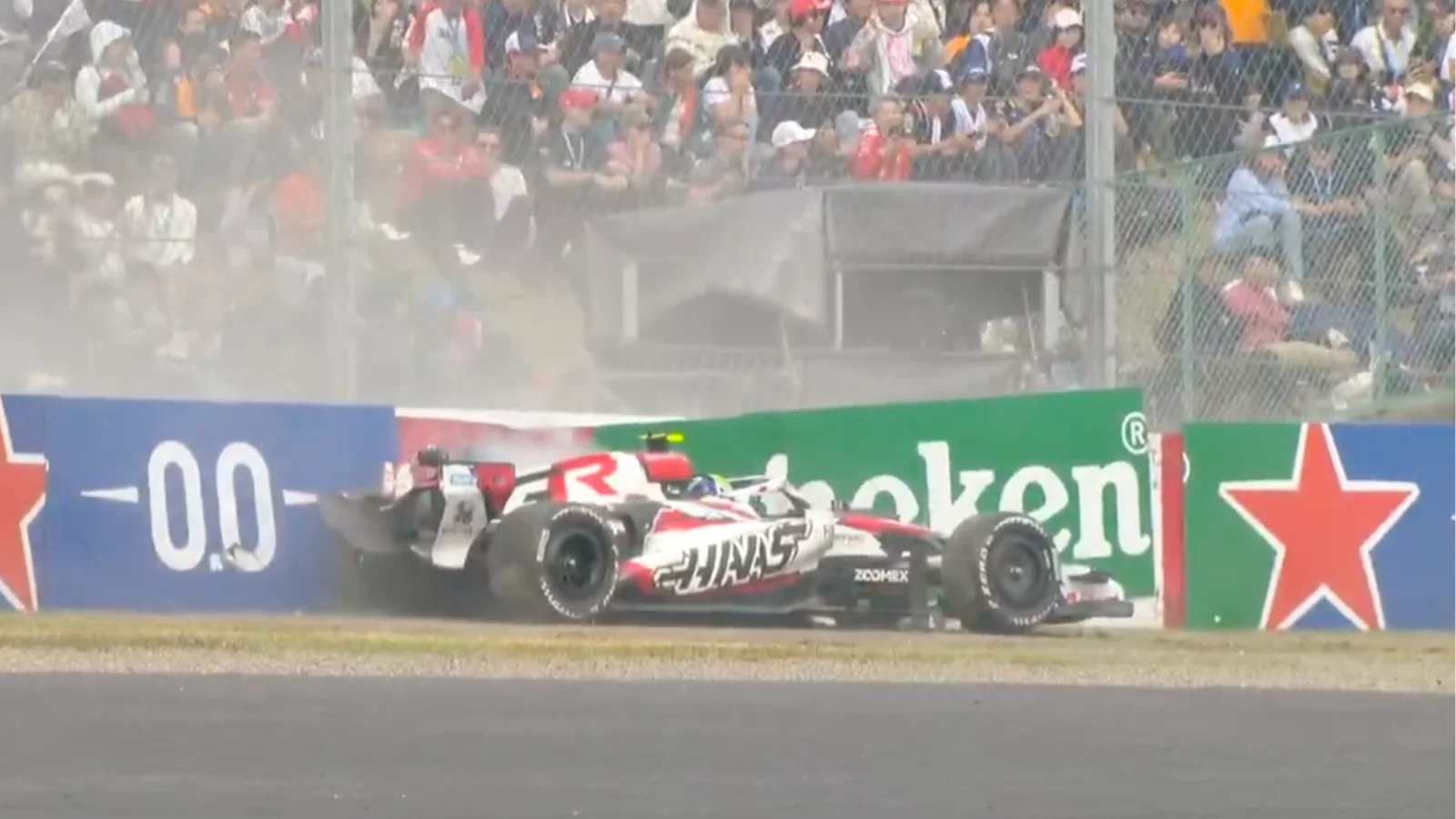
On paper, the 2026 Japanese GP should be remembered as Kimi Antonelli showcasing that he’s the real deal after his second consecutive victory… Instead, it will likely go down as one of the biggest examples of shameful propaganda and a cover-up that rivals a government scandal. All overshadowed by a horrifying crash for Oliver Bearman that drivers long predicted.
Since the Australian Grand Prix, just four weeks ago, we have all been told to give the new regulations a chance, to embrace the “new” racing, and seemingly gloss over the inherent flaws of these rules. Journalists and TV crews alike have given them the benefit of the doubt, but now, without question, an endgame might just have been reached after three races.
The attempt by the powers that be to control the narrative has become, to use a Gen Z term, “sus”. What started as a widely ridiculed move to run Formula 1 cars with a half ICE, half electric powertrain, has become a downright ridiculous experiment. The fact that it has now transcended to such levels that have, at last, been acknowledged by the powers that be as a cause for widespread concern, is a sad consolation prize.
Oliver Bearman’s terrifying crash at Spoon could well be the culmination of a desperate attempt to save face from those in charge of the sport and to protect the commercial interests at the expense of driver safety.
Now, after the failure to protect a happy, smiley, ‘it’s all ok, nothing to see here’ image, Formula 1 is facing a reckoning from drivers, fans and the media, and rightly so. That it was prepared to let a driver be severely injured or killed rather than admit the basic rules/formula premise was wrong, despite the warnings, is disgraceful.
The really sad thing? This has all happened before; almost 32 years ago, to be precise. But the drivers that triggered that change were not so lucky in their story, although the events of that time changed Formula 1 forever…
Failure to learn from history
The story started in 1989, cars were fast and exciting to watch; turbos may have been banned, but make no mistake, those cars were highly dangerous. Cockpit sides had started to get low to the point that drivers’ shoulders were visible, while the overall size of the cars had dramatically shrunk. But Formula 1 was still deemed safe, due to a streak of drivers walking away from accidents. That was, until that year’s San Marino GP.
Ferrari’s Gerhard Berger suffered a high-speed accident at the then flat-out Tamburello corner, his F640 hitting the concrete barriers side on and bursting into flames. Shock permeated the paddock, with commentator Murray Walker remarking on how the Austrian escaped only because of the safety features of the then-modern Formula 1 cars.
But Berger, and more importantly, his close friend Ayrton Senna spotted a disaster waiting to happen, Berger going as far as to say: “Ayrton, we have to change that f***ing wall, it’s too dangerous”. But nothing was done. As the 1990s started, the cars continued to get faster and faster, the cockpits becoming even lower, as well as moving to just inches off the ground.
Concerns surrounding safety got louder with each passing accident, including Erik Comas’ near-fatal accident in 1992, when Senna saved the Frenchman’s life at the Belgian Grand Prix after he was knocked unconscious following a crash at Blanchimont.
By 1993 driver aids were commonplace. Traction control, semi-automatic gearboxes, among other aids, assisted with the low ride height, and brought the monster cars, now powered by ferocious V8 and V10 engines [with the odd smattering of V12s], under control. But this changed dramatically for the ill-fated 1994 season.
The driver aids were suddenly banned, meaning the cars designed specifically with these in mind were no longer operating as they should. The impact on the driver experience was profound. Using passive springs, the cars became twitchy and nervous under braking.
“I have a very negative feeling about driving the car and driving it on the limit…,” Senna commented at the time. “It’s going to be a season with lots of accidents, and I’ll risk saying that we’ll be lucky if something really serious doesn’t happen.”
These words would ring true just a few months later…
But the writing was already on the wall during preseason testing. Benetton’s JJ Lehto had a crash, fracturing vertebrae in his neck. Jean Alesi suffered a high-speed crash in a private test at Mugello between rounds one and two, injuring his neck. And yet, the cars continued to race, the powers that be turning a blind eye to the seriousness of the situation.
We all know what happened at the next round at Imola. Two drivers lost in two days, numerous other accidents, and a weekend forever etched into Formula 1 lore as a warning of turning a blind eye. Those in charge were forced to defend their course of action in the buildup to that tragic weekend, before urgent work started to slow the cars down.
All it took for rule makers to wake up to the situation and take their heads out of the sand of self-pride and commercial interest was two deaths in one event.
Fast forward 32 years, and the trends are remarkably similar. Drivers are warning that the 2026 cars are dangerous. Concerns have been brushed aside with a “we are gathering data” explanation, designed to distract and deter criticism. Well, we’ve now had a serious accident with Bearman’s crash, injuring the Briton, no fault of the driver or his colleague immediately in front of him.
The next similarity does not bear thinking about; time, it seems, has stood still once again.
Just how bad was the crash?
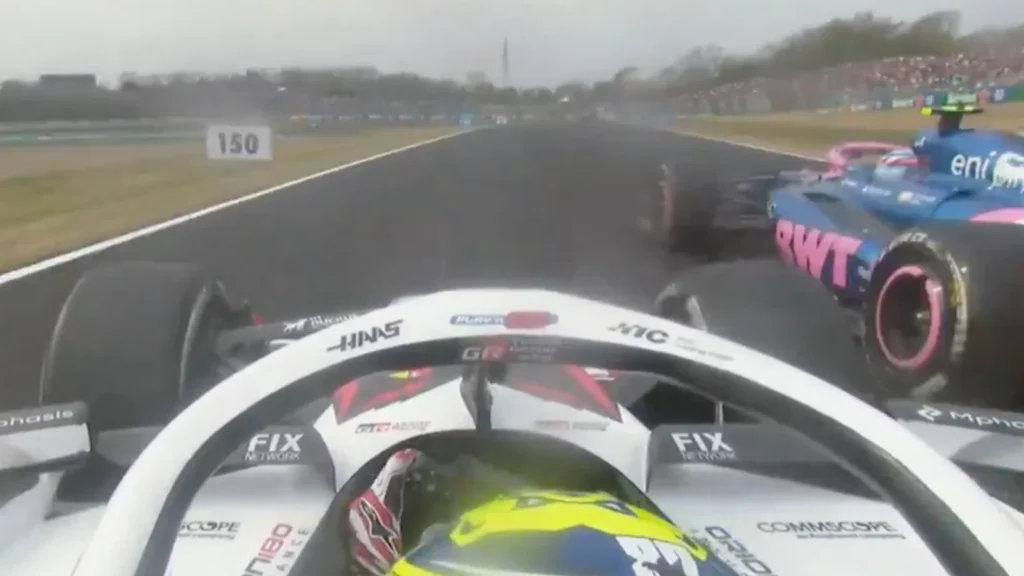
Needless to say, a Formula 1 driver should never be placed in a position where they must choose between hitting someone or crashing. Yet this entirely avoidable situation is exactly what Bearman faced in Japan. The more this accident is analysed, the more preposterous the circumstances surrounding it become.
Let’s start with the closing speed differential of the Haas to the Alpine. Bearman closed in on Colapinto at a vast rate of knots while doing speeds in excess of 160mph. Colapinto was slowing dramatically. That situation was a possible death sentence if the two cars had collided.
Colapinto, for his part, did absolutely nothing wrong. He was simply recharging energy through the corner, while Bearman was closing rapidly using his deployment. The reason for this is that the incident occurred in what has become known as a zero-kilowatt corner – a corner where harvesting is limited. Colapinto’s Alpine stopped delivering power, while Bearman was doing the opposite; he was in “Override Mode”, receiving a surge of power.
This left Bearman with no time to react whatsoever. He faced an impossible choice and picked the best out of a bad situation, one he should never have been placed in, and one that, without urgent changes, will be repeated. On a motorway, if you are unlucky enough to encounter a car travelling at a significantly slower speed, you dive out of the way, or slow down yourself. The one thing you do not do is accelerate.
Due to the ways these new power units are designed, this is the equivalent of what Bearman faced when bearing down on Colapinto. It is complete madness. It may be an exaggeration to say the accident could have killed Bearman, but it is not far off. That he walked away with nothing more than contusions on his knee is a miracle. How bad was the crash? It was bad. Very bad. The cause? To some, political and commercial interests over safety. Again.
Politics and censorship over common sense
How we got to the position leading up to Bearman’s crash is wholly unacceptable. The Japanese Grand Prix was not a normal race from a media perspective when examined with a microscope. It actually showcased the level of farce and deception that is being undertaken to hide just how bad these regulations are.
Take qualifying. A small change was made to energy management in qualifying to bring back the spectacle. Did it help? Not really. The same issues of not running at full power remained, reinforced by the mysterious absence of onboard footage of polesitter Kimi Antonelli going through 130R, usually a high-speed corner, or indeed, his full onboard lap. Formula 1 attempted to explain that a technical issue meant the lap could not be broadcast.
“Unfortunately, Kimi’s onboard camera had a technical issue partway through his lap, meaning we are unable to bring you the lap onboard in full,” read the FOM statement.
But eagle-eyed fans soon found the footage, adding fuel to an already burning dumpster fire, although the biggest clue of potential censorship came from the commentary box. The entire race had only positives coming from David Croft and Jenson Button, with praise for the new regulations coming almost every few minutes.
It almost seemed like they were bound to not say anything negative about the race. But the problem with that is that it can be seen through by a wider audience. Debate encourages discussion; propaganda is opaque. Perhaps more embarrassingly, the cast of the new Super Mario film was at Suzuka and got airtime to promote the movie at the same time the sport is being compared to Mario Kart; you couldn’t make this up…
The FIA, seemingly realising that the game was up in ignoring criticism, issued its statement, which, in reality, didn’t really say anything at all. It defended its actions and highlighted meetings in the coming weeks.
“Following the accident involving Oliver Bearman at the Japanese GP and the contribution of high closing speeds in the accident, the FIA would like to provide the following clarifications,” read the statement. “Since their introduction, the 2026 regulations have been the subject of ongoing discussions between the FIA, Teams, Power Unit Manufacturers, Drivers and FOM. By design, these regulations include a number of adjustable parameters, particularly in relation to energy management, which allow for optimisation based on real-world data.
“It has been the consistent position of all stakeholders that a structured review would take place after the opening phase of the season, to allow for sufficient data to be gathered and analysed. A number of meetings are therefore scheduled in April to assess the operation of the new regulations and to determine whether any refinements are required. Any potential adjustments, particularly those related to energy management, require careful simulation and detailed analysis.
“The FIA will continue to work in close and constructive collaboration with all stakeholders to ensure the best possible outcome for the sport and safety will always remain a core element of the FIA’s mission. At this stage, any speculation regarding the nature of potential changes would be premature. Further updates will be communicated in due course.”
The endgame has been reached with the new regulations. Controlling the narrative has failed. Ignoring criticism has failed. Attempting to blindly induce a following has failed. A driver has had a serious accident, the sport is being mocked by its drivers and ridiculed by some circles of its fanbase, with concerns that safety is being overlooked.
32 years on from one of the worst examples of sporting negligence, history is on the verge of repeating itself. This must not happen. But now the narrative has shifted, change has to come and will come. It’s about time!