
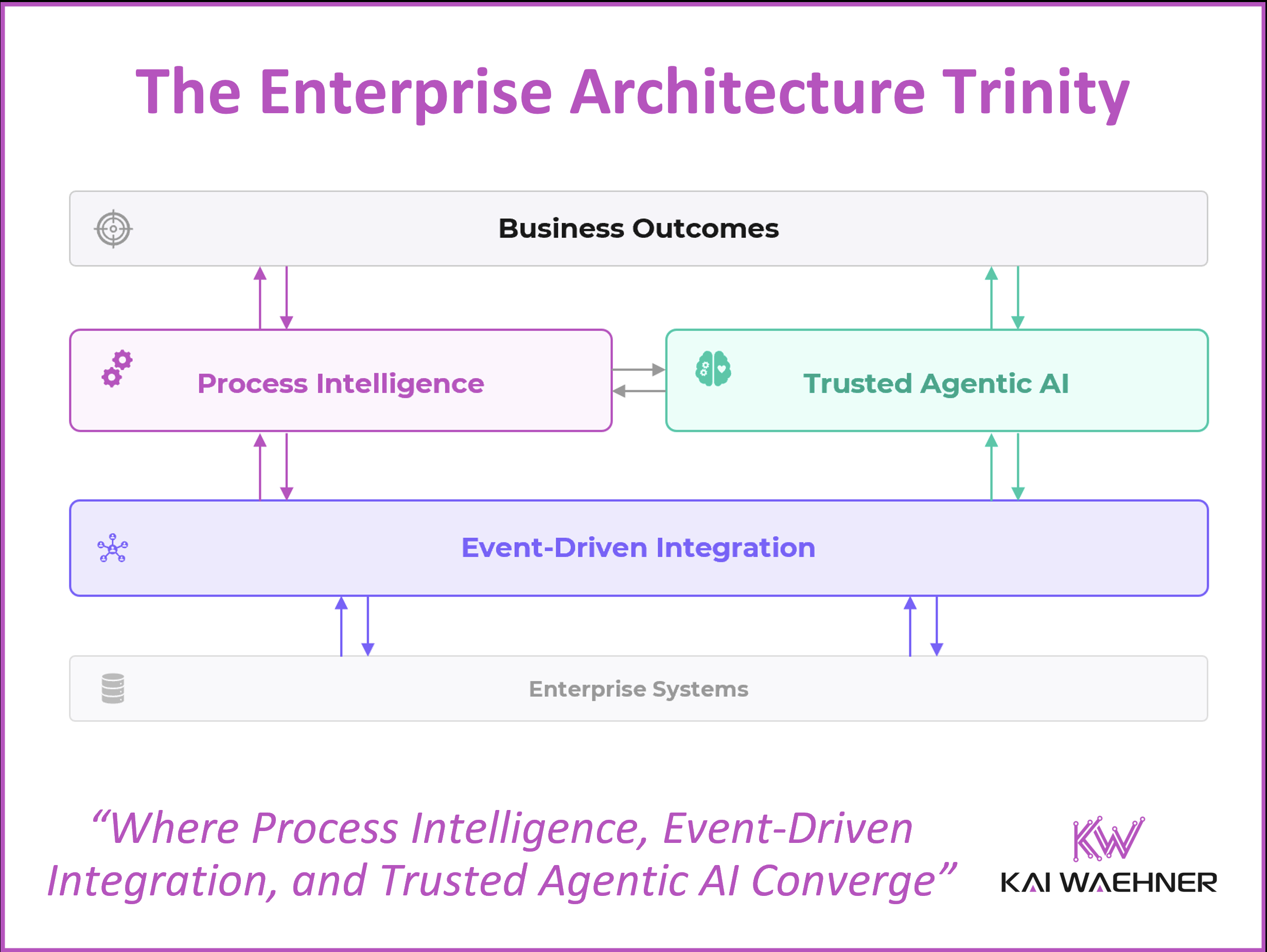
Most enterprises have all three pieces. A process automation layer. A data integration strategy. An AI initiative. Yet critical decisions still fail, agents still hallucinate, and workflows still run on yesterday’s data. The investments exist. The convergence does not. The problem is not a lack of technology. It is a lack of architectural thinking. Process intelligence, event-driven integration, and trusted agentic AI are being built in isolation, by different teams, with different goals, on different timelines. The result is an architecture that looks complete on a slide and breaks in production. This post argues that these three capabilities form a Trinity. They only deliver their full value when they are designed to work together.
Stay informed about the latest thinking on data integration, process intelligence, and trusted agentic AI by subscribing to my newsletter and following me on LinkedIn or X. And download my free book, The Ultimate Data Streaming Guide, a practical resource covering data streaming use cases, architectures, and real-world industry case studies.
Three Capabilities, One Architectural Commitment
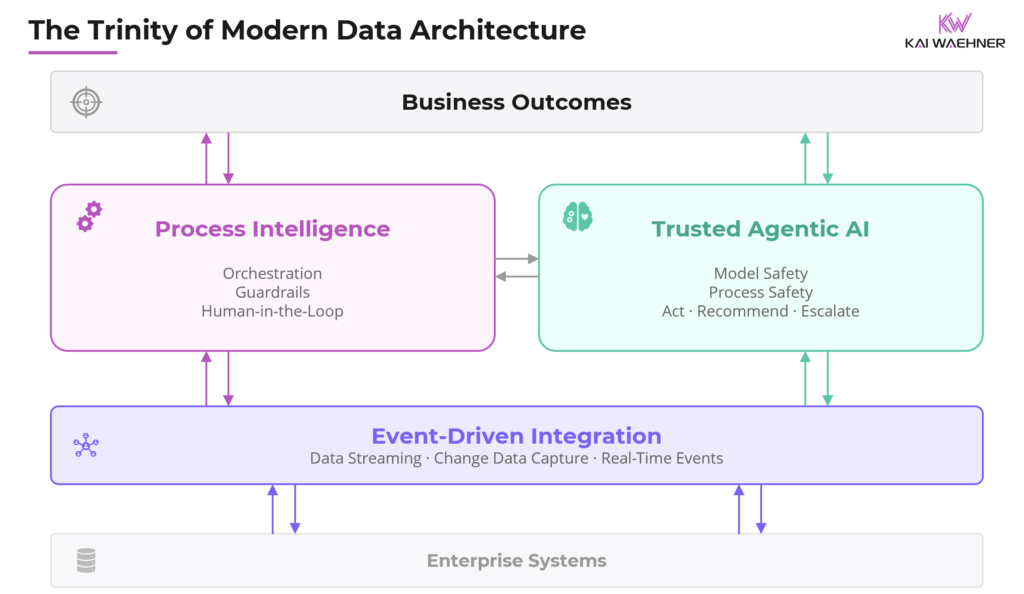
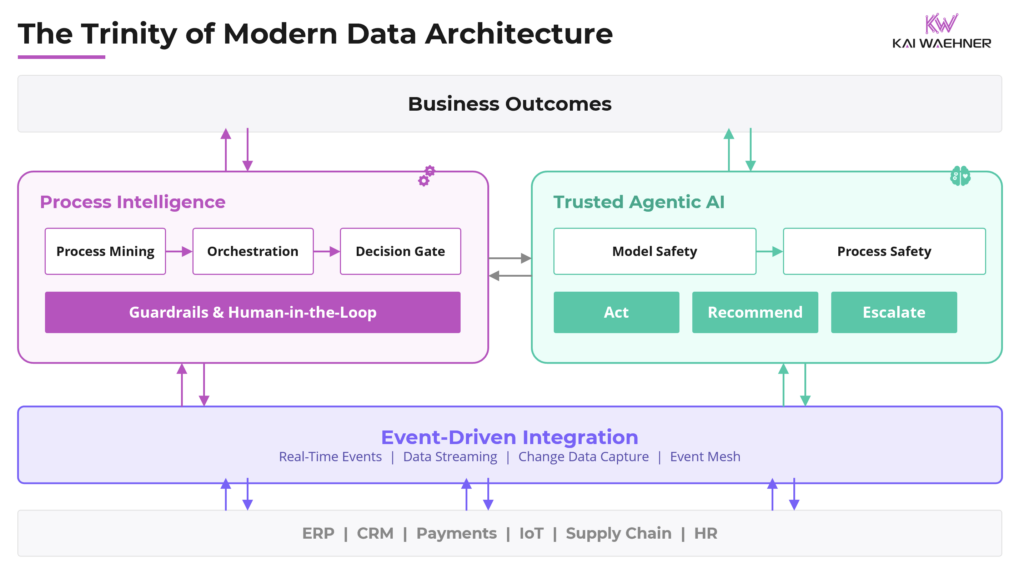
Process intelligence, event-driven integration, and trusted agentic AI each solve a real problem. Each one also creates new risks when it operates alone. The following architecture shows how the three layers connect into a single, converged system.
Process Intelligence: The Layer That Gives Agentic AI Its Boundaries
Process intelligence is the evolution of classic Business Process Management (BPM) into something adaptive, event-aware, and AI-ready. It is the layer where technology maps directly to business value. Every workflow connects to a concrete business outcome: a loan approved, a shipment rerouted, a fraud case resolved.
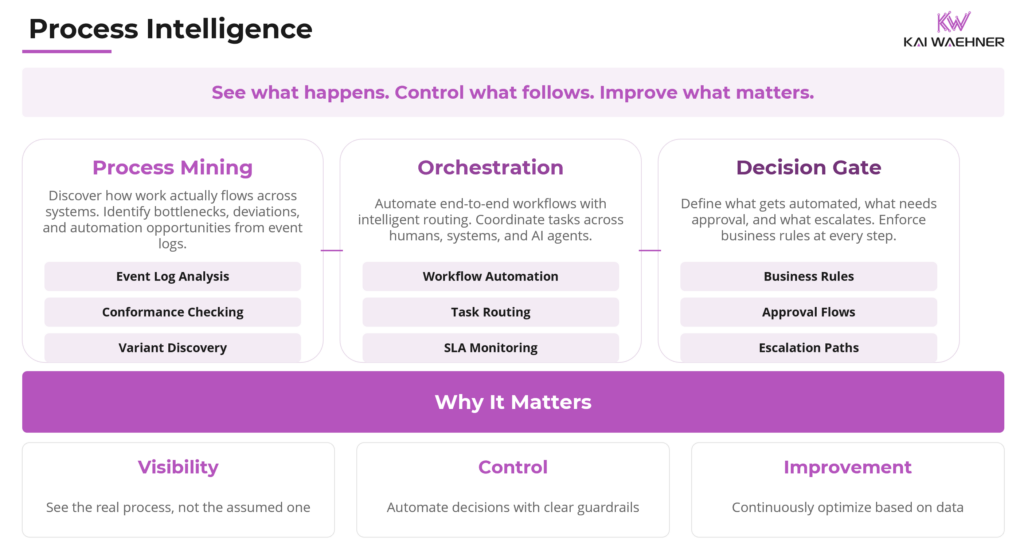
Process mining observes how business processes actually run, identifies where decisions fail, and surfaces where automation would deliver the most value. Vendors like Celonis have built entire platforms around this capability. Process orchestration executes workflows, enforces business rules, and produces the audit trails that compliance teams depend on. Camunda is a leading example. Agentic process orchestration goes one step further: it allows AI agents to participate directly in workflow execution, taking autonomous actions within defined boundaries while the process layer maintains control.
Automation is the business driver. Organizations adopt process intelligence to automate more, faster, with less manual intervention, while keeping humans in control of the decisions that matter. But agentic automation only works safely when the process layer defines the operational envelope: what the agent can decide alone, what requires human approval, and what must be escalated regardless of what the model recommends.
This is where guardrails live in practice. Not as theoretical constraints inside a model, but as concrete workflow gates that stop, route, or escalate before an action is executed. Process intelligence is what makes automation trustworthy at scale.
Event-Driven Integration: From Scheduled Batches to Live Events
Event-driven integration is the architectural principle that connects operational systems continuously, based on what happens rather than when a scheduler runs. An event from a payment system, a sensor, a CRM update, or a logistics platform travels in real time to whatever system needs to act on it.
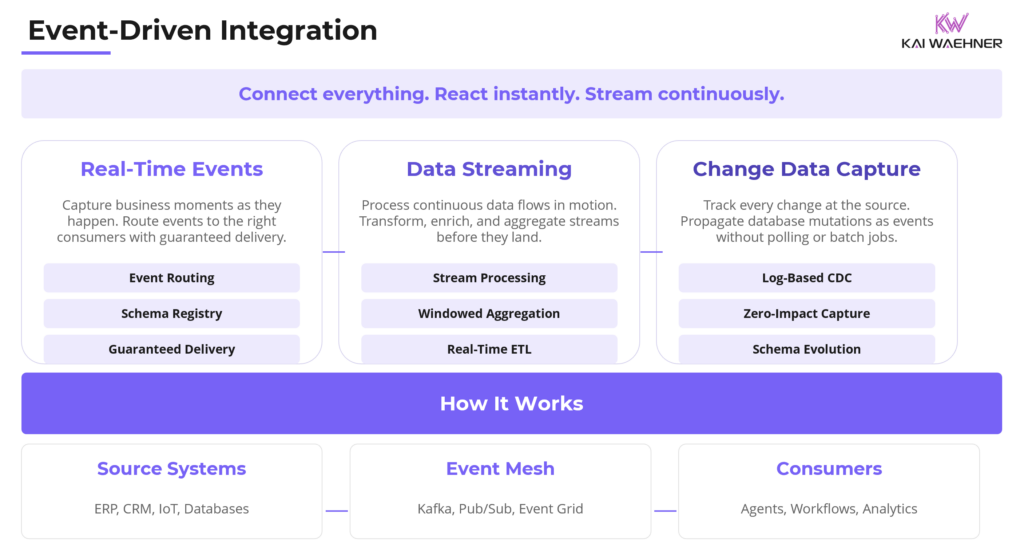
Apache Kafka has become the de facto standard for event-driven integration at enterprise scale. Other options exist, including cloud-native messaging services and specialized event brokers, but Kafka is where the ecosystem has converged. What matters in any case is the commitment to events as the primary integration primitive to ensure true decoupling, scalability, and data consistency across real-time and batch systems.
The market reflects this shift. Process orchestration engines have rearchitected their core runtimes to be event-driven from the ground up, built for real-time throughput and horizontal scale. Camunda’s Zeebe is a leading example. Zeebe is itself an event-driven engine, which means organizations can implement event-driven workflows and lightweight integration patterns without Kafka as a prerequisite. For broader enterprise integration at scale, Apache Kafka complements the process orchestration layer, connecting the full landscape of operational systems, SaaS platforms, and data infrastructure into a single event-driven backbone.
Core business applications and SaaS platforms followed. SAP S/4HANA, Salesforce CRM, and ServiceNow have all added eventing interfaces and Change Data Capture (CDC) capabilities alongside their traditional API-based request-response integrations. The direction is clear: even systems that were designed around synchronous HTTP are moving toward event-driven models.
Process engines receive live state. Agentic AI systems receive current context. Decisions are made on what is actually happening, not on what happened last night.
Trusted Agentic AI: Safety Is an Architecture, Not a Setting
Trusted agentic AI is an architectural property, not a product feature. Agentic AI systems do not just generate responses. They take actions, trigger workflows, and interact with operational systems. That autonomy is what makes trust and safety an architectural concern rather than a model configuration. It operates at two levels. The first is the model itself. Vendors like Anthropic and Mistral build alignment, constitutional constraints, and refusal behaviors directly into their models. This provides a baseline. The second level is the process intelligence layer. A well-aligned model can still be manipulated through prompt injection or adversarial inputs. It can still hallucinate when the surrounding data is stale or incomplete.
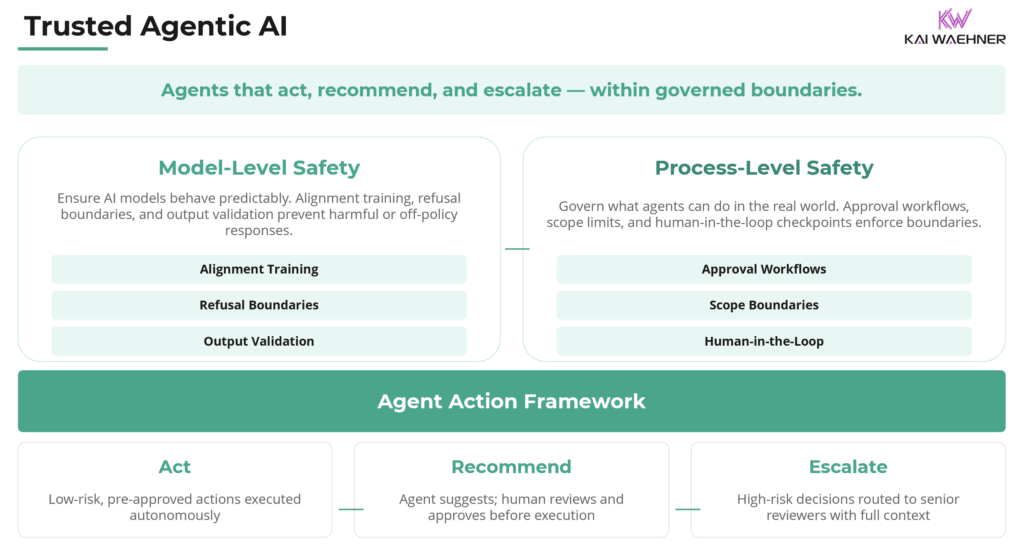
Model-level safety defines how the agent behaves within a given context. Process-level safety defines the operational envelope: what the agent is allowed to do, which decisions require human approval, and what the fallback is when the agent is wrong. Both levels are necessary. Neither is sufficient alone.
When the Trinity Splits: Three Agentic AI Failure Scenarios
Three short failure scenarios make this concrete.
Process intelligence without event-driven integration. A workflow engine automates a credit decision. The data feeding it comes from a nightly batch export. The process runs correctly. The decision is based on a customer’s financial state from 18 hours ago. The automation worked. The outcome was wrong.
Event-driven integration without process intelligence. Transaction data flows in real time across systems. An agentic AI system detects an anomaly and flags a potential fraud case. But there is no process intelligence layer defining what happens next. There is no approval gate, no escalation path, no audit trail. The agent acts, or it does not, and nobody can explain which or why.
Trusted agentic AI without the other two. The agent is aligned, tested, and governed at the model level. But it receives context from a batch pipeline, so its reasoning is grounded in outdated information. And there is no process intelligence layer to enforce boundaries on what it is allowed to do next. The agent behaves well in the lab. It causes problems in production.
The Trinity in Action: Process Intelligence and Agentic AI Across Three Industries
The following three scenarios show this architectural model working across industries. Each one is different. The pattern is the same: an event triggers a process, an agentic AI system acts within it, and process intelligence defines the boundary between automation and human control.
Financial services. A transaction event triggers an agentic AI fraud risk assessment in real time. The risk score flows into a case management workflow. Below a defined threshold, the process is automated. Above it, the process intelligence layer routes the case to a human analyst before any account action is taken. The guardrail is not inside the model. It is inside the process.
Healthcare. A patient monitoring system emits a deterioration signal. The event reaches a care pathway engine, which initiates the appropriate clinical workflow. An agentic AI system recommends an intervention. The process intelligence layer requires clinician confirmation before that recommendation becomes an order. The agent informs. The human decides. The process enforces that boundary every time.
Supply chain. A supplier sends a disruption signal. The event reaches the process engine before the procurement team opens their inbox. An agentic AI system analyzes inventory, evaluates alternative suppliers, and proposes rerouting options. The process intelligence layer defines which decisions the agent can execute autonomously and which require sign-off. Speed comes from the event-driven layer. Governance comes from process intelligence. Trust comes from both working together.
Build the Trinity, Not the Parts
This Trinity is not a new product category. It is a way of thinking about a converged architecture that most enterprises have not yet adopted.
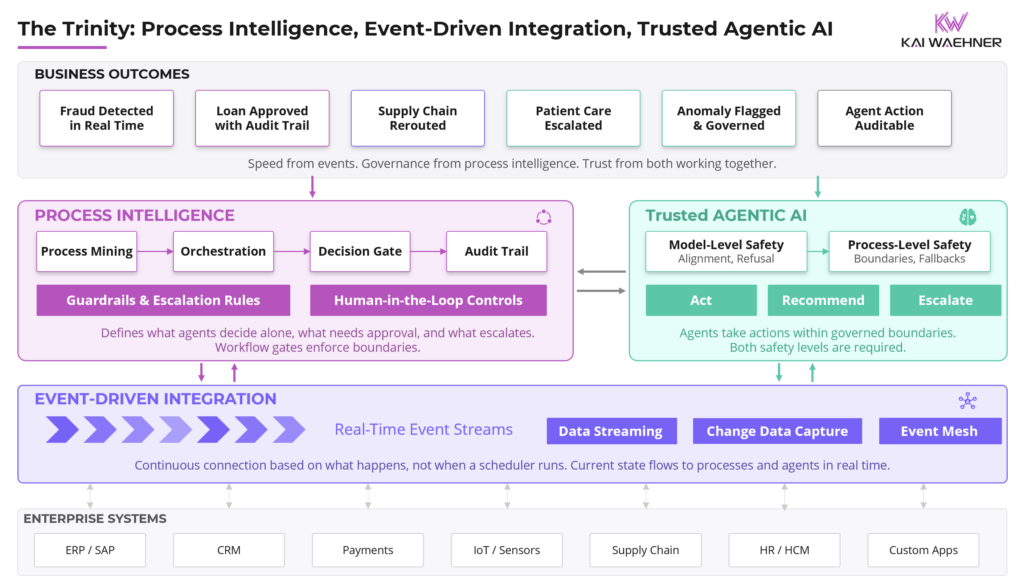
Event-driven integration ensures that every process and every agentic AI system works on current reality. Process intelligence ensures that automation stays within governed, auditable boundaries. Trusted agentic AI ensures that agents behave reliably within the context they are given, and that the process intelligence layer catches what the agent cannot.
The following architecture maps the complete picture across all three layers:
Organizations that invest in all three separately will continue to get the results they are getting today. Organizations that design them to converge will build something qualitatively different: infrastructure that moves fast, governs well, and earns the trust of the business.
The technology exists. The architectural commitment is what is missing.
Stay informed about the latest thinking on data integration, process intelligence, and trusted agentic AI by subscribing to my newsletter and following me on LinkedIn or X. And download my free book, The Ultimate Data Streaming Guide, a practical resource covering data streaming use cases, architectures, and real-world industry case studies.