

He added he’s always preferred blades with soft inserts, but he’s open to change. He just hasn’t.
In some ways, that explains the difference between blade and mallet players. Aberg doesn’t refuse to play a mallet; he just simply sees keeping what he’s known as his best bet.
Scottie Scheffler and Rory McIlroy have made some of the highest-profile mallet switches over the last few years and both did so because they acknowledged it helped their games.
But McIlroy explained this week that he still likes to practice with blades.
“I’ve made enough bad strokes with the Spider where the ball still went in the hole from inside six feet that, yeah, it’s a lot more forgiving,” he said Wednesday. “I practice with a blade at home because I think when you practice with a blade a little bit and then you go back to the Spider, it feels just that little bit easier.”
Aberg may have caught on to the idea. He was spotted testing a new prototype Scotty Cameron mallet this week.
Talking putter grips with the GOAT
Something about Tiger Woods roaming around a PGA Tour event just feels right, and he’s been front and center this week as the Genesis Invitational’s host.
And something we’ve seen constantly from Woods this year at the TGL, while he recovers from back and ankle surgeries, is he seems thoroughly fascinated by other players’ gear.
On Wednesday, he dropped in to Collin Morikawa’s practice round to talk shop with last week’s winner and check out what he has in the bag.
It shouldn’t be surprising that Woods was drawn to Morikawa’s MG5 lob wedge because the World No. 5 plays Woods’ TW-grind, something Woods hasn’t yet had the chance to do in competition with the MG5.
But the more interesting banter came when Morikawa was talking about his new TaylorMade Spider Tour X putter with a flow neck. Morikawa was explaining how the toe hang of the putter allowed him to feel a release through the stroke, something Woods has always been an advocate of.
“So this putter actually feels good because it swings,” Morikawa said. “A little toe hang, but it’s a mallet so it doesn’t open as much for me going back, but then it closes, which is what I need.”
“I love that,” Woods replied.
Morikawa continued explaining that if a putter opens too much, then he struggles to square the face back at impact.
That’s when Woods chimed in with a thought on-brand with his ethos of putting.
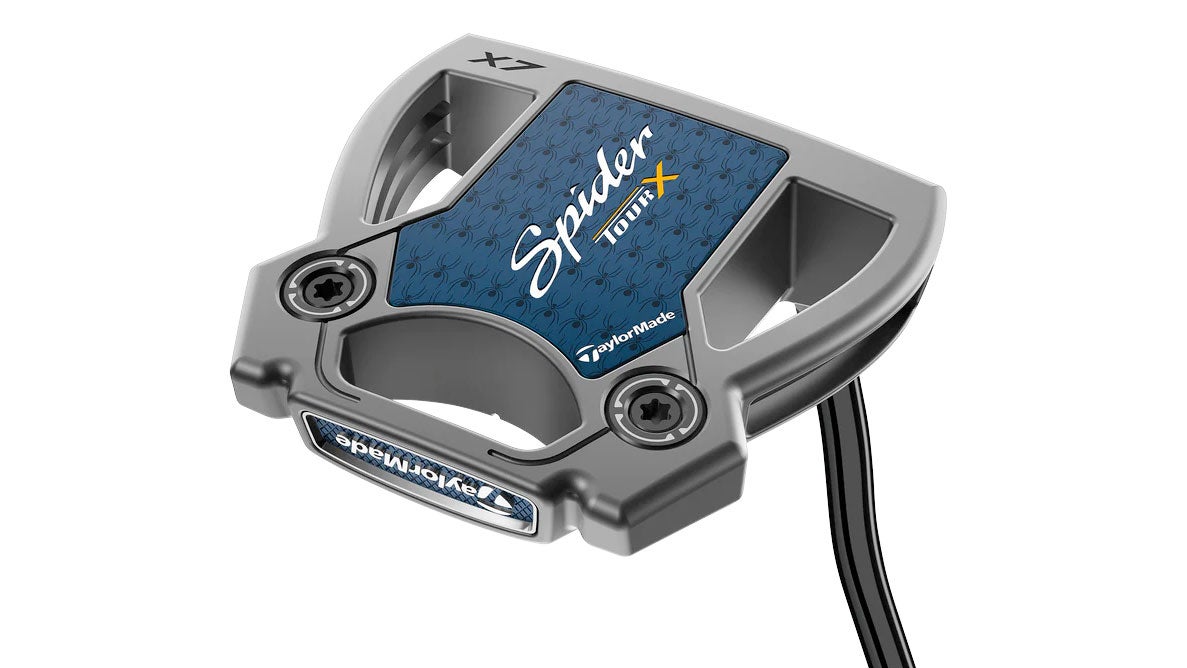
TaylorMade Spider Tour X Custom Putter
TRUE PATH ALIGNMENT The patented alignment system provides visual clarity and helps golfers better envision the line to the hole. WHITE TPU PURE ROLL INSERT Made from a combination of Surlyn and aluminum, the white TPU Pure Roll insert creates a softer feel. Grooves are angled at 45° to encourage optimal forward roll as well as better sound, feel and overall roll characteristics. The white insert also creates better symmetry with the white True Path alignment. THIN WALL UNDERCUT CONSTRUCTION We’ve engineered a super stable structure by removing excess weight to create high MOI and legendary Spider performance.
ALSO AVAILABLE AT: PGA Tour Superstore, TaylorMade
“It’s hard to shut it with that big of a grip, though,” Woods said.
On almost all of his putters, Morikawa had been using an oversized SuperStroke Zenergy Tour 2.0 putter grip, seemingly to take more of his hands out of the stroke.
Woods has always been adamant about keeping the right-hand release active through the stroke. On his putter, he almost always played a slim Ping PP58 putter grip. When he felt he was getting too handsy in the stroke, he would switch to a slightly larger Lamkin pistol grip, but it would still be considered small by modern standards.
It’s counterintuitive to a lot of modern conventions about putting, but it’s also hard to argue with Woods’ results.
But with Morikawa’s new putter, he uses a Golf Pride Tour Tradition, more traditional slim pistol grip. That earned the 15-time major champ’s approval.
“There ya go,” Woods said, smiling and nodding.
Check this out
This section is dedicated to cool photos we’ve snapped recently on Tour, but haven’t had a reason to share yet. For this week, check out Aldrich Potgieter’s Scotty Cameron 009M putter as he gets in contention this weekend at Riviera.
;)
Jack Hirsh/GOLF
Odds and Ends
Some other gear changes and notes we’re tracking this week.
Both Min Woo Lee and Max Greyserman traded in their Elyte Mini drivers for the new Quantum Mini driver, which launched last week on the PGA Tour. … Wyndham Clark is enjoying free agency because he just made a change to his fourth different driver of the season with a new TaylorMade Qi4D 10.5 and Project X’s new Titan 70 TX shaft. … Max Homa moved from Cobra OPTM LS-K driver to the OPTM X with a lighter Fujikura Ventus Blue+ 6-X shaft . … While Aaron Rai recently went back to his M6 driver, Jason Day and Justin Rose are ditching their M6 3-woods. Day is now in a Titleist GT1 3Tour 14.5 3-wood and Rose added two new Qi4D Tour 3- and 5-woods this week. Rose was in a Qi4D (core) 7-wood previously. … Lucas Glover added a new Ping G440 K 9.0 driver with a Graphite Design Tour AD-UB 6-TX shaft. Glover previously used a 440 Max 10.5 head, but it’s been an ongoing trend for 440 K players to loft down. … Jhonattan Vegas added a set of Mizuno JPX 923 Tour irons. … Tommy Fleetwood (24.0!!!), Jacob Bridgeman (16.5, 21.0), Pierceson Coody (15.0), Robert MacIntyre (21.0) and J.T. Poston (21.0) added new Qi4D core fairway woods.
3 things you should read/watch
A selection of GOLF content from the past week that may interest you.
Rickie Fowler changed nearly every club this year. He told us why | Bag Spy — In our newly relaunched Bag Spy series, we take a deep dive into the bag of Rickie Fowler, from his Scotty Cameron GoLo putter to his custom 3D-printed irons and a mini driver designed for him.

Cobra 3DP Tour Custom Irons
The KING 3D Printed TOUR irons utilize 3D printing technology to unlock a new realm of performance. Their one of a kind design features the most forgiving blade shape on the market, delivering the forgiveness that aspirational players need, and the sleek looks and soft feel that better players desire.
3D PRINTED STEEL CONSTRUCTION
Each iron is fully 3D printed from 316 stainless steel. 3D printing provides significant advantages over traditional methods of casting and forging, unlocking more design freedom and significant performance improvements.
FORGIVING PLAYERS BLADE SHAPE
3D printing has unlocked new design possibilities, enabling COBRA engineers to create a compact blade shape with the mass properties (high MOI, low CG) of a game improvement iron without sacrificing looks and soft feel that better players demand.
INTERNAL LATTICE STRUCTURE
COBRA took a muscle-back blade shape (similar in size and shape to the KING TOUR iron), and transformed the inside of the blade into a complex internal lattice structure to reduce the weight of the club by 33%. That discretionary weight was repositioned to optimize feel, CG position, and MOI.
View Product