
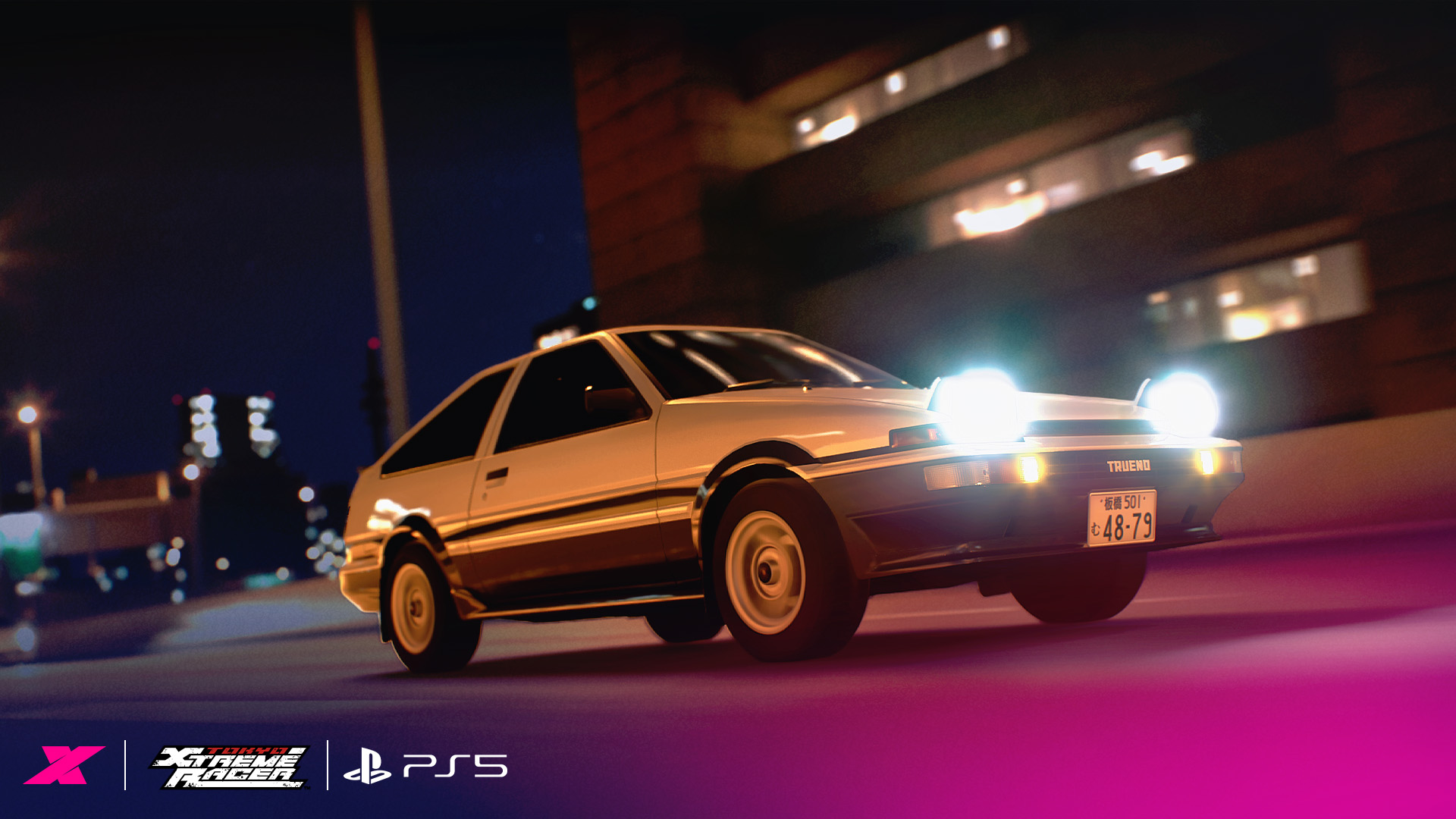
Tokyo Extreme Racer on PlayStation 5 is a significant racing game reunion. Gone for 20 years, excluding mobile versions, the inimitable Genki street-racing series has finally made its way back to Sony devices.
There are slick Unreal Engine graphics and an up-to-date car roster to boot.
Despite this being a new release, however, it remains resolutely steadfast in its 1990s-style approach, which is both a positive and a negative.
We must begin with a little history lesson and gameplay explainer, but only a small one. Once you’ve finished with this review, we recommend that you read our history of Tokyo Xtreme Racer article too.
There is a lineage stretching back to 1994, and several Shutokō Battle drift-themed games, before the first let’s say ‘mainline’ Tokyo Xtreme Racer arrived in 1999. There have been an almost innumerable number of sequels and spin-offs since then, last ‘properly’ appearing on Xbox 360 with Shutokō Battle X / Import Tuner Challenge in 2006.
Excluding spin-offs and mobile apps, the major series entries largely follow the format of these originals.
This means you drive along Tokyo’s infamous Shuto Expressway. A humdrum route designed to make sure people get to work, the shops or martial arts class. By night, it gained notoriety as people began tuning cars and allegedly racing them along the metropolitan highway.
In this game series, you must find rival drivers, and upon doing so, flash your lights to start a race.
Although not a ‘normal’ race in a traditional sense. No, this is actually an SP battle, where each driver has an energy bar like in Tekken. Hitting your opponent – or more likely, opening up a gap ahead of them – reduces their bar. Likewise, they can do the same to you. Deplete your competitor’s bar to win.
Win some more, earn BP to unlock cars and perks, and CP (aka cash), to buy the cars and performance-enhancing parts.
Keep winning, keep exploring, and you find more racers, more battles and even bosses. The main goal is to find, and best, all of the racers and their encompassing teams.
Right, those are the basics. Here’s how it works in practice.
You start out in a slow car, and if you like your progress as equally glacial, then Tokyo Xtreme Racer is for you.
Flying in the face of today’s dwindling attention spans, if you pine for a relatively modest (in video game terms) Toyota GR Yaris, then get ready to play for over 20 hours.
There are no 2000-horsepower electric hypercars here. Instead, one of the later vehicles is a humble truck, and you have to really work at it to add it to your collection.
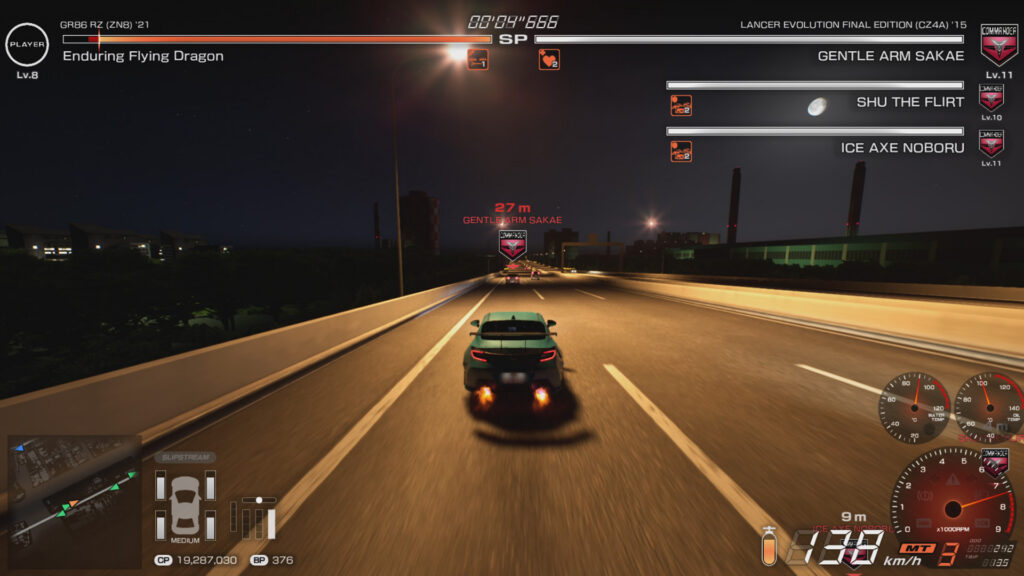
Upgrades, too, must be earned. Like really, earned. Blood, sweat and aching index fingers are required to take you to the quickest bosses. Progress isn’t always clear either – word of warning, we got caught at one point testing out the Honda Fit, before realising it wouldn’t be quick enough to take on some rivals.
Faced with potentially grinding the same events for eternity, we opted for a complete restart of the game instead.
This, for many, is actually the main appeal to Tokyo Xtreme Racer. You may require notepads and Reddit threads to figure out your path ahead.
For instance, if you take a contemporary rival street racing game, to add nitrous to your ride, you simply earn enough cash and purchase it.
Here, it’s not so simple.
- First, earn enough BP to unlock tuning perks, in the correct order
- This requires unlocking the path with the Level 2 intake system
- But that alone isn’t enough, as nitro is still locked
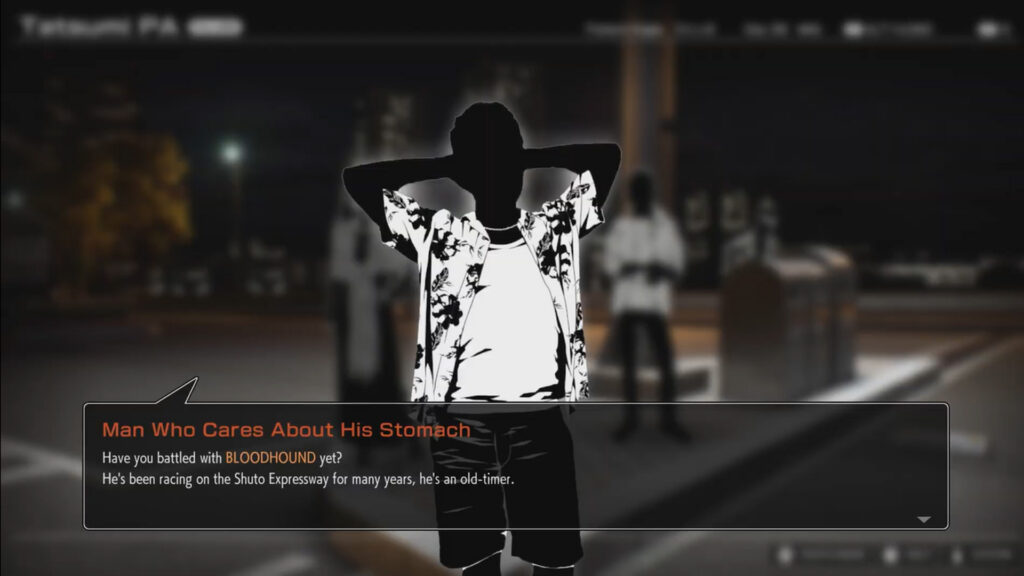
- You must defeat a racer with the name of Bloodhound
- Where is this racer? Well, it’s a Wanderer
- Wanderers must be discovered, in many cases, by listening to conversations in Parking Lots
- Then, when they appear on the map, you must defeat them, which is no easy task
- Once done, then go back, unlock nitrous with BP
- THEN buy it with CP to finally add it to your car
So you see, that can be deeply frustrating for those who have grown up in this instant-gratification age of music streaming, Instagram algorithms and Snapchat stories.
But for those looking for a nuanced experience they can sink their teeth into, there’s also nothing else quite like it.
This is the very definition of a ‘Marmite’ experience. You’ll hate it or adore it. Or, just snigger at the overtly and deliberately silly nomenclature.
You don’t enter the track, but rather “Depart”. No, it’s not ‘buy car’ but ‘decide’. A rival has a fake car sponsor of “No Soda, No Life”. Another with the name “Shu the Flirt” or “Man who cares about his stomach”. These are all franchise lore, and as the years progress, they seem more behind the times than ever.
Again, though, for some, this is the intrinsic appeal. It’s charming. There’s also no always-online connection requirement. Leaderboards. Season Passes. Driver avatar customisation. Unlockable emotes. Seasonal challenges.
In many ways, it’s better for it too. Like when games used to come on a disc, complete, this is a full racing game, laser-focused on its primary goal with no bloat.
Yet, once you’re through the initial stages, a larger area to race within wouldn’t go amiss, especially considering its potentially gargantuan playthrough time. The SP battles are relatively basic and can get repetitive, although generally they are so short that you stack a few back-to-back, return to the garage, unlock some items, tweak your vehicle and then go again.
This process does break up the action, and later, there are battles against a number of opponents at the same time. There’s also the option of ‘additional rules’, which sees the return of managing water and oil temperatures, and for some cars, turbo temps too.
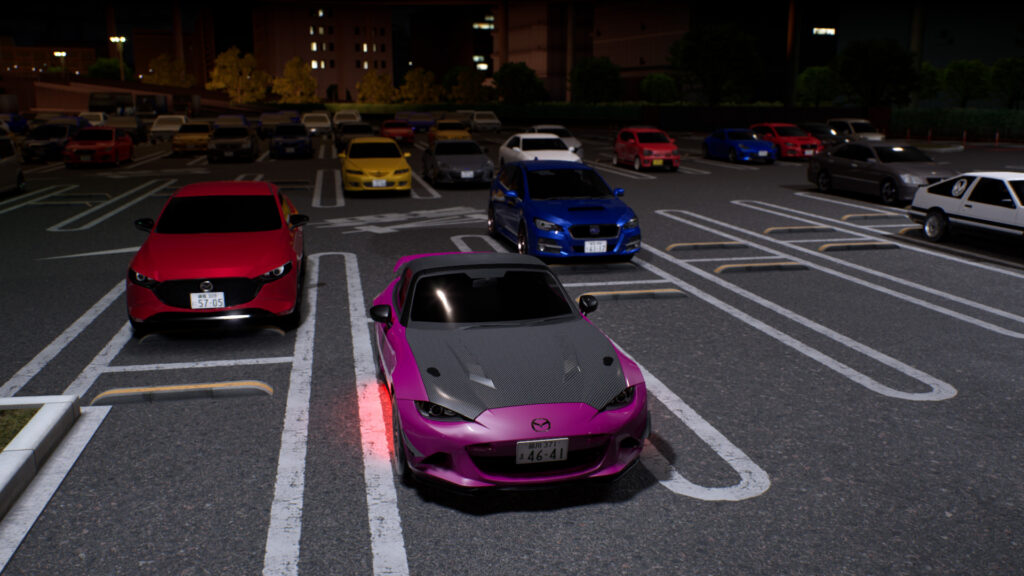
This is in addition to the tyre wear. Simply, these will become worn down, in a gameplay mechanic that forces you to visit the garage, or a Parking Lot, and thus creates the main loop.
That’s true also for the aforementioned vehicle temperatures, and this varies from car to car. A tuned MX-5 would overheat for us after two or three races, a Toyota GR86 would almost go all night, and an RX-7 would suffer from power loss if the turbo was too warm.
We just can’t help but feel the loading time from the expressway to the garage is too long, robbing momentum.
Compared to our specific PC equipment, the PS5 version does load a smidgen quicker, which helps, although we noticed a very brief stutter, or micro-pause, each time the console version saves, which is not present on our PC. Otherwise, the visual performance is near identical between the two platforms.
Whichever device you play on, the photo mode is capable of delivering some spectacular results. A Honda Fit (or Jazz) has never looked so good, or bad, depending on your customisation selection…
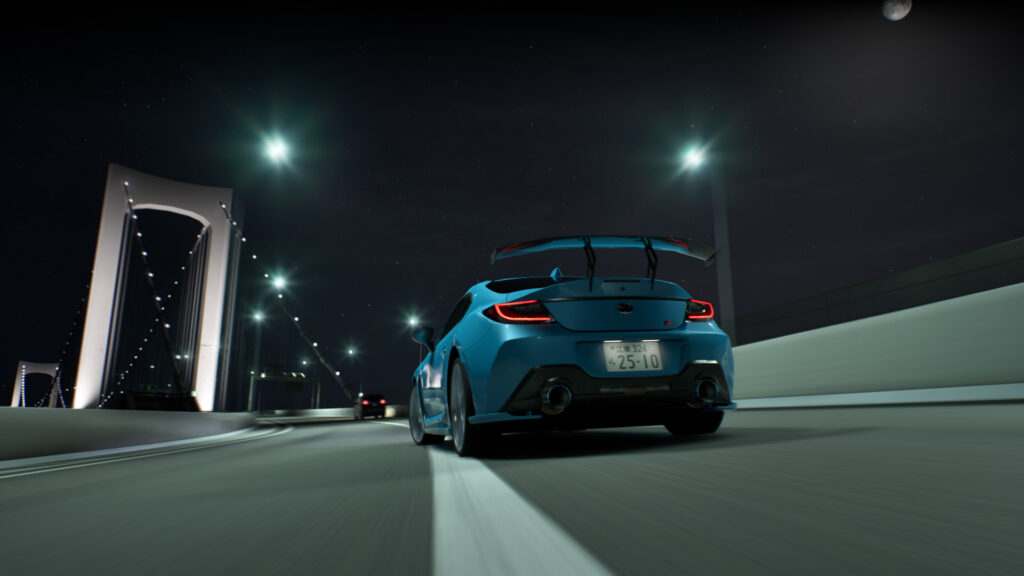
Once you’ve stopped snapping, you’ll notice the vehicle handling is always benign. Even with a highly tuned rear-wheel drive car, it’s an accessible game, but you won’t be powersliding about. There’s an inherent numbness to the responses, and the performance of the AI is either ridiculously rapid or generally a bit daft. But again, that’s part of the easy-going nature of Tokyo Xtreme Racer.
This is more about the finding, the unlocking, the grinding, the tuning and sometimes tense highway duels. When paired with esoteric car models, oddball characters and distinctly Japanese culture, the cognescenti will adore this new instalment.
Everyone else may end up a little baffled. Push through, and you will be rewarded, but it’s certainly not for everyone. Purposefully so.