
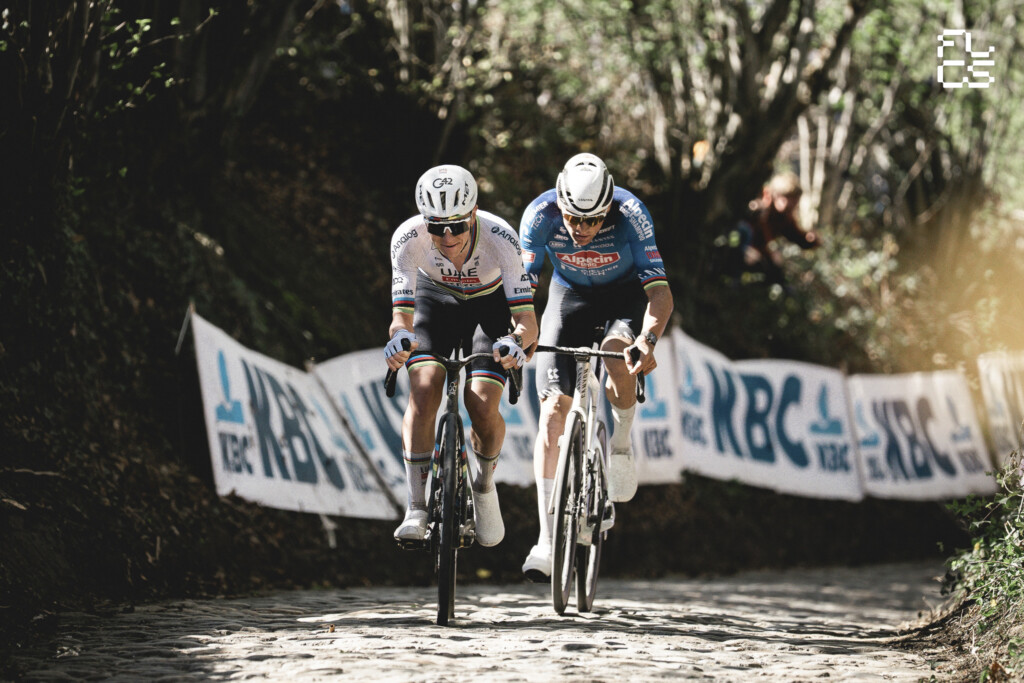
Tadej Pogačar claimed his third Tour of Flanders with a solo performance of frightening authority, dropping Mathieu van der Poel on the final Oude Kwaremont while Remco Evenepoel — losing teammates to abandonment and mechanical failure from the opening hour — announced himself on his Classic debut with a stirring third place.
ANTWERP, Belgium — The 110th Tour of Flanders began, as these things always do, with theater. The start podium presentations in Antwerp had drawn thousands into the Flemish morning, and when Red Bull–Bora–Hansgrohe arrived as a group of six before their seventh rider made his entrance alone, the crowd understood what was being communicated. Remco Evenepoel — world champion, Olympic champion, Grand Tour winner — walked into his first Tour of Flanders to a wall of noise. He wore the expression of a man who has been waiting a long time for a particular appointment.
“Nervous? Not really,” he told the microphones. “Healthy tension.” It was a careful formulation — the kind of answer a man gives when he knows the question behind the question. Earlier that morning he had offered something more revealing: he was approaching the day, he said, like a child waiting for Christmas. “Healthy excitement.” The Tour of Flanders was the one Monument that had always been withheld from him, the palmarès entry that would confirm what many already suspected. He had ridden into Antwerp not merely as a participant but as a threat. The race, he suggested, could be an early opener.
Mathieu van der Poel arrived with his father Adrie, as he sometimes does on the days that matter most. The Alpecin–Premier Tech leader holds the Tour of Flanders record jointly at three victories; a fourth would put him alone at the top of the all‑time list. “I feel ready,” he said. “Hopefully I’ll have an exceptional day and can mix it up for the win.” His team manager Christophe Roodhooft, asked about Red Bull’s theatrical announcement of Evenepoel’s participation, kept his powder dry: “We would never have announced it that way. They’ll have had their reasons.”
UAE Team Emirates–XRG appeared with Tadej Pogačar and Florian Vermeersch walking together — the two had spent recent weeks reconnoitring the Flemish roads in preparation, a detail that had not gone unnoticed in the peloton. Asked about the apparent bromance, Pogačar laughed and said it was complicated, before settling into something more sincere: he thought this was the most beautiful day of the year. He had won here in 2022 and 2024, and his domestique had already drawn his own lines. “The form has been super in recent races,” Vermeersch said. “My plan is to stay with Tadej as long as possible, certainly through the second Kwaremont.”
Last to be presented was Visma–Lease a Bike, and when Wout van Aert emerged the roar exceeded anything the previous three had received. He was the clear sentimental favorite, the Belgian who has finished on the wrong side of this podium too many times. “Anticipating is always difficult in that very tough finale,” he said. “So the initial plan is to follow for as long as possible.” He had the look of a man who had rehearsed that answer until it no longer gave anything away.
Mayor Els van Doesburg fired the unofficial starting gun at 10:03. With Evenepoel, Pogačar, Van Aert, Mads Pedersen, and Van der Poel on the front row, the race was underway. It lasted approximately one second before Rui Oliveira, one of Pogačar’s UAE teammates, went down in the neutral zone after clipping a rear wheel and tumbling into the barriers. He continued, but the tone had been set. Through the heart of Antwerp, the peloton rolled in procession along the De Meir, and in the Konijnenpijp tunnel that leads out of the city, riders availed themselves en masse of a comfort stop. Then the road opened up, the flag dropped for real, and the racing began.
THE BREAKAWAY
The fight for the early break extended for more than 20 kilometers, through the outskirts of Antwerp and south toward Temse, before a group of 13 finally opened a gap that UAE was prepared to honor. Burgos–BH and Team Flanders–Baloise had been the most aggressive from the opening kilometers — Burgos making their Tour of Flanders debut and determined to announce themselves — and when the break finally went, it contained three riders making history: Eric Antonio Fagúndez of Uruguay, César Macías of Mexico, and Jambaljamts Sainbayar of Mongolia, each the first representative of his country ever to start the race. With Silvan Dillier, Kamil Gradek, Luke Lamperti, Connor Swift, Luca Van Boven, Dries De Pooter, Julius van den Berg, Edoardo Zamperini, Frederik Frison, Victor Vercouillie, and Hartthijs de Vries completing the group, the escape totaled 13 riders from 11 teams.
It was a break with more credibility than most. Lamperti had been among the most consistent riders of the Flemish spring — 10th at the Omloop, 9th at Kuurne, 9th in Brugge — and Swift had been in the Flanders breakaway the previous year. Vercouillie was in the move for the second year running, the Flanders–Baloise rider driven by something beyond pure racing: his father was battling bowel cancer. Van Boven felt the road differently too — he was born in Zottegem, the East Flemish city the route passes through in its early kilometers. Today’s edition was one of the five longest Tours of Flanders ever run at 278.2 km; the 13 leaders had plenty of time to contemplate that as their advantage climbed past five minutes.
Mathieu van der Poel was not pleased to see Dillier go. The big Swiss rider had been earmarked as a possible tempo‑setter for Alpecin in the peloton; instead he was up the road. In Dillier’s absence, UAE deployed Mikkel Bjerg for the donkey work, and the Velon power data told the story of the early race with unsparing clarity: while Pogačar sat in the belly of the group at a modest 210 watts, Bjerg was already putting out 350 at the front. That differential would only grow. By the time the first Kwaremont arrived, Bjerg had averaged 360 watts across more than two hours of pacemaking — this from a rider back in competition for only a week after breaking his hand in the Tour Down Under’s infamous kangaroo crash. He had finished fourth here two years earlier; he knew precisely what the day was worth.
In the peloton, the first trouble arrived early for Evenepoel. His teammate Jarrad Drizners crashed into a team car and abandoned — one domestique down before the race had reached its first cobbles. It was the kind of subtraction that would compound, and it left Evenepoel exposed to whatever the climbs would demand of him later.
THE LEVEL CROSSING
What should have been a routine stretch of racing through Lede became one of the day’s defining subplots. The level‑crossing lights turned red just as the peloton arrived; the front section slipped through, but the barriers came down on the rest. Among those who made it through: Pogačar and Evenepoel. Among those who did not: Van der Poel. The regulations required the two groups to rejoin before resuming racing but did not require the escapees to wait, and the leaders collected the windfall accordingly — their advantage ballooning toward five and a half minutes while the officials deliberated. A UCI commissaire later stated the obvious: “The rules are clear. Riders must stop at a red light. Anyone who rides through it should be removed from the race.” No action was taken. The incident generated debate long after the peloton had moved on, but Bjerg had no time for it. He got back to work.
Rain came and went in the first half of the race — enough to put jackets on and take them off again, enough to worry about the Koppenberg later in the afternoon. The peloton reached the cobbled Lippenhovestraat and Paddestraat sectors with Bjerg having reclaimed roughly 30 seconds from the break’s advantage: a modest return for an enormous personal investment.
FIRST COBBLES
Jasper Stuyven had been candid before the start about how he intended to ride. “Many riders will try to anticipate,” he said. “My best results have come from following.” Matteo Trentin of Tudor had offered a more explicit read of the field: “This year I see three top favorites — Pogačar, Van Aert, and Van der Poel. Evenepoel is a dark horse. I’m hoping for a top 10.” Mads Pedersen, nursing an injury through the spring, had been honest about his own standing: he didn’t feel like one of the big favorites, he said, even as he called it the most beautiful race of the year. Christophe Laporte had been precise about the Visma hierarchy: his role was to be with Van Aert in the finale and help him if necessary, nothing more complicated than that.
The first Kwaremont came and went without drama, which was to be expected. Sainbayar crested the summit first in the breakaway, to the delight of packed crowds on either side of the narrow lane. On the climb, those same crowds chanted the names of Van Aert and Evenepoel — and both men were buried deep in the peloton, absorbing the noise and saving everything they had for later. Van Aert, curiously, made a detour to the team car just before the climb — a strange choice given the jostling for position — before rejoining. The break held more than five minutes. There would be time enough for hostilities later.
EIKENBERG, WOLVENBERG, AND MOLENBERG
The Eikenberg changed the texture of the race. Gianni Vermeersch suffered a puncture before the climb — bad timing for Evenepoel’s right‑hand man, though he would rejoin at the foot. Benoît Cosnefroy came down in the descent, reportedly in significant pain, removing another helper from Pogačar’s toolkit. Then came a second blow for Evenepoel’s Red Bull team: Hagenes suffered a mechanical failure and was forced to the back of the peloton, effectively removing him from the equation for the rest of the day. Having already lost Drizners to abandonment hours earlier, Evenepoel now entered the decisive kilometers of the race with a skeleton crew.
On the Wolvenberg, Groupama–FDJ opened the racing with a series of accelerations, Laporte moving up in response. Connor Swift crashed heavily on the cobbles after fumbling with his jersey and clipping a curb; he got up but had lost his place in the lead group. Cyclocross champion Toon Aerts, making his Tour of Flanders debut, flatted. Tomas Kopecky tried a solo move on the Kerkgate cobbles that went nowhere. Luxembourg champion Arthur Kluckers drifted too close to the road’s edge and nosedived into the grass, fortunately away from rather than into the peloton. Jonas Abrahamsen was forced into an emergency bike change. The race was coming apart at its edges in the way it always does — the steady attrition that precedes the real thing.
But the Molenberg is where it truly ignited.
Florian Vermeersch drove to the front on the Molenberg’s opening meters, UAE stringing the race out with a crosswind. Van Aert — dangerously far back, in part because Hagenes was no longer available to help him move up — clawed his way forward just in time. Sheffield bridged across. Van der Poel and Pedersen came with him. With 101 kilometers remaining, all the favorites were together in a single elite group. The peloton was over a minute down and no longer relevant to the outcome.
BERENDRIES AND VALKENBERG
After the Molenberg, the elite group — now approximately 28 strong after absorbing what remained of the breakaway — worked smoothly across the Berendries. Behind them, Vacek and Braet maintained a disciplined chase as a duo, neither able to bridge across; the peloton had already ceded the day and was racing for scraps. Sainbayar, who had spent hours at the front and crested the first Kwaremont to brief Mongolian glory, was passed and shed on the Berendries, his moment in the spotlight giving way to the heavy machinery.
A second rain shower caught the leaders before Berg Ten Houte — nobody had a jacket left. Then came more carnage: Iván García Cortina went down, and in the aftermath Alleno, Biermans, Wærenskjold, Corkery, and Welsford all abandoned. The day had already consumed half a dozen riders by the time it reached its decisive terrain. Belgian TV commentator José De Cauwer had called the break’s endurance correctly at the outset: “These men can last until the second time up the Oude Kwaremont — and perhaps even further.” He had been right, but only barely.
On the Valkenberg, Pogačar made a cautious flex out of the saddle, Evenepoel cool on his wheel before taking a turn at the front. Stuyven began to lose ground. The race was thinning to its essentials.
BERG TEN HOUTE
On Berg Ten Houte, the favorites’ group merged with what remained of the breakaway to form a 28‑rider front group. Frison and Dillier were the first casualties; Edoardo Zamperini, who had spent hours in the move, bravely tracked Pogačar and Evenepoel before the gap became irrecoverable. Pedersen and Van Aert rode at the back of the group, managing their reserves. The rain had given way to a fragile, cautious sunshine, though the roads remained slick.
On the Nieuwe Kruisberg, an image materialized that will outlast the race itself: Pogačar, Evenepoel, Van der Poel, and Van Aert in positions one, two, three, and four at the head of the front group — the four most consequential riders in modern one‑day racing, arranged in a line with 70 kilometers still to race. On the Hotond, Florian Vermeersch tried to slip away quietly with Swift and Rick Pluimers; Laporte chased them down immediately, unwilling to hand out free ground to anyone. Red Bull drove the pace for Evenepoel as the race wound toward the second Oude Kwaremont. The breakaway was finished, its survivors absorbed or dropped. With 60 kilometers to go, this was a race between four men.
OUDE KWAREMONT: SECOND PASSAGE
The second ascent of the Oude Kwaremont arrived with the kind of expectation that silences crowds just before it releases them. Van der Poel and Pogačar approached in the second row, Van Aert and Evenepoel just behind. Swift set the pace at the front.
Then Pogačar attacked.
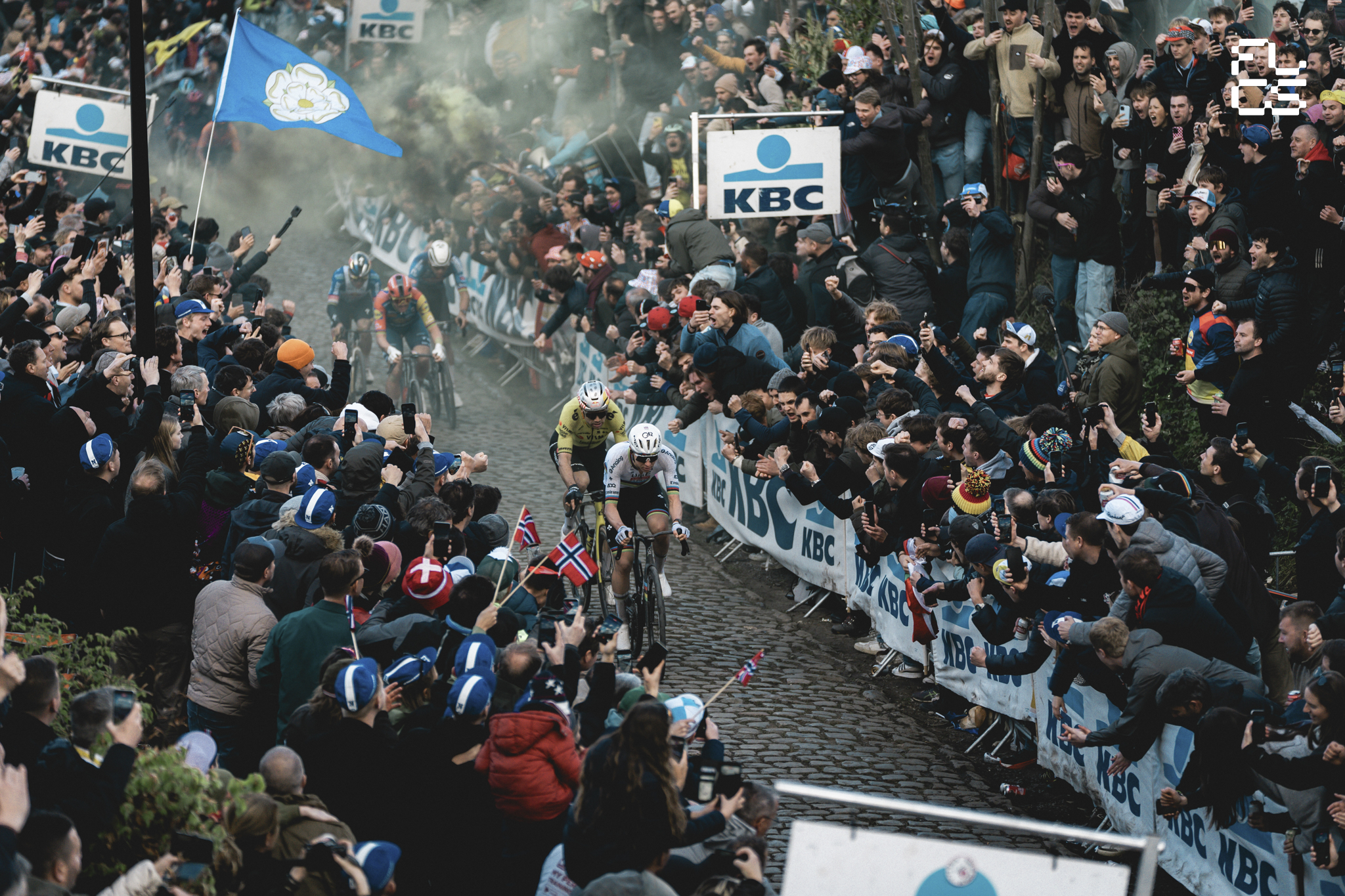
Van Aert jumped immediately to his wheel. Pedersen could not follow. Evenepoel came up. Van der Poel, caught out of position, launched a heroic chase and made contact as Pogačar drove toward the summit, Van Aert refusing to be shaken for most of the climb. But the last meters were too many; he cracked at the top, ceding to the three riders who would now contest the victory. He fought back to the trio on the asphalt beyond the summit, but Pogačar had already driven hard into the dip toward the Paterberg, and when Van Aert arrived at the rear of the three‑man group he was already spent.
PATERBERG: THREE BECOME TWO
Evenepoel led onto the Paterberg, but Pogačar was immediately beside him, fighting for the front, the pair side by side in the opening meters as if it were a sprint rather than a cobbled wall. Van der Poel took Pogačar’s wheel. Evenepoel came over the top a few lengths back with five seconds to make up.
It was not yet decisive. But Pogačar and Van der Poel were not interested in making it easy. They drove hard, and the gap held. De Cauwer identified the tactical logic precisely: “They need each other to keep Evenepoel behind. Man‑to‑man it wouldn’t have been easy.”
KOPPENBERG
The Koppenberg arrived dry — a mercy, given the earlier rain — and Pogačar pushed for the knockout blow on the steep cobbles. Van der Poel wobbled briefly but the two crested together. Evenepoel had been forced into a gear change at the worst possible moment and arrived at the summit 20 seconds down.
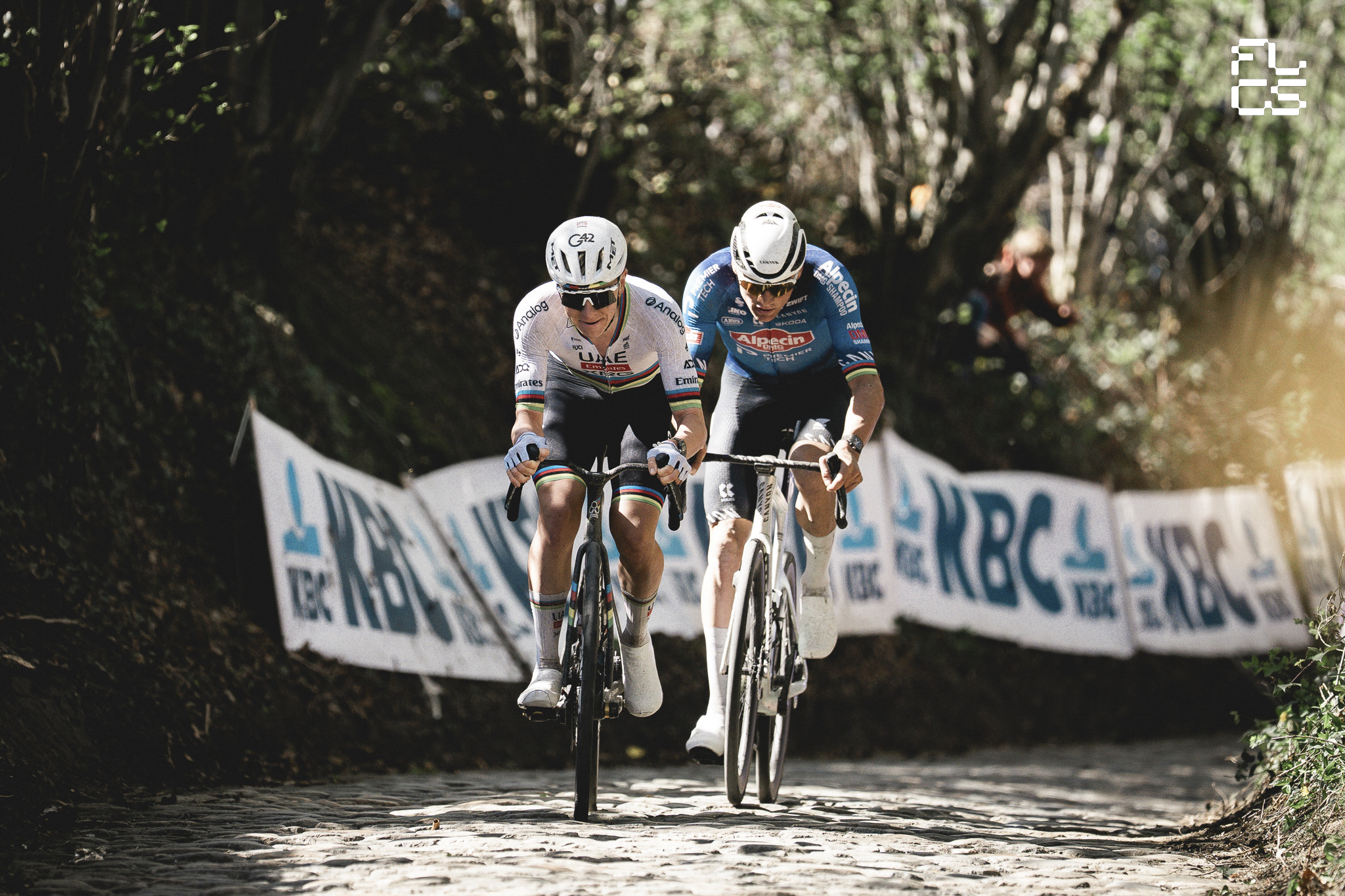
In the descent, he flew. He closed to within 10 seconds on the newly resurfaced Mariaborrestraat cobbles, the gap approaching something that might have been called catchable. But each time he drew within range, Pogačar drove through once more, opening the gap again by another handful of seconds. The Van der Poel–Pogačar head‑to‑head record entering this day stood at 10–10 across their last 20 one‑day races. The tiebreaker, it turned out, would be resolved between the two of them.
TAAIENBERG AND THE ROAD TO THE FINALE
The Taaienberg did not resolve the contest. Evenepoel matched the pace of the leading pair over the summit and kept his deficit intact, preserving his hopes for the Oude Kruisberg and Hotond combination ahead.
But a headwind on the transition section did what the climbs had not quite managed. Evenepoel crept to within 10 seconds at one point before the gap opened back to 20, then to 30 on the Oude Kruisberg, where Van der Poel was visibly straining at Pogačar’s wheel. The Slovenian looked the strongest he had all day. As the team cars passed Evenepoel on the connecting road toward the Hotond, he was grinding through the headwind with his gap over Pedersen and Van Aert stretching toward 50 seconds — fighting on two fronts simultaneously, trying to close the pair ahead while managing the pair behind. The Belgian was simultaneously the third‑best rider in the world at that moment and the most isolated, with no teammates remaining to give him shelter or pacing on the road. It was one of the most compelling individual performances in a Tour of Flanders that didn’t end on the podium in many years.
On the Hotond, Evenepoel closed again to within 20 seconds. An unrewarding stretch followed where Van der Poel and Pogačar could accelerate freely. The final Kwaremont was imminent.
OUDE KWAREMONT: THE DECISIVE THIRD PASSAGE
Pogačar attacked before the cobbles even began.
No hesitation. No feinting. No reading of Van der Poel’s response before committing. On the first setts of the Oude Kwaremont he was already alone, Van der Poel conceding ground with each pedal stroke. Van der Poel found something halfway up — summoning a second wind from wherever those come from — and came to within five seconds at the summit exit. Not quite over. But very nearly. Evenepoel’s gap exploded to a full minute at a stroke. Van Aert dropped Pedersen on the same climb, riding his own race for fourth. Pogačar topped the Kwaremont in 3:02. Van der Poel arrived six seconds later.
PATERBERG AND THE RUN TO OUDENAARDE
By the time the Paterberg arrived, Pogačar’s lead had grown to 15 seconds. On the cobbled wall he moved with the ease of a man who has already solved the problem. Van der Poel rose out of the saddle once more — not losing further time, refusing the humiliation of collapse, but unable to close the gap. At 25 seconds over Van der Poel entering the final 13 km to Oudenaarde, Pogačar had the race in hand.
He removed his gloves at the roadside and gave them to a young fan — the gesture of a man entirely at peace with what was coming. At 5 km to go, the gap read 35 seconds. At 2 km, it was over 40.
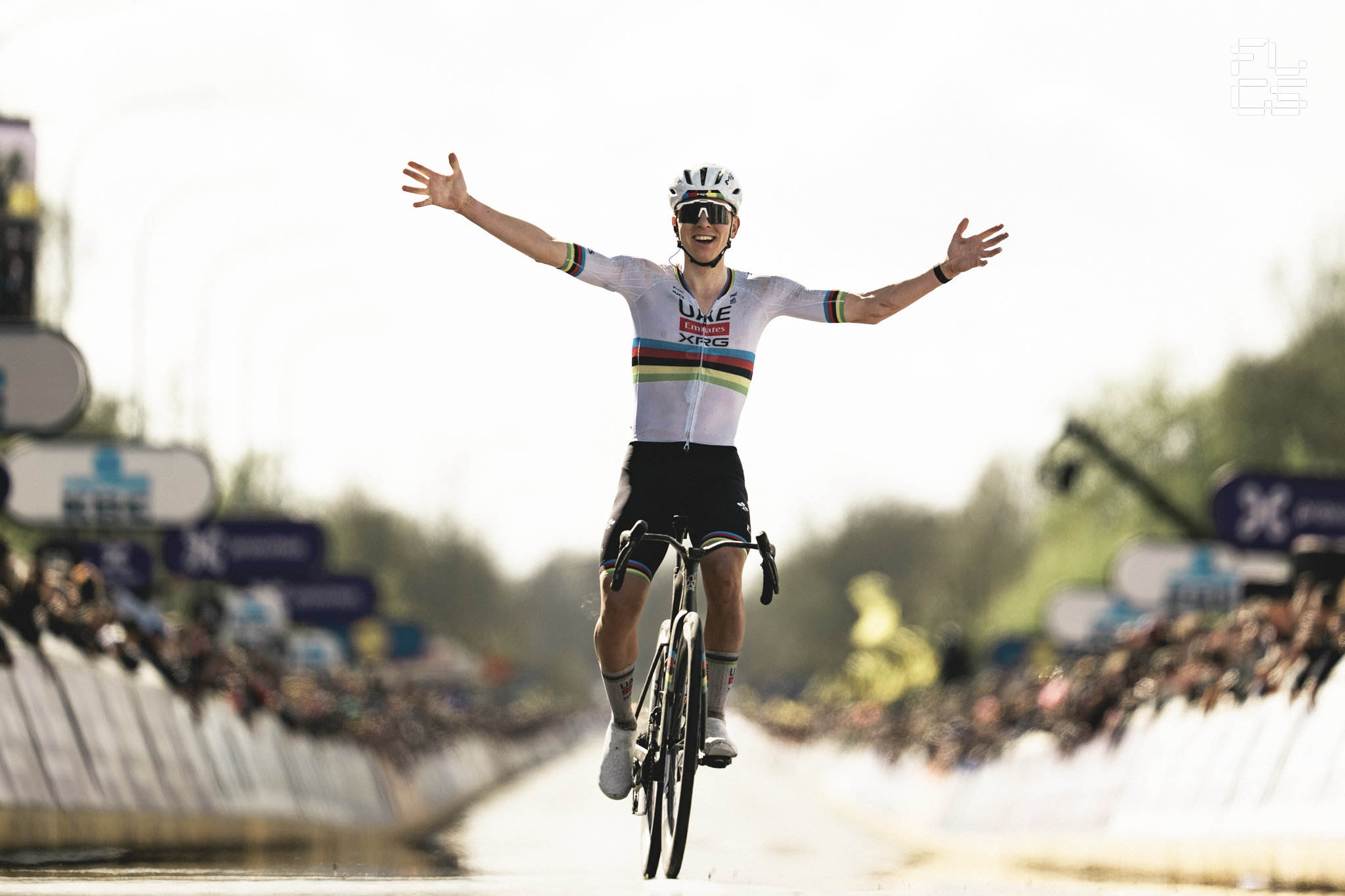
Tadej Pogačar crossed the line alone in Oudenaarde at 6:20:07, solo for the second year in a row, for his third Tour of Flanders. Van der Poel arrived 34 seconds later. Evenepoel — who had been shed on the Paterberg and chased alone for more than 50 kilometers, through the Koppenberg, the Taaienberg, the Kruisberg, and the Hotond, without a teammate in sight, never once fully conceding — came home 1:11 back for the most impressive Tour of Flanders debut in years. Van Aert finished fourth once again. Pedersen fifth.
“It was a really crazy race today,” Pogačar said afterward. “I don’t know what to say.” When asked why he had not waited for Evenepoel after the Koppenberg, he was precise: “I didn’t wait for Remco because his endurance is very good — he can beat you in the end.”
And thus, about 16 km from the finish, on the cobbled ramp of the Oude Kwaremont, is where the man from Slovenia decided it was time to end the conversation.
Three wins at Flanders. Two Monuments from two starts in 2026.
RESULTS — TOUR OF FLANDERS • ANTWERP → OUDENAARDE • 278.2 KM • APRIL 5, 2026
| Pos. | Rider | Team | Time |
| 1 | Tadej Pogačar | UAE Team Emirates‑XRG | 6:20:07 |
| 2 | Mathieu van der Poel | Alpecin‑Premier Tech | 6:20:41 |
| 3 | Remco Evenepoel | Red Bull‑Bora‑Hansgrohe | 6:21:18 |
| 4 | Wout van Aert | Team Visma | Lease a Bike | 6:22:11 |
| 5 | Mads Pedersen | Lidl‑Trek | 6:22:55 |
| 6 | Jasper Stuyven | Soudal Quick‑Step | 6:24:35 |
| 7 | Florian Vermeersch | UAE Team Emirates‑XRG | 6:24:35 |
| 8 | Matej Mohořič | Bahrain Victorious | 6:24:37 |
| 9 | Christophe Laporte | Team Visma | Lease a Bike | 6:25:29 |
| 10 | Gianni Vermeersch | Red Bull‑Bora‑Hansgrohe | 6:25:29 |
(Visited 38 times, 6 visits today)