

Updated February 16, 2026 04:43AM
Mathieu van der Poel set pulses racing in the endurance and wellness communities last week when he shared his freakish resting heart rate and HRV data.
“A resting heart rate of 38? An HRV of 200?
“WTF?!?”
But hold the hype train.
Those anomalous data points don’t mean Van der Poel is some superhuman. [Although his ability to foil Tadej Pogačar in Milan-San Remo and Paris-Roubaix may suggest otherwise.]
Yes, MVDP’s resting heart rate and heart rate variability [HRV] scores make him a physiological outlier. But without context, his data doesn’t really mean much at all.
Van der Poel breaks the internet with WHOOP revelations
Van der Poel discussed his heart rate deets in the latest episode of the WHOOP podcast.
For those out of the loop on WHOOP, they’re the bands strapped around the wrists of businessmen, biohackers, and athletes all over the world. They track sleep, movement, and heart rate data to spit out sleep scores, recovery markers, HRV, and a whole lot more.
The U.S. brand partners with Van der Poel’s Alpecin-Premier Tech team, and has supported EF Pro Cycling.
In the podcast, WHOOP CEO and show host Will Ahmed probes his monument-munching guest on his very notable vital statistics. Van der Poel’s WHOOP reports an HRV averaging around 200, and a typical resting heart rate of 38bpm.
“I’m really high in HRV. I have this discussion with a lot of friends. I think it’s a bit genetic maybe as well, but fitness is also important,” Van der Poel said.
And Van der Poel’s resting heart rate?
“The average is 38, the lowest that was recorded I think is 34. But I think a lot of endurance athletes have this. The heart is really well trained,” he said.
Certain niche segments of the internet exploded. Those stats are several deviations away from any average.
The 31-year-old’s resting pulse – a strong indicator of cardiovascular health – is maybe 20 beats lower than that of a “normie.” His HRV score might be more than twice that of us 4 w/kg dribblers.
But what do those numbers actually mean, really?
What is heart rate variability, anyway?
The heart doesn’t beat a steady 4/4 tempo suited to The Beatles. Instead, it pulses at a scattered, syncopated rhythm more suited to a jazz drummer.
Heart rate variability is the variance in time between those beats.
The better rested the heart, the more erratic the rhythm, and the higher the HRV.
A high HRV signals that the body is in a more parasympathetic, relaxed state. The body’s autonomic nervous system has the bandwidth to endure a set of VO2 Max intervals or a bout with Pogačar on the pavé.
A lower HRV indicates the nervous system is tilted toward a sympathetic state. You’re taut, stressed, and less able to manage fatigue.
That’s why heart rate variability data is one of the best available measures of relative levels of stress and rest.
As this study reaffirmed, it can help gauge whether you should switch your intervals to a recovery ride, if you’re getting sick, or if you’re worn out by work.
HRV naturally declines with age, and is lowered by multiple risk factors for poor health. Studies have shown that a healthy lifestyle and regular training can increase variability.
WHOOP straps, Oura rings, and most higher-end smart watches can measure HRV, provided the wearable is worn 24/7.
Why does Van der Poel’s HRV data mean, really?

Van der Poel’s HRV score of 200 stands out.
The WHOOP website indicates users of his age typically have a heart rate variability in the range of 55-105. This crusty no-hoper has a baseline HRV in the 60s.
But that doesn’t indicate MVDP is at least two times “better” than Joe Blogs or three times “healthier” than me [although his power numbers suggest otherwise].
As Van der Poel acknowledges, everyone’s heart rate variability is unique. HRV scores differ by gender and race and fluctuate further within a given population. Who knows? Pogačar’s baseline HRV might be 50.
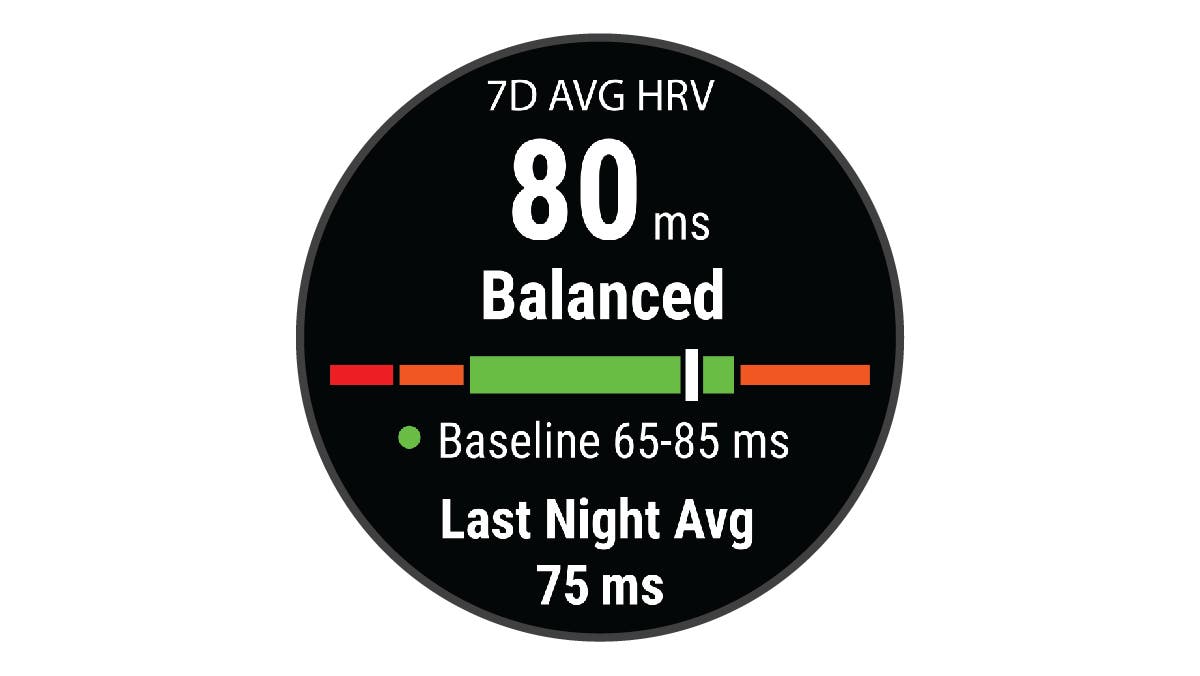
And while baseline HRV can serve as a strong indicator of well-being, it’s the daily deviations from an individual’s average that are most important.
For example, Van der Poel will know he’s primed for Paris-Roubaix if his HRV is at 250, a score 50 points higher than his norm. Contrastingly, he’ll know he’s in for a hard ride if the number is tracking down in the 100s – a score that’s significantly higher than that of the average population, but very low for him.
So yes, Van der Poel’s HRV is crazy high. Only gifted athletes and genetic outliers might have those numbers.
But in isolation, an HRV of 200 doesn’t really mean anything.
Heart rate variability should be considered relative to an individual’s own dataset. It’s not an absolute measure that’s relevant for comparison.
Van der Poel’s resting heart rate: Impressive, but not unknown

And Van der Poel’s resting heart rate [RHR]?
That is an eyebrow-raising stat that can serve as a reference point for comparison.
It’s long been known that a low RHR can indicate better physical fitness and lower risk of cardiac illness.
Studies agree that 60-100 is a “normal” RHR for a healthy human. Van der Poel’s resting pulse of 38 is so far from that, he’s basically a blue whale.
But MVDP is not that unique, really – especially among the sporting elite.
Five-time Tour de France winner Miguel Induráin famously tested at 28bpm, and marathon GOAT Eliud Kipchoge reportedly averages at around 33. French Biathlete Martin Fourcade once shared images suggesting his RHR was 25.
After decades of being a distinctly average rider, runner, [and writer], even my resting heart rate is in the 37-39 range.
What’s more interesting about Van der Poel’s heart rate data is that, per WHOOP, he can max out at 190bpm+. The huge headroom in his resting cardiac capacity may be a more telling sign that he’s a physiological dominator.
Why do teams and athletes use HRV and heart rate?

Van der Poel explains in the WHOOP podcast that he uses his resting heart rate and HRV to monitor how well he’s recovered from training.
And he’s not alone.
Almost every team in the men’s and women’s WorldTours will be tracking trends in their riders’ HRV and resting heart rate as part of a wider monitoring system. These scores provide an objective early warning of overtraining or sickness that medics and trainers correlate against an athlete’s mood, training load, and daily physical markers.
And that’s why Van der Poel’s eyebrow-raising heart rate and HRV scores mean relatively little to you.
It’s the variances in heart rate data that matter most when assessing health and well-being, not the absolutes.