
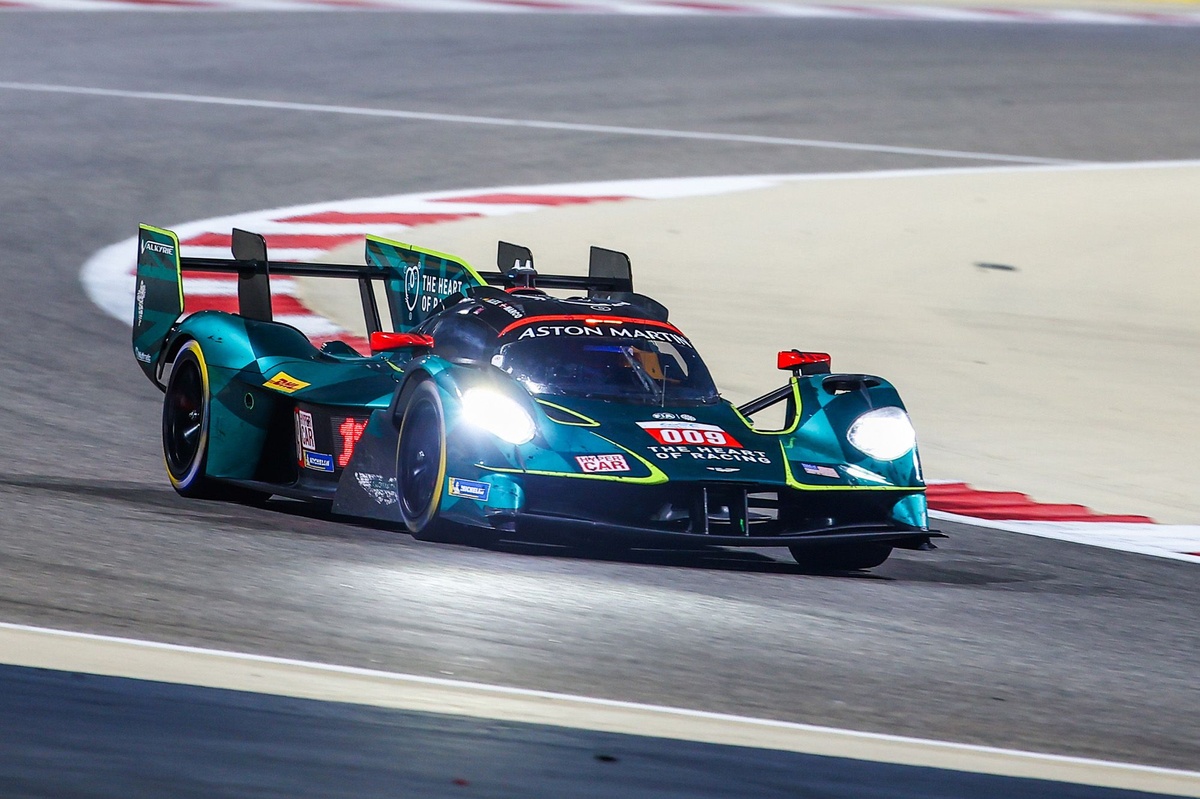
Every beginning your journey in Hypercar is difficult, both figuratively and literally, as the BoP graph for the Aston Martin Valkyrie illustrates.
As a new entry, a certain ‘rookie bonus’ is to be expected, but ultimately, it must be said: in their first year, there have been others that left a far more clumsy impression than Aston Martin did in the 2025 WEC.
“We are very happy with where we stand,” said Aston Martin’s Head of Motorsport, Adam Carter, at the season finale in Bahrain.
He had every reason to be happy, as the Valkyrie had secured its first world championship points at Fuji Speedway just a few weeks earlier and claimed its first podium in the IMSA SportsCar Championship at the season-ending Petit Le Mans.
Hypercar newcomers have often fared much worse than Aston Martin did in its debut season. Throughout the year, a clear progression was evident, with the Valkyrie evolving from a backmarker at the season start into a solid points contender in the final races.
Of course, looking at the classification graph raises the question: how much of the Valkyrie’s improvement was down to the operational team, The Heart of Racing (THOR), and how much was due to the BoP?
In the end, it was most likely a combination of both. In the first two races, the Valkyrie received a conservative BoP. The FIA and ACO’s primary concern is always preventing a new car from arriving and immediately blowing the competition out of the water.
However, the initial power-to-weight ratios of 2.067kg/kW (Qatar) and 2.081kg/kW (Imola) below 250kph were not the worst in the field; both Toyota and Porsche had a less favourable BoP in both races.
It was only when the BoP started to be based on the rolling average of the two previous races at Spa-Francorchamps that the Valkyrie’s power-to-weight ratio dropped below 2.0, where it remained for the rest of the season.
Le Mans as the turning point
Until Le Mans, the Valkyrie was off the pace but showed remarkable reliability. According to Carter, this was key to accelerating development.
“Once you find a rhythm and every day doesn’t bring something new, it opens up capacity to work on other areas. We needed the car’s reliability to have a platform for development,” he said.
“That’s when everything started to come together. When you’re no longer just trying to survive the race, you have more room to think about performance.”
Le Mans provided the first real achievement for the Aston Martin THOR team. The #009 outqualified a Toyota and both Peugeot 9X8s—not due to external circumstances, but on pure merit.
In the race, both Valkyries ran faultlessly again. The #009 only narrowly missed its first championship point by one position, as the eighth-placed #4 Porsche was not eligible for WEC points.
Despite the V12-powered machine enjoying the best power-to-weight ratio alongside the BMW in the above-250 kph range at Le Mans, it suffered from a massive lack of top speed.
This is a recurring issue that also affected the Valkyrie recently at Daytona. Aston Martin and Toyota were the weakest marques in terms of top speed at Le Mans in 2025.
It is undeniable that Aston Martin made a major step forward before Le Mans. In the special BoP for the Circuit de la Sarthe, their power-to-weight ratio relative to the competition was only worse for the first two races of the season.
The progress achieved was most evident mid-corner, where the Valkyrie made its biggest gains throughout the year.
Late-season BoP highlights there is work to do
Once the automated BoP returned after Le Mans, Aston Martin finished the season with the ideal power-to-weight ratio of 1.981kg/kW, shared with Peugeot. In the over-250kph range, the Aston Martin also enjoyed the ideal rating of 520kW at 1,030 kilograms.
However, the graph also reveals that Aston Martin still has a long road ahead. The increasingly unfavorable ratings for the other hypercars were primarily due to the struggling brands Aston Martin and Peugeot.
The Valkyrie would likely have scored its first points—and perhaps even a podium—in Austin, had an overheating issue not struck both cars shortly before the finish.
It was the first time the Valkyrie developed a reliability problem. Nevertheless, the rain-hit race was a vital opportunity to gather data under wet conditions.
The breakthrough finally came at Fuji Speedway. In addition to the first points finish, Marco Sorensen set the second-fastest lap of the race. A collision with a GT Aston Martin ended the race for the #007 prematurely.
While The Heart of Racing’s achievement in making the package competitive in a relatively short time is highly impressive, the massive gap in power-to-weight ratio between Peugeot/Aston Martin and the rest of the Hypercar field cannot be ignored.
Excluding Peugeot, at the Bahrain finale, the next best-rated car’s (Alpine A424) power-to-weight ratio was more than 0.1kg/kW worse than the Aston’s, with the bulk of the field being 0.2kg/kW worse off.
According to Adam Carter, it is too early to think about Evo Jokers. The focus remains on optimising the existing package: “It’s the famous ‘a little bit of everything.’ The sum of all parts. It’s about fully extracting the car’s potential.”
Aston Martin still needs to make progress regarding tyre wear. This was evident in Bahrain, where the #007 had to change tyres early while others were pulling double stints.
While this briefly gave Alex Riberas the lead and the third-fastest lap, the car lacked the firepower to fight at the front in the closing stages. Nevertheless, the season ended with a second points finish for the #009.
The question for 2026 is: Can Aston Martin make a similar leap over the winter like Ferrari did in 2024/25? Or will the updates to numerous other hypercars require an equally large BoP gap once again?
We want your opinion!
What would you like to see on Motorsport.com?
– The Motorsport.com Team