
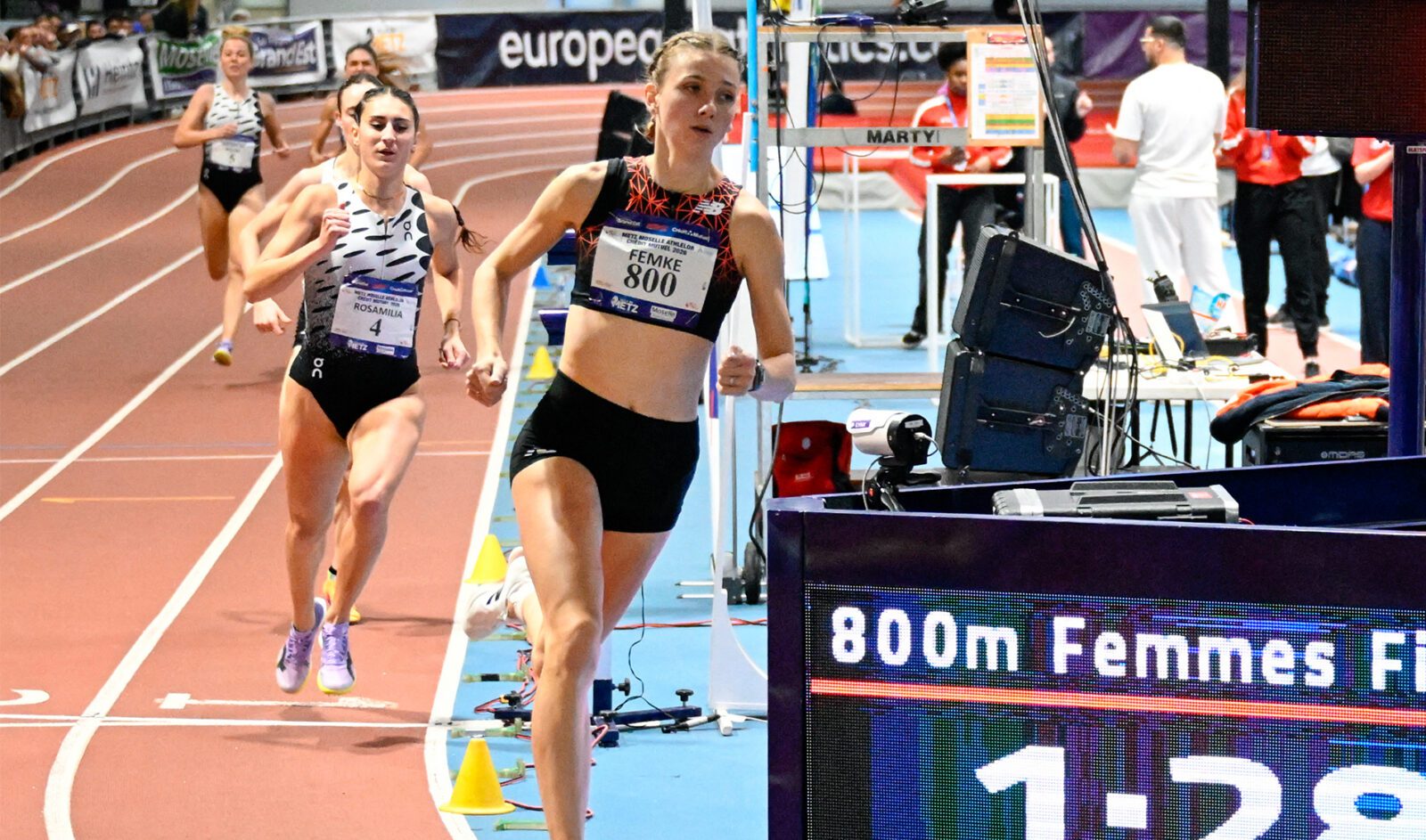
After Femke Bol’s debut over 800m, Cathal Dennehy analyses what that run could tell us about the Dutchwoman’s potential – and what it’s likely to take for her to become a contender at the top level in her new discipline.
As Femke Bol floated across the line in Metz – her loping stride seemingly untroubled by the wicked acidosis of the 800m – commentator Tim Hutchings cast his judgement on one of the most fascinating pivots in the sport’s history.
“This has been a wonderful debut,” he said. “Job done. She will learn and she will build on that.”
Only the harshest of critics could have been left unimpressed by Bol’s first senior outing over 800m – winning in a Dutch indoor record of 1:59.07 – and Hutchings has been around the sport’s top tier long enough not to be drawn into hyperbole. “She’s in the pack now, and building,” he added. “She will be a real threat.”
How much of a threat? That should become clear in the summer.
While there was the usual mixed bag of reactions to her run, most observers were in the same category: We didn’t see enough to predict that she will conquer the world over 800m. But we certainly saw enough to know it’s possible.
The genesis of this move can be traced back to 2024. Exactly 18 months before Bol toed the line over 800m in Metz, she was third in the Olympic 400m hurdles final, her attempt to match Sydney McLaughlin-Levrone’s scorching pace backfiring as she faded late in the race, clocking 52.15 – a result that left her smacking her head in frustration while trackside in the Stade de France.
Bol soon expressed to her long-time coach Laurent Meuwly that she wanted to switch to the 800m in 2025 but, as Meuwly explains elsewhere in this issue, he convinced her to give it one more year in the 400m hurdles. She duly went unbeaten in her specialist event in 2025, capped with her second world title in 51.54.
The 800m move was announced last October and the athletics world was quickly ablaze with speculation, with sceptics doubtful that she’d ever win a global medal, while the true Bol-ievers predicted a world record down the line.
But the chasm she’s crossing is a big one, the doubling in distance tipping the balance of performance demands towards the aerobic, with Bol still needing to maintain similar sprinting speed capability to enable efficient race pace.
Findings vary regarding the respective energy system contribution in the 400m and 800m, and that can be highly individual, though in this department the 400m hurdles is notably closer than the 400m to the 800m. A 2010 study in the Journal of Strength and Conditioning Research found the aerobic contribution was 43 per cent in the 400m hurdles versus 37 per cent in the 400m, meaning Bol should find the transition easier than a true 400m specialist.
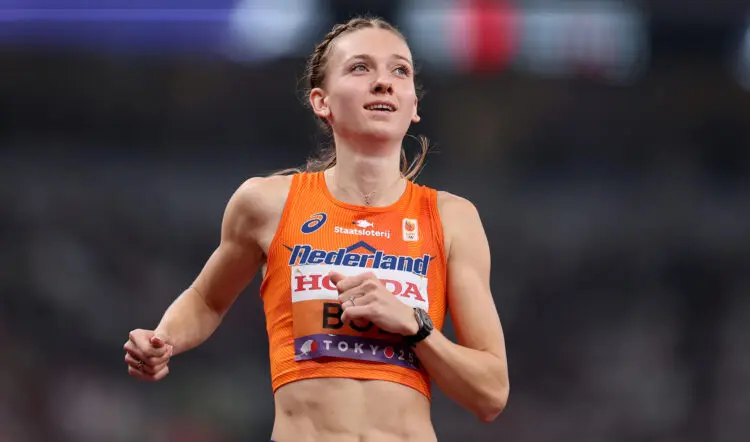
The 800m sits at a key inflection point on the athletics spectrum, with Bol essentially crossing the divide between sprinter and middle-distance runner – two worlds with very different coaching philosophies and skill sets. It may only be double the distance, but it’s not like a 100m specialist switching their focus to the 200m or a half marathoner moving up to the marathon.
Bol has spent the past decade specialising in one-lap running and now, at 26, she’s attempting to recalibrate her highly trained engine. Yet much of the foundational work is already done. For someone who’s run under 51 for 400m hurdles and a world indoor 400m record of 49.17, her 200m PB of 22.64 is comparatively weak. But that suggests Bol had a far stronger aerobic capacity than most of her former rivals. Meuwly’s group is also known to take a higher-volume approach to 400m training.
At the highest level, the 800m is a fiendishly tricky puzzle, one that typically requires significant trial and error before it’s solved. Talk to world-class operators in this realm and it’s clear that most have experimented with their training over the years, sprinkling varying amounts of specific work before figuring out what recipe worked best.
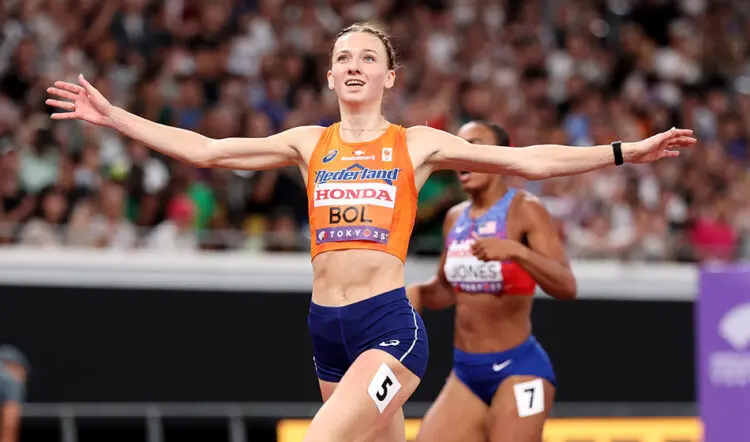
In addition to an adjusted blend of metabolic conditioning, Bol will need to develop the mechanical and neuromuscular proficiency that’s specific to the 800m. With great variance between the profiles of 800m runners, there’s a need for an individualised approach.
“400-800m transitions are governed by constraints created by an athlete’s existing profile, not simply intent or preparation,” says Performance Consultant Gareth Sandford, who works with a range of top-level coaches to develop support systems around 800m runners from speed to endurance and everything in between.
“The challenge is adapting to the event from the reality of the athlete’s profile, not from models built around other runners,” he adds. “At this level, athletes aren’t building new engines. They’re changing how the same engine is expressed. Two athletes can do similar work and arrive at very different outcomes because the event is asking different questions of their profile.”
It’s why there’s such a wide spectrum – perhaps the widest of any event – in how world-class athletes train for it. Those with a speed profile might only log 40-60km a week, while those with an endurance profile might do 100-120km.

For Bol, the key will be to strengthen her weaknesses without weakening her strengths. Meuwly has suggested the bulk of her aerobic work will be done by cross training, with running kept for more specific sessions. He will undoubtedly have learned much from coaching Eveline Saalberg, a 50.95-second 400m runner who spent last year transitioning to 800m, clocking a best of 2:02.97.
In Metz, Bol coasted through the opening lap in 27.4 and the second in 30.0. The third lap was mistakenly listed as 32.2 on the race splits, but French stats guru PJ Vazel calculated that it was actually 30.9, with Bol closing in 30.8. Meuwly said the third lap being the slowest showed that she had “a little too much respect” for the 800m and, given how strongly she finished, it’s likely she’ll attack that section a lot more outdoors.
There’s also the matter of mechanics. It’s very early days in her transition, but in Metz Bol looked to be running much the same way as she did over 400m, with a low arm carriage, hands out from her body – similar to McLaughlin-Levrone. It’s a notable difference to the likes of Keely Hodgkinson or Mary Moraa, who run with their arms tucked higher, their hands closer to the body. Getting Bol to move more like a middle-distance runner could also be a factor in this transition.
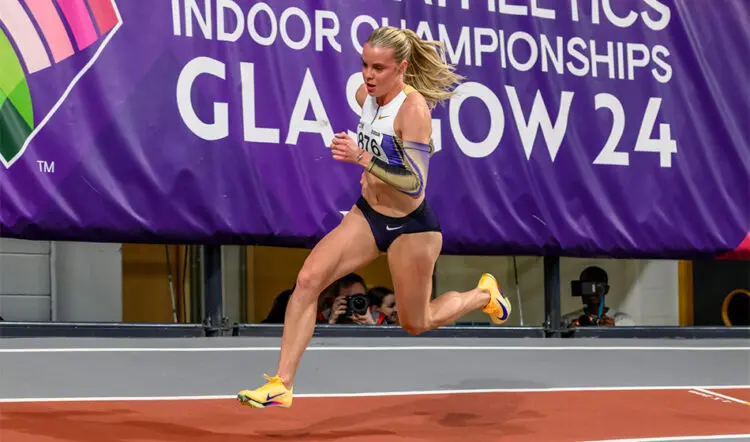
But how far can she go? It will be a shock if Bol challenges Hodgkinson this season but the goal, of course, is not to do that in 2026, but in 2028. The potential is clearly there. Bol is two seconds quicker than Hodgkinson over 400m but obviously has a huge river to cross to match the Briton and world champion Lilian Odira over 800m. Still, she has the raw materials to make it happen.
Late last year, she told European Athletics she “had a full year to really think about it” before making the switch and “mentally to say goodbye to my hurdles”.
But is this really a final goodbye? It’s too early to know where Bol’s ceiling might be over 800m, but we’ll know much more after the Europeans in August and especially after next year’s World Championships in Beijing. If Bol can’t win an 800m medal at the latter, we could see her drop back down in distance ahead of Los Angeles 2028.
After all, the 400m-400m hurdles double is not feasible in LA and it seems likely that McLaughlin-Levrone will opt for the flat race. If the US superstar is no longer competing in the 400m hurdles – an event which she has now essentially completed – the path could be clear for Bol to win the one thing missing in her stellar career: an individual Olympic gold.
That remains the overarching goal and, in another 18 months, could be realistic in either event. But, whatever way this goes, her journey will be fascinating to follow.