
Updated March 24, 2026 08:10AM
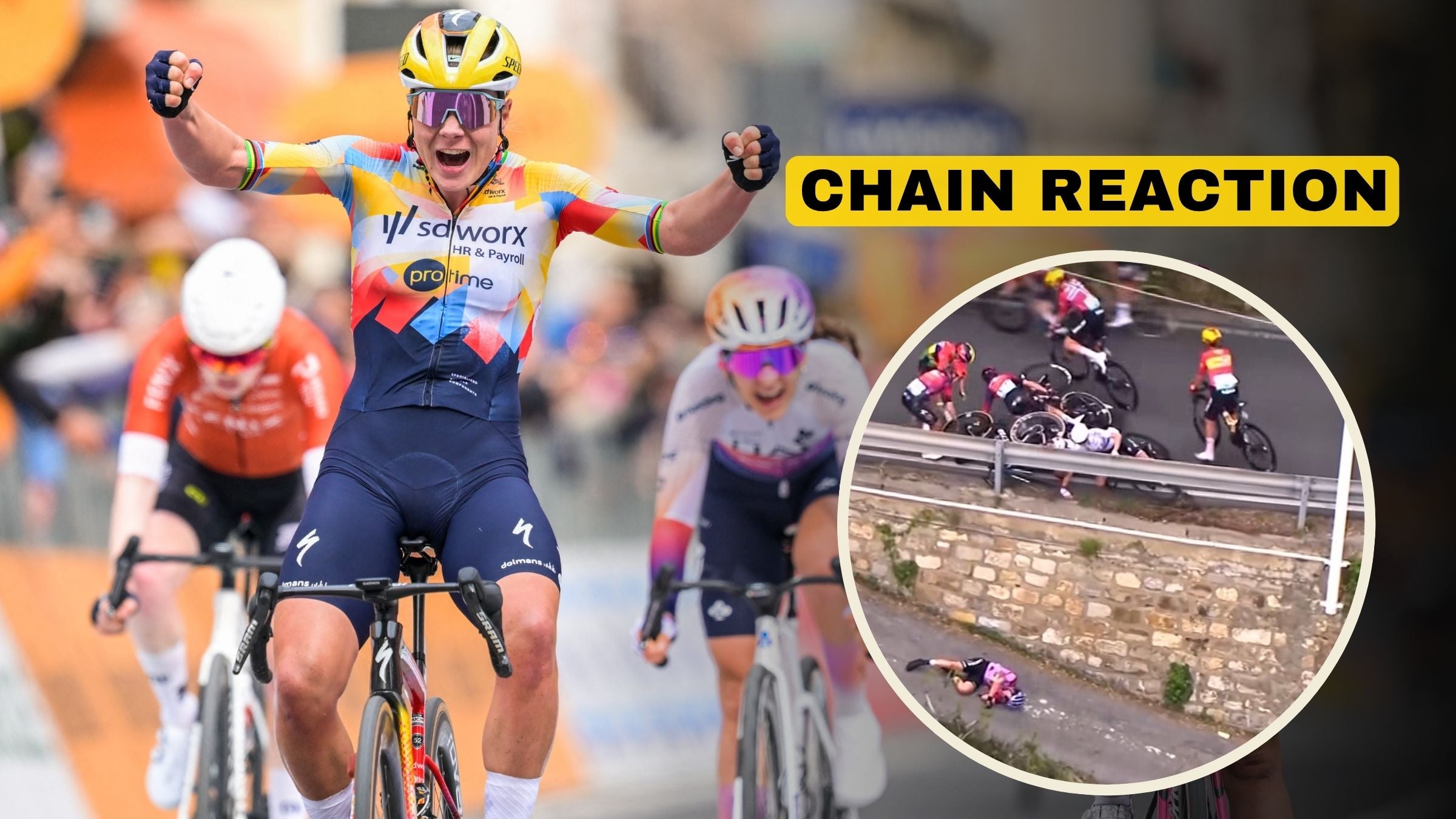
The peloton is still coming to terms with Saturday’s string of terrifying, high-speed crashes at Milan-San Remo Women on the Cipressa descent that sent riders tumbling onto the tarmac and catapulting over guardrails.
The dreadful aftermath is that this could have been much worse.
Everyone accepts the risks that come with racing bikes on open roads, but many are asking (again) why it feels like that danger is only increasing.
Saturday’s violent crash came at the sharp end of the Italian classic, just as the favorites were fighting for position on one of the most decisive sections of Milan-San Remo.
Riders took the inevitable gamble that comes with being at the front. Some made it through. Others did not.
Debora Silvestri, the Italian rider for Laboral Kutxa-Fundación Euskadi, suffered a brutal fall that is still rattling the sport days later.
She was launched over a roadside barrier and fell roughly two meters onto a lower road. Her body lay motionless in horrifying scenes no one wants to witness, before being taken to a local hospital.
Fortunately, the sport avoided a far worse outcome. She later confirmed five broken ribs and a fractured shoulder.
“All in all, I feel good,” Silvestri wrote on social media. “This could have ended much worse.”
That line continues to echo across the peloton days later.
Silvestri remains on a respirator
The crash unfolded in seconds just as Milan-San Remo was heating up.
Kasia Niewiadoma (Canyon-SRAM) lost control in a tight, sweeping, high-speed corner on the Cipressa descent, triggering a violent chain reaction behind her.
Shocking images unfolded on live TV showed riders barreling into the corner at full speed, only to find a blocked road and no clear line through the carnage.
There was little time to react. Several slammed into fallen riders in the roadway despite frantic efforts to wave them down.
Margaux Vigié (Visma-Lease a Bike) was the first to vault the barrier, but incredibly managed to get back on her bike.
Silvestri followed moments later at an even higher speed and was launched over the guardrail.
The team updated her condition on Tuesday and confirmed she will remain in the hospital.
“Debora Silvestri continues to show favorable clinical progress, in line with the severity of her injuries,” officials said. “As a result of the severe chest trauma, she still requires respiratory support.”
It’s not just the violence of the crash, but the almost resigned acceptance of the risk that comes with pro bike racing.
“If you don’t take risks, it’s not top-level sport,” Niewiadoma wrote on social media, confirming that she was not seriously injured. “I probably could have been a bit more careful, but at the same time, I wanted to seize every opportunity.”
So far, there have been no suggestions of poor road conditions or a lack of safety measures.
There may be questions about additional padding or netting at that point of the course, but it is nearly impossible to protect every corner of one of cycling’s longest races.
That trade-off — risk versus reward — sits at the center of modern cycling.
Riders were pushing the pace to gain an advantage on Saturday.
There is always a thin line between opportunity and disaster in pro racing.
Safer, but never truly safe
Saturday’s crash unfolded as the question of rider safety continues to simmer in the background.
Despite ongoing efforts from across the sport’s stakeholders, crashes keep happening and at times appear to be getting worse.
The sport has endured three gut-wrenching racing fatalities in recent years, including Gino Mäder in 2023, Muriel Fürrer at the road world championships, and André Drege at the Tour of Austria in 2024.
Under pressure, the UCI and other stakeholders have intensified efforts to improve safety.
Also read: Broken Spine, Torn Anus, Ripped Up Glutes: The Brutal Toll of Crashing at 100kph
The UCI launched the SafeR project to bring together teams, riders, race organizers, and governing bodies to address cycling’s inherent dangers.
There has been some infighting and the inevitable politics, but at least there is a collective conversation.
It is difficult to pinpoint a single cause behind Saturday’s crash, but the UCI has been studying incident data and analyzing trends from 2024.
A total of 497 incidents were recorded across men’s and women’s WorldTour and ProSeries races.
According to the UCI’s analysis, 35 percent of crashes were attributed to unprovoked rider error, while 13 percent occurred in moments of heightened tension ahead of key race points such as climbs or cobbled sectors.
At first glance, Saturday’s violent crash appears to be a convergence of those factors.
Other factors include hazardous conditions, including wet roads, which accounted for 11 percent of incidents, followed by road infrastructure at 9 percent and poor road conditions at 4 percent. Only 1 percent of cases were linked to vehicle behavior.
That data has helped deliver real-time solutions that have been rolled out, from measures such as yellow cards, improved signage, warning lights, and clearer road directions.
Other radical ideas are still on the table, like limiting gear ratios and changing tires to reduce speeds, and exploring the use of airbags and GPS tracking devices.
There is no magic wand to make pro racing completely safe.
Every race is full-tilt from the gun. Speeds keep going up, there’s the eternal pressure to perform, and talk about a lack of respect in the bunch.
The traditional “patron” figure, a boss capable of controlling the unruly bunch, has largely disappeared.
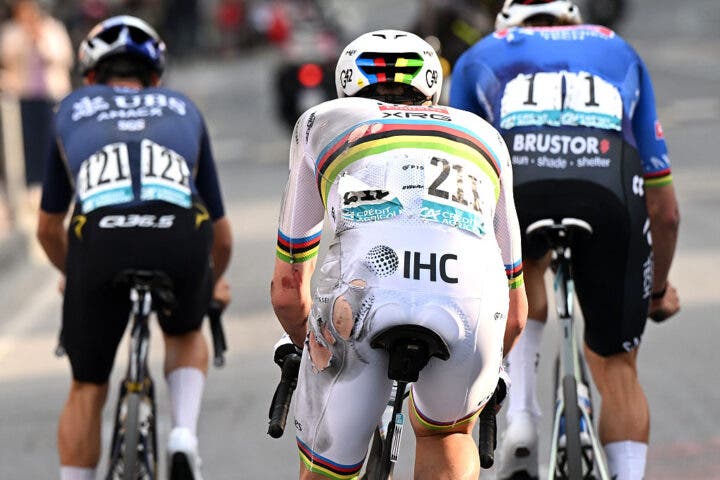
A crash in the men’s race almost took out world champion and eventual winner Tadej Pogačar.
Crashes are inevitable. There’s no consensus on what to do about it.
‘I audibly yelped’
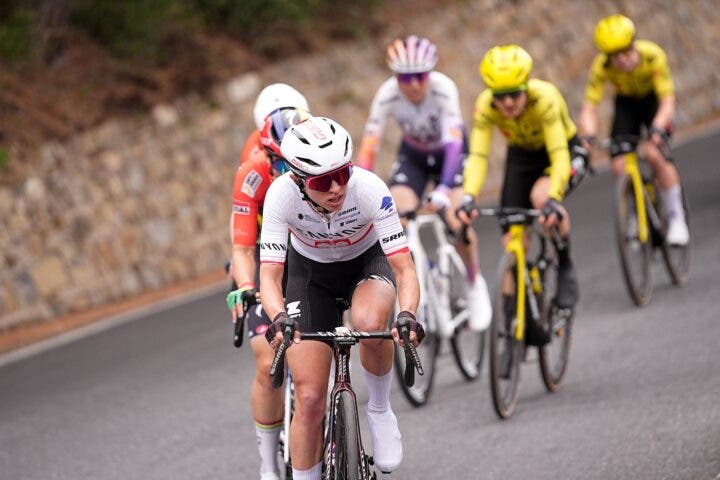
Improved safety measures should help, but the crashes keep coming.
Former pro Grace Brown, now watching from the sidelines as an analyst for SBS, shared her reaction.
“I audibly yelped,” she said in a podcast. “Honestly, the first thing that goes through my mind when I see footage like this is, I’m so glad I’m not racing anymore, and that I made it out alive.
“That’s a bit crazy, right? But I know a lot of riders who, from time to time, fear for their lives.”
Brown pointed out cycling’s growing contradiction over rider safety.
Even as the sport has doubled down on safety measures, the perception inside the bunch is that crashes are becoming more frequent and more severe.
So what’s driving it? She had an interesting take.
“There’s more money in the sport now,” Brown said. “But I think the biggest shift is visibility. Racing has never been more watched, and riders know it.
“The stakes feel higher because the audience is bigger,” she said. “It’s ego and career success.”
Ultimately, Brown said that the responsibility cannot rest solely with race organizers or the suits at the UCI.
“The sport needs to be honest about what it’s asking of riders, and riders need to be honest with themselves about why they take the risks they do,” she said.
Dodging another bullet
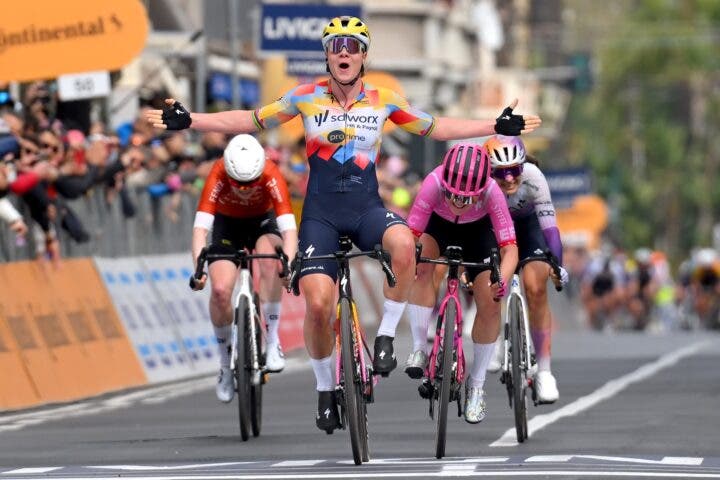
So far, reaction from officials has been muted.
Silvestri escaped with fractures and remains in a hospital. Others walked away.
Kim Le Court, who also crashed, stopped to check on the 2024 Tour de France Femmes winner, sacrificing her race in a rare human moment amid the chaos.
The general feeling is that this could have been much worse, but the racing calendar moves on. Milan-San Remo is already yesterday’s news.
Also read: Riders Involved in San Remo Horror Crash Dodge Catastrophe
But in a sport contested on open roads, danger will always be a permanent part of the equation.
The brutal images of riders thrown over barriers and racers stacked up across the road serve as the latest reminder of how narrowly the sport avoided catastrophe.
The debate over safety issues will continue to bubble in the background.
Everyone agrees that cycling should be safer.
It just doesn’t feel that way yet.