
Published March 14, 2026 03:58AM
You might think that Tadej Pogačar’s breakthrough was the 2020 Tour de France.
The Slovenian shocked everyone to win the yellow jersey atop La Planche des Belles Filles, but his rise to the top of professional cycling might have begun a few years earlier with a shift in his training.
In 2018, Pogačar won the Tour de l’Avenir, the biggest stage race in U23 cycling and what many tout as the U23 Tour de France. Pogačar had been riding for Ljubljana Gusto Xaurum, a Continental team in Slovenia. But from 2019 onwards, he joined UAE Team Emirates.
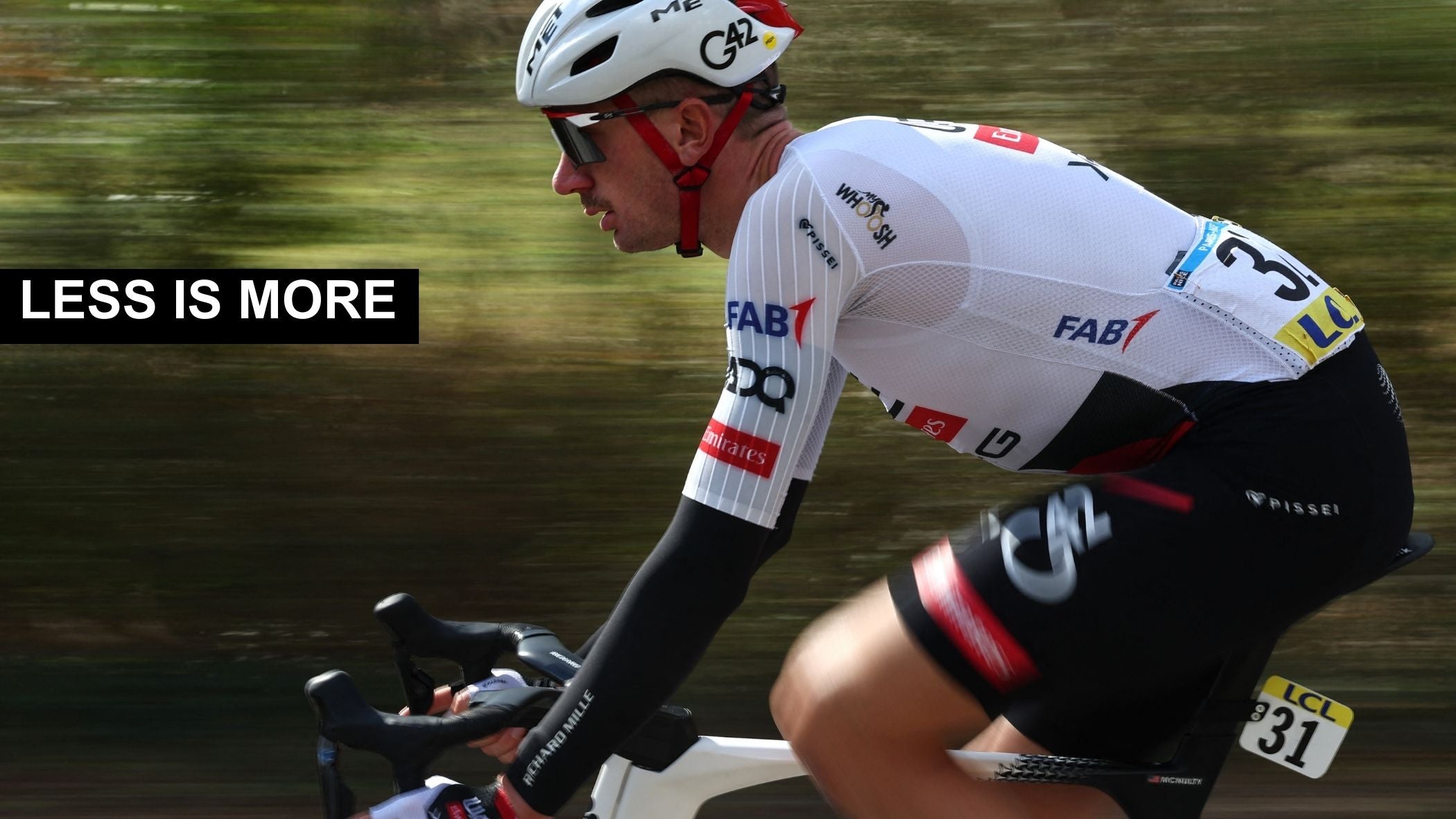
The head of performance at UAE Emirates-XRG, Jeroen Swart, had just made a major change when Pogačar joined the team: less volume, more quality.
Swart said, “One of the biggest things that I introduced to the team when I joined UAE Team Emirates in late 2018 was increasing the load monitoring and backing people off because back then, cyclists were doing far too much. And by doing less, performance increased.”
Perhaps Pogačar’s training changed a lot, or maybe it changed a little.
But there is no doubt that Swart’s methods have worked. From its early days as the new-look Lampre-Merida team, UAE Emirates-XRG has become the number-one team in professional cycling. Of course, they have signed several superstar riders.
But they have also turned good cyclists into great ones: Jhonatan Narváez and Tim Wellens, for example.
What is the method behind this madness? Low-volume training. Compared to those doing 35-hour weeks, UAE Emirates-XRG riders are hardly doing half of that.
Jay Vine said that when he made the move from Alpecin-Fenix to UAE Team Emirates, his training volume actually decreased. Nowadays, a 20-hour week is normal for most UAE Emirates-XRG riders. Here is why it works for them.
Low Volume + High Quality = Maximal Gains
There are some key differences between UAE Emirates-XRG training and the rest of the WorldTour. For one, UAE Emirates-XRG riders seem to train 15-20 hours per week.
Some riders might do more during key training blocks, while others actually do less.
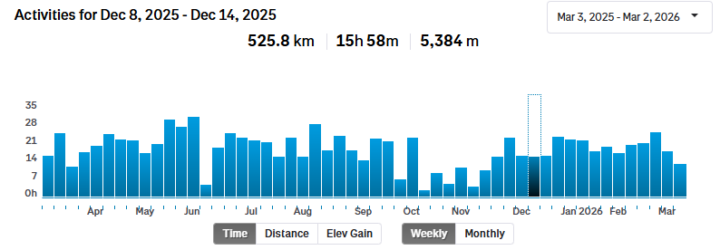
Peruse Brandon McNulty’s Strava, and you will find few weeks that include more than 25 hours of training. In fact, his biggest weeks are more often at a stage race than at home in Arizona. Between December and January of this past winter, his average weekly volume was under 20 hours; and this was during base season, the time of year when you might expect that a cyclist would be training the most.
“Many professional athletes make the mistake of doing too much training or too little recovery,” said Swart.
You can see this mantra throughout each week of training, as well as the UAE Emirates-XRG riders and how they speak about the training philosophy.
“There’s a lot more efforts involved, and there’s a lot less riding around at sub-endurance,” said Vine, one of the team’s strongest climbers who trains less than most other WorldTour riders. You might be wondering what he means by ‘sub-endurance,’ and if I had to guess, he is talking about Zone 1 or low Zone 2 riding. AKA: junk miles.
Components of the UAE Team Emirates-XRG Training Plan
UAE Emirates-XRG has a reputation in the professional peloton, not just for their winning ways, but for their unique training styles. There are a few pillars that have come up over and over again: high Zone 2, strength work, torque and super high intensity sessions.
First: high Zone 2. When cyclists and coaches talk about “Zone 2,” they are typically referring to 55-75% FTP. That is a big range, especially if you are riding for more than a few hours. A pro doing four hours at 55% FTP will hardly break a sweat, whereas the same rider doing four hours at 75% FTP will come home exhausted.
What UAE Emirates-XRG seems to do is find the razor’s edge. Instead of riding throughout the range of Zone 2, their riders target high or upper Zone 2 during their endurance sessions. The exact power targets are likely determined through lab testing, but for most riders, this will be 70-75% of their FTP.
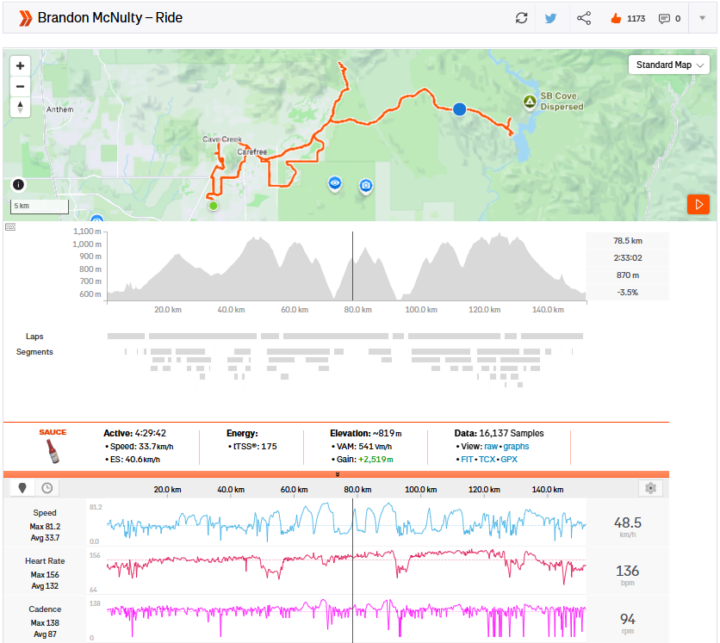
Another crucial aspect to mention here is that UAE Emirates-XRG riders don’t always do unstructured Zone 2 rides. Instead, they do 3x20min or 3x1hr Zone 2 intervals with 10-20min recoveries in between each effort. This allows them to accumulate more time at their higher power output without completely destroying their legs in a four-hour ride. Here is one of the rides that McNulty did over the winter – if you spend enough time on Strava, you will find many other UAE Emirates-XRG riders doing the same type of session.
Another reason that UAE Emirates-XRG riders might be spending less time on the bike is that they’re spending more time in the gym. Strength training has become increasingly popular in professional cycling, and for good reason.
“We’re seeing more and more data that showed how critical torque capacity was in terms of VO2 Max level and efforts,” says Swart. “But we also see from our own data that shows that durability, that ability to maintain power later in a race when you’ve got accumulated, more long-lasting fatigue effects, that durability is very much affected by your functional strength on the bike.”
UAE Emirates-XRG riders are in the gym three times a week doing very specific exercises. That is more than we’ve probably ever heard of in professional cycling, but that’s not all. At certain times of year, especially in the winter, UAE Emirates-XRG riders are, “doing about two sessions a week where we’re focusing very much on functional strength,” said Swart.
What are the specific exercises? That might be a well-kept secret. You could certainly try following UAE Emirates-XRG and their riders on social media. Every once in a while, you will see a clip from the gym or a physio’s office. There, you can see exactly what their riders are doing to increase their strength on the bike.
Strength work on the bike comes in the form of torque work, or low cadence/high power. These workouts can vary, but the typical UAE Emirates-XRG torque session is 8x4min at 40-50 rpm at 90-100% FTP.
At the beginning of the winter, riders might target 4x4min torque at 90% FTP. But after a few months of gym work and strength training, they can achieve the ‘gold standard’ of 8x4min torque at 100% FTP.
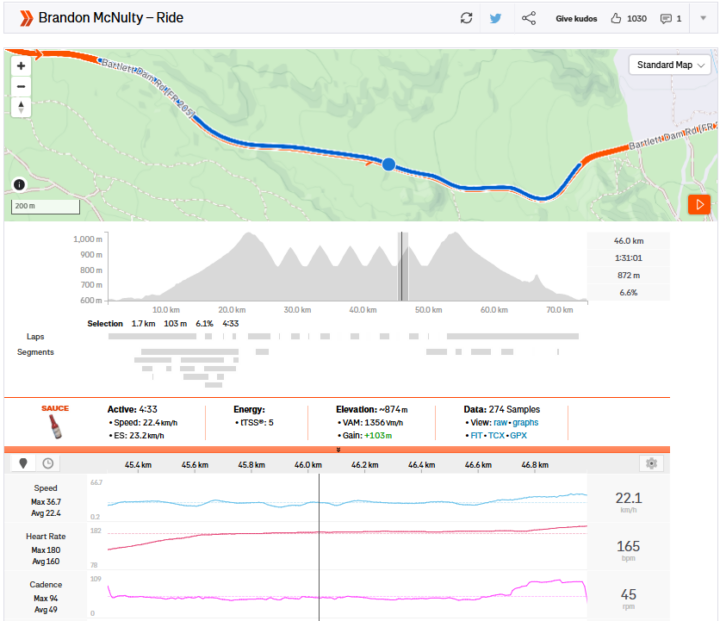
McNulty – 4min Torque Repeats
- Time: 4:30
- 4min Interval: 40 rpm at 90-100% FTP
- 30sec burst: 90rpm, max effort up to 180 bpm HR
The final aspect of the UAE Emirates-XRG plan to point out is their high-intensity interval training. Now, there are a million different ways that you can do a high-intensity interval session, so we won’t dive too deep into the specifics here. But the number-one thing that stands out about UAE Emirates-XRG’s HIIT sessions is that they are super hard, lung-bursting efforts at race intensity.
UAE Emirates-XRG riders spend very little time in Zones 3 and 4. When they do Threshold intervals, they are more than likely riding at 100-105% FTP for 10-20 minutes. When they are doing VO2 Max intervals, they are targeting upwards of 120%, or doing 40/20s at 650w.
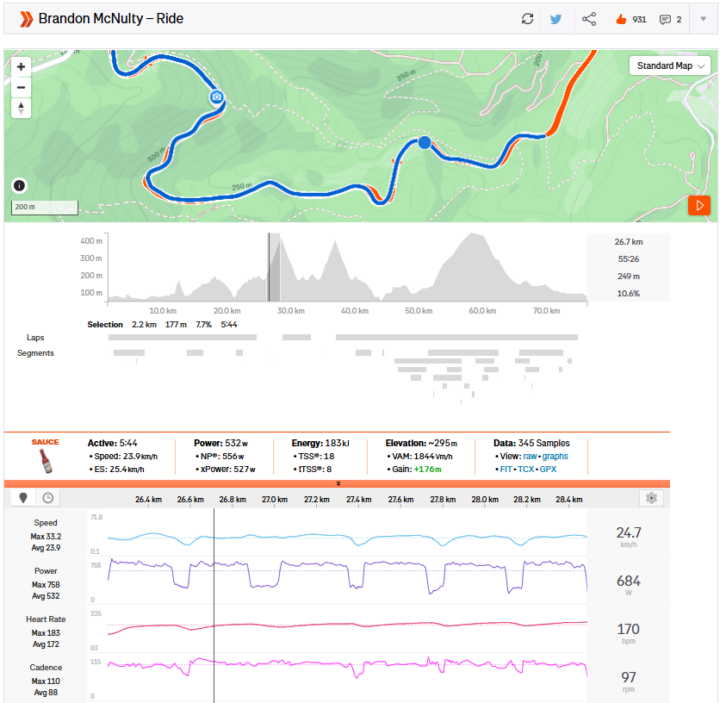
McNulty – Full Gas 40/20s
- Time: 5:44
- Avg Power: 531w
- NP: 555w
- 40sec Intervals: 600-700w
- 20sec Intervals: 200-250w
The thinking here is that you are accumulating more time at a higher percentage of the target training zone. It’s the same philosophy that applies to the team’s Zone 2 riders. Instead of doing four hours at 60% FTP, do 3x1hr intervals at 70% FTP.
Instead of doing 4x5min VO2 Max intervals at 110% FTP – a hard but comfortable interval session – do 4x5min 40/20s at >600w, basically all out.
Some UAE Emirates-XRG coaches have mentioned an interval session that is basically a fatigued power test: go out and ride three hours at Zone 2 pace. Then, perform 3x3min all-out efforts at the end of the ride. It’s a simple but brutal session, and it works because it simulates the demands of a race. Instead of pacing yourself through a series of typical intervals, you first have to accumulate a few hours of fatigue. This forces you to nail your fueling strategy because you know the hardest efforts are coming at the end of the ride. You also have to be mentally switched on all day, especially at the end of the session, which simulates the demands of the race without leg-crushing sprints out of every corner.
The Future of Cycling Training
So what does this all mean? Will professional cyclists start training less and less?
It’s an interesting question because we don’t really know what the tipping point is. For one, it seems like 40 hours per week is too much for a professional cyclist. But at the same time, 10 hours per week isn’t enough.
We can’t say there is a “perfect” amount of weekly training volume because there are so many other factors at play. Plus, you must consider the training or racing phase of the rider – are they in the middle of their off-season, or about to peak for the Tour de France?
Perhaps we’ll see another training revolution in the future. Some riders might ride less than 15 hours per week, but they’ll maintain the same volume throughout the season rather than taking a long off-season break. We’ve already heard of some WorldTour pros shortening their off-season from four weeks to two, so who knows what is next.
It seems that, oftentimes, the off-season is more needed mentally than it is physically. Big training blocks push the body past its limits, and with adequate rest, you come back stronger. Instead of needing a reset at the end of the season, what if we just kept pushing the body constantly?
Instead of a giant fitness climb based on 25-30 hour weeks followed by a massive dip in the off-season, what if we just trained 10-20 hours per week year-round? Maybe that’s what’s next for UAE Emirates-XRG. The low-volume training seems to be working, so I wouldn’t be surprised to see it go even lower in the future.