
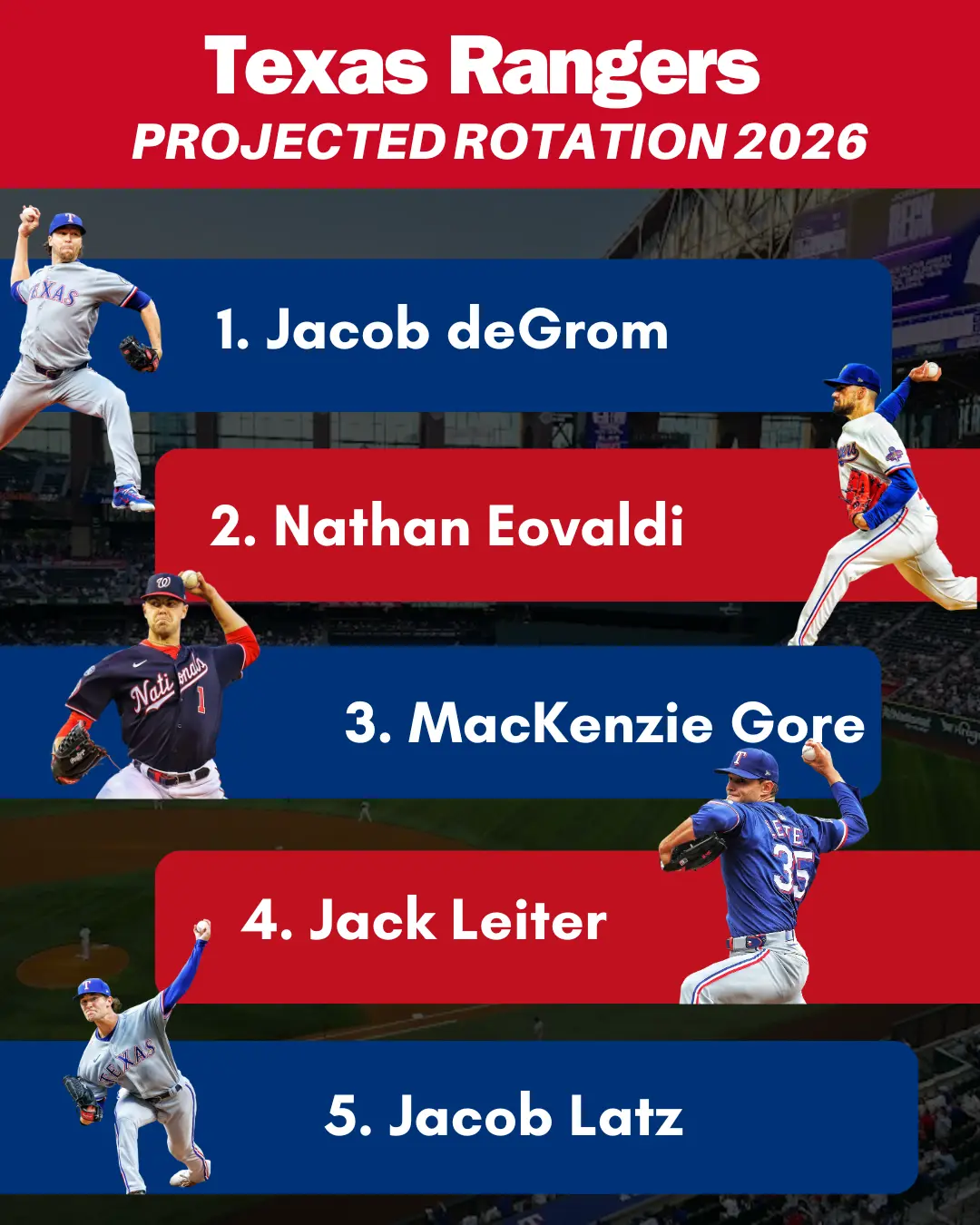
If you’re stacking up starting rotations heading into the 2026 season, the Texas Rangers deserve to be near the very top of the list. Not only do they play half of their games in an extremely pitcher-friendly park, combine that with a front line of Jacob deGrom and Nathan Eovaldi, followed by rising arms in Jack Leiter and MacKenzie Gore, and real depth options competing for the fifth spot, Texas checks nearly every box teams look for in an elite pitching staff: top-end dominance, strikeout ability, innings capacity, and legitimate fallback options.
What separates the Rangers from most contenders is that they don’t rely on just one ace carrying the load. They bring multiple starters who can miss bats, limit damage, and work deep into games — the exact profile of a postseason-caliber rotation.
deGrom and Eovaldi: Ace-Level Production at the Top
Jacob deGrom’s 2025 season showed that, when healthy, he remains one of the most dominant pitchers in the sport. He finished the year with a 2.97 ERA, approximately 173 innings, and 185 strikeouts, good for a strikeout rate north of 30%, while posting a WHIP around 0.92. His expected metrics backed it up, with xERA and xwOBA both ranking among the best in baseball. On Baseball Savant, deGrom continued to rate well above league average in whiff rate, strikeout percentage, and hard-hit suppression, and his fastball velocity remained in the upper-90s, keeping his overall Stuff+ in the well-above-average range (roughly 115+).
Nathan Eovaldi matched deGrom in run prevention and arguably surpassed him in efficiency. In 2025, Eovaldi posted a 1.73 ERA across more than 20 starts, one of the lowest marks in MLB among qualified or near-qualified starters. His strikeout totals were slightly lower than deGrom’s, but his ability to limit walks and weak contact led to elite run suppression. Statcast data showed strong results in barrel rate allowed and expected slugging, and advanced models still graded his pitch mix as comfortably above league average. While his raw Stuff+ is not as high as deGrom’s, his Pitching+ and run value by pitch type reflect how effective his cutter and splitter remain at generating poor contact.
Most teams would consider having either of these pitchers as their clear No. 1 a luxury. Texas has them both.
If you enjoy our content add The Prospect Times as source on Google.
Jack Leiter’s Emergence Adds a Legitimate No. 3
Jack Leiter’s breakout in 2025 turned Texas from a top-heavy rotation into a legitimately deep one. Over roughly 150 innings, Leiter posted an ERA in the high-3.00s with close to 150 strikeouts, showing he could handle both workload and lineup turnover. His strikeout rate hovered around league average to slightly above, but his stuff metrics suggest there is more upside.
On Baseball Savant, Leiter’s fastball and slider both rate positively in whiff rate, and his overall Stuff+ grades as above league average, particularly because of fastball shape and vertical separation. His expected metrics were slightly better than his ERA, suggesting some room for improvement as command and sequencing continue to develop.
For a third starter, that is an extremely strong profile. Many playoff teams enter October with a clear drop-off after their top two arms. Texas does not.
MacKenzie Gore Brings High-End Swing-and-Miss as a Fourth Starter
MacKenzie Gore adds a different kind of value: volatility paired with real upside. In 2025, Gore struck out roughly 180 hitters in about 160 innings, one of the stronger strikeout totals among mid-rotation starters. His ERA was more variable, driven largely by bouts of control issues, but his underlying pitch quality remains excellent.
Statcast metrics show strong chase rates and whiff percentages, especially on his breaking ball, and his fastball velocity and movement profile continue to generate uncomfortable at-bats for hitters. Gore’s overall Stuff+ typically grades well above league average, even when his results fluctuate. As a fourth starter, that kind of swing-and-miss profile is rare and extremely valuable, particularly in short postseason series where dominance can outweigh occasional inefficiency.
Fifth Starter Competition: Real, Usable Depth
The fifth starter spot is expected to be a competition among Cody Bradford, Jake Latz, and Kumar Rocker, and projection systems view all three as viable major-league options rather than emergency depth. ZiPS and similar models project ERAs in roughly the 3.8 to 4.4 range, with WAR projections generally around 1.0 to 1.5 WAR for a full season of work, depending on role and health.
Bradford and Latz provide left-handed options who can navigate lineups multiple times, while Rocker offers power stuff and strikeout upside if he claims a permanent role. The key point is that Texas is not relying on a single fragile fifth starter. They have multiple pitchers who can cover innings without significantly degrading overall rotation performance.
How Texas Compares League-Wide
In 2025, Rangers starters collectively posted an ERA near 3.00, compared to an MLB average closer to 4.00, placing them firmly among the league’s best run-prevention units. They also ranked near the top in quality starts and strikeout rate, meaning they were not only preventing runs but also reducing bullpen strain.
When compared to other respected rotations:
Detroit features an elite ace in Tarik Skubal, but lacks the same level of depth behind him.
Toronto has recognizable names but fewer recent examples of ace-level run suppression at the very top.
The Dodgers feature upside but more workload uncertainty and injury management.
Texas stands out because it combines two legitimate ace-level performers, two additional starters with above-average stuff and strikeout ability, and multiple capable depth options. Very few teams can match that balance.
Why This Rotation Is Built for October
Postseason success often hinges on how many times you can send elite pitching to the mound in a short series. With deGrom, Eovaldi, Leiter, and Gore, Texas can realistically run four straight games with pitchers who miss bats and limit baserunners.
Equally important, several of these pitchers consistently work into the sixth and seventh innings, which protects the bullpen and allows for more aggressive matchup-based relief usage. That flexibility becomes critical in tightly contested playoff series.
Final Take
The Rangers’ rotation is not just strong at the top and survivable at the bottom. It is strong throughout. With ace-level production, emerging young starters, high-end swing-and-miss arms, and legitimate depth, Texas is built to handle both the grind of the regular season and the intensity of postseason play.
That combination is why the Rangers don’t just profile as a top-five rotation heading into 2026 — they have a legitimate argument for the best overall starting staff in baseball.