
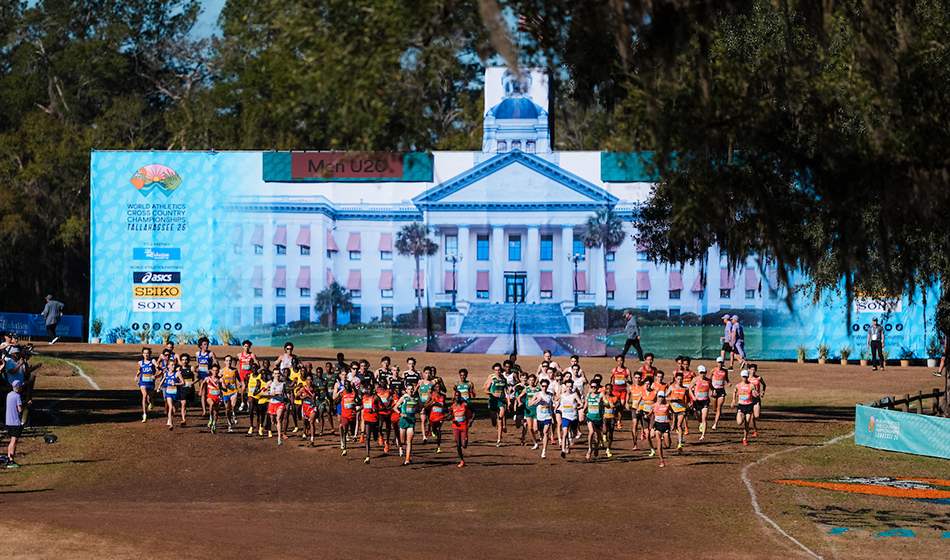
The World Cross Country Championships are in trouble, writes Cathal Dennehy, and the best way to stop it from withering on the vine is to persuade the biggest names in distance running to compete.
The first step in fixing a problem is accepting there is one. The World Cross Country Championships are in trouble, and there’s no point pretending otherwise. To do so would only push the event further along on the slide towards irrelevance.
That may be contentious for those who were in Tallahassee for this year’s edition, who by all accounts had a thoroughly enjoyable experience – and hats off to the hosts for that. An impressive crowd of close to 10,000 saw peerless displays by two of the world’s best distance runners: Agnes Ngetich and Jacob Kiplimo. But the unfortunate reality is that most of the sporting world didn’t even know this was happening, and most of the distance devotees watching on TV or online were left unimpressed.
Hannah England was alone on commentary on the world feed but, as per usual, she did an outstanding job. She was insightful, informative and entertaining, weaving in local knowledge as a former alumna of Florida State University, including how her former coach used to refer to training in the local humidity as a “poor man’s altitude”.
It was a 10-out-of-10 display, but she shouldn’t have been left to carry the can alone. A second person alongside should be mandatory for an event of this stature as it intermittently frees up each commentator to get up to speed on lap splits, team scores and spot something the other might have missed. It also allows for a natural back-and-forth chat, debate and banter – the kind that’s difficult to have when you’re alone. One commentator is fine for lower-tier events, but it should never be the case for a world championship, even when it’s one as brilliant as England.
Watching from afar, many had the same question about the broadcast: why are the pictures so bad? It had the feel of a domestic event, not a global one.
Given part of the course ran through the woods, it apparently wasn’t feasible to have a parallel lane to film athletes from a quad bike, so instead we got a deluge of drone shots from behind the athletes with poor resolution and were often left looking at the tops of trees with no idea what was happening below. Again, this is the World Cross Country, not the Liverpool Cross Challenge.
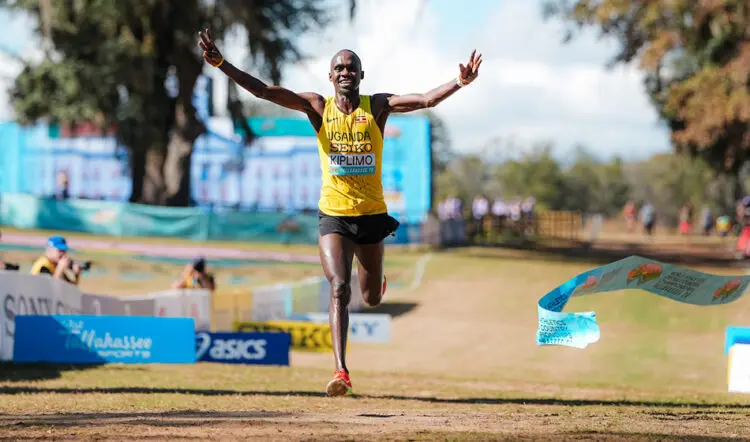
The shot of athletes crossing the line was also strangely distant, well beyond where it needed to be to frame the event branding. As such, it all just had the feel of a scaled-back, low-budget production, but if World Athletics president Seb Coe is serious about getting cross country into the Winter Olympics, that’s not the kind of output you’d put on the table to convince the International Olympic Committee.
Still, the issues facing the World Cross go far beyond its broadcast. It’s now 25 years since a non-African athlete made the senior men’s individual podium, and 15 years since a non-African woman did. The superiority of East African nations has led to declining interest outside of that region but, even within the last two decades of African dominance, the event has still lost something.
I’m thinking here of how great it was back in 2007, when Eritrea’s Zersenay Tadese ran the legs off Kenenisa Bekele in the sweltering heat of Mombasa and tens of thousands of Kenyans erupted in celebration as the Ethiopian great stepped off the course. Just because no American or European was in contention didn’t make it any less captivating. Kampala in 2017 was another great edition, the crowds and atmosphere in Uganda truly befitting the event.
Maybe it needs to return to East Africa. Or to Aarhus in Denmark, which did a fine job in 2019, one that was followed by a mediocre edition in Australia and then an undeniably poor one in Serbia – organised at short notice having originally been slated for Croatia.

Cities willing to bid for it are often hard to come by, but huge focus should be placed on ensuring it goes where it will have several thousand fans – Tallahassee and Aarhus smartly ensured that by staging other races on the same weekend.
But the biggest problem for the World Cross is not the venue or the TV broadcast or whether purists consider the course to be “real cross country” – a term I always find small-minded, given “real cross country” is very different whether you’re living in Nairobi, Edinburgh, Oslo or Madrid. (On this, let’s not homogenise courses to a default setting. The sport’s very nature is that you adjust to the terrain of the host country, whether that’s flat, fairway-like grass, climbing soul-crushing hills or going knee-deep through a muddy quagmire).
No, the biggest issue the World Cross Country has is getting the best athletes to show up. Road races have exploded in quantity and quality over the last two decades and many athletes prioritised them this year over a tilt at the World Cross.
None of the Paris Olympic medallists over 5000m or 10,000m raced in Tallahassee. Just one of the nine athletes to win a medal at those distances at the world championships in Tokyo last year lined up. Out of the 54 athletes who raced over 10,000m in Japan, just 15 raced the World Cross four months later.
The new January slot for the World Cross should, on paper, have made athletes more interested, but it seems it did not. So many European nations have thrown in the towel, seeing it as an unnecessary expense when there’s almost no chance of making an impact.
That attitude runs from federations down to athletes, many of whom are understandably not keen to take an unmerciful beating, feeling the World Cross is no place to be unless you’re firing at full capacity which, let’s face it, no one is in January – not even Kiplimo or Ngetich. Those who do get on the line and risk finishing half a lap behind the world’s best are to be utterly commended.
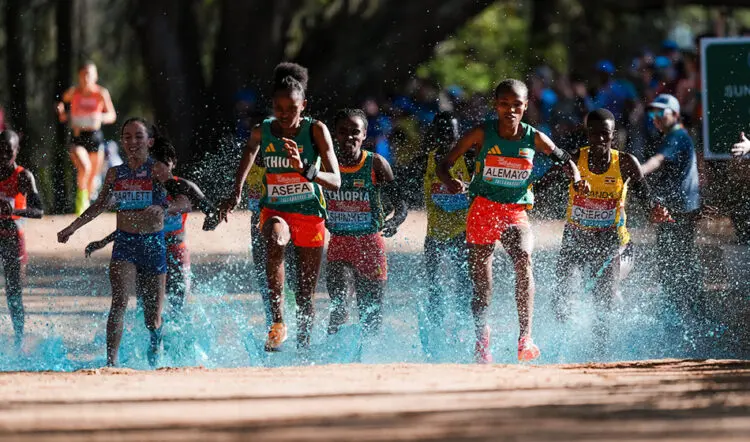
In recent times, there’s been a growing number of gimmicks on the course like water/sand/mud pits. They’re interesting for viewers, welcomed by photographers, but organisers should tread with caution as a course that starts to look like a recipe for injury is one the world’s best track athletes will dodge.
On the track right now, European and US distance runners have closed the gap substantially on their African rivals, but most of them still didn’t want to take them on on a flat, (mostly) dry cross country course. Why?
Maybe it’s time for World Athletics to initiate a consultation process with the likes of Jakob Ingebrigtsen, Nadia Battocletti, Cole Hocker, Grant Fisher, Andreas Almgren and others like them, along with their coaches and managers, asking what date on the calendar, financial incentives and course requirements would need to be met for them to show up and take their shot when the next edition rolls around in 2029.
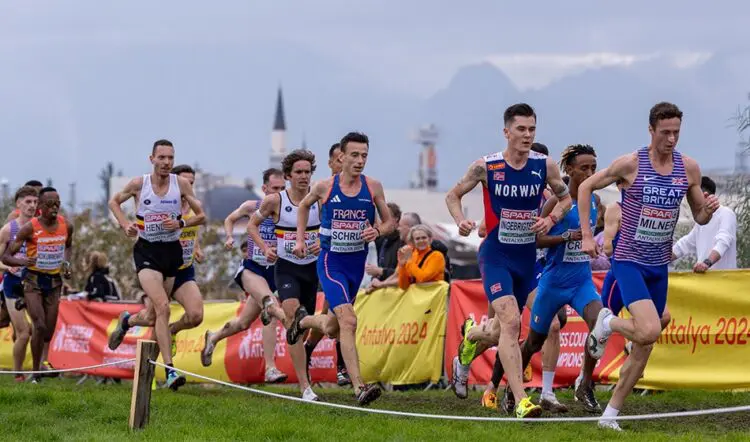
Because for this event to survive, and thrive, it needs the majority of the world’s best 10km runners on that line and, right now, that’s not happening.
On the Podium Athletics podcast, Hannah England put forward two good suggestions: changing the team scoring from four to three, thereby encouraging smaller nations (and lowering their costs); and offering automatic qualification for the World Championships 10,000m to the top-20 across the line.
For Tokyo last year, 14 of the 16 relay qualifying spots were awarded at the World Relays, forcing the hand of nations that otherwise would not have sent teams to China. In 2029, why not give 20 of the 27 spots in the 10,000m away at the World Cross, then fill up the remainder based on world rankings. That – you can be sure – will result in a lot more getting on the start line.
There needs to be more incentive because, right now, too many prefer to race a glorified time trial on the streets of Valencia or around an indoor track in Boston than represent their country at a global championship. That’s not how it should be.
Events come and go in athletics all the time. Just like athletes, they develop, they peak, they decline and then eventually disappear. It’s clear what stage the World Cross Country has now reached. But this is far too good an event, far too prestigious a part of this sport, to be allowed to just wither on the vine.