

Published December 15, 2025 04:38PM
On December 3, Wahoo once again initiated a legal challenge against rival smart trainer company JetBlack. The action represents a new chapter in a years-old story long thought finished. Here’s what has changed since that last chapter in 2022.
In 2022, Wahoo took JetBlack to court
In 2022, Zwift launched a product called the Zwift Hub. It was groundbreaking because it simplified the experience of getting on Zwift and it was a collaboration. The Zwift contribution was color coded directions and ease of use but the actual hardware came from an at the time little known Australian company called JetBlack. JetBlack didn’t only contribute hardware though.
The JetBlack Volt that Zwift rebadged wasn’t just another smart trainer. Actually, it was in a way but what set it apart was price. The Wahoo Kickr Core launched in 2018 for $899 then dropped in price slightly to $699 in 2021. JetBlack and Zwift were offering a quality product that felt a whole like the Wahoo Kickr Core at a price of $499 including a cassette.
I remember sitting in a conference room in Zwift headquarters stating that this would change the industry. I was right about that, but not in the way I thought.
The fallout from the original lawsuit
Turns out that it wasn’t only consumers that saw similarities between the Wahoo Kickr Core and the JetBlack Volt. Wahoo quickly took legal action against JetBlack for patent infringement and the two companies settled. JetBlack agreed to cease all Volt smart trainer imports into the US and Europe and everyone moved on.
The settlement was finalized in September of 2023 and in November 2023, the Zwift Hub Classic was no more. At the time, the replacement was a Wahoo Kickr Core bundle and the Zwift Hub One became the only Zwift branded smart trainer still available. A few months later, in February of 2024, that disappeared as well.
Zwift stopped working with JetBlack and moved that hardware partnership to Wahoo while Wahoo dropped the price of the Kickr Core. This left the two companies with a commanding lead for the entry level smart trainer market. The name recognition of both, combined with more affordable prices, meant that few people looked elsewhere and companies like Garmin effectively stopped competing at that price point. You can see that reflected in my best smart trainers buyers guide.
JetBlack, however, also moved on.
The JetBlack Victory works a lot like the Wahoo Kickr Core 2
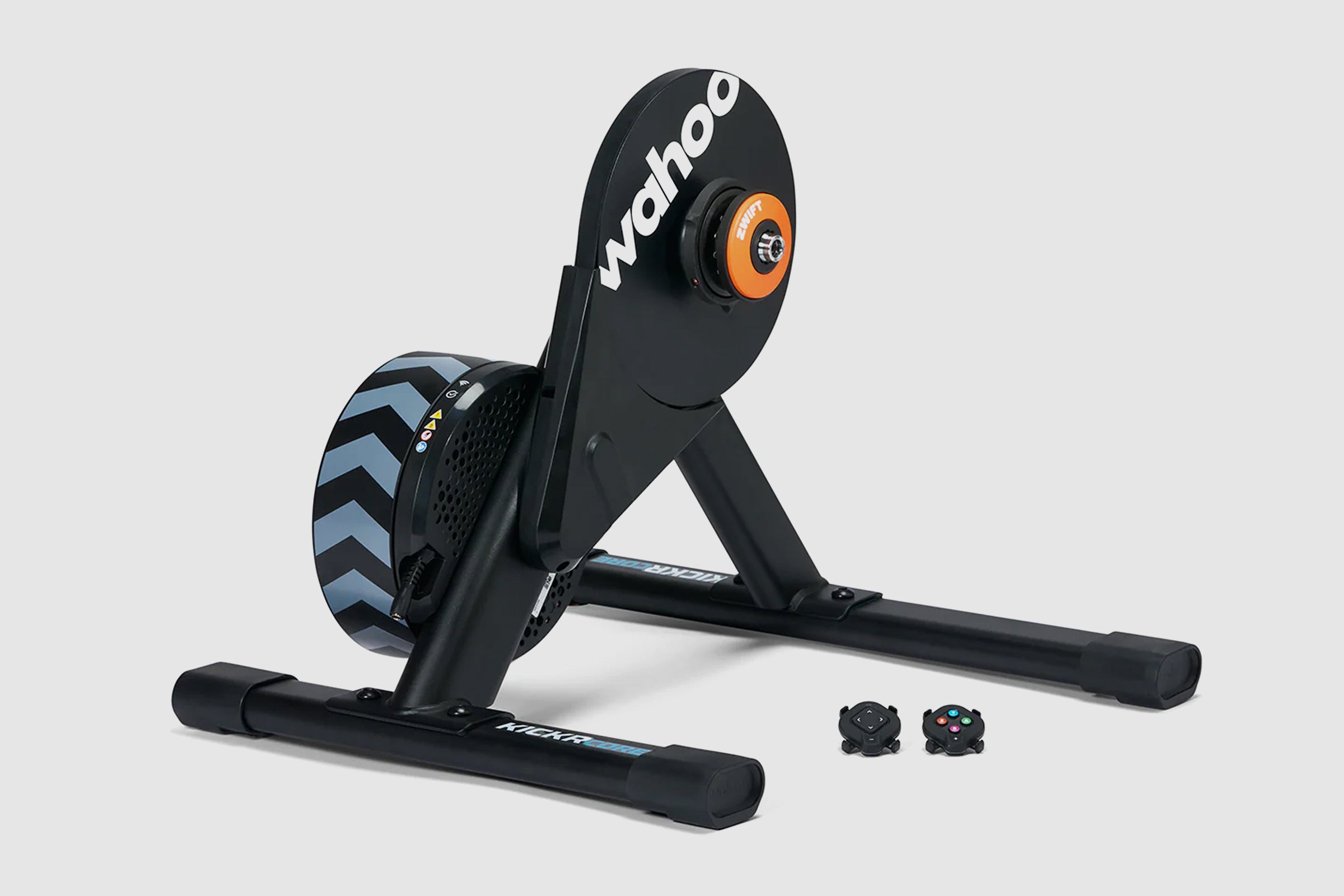
This September, Wahoo updated the Kickr Core. The new Kickr Core 2 refined some of the features of the older model, with things like an updated leg attachment, but also added in features from the Wahoo Kickr. Max resistance and power accuracy remained the same, as did the Zwift Cog compatibility, but now WiFi and race mode are available in the Kickr Core 2 at a price of $549. The Kickr Core 2 launched in September 2025.
Alternatively you could choose the JetBlack Victory smart trainer. The Victory has the exact same features. The Zwift Cog is preinstalled, there’s +/- 2% power accuracy, 1800 max resistance, WiFi, and a 10hz race mode. Instead of $549 the price is $399. The JetBlack Victory launched in November 2024.
The new Wahoo complaint is different
The obvious narrative here is that JetBlack introduced a new model after the 2022 tussle completed and Wahoo is once again claiming patent infringement. The catch is that you’ll notice that the JetBlack Victory was on the market for a year before Wahoo took issue with it.
You could argue that it’s irrelevant when Wahoo claims infringement since Wahoo has the patents. In reality, though, the new case is not the same as the old one. In this 2025 filing, Wahoo is claiming infringement of Patent 10,933,290, Patent 11,559,732, Patent 11,090,542, and Patent 12,330,036. This differs from the first case, which relied on Patent No. 10,046,222.
Critically, two of the patents in the new case are more recent than the 2022 settlement. US Patent No. 11,559,732 was issued in 2023, and US Patent No. 12,330,036 was only issued in June of this year.
While it remains to be proven in court, it appears that this round of alleged infringements is more software-focused than before. The first suit was about hardware — specifically flywheels and belts. This time, the latest 2025 patent covers a “System and Method for Controlling a Bicycle Trainer,” which points to the firmware used to control exact power targets. This likely has a lot to do with the specific tech required to make virtual shifting work with the Zwift Cog.
The other major difference this time is venue. Wahoo is not just suing JetBlack in district court for damages. Instead, Wahoo has opened a complaint with the ITC (International Trade Commission) to specifically block imports of the JetBlack Victory into the United States.
There is no stated rationale for this change in tactic, but there are strategic advantages. First, the ITC is often faster. Because JetBlack is not an American company, a standard patent dispute in federal court could drag on for years.
Second, and perhaps more importantly, the ITC deals in absolute bans rather than licensing fees. Even if Wahoo were to win a standard court case, the result might just be JetBlack paying a royalty fee to Wahoo. That result would be deemed a win that levels the field, but that kind of win can leave hollowed-out companies that exist only through licensing fees. The ITC, however, controls the border. If Wahoo wins here, the JetBlack Victory could immediately disappear from the American market for good.
Someone could be doing some math and deciding that’s a better deal for Wahoo than a settlement.