
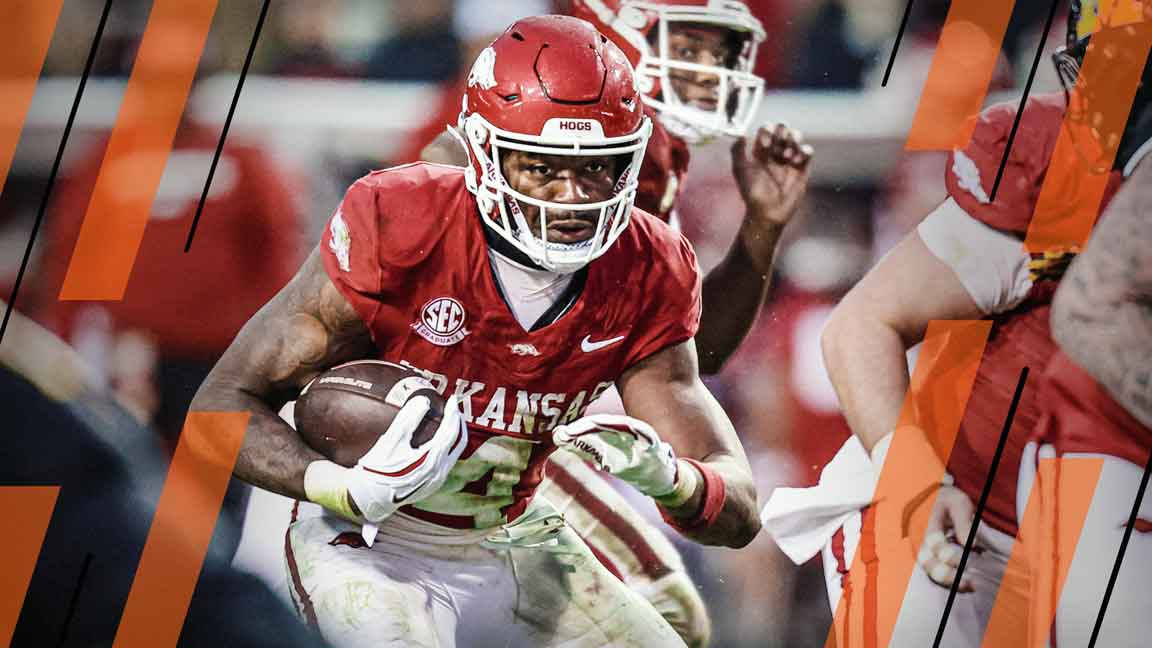
The 2026 NFL Draft delivered on star power at the top, but as always, the first round was just the beginning.
While teams addressed premium needs early, there are still a lot of talented players available heading into Day 2 — a group headlined by players like Georgia linebacker CJ Allen, Toledo standout Emmanuel McNeil-Warren, Clemson cornerback Avieon Terrell and Texas A&M edge defender Cashius Howell.
With value still available across multiple positions, the next two rounds will be critical in shaping the true strength of each draft class. So, as Round 2 approaches, here’s a look at the top remaining prospects at every position.
Click here to jump to position:
QB | RB | WR | TE | T | IOL | DI | ED | LB | CB | S
Quarterback
1. QB Garrett Nussmeier, LSU Tigers
Nussmeier brings NFL bloodlines and a polished, foundational approach to the position, traits that fuel his confidence as a vertical pocket passer. However, his average arm strength and below-average stature could create challenges for his aggressive, gunslinging style at the next level.
2. QB Drew Allar, Penn State Nittany Lions
Allar has the arm talent to play in any offense in the NFL, but he was gun-shy and too inaccurate in 2025. He’s a developmental toolsy prospect who needs some time to refine his game.
3. QB Carson Beck, Miami (FL) Hurricanes
Beck enters the NFL with a ton of playing experience, clean fundamentals and a good game manager’s mindset. However, his arm talent took a big hit in 2025 after his UCL surgery and could be an unfortunate roadblock to NFL success.
4. QB Cade Klubnik, Clemson Tigers
Klubnik brings high football character and a pretty passing style as a touch passer, but there’s a good chance he lacks the physical traits or arm talent to be a long-term starter in the pro game. He’ll have to be an assassin in his pre-snap reads and post-snap recognition to be a starter — but at worst, he is a preferred long-term backup.
5. QB Jalon Daniels, Kansas Jayhawks
Daniels’ profile reflects steady but unspectacular production, with PFF grades ranging from 84.6 in 2023 to 77.1 in 2025 over the past five seasons. In 2025, he completed 198 of 321 passes for 2,531 yards, 22 touchdowns and seven interceptions, recording 18 big-time throws against 15 turnover-worthy plays. His 82.7 clean-pocket grade drops sharply to 44.6 under pressure, underscoring his inconsistency when forced off his spot. At 6-foot and 219 pounds, Daniels offers added value as a runner, totaling 1,916 career rushing yards and 23 touchdowns. However, 33 career fumbles and below-average stable passing metrics limit his overall projection. The profile aligns with his No. 240 ranking on PFF’s Big Board as a developmental quarterback with dual-threat ability but significant refinement needed as a passer.
6. QB Taylen Green, Arkansas Razorbacks
Green is a well-built, athletically gifted prospect whose inconsistent passing will likely hold him back from a shot at a starter role (and maybe even a backup) in the pros. However, he is such a good athlete that a change to tight end or wide receiver could be in the cards.
7. QB Cole Payton, North Dakota State Bison
In a world where people like to force “the next Taysom Hill” each draft season, Payton actually has the ingredients to potentially be worthy of that comparison. He is a well-above-average athlete for the position and a decent enough passer (lefty) to play as an H-back and even a dropback quarterback in a pinch. However, his play as a quarterback under pressure against NFL-caliber competition is still quite unproven.
8. QB Luke Altmyer, Illinois Fighting Illini
Altmyer’s physical limitations lower his ceiling in the pros, but due to his high football IQ and how calm he is as a pocket passer with good feel, timing and touch, he presents a good floor as a backup quarterback who could come in and start with moderate success in a pinch.
9. QB Sawyer Robertson, Baylor Bears
Robertson has NFL-caliber tools (arm strength and overall size), but his inconsistent fundamentals lead to too many inconsistent results and negative plays in his current state. That must be cleaned up before he gets a starting shot in the pros.
10. QB Haynes King, Georgia Tech Yellow Jackets
King is a 25-year-old quarterback with three years of starting experience at Georgia Tech after beginning his career at Texas A&M. His profile centers on toughness and rushing value, with more than 150 rushing conversions over the past three seasons and at least 10 rushing touchdowns in each year, though he still requires development as a passer. He earned an 80.9 PFF passing grade in 2025 and completed 252 of 365 passes for 2,936 yards, with 15 big-time throws against four turnover-worthy plays. His performance split shows a clear gap, with a 91.0 passing grade from a clean pocket compared to 48.7 under pressure last season, and three of his four turnover-worthy plays came on pressured dropbacks.
Running back
1. HB Mike Washington Jr., Arkansas Razorbacks
Washington brings alluring size, straight-line speed and yards-after-contact potential as a power back, but also noticeably good vision and footwork to be a potential early-down back in a committee in a man- or gap-scheme run game.
2. HB Jonah Coleman, Washington Huskies
Coleman may not have the flashy athleticism of a fan-favorite RB1, but his game is efficient, powerful and translatable to NFL success, specifically behind zone-blocking schemes where he can gain momentum and one-cut into rushing lanes. He also brings plus third-down reliability as a receiver and pass protector.
3. HB Seth McGowan, Kentucky Wildcats
McGowan has the build and athleticism to be a starting-caliber back at the NFL level. His explosiveness in short areas and long speed, paired with quick processing and play speed, make him a difference-maker between the tackles in power-run concepts.
4. HB Emmett Johnson, Nebraska Cornhuskers
Johnson brings excellent footwork and quickness to the backfield, with good receiving ability to boot. His résumé is of a player who can be successful in man- or gap-blocking concepts, with three-down potential, especially as a receiver.
5. HB Nicholas Singleton, Penn State Nittany Lions
Singleton is a gifted athlete, particularly for his size. He has the physical tools to be a productive NFL back, but inconsistent patience and creativity with the ball limit his ceiling. He does offer legitimate third-down potential as a capable receiver and generally reliable pass protector, though he must eliminate the occasional negative play in pass protection.
6. HB Le’Veon Moss, Texas A&M Aggies
Moss’ injury history will likely push him into Day 3, but he remains a solid all-around back with three-down potential and an RB2 or RB3 projection. His foot quickness and processing ability give him a chance to succeed in man- and gap-scheme blocking concepts.
7. HB Jaydn Ott, Oklahoma Sooners
Ott is a talented back who showed three-down ability as an underclassman, but a puzzling 2025 for him — both in terms of when he was playing and why he wasn’t — clouds his draft projection.
8. HB Kaytron Allen, Penn State Nittany Lions
Allen is somewhat limited in his overall athletic profile, but when viewed through the lens of a power back — short-yardage efficiency, yards after contact and pass protection — he projects as a useful committee contributor. He fits best in an offense built around man- and gap-scheme concepts between the tackles.
9. HB Demond Claiborne, Wake Forest Demon Deacons
Claiborne is a souped-up, scatback-type runner with a sprinter’s track background that clearly translates to the field. He is at his best in zone-blocking concepts, where his speed and acceleration can stress defenses. He offers solid receiving upside and projects as an RB3 with special-teams value or as a speed complement in a two-back rotation.
10. HB J’Mari Taylor, Virginia Cavaliers
Taylor’s college journey has been defined by having to prove himself at every stop. He brings a compact but strong build suited for the NFL and has the overall talent to project as an RB3 with spot-start potential in power and inside-zone concepts.
Wide receiver
1. WR Denzel Boston, Washington Huskies
Boston is a smooth-moving “X” receiver with the size and skill set to develop into a starting outside receiver at the next level. He is less comfortable and productive against zone coverage, but in single-coverage situations, he is often the player to bet on thanks to his elite hand strength.
2. WR Chris Bell, Louisville Cardinals
Bell offers an impressive blend of size — particularly weight — and explosiveness as a WR2 in a vertical offense. Some tightness in his lateral movements limits his ability to win with nuanced route-running, but when kept on vertical or horizontal routes, he can generate separation on deep routes and create yards after the catch on shorter touches.
3. WR Germie Bernard, Alabama Crimson Tide
Bernard has developed into a solid, high-floor receiver with good nuance and football IQ, though his limited physical and athletic ceiling projects him more as a depth option than a consistent contributor.
4. WR Chris Brazzell II, Tennessee Volunteers
Brazzell is a boom-or-bust vertical receiver capable of posting 100 yards one week and 20 the next. His route tree is limited, but what he does — winning downfield — he does very well. In a vertical offense, he projects as a high-upside outside receiver who will likely begin his career as a WR3. If a team bets on his skill set and he hits, he has the potential to become an impact player.
5. WR Skyler Bell, Connecticut Huskies
Bell looked uncoverable at times against his level of competition in his final season and, despite below-average size and athleticism, produced like a top-100 prospect as a productive slot receiver.
6. WR Bryce Lance, North Dakota State Bison
Lance dominated FCS competition as a versatile “X” receiver. He moves well for his size and pairs that with reliable contested-catch production, giving him a strong case as an early Day 3 pick with the potential to develop into a contributing NFL receiver.
7. WR Antonio Williams, Clemson Tigers
Williams is a quick, precise slot-only receiver with strong separation metrics but a low average depth of target. His special teams experience helps support his projection as a depth receiver.
8. WR Elijah Sarratt, Indiana Hoosiers
Sarratt may profile as a below-average athlete for an NFL “X” receiver, but there is still plenty to like in his game. His strong hands, coordination and determination at the catch point — combined with his constant competitiveness — give him starter potential as an outside WR2 in offenses that value jump-ball opportunities.
9. WR Zachariah Branch, Georgia Bulldogs
Branch is a likely Day 2 pick due to his rare, difference-making athleticism. However, he relies heavily on speed and must continue to refine the nuance and technique in his route running to avoid being limited to a special teams role.
10. WR Deion Burks, Oklahoma Sooners
Burks’ size and production do not clearly point to a future NFL contributor, but his athleticism and strength make him difficult to dismiss. He offers intriguing upside as an explosive slot receiver, though he may not fit every scheme.
Tight end
1. TE Eli Stowers, Vanderbilt Commodores
Stowers is a natural, versatile athlete with a high usage rate over the past two seasons, projecting to a contributing NFL role. He is best utilized as a backfield or big-slot option rather than as an in-line blocker, where his impact is limited.
2. TE Max Klare, Ohio State Buckeyes
Klare is a lighter tight end whose blocking flashes but lacks consistency. He compensates with savvy receiving skills and reliable hands, projecting as a potential starter for teams that prioritize tight end involvement in the passing game.
3. TE Sam Roush, Stanford Cardinal
Roush has the build of an NFL tight end capable of playing on the line of scrimmage. As a blocking “Y” tight end, he can be a valuable piece in heavy personnel packages and some single-tight-end looks, though his impact in the passing game will likely be limited.
4. TE Michael Trigg, Baylor Bears
Trigg may have one of the widest ranges of outcomes in the 2026 class. At his best, his vertical athleticism and contested-catch ability suggest top-50 potential, but inconsistencies with technique and focus create volatility in his projection.
5. TE Justin Joly, North Carolina State Wolfpack
Joly is a natural receiving tight end with strong hands, a high football IQ and a competitive edge. While he lacks standout athletic traits, he offers enough to project as a contributor on offense and special teams.
6. TE Jack Endries, Texas Longhorns
Endries profiles as a strong mid-round option for teams that utilize heavier personnel and want to stretch the field vertically. He offers alignment versatility as a slot or wing and contributes as both a pass catcher and lead blocker.
7. TE Marlin Klein, Michigan Wolverines
Klein is an intriguing young prospect who is relatively new to football but shows the effort and mentality to develop into a difference-making in-line tight end. If he continues to add weight and strength, he projects as a strong TE2-type with blocking upside.
8. TE Dallen Bentley, Utah Utes
Bentley produced as a receiving tight end in 2025 but likely lacks the baseline athleticism needed to stick at the next level. He will need to win with anticipation and route nuance to overcome those limitations.
9. TE Nate Boerkircher, Texas A&M Aggies
Boerkircher will be one of the oldest prospects in the class as a sixth-year senior, but he showed depth-level NFL ability in 2025. He is a tenacious run blocker with strong competitive toughness and better athleticism than his receiving production suggests. He projects as a Day 3 depth option with versatile blocking value.
10. TE Joe Royer, Cincinnati Bearcats
Royer is a receiving-focused tight end best kept out of key blocking situations. He brings above-average athleticism and excellent hands, projecting as a TE2 with flexibility to align in receiver roles.
Tackle
1. T Gennings Dunker, Iowa Hawkeyes
Dunker has tackle experience but projects best to guard due to his build and skill set. He flashes devastating power, particularly in zone schemes, but must clean up inconsistencies with balance and patience to raise his floor.
2. T Caleb Tiernan, Northwestern Wildcats
Tiernan is a smart, balanced and experienced tackle whose limitations stem from a naturally high pad level and shorter arm length. Despite that, his technique and football IQ give him a path to a starting role.
3. T Markel Bell, Miami (FL) Hurricanes
Bell’s size is a rare trait, even at the NFL level. He is a better athlete than expected for his frame, but limitations in foot speed and flexibility could impact his ability to develop into a full-time starter.
4. T Dametrious Crownover, Texas A&M Aggies
Crownover stands out for his massive frame at 6-foot-7 and 319 pounds with over 35-inch arms, which should earn him a look at the next level. However, he must translate those physical traits more consistently in pass protection to reach his potential. He earned a 58.4 pass-blocking grade in 2025 and allowed two sacks, two hits and 23 hurries across 428 pass-blocking snaps.
5. T Kage Casey, Boise State Broncos
Casey drew attention as the lead blocker for Ashton Jeanty and dominated Mountain West competition in both phases. He earned an 80.0 PFF grade in 2025, including an 80.1 pass-blocking grade and a 75.8 run-blocking mark. His 33.25-inch arms rank in the 31st percentile at the position, which suggests a likely move inside, where his limitations in burst can be mitigated.
6. T Brian Parker II, Duke Blue Devils
Parker offers positional versatility with the ability to play both guard and tackle, and his strength in the run game stands out through consistent displacement at the point of attack. He earned an 83.9 run-blocking grade alongside an 83.4 pass-blocking grade in 2025, which reflects balanced production across both phases. He allowed three sacks, two hits and 15 hurries on 538 pass-blocking snaps, and must reduce the rate at which pressures turn into sacks to maximize his effectiveness at the next level.
7. T Jude Bowry, Boston College Eagles
Bowry is a solid athlete with good size who projects as a versatile swing lineman in a zone scheme, though he may lack the power needed to become a full-time starter.
8. T Trey Zuhn III, Texas A&M Aggies
Zuhn stands out as one of the cleaner pass protectors in college football, though his run blocking lags behind, and his shorter arms project a move inside to guard despite extensive SEC experience. He measured 6-foot-7 and 312 pounds and paired that size with strong testing, including a 5.00 40-yard dash (89th percentile), 2.83 20-yard split (96th percentile) and 1.70 10-yard split (94th percentile), along with 33 bench reps, a 32-inch vertical (90th percentile) and a 9-foot-3 broad jump (86th percentile). He earned an elite 96.8 pass-blocking grade in 2025 and allowed two sacks, one hit and seven hurries across 435 pass-blocking snaps.
9. T J.C. Davis, Illinois Fighting Illini
Davis, a two-year starter at Illinois, has the length to remain at tackle at the next level, though improved recovery in pass protection will be key to earning early playing time. He earned an 82.1 pass-blocking grade at New Mexico in 2023, followed by marks of 73.1 in 2024 and 77.4 in 2025 at Illinois. In his final season, he allowed three sacks, two hits and 13 hurries across 417 pass-blocking snaps, while posting an 86.7 run-blocking grade that highlights his impact in the run game.
10. T Austin Barber, Florida Gators
Barber, a three-star recruit from Jacksonville, Florida, developed into a multi-year starter at left tackle after beginning his career on the right side. At over 6-foot-6 and 315 pounds, he has a prototypical frame with solid athleticism, flexibility and balance, giving him developmental starting potential.

Interior offensive line
1. G Emmanuel Pregnon, Oregon Ducks
Pregnon took a major leap in 2025, earning an 86.7 PFF grade across a career-high 910 snaps after never dipping below 625 snaps in any season. His 88.1 pass-blocking grade ranked seventh among FBS guards, and he allowed just one sack, two hits and two hurries on 471 pass-blocking snaps. He flashed high-end upside with 85th-percentile marks on true pass sets and elite production in zone schemes (98th percentile zone run-blocking grade).
2. G Chase Bisontis, Texas A&M Aggies
Bisontis posted a 62.4 PFF grade in 2025 across a career-high 795 snaps after earning marks of 55.2 in 2023 and 70.2 in 2024. He ranked in the 56th percentile in run-blocking grade on zone runs, 23rd percentile on gap runs and 59th percentile in pass-blocking grade on true pass sets.
3. C Connor Lew, Auburn Tigers
Lew is a technically sound center with excellent leverage, balance and posture. His consistent fundamentals allow him to win positioning battles, though he can struggle against top-end power due to his lighter build. His upside is high given his age and technique.
4. C Sam Hecht, Kansas State Wildcats
Hecht delivered a strong 2025 campaign, earning an 80.3 PFF overall grade that ranked fourth among centers. He brings a balanced profile, ranking 10th in PFF run-blocking grade (77.7) while holding up adequately in pass protection. Across 759 snaps, he allowed just seven pressures, with zero sacks and zero quarterback hits, and committed no penalties.
5. G Jalen Farmer, Kentucky Wildcats
Farmer put together a solid but unspectacular 2025 season, earning a 69.8 PFF overall grade that ranked 93rd among guards. His best work came in pass protection, where his 72.4 PFF pass-blocking grade ranked 256th, while his 67.4 run-blocking grade ranked 113th. Across 818 snaps, he allowed 14 pressures, including three sacks and no quarterback hits, and committed one penalty.
6. C Jake Slaughter, Florida Gators
Slaughter is a smart, finesse center who thrives in zone schemes. He is quick off the ball, coordinated in space and effective at the second level. While his athleticism helps offset below-average size and length, he can struggle against NFL-caliber power in one-on-one situations.
7. C Logan Jones, Iowa Hawkeyes
Jones is a high-IQ, feisty center with strong athleticism for zone schemes. He moves well laterally and shows good hand usage, but his outlier-short arm length creates challenges sustaining blocks and handling longer defenders.
8. G Billy Schrauth, Notre Dame Fighting Irish
Schrauth’s career included injury setbacks, but his play on the field showed a high level of performance for Notre Dame. He earned an 82.7 pass-blocking grade and a 73.1 run-blocking grade in 2025, and he did not allow a sack or a hit while surrendering just two hurries across 213 pass-blocking snaps. His game features strong pad level, a firm anchor in pass protection and good grip strength, though balance and foot speed present some limitations. The overall profile supports projection as a starting-caliber interior lineman.
9. G Beau Stephens, Iowa Hawkeyes
Stephens produced high-level play on one of the nation’s top offensive lines, with strong results in both pass protection and the run game. He measured 6-foot-6 and 315 pounds, but his 31.63-inch arms rank in the ninth percentile at the position, which raises concerns about length and overall athletic profile. He earned a 91.6 pass-blocking grade in 2025 and did not allow a sack or a hit, while surrendering just four hurries across 304 pass-blocking snaps. Teams must weigh the quality of his tape against those physical limitations when projecting his role at the next level.
10. C Jager Burton, Kentucky Wildcats
Burton’s quickness stands out as a defining trait, and he fits well in gap-based run schemes. He ranks No. 141 on PFF’s Big Board and earned a career-best 71.3 PFF grade in 2025, including a 79.5 pass-blocking grade and a 67.5 run-blocking grade. He allowed 12 pressures on 457 pass-blocking snaps, all of which came as hurries, without surrendering a sack or a hit. His athletic profile supports that performance, with most measurables above the 75th percentile, including a 98th-percentile broad jump and a 4.94 40-yard dash that ranks in the 96th percentile.
Defensive interior
1. DI Kayden McDonald, Ohio State Buckeyes
McDonald posted a career-best 86.0 PFF grade in 2025, fueled by elite run defense, where his 91.2 grade ranked first among qualifying FBS interior defenders. He backed that up with top-tier stability, landing in the 99th percentile in run-stop rate and 95th percentile in run-defense grade. The pass-rush profile remains limited, though, with a 63.1 grade and sub-15th percentile marks in both overall and true pass-rush situations.
2. DI Christen Miller, Georgia Bulldogs
Miller has a strong frame with good length and rare twitch for an interior defender. His quick first step and leverage make him a reliable run defender, and his processing ability adds to his projection, though he must continue to develop his anchor.
3. DI Lee Hunter, Texas Tech Red Raiders
Hunter showed steady improvement across four seasons, culminating in a career-best 80.9 PFF grade in 2025. He earned an 84.5 run-defense grade, 12th among FBS interior defenders, finishing in the 96th percentile in run-stop rate. His pass-rush profile was solid but unspectacular, generating 26 pressures and a 72.1 grade, with above-average marks in both overall and true pass-rush situations.
4. DI Gracen Halton, Oklahoma Sooners
Halton is an undersized, versatile defensive lineman who wins with quickness, effort and movement skills. His lack of strength can be an issue, but he fits well in multiple or movement-based fronts.
5. DI Domonique Orange, Iowa State Cyclones
Orange is a massive defensive line prospect with elite power potential, supported by impressive weight-room strength. His first-step explosiveness allows him to generate strong speed-to-power as a bull rusher, particularly in attack mode. However, his hand speed and pass-rush finesse are limited, which impacts his ability to disengage consistently. He projects best as a high-effort, power-based lineman in a 3-4 scheme.
6. DI Darrell Jackson Jr., Florida State Seminoles
Jackson is a massive, powerful defensive tackle with imposing physical traits. When his hand usage is right, he can be dominant, but inconsistency in technique and processing limits his impact. He remains a high-upside prospect.
7. DI Rayshaun Benny, Michigan Wolverines
Benny earned a 79.3 PFF grade in 2025, ranking 62nd among 887 qualifying interior defenders. He posted a 68.5 pass-rush grade (161st) and an 83.5 run-defense grade (35th). His production leaned toward run defense, with a clear disparity between phases.
8. DI Dontay Corleone, Cincinnati Bearcats
Corleone, known as “The Godfather,” was one of the most dominant run defenders in 2022, using his size and strength to control the line of scrimmage. His performance has declined in recent seasons, and his 2024 medical history adds some concern. He offers rare quickness for a nose tackle and can control blockers despite shorter arms, though his pass-rush impact remains limited. He projects as a traditional 3-4 nose tackle.
9. DI Kaleb Proctor, Southeastern Louisiana Lions
Proctor, No. 111 on PFF’s Big Board, offers an unusual profile given his size and level of competition, but his explosiveness and pass-rushing ability stand out. His 2025 production supports that evaluation, as he earned an 86.5 PFF grade and generated 39 pressures, including nine sacks, four hits and 26 hurries. His performance against LSU in particular highlights his upside and reinforces his case as a potential late-round value.
10. DI Zxavian Harris, Mississippi Rebels
Harris has intriguing size and length but must find a consistent playing weight to define his role. His high pad level and inconsistent technique limit his impact, projecting him as a rotational player in an odd front.
Edge
1. ED Cashius Howell, Texas A&M Aggies
Howell’s measurables are not ideal, but his hand usage, burst and pass-rush arsenal allow him to be disruptive in one-on-one situations as a situational edge defender.
2. ED T.J. Parker, Clemson Tigers
Parker is a well-rounded edge defender who does many things at a solid level but lacks a true difference-making trait. He projects as a rotational player with starting potential if he develops more strength or explosiveness.
3. ED Zion Young, Missouri Tigers
Young is a well-built, high-effort edge defender who brings consistent energy and strength in run defense. His overall athletic limitations may cap his pass-rush production.
4. ED R Mason Thomas, Oklahoma Sooners
Thomas brings explosive traits from his track background, giving him pass-rush upside despite size limitations. He projects as a situational contributor.
5. ED Gabe Jacas, Illinois Fighting Illini
Jacas can be reactionary at times, but when he diagnoses plays correctly, he shows NFL-level playmaking ability. His build and strength support versatility as a 3-4 defensive end or outside linebacker.
6. ED Joshua Josephs, Tennessee Volunteers
Josephs has an appealing blend of size and explosiveness but must improve his technique and anticipation to reach his potential.
7. ED Derrick Moore, Michigan Wolverines
Moore is a smaller edge defender who wins with quickness and pass-rush IQ. His lack of length may limit sack totals, but he can contribute as a rotational 3-4 outside linebacker.
8. ED Dani Dennis-Sutton, Penn State Nittany Lions
Dennis-Sutton projects best as a 3-4 defensive end with some 4-3 flexibility. His length and size are clear strengths, though his agility in space is more limited. With ascending play, he could be drafted higher than his current tape suggests.
9. ED Romello Height, Texas Tech Red Raiders
Height shows pass-rush ability with quickness and technique but must add strength to hold up consistently. His projection depends on maintaining athleticism as he develops physically.
10. ED LT Overton, Alabama Crimson Tide
Overton fits best as a 3-4 defensive end with inside-out versatility. He can contribute in a 4-3 as a power end, but his lack of bend and stride length limits his ability to consistently threaten the edge.
Linebacker
1. LB CJ Allen, Georgia Bulldogs
Allen is a physical, reliable middle linebacker with strong run-defense ability. His length limitations are notable, but he flashes enough in coverage to project as a starter.
2. LB Jacob Rodriguez, Texas Tech Red Raiders
Rodriguez has elite football IQ but lacks the physical tools to match. His instincts keep him in position, though his limited range and power cap his ceiling.
3. LB Jake Golday, Cincinnati Bearcats
Golday has intriguing length and athleticism with starter potential, but he must improve instincts and anticipation. At worst, he profiles as a strong depth and special teams option.
4. LB Josiah Trotter, Missouri Tigers
Trotter is a physical, downhill linebacker best suited for a 3-4 scheme. He must improve in coverage and play recognition to become a consistent starter.
5. LB Kyle Louis, Pittsburgh Panthers
Louis is an undersized linebacker who projects best as a versatile space defender. In the right role, he can be an impact nickel player thanks to his explosiveness and coverage ability.
6. LB Anthony Hill Jr., Texas Longhorns
Hill is a strong athlete with good length who fits best as a WILL linebacker in a 4-3 scheme, where he can play in space and avoid consistent block engagement.
7. LB Keyshaun Elliott, Arizona State Sun Devils
Elliott has shown flashes as a downhill player, with effectiveness as a run defender and blitzer, but his below-average frame helps explain his limitations in coverage. He earned PFF grades of 67.8 in 2024 and 67.5 in 2025, which reflect a steady but unspectacular profile. His struggles in coverage may limit his role at the next level, though he still offers some starting upside in the right situation.
8. LB Deontae Lawson, Alabama Crimson Tide
Lawson is undersized but experienced and quick. He projects as a rotational linebacker with some starting potential.
9. LB Bryce Boettcher, Oregon Ducks
Boettcher is a high-energy, multi-sport athlete who plays with physicality despite a smaller frame. He could carve out a role in an attacking defensive scheme.
10. LB Taurean York, Texas A&M Aggies
York wins with elite anticipation and instincts despite below-average measurables. His intelligence and competitiveness give him a chance to stick as a MIKE linebacker.
Cornerback
1. CB Jermod McCoy, Tennessee Volunteers
McCoy’s medical evaluations will be critical, but based on his measurables and 2024 tape, he profiles as a first-round talent with shutdown potential in press-man coverage.
2. CB Avieon Terrell, Clemson Tigers
Terrell’s lack of length may limit him to zone-heavy schemes, but his elite football IQ and playmaking instincts give him starting potential across multiple systems.
3. CB Colton Hood, Tennessee Volunteers
Hood is a talented but inconsistent young prospect who needs further development. With only one full season as a starter, he may struggle early if tasked with covering NFL receivers right away.
4. CB Brandon Cisse, South Carolina Gamecocks
Cisse can lack physicality at times, but his explosiveness and twitch give him the tools to develop into a starting NFL cornerback.
5. CB D’Angelo Ponds, Indiana Hoosiers
Ponds plays with clear passion and urgency every snap. While his size, athleticism and strength limitations cap his ceiling, his football IQ and instincts give him starter potential as a zone defender.
6. CB Keith Abney II, Arizona State Sun Devils
Abney’s lack of length and top-tier athleticism may limit him to zone schemes, but his competitiveness and run-defense mentality make him a valuable rotational defensive back with starter potential.
7. CB Keionte Scott, Miami (FL) Hurricanes
Scott is a tone-setter in run defense with a physical mentality. His zone coverage is adequate, but man coverage limitations may restrict his role.
8. CB Treydan Stukes, Arizona Wildcats
Stukes worked his way from walk-on to starter and projects best as a hybrid slot defender. While he lacks top-tier athleticism for outside roles, his instincts and playmaking ability stand out.
9. CB Davison Igbinosun, Ohio State Buckeyes
Igbinosun has the size and physicality teams want in press-man coverage, but he must clean up his technique and avoid panic at the catch point to limit penalties.
10. CB Chandler Rivers, Duke Blue Devils
Rivers logged 3,186 defensive snaps across four seasons at Duke and allowed just one touchdown in coverage in 2025, with a sub-85.0 passer rating when targeted for the third straight year. He earned a 90.7 PFF grade in 2024 before taking a step back in 2025. Over the past three seasons, he has been flagged just four times while playing more than 70% of his snaps on the outside.
Safety
1. S Emmanuel McNeil-Warren, Toledo Rockets
McNeil-Warren is a big, explosive safety with a knack for creating turnovers. He projects as a potential impact starter in a box role.
2. S A.J. Haulcy, LSU Tigers
Haulcy is a true deep safety with strong range, ball skills and an aggressive playmaking mentality. He projects as a starter in systems that keep him in a traditional backend role.
3. S Kamari Ramsey, USC Trojans
Ramsey provides versatility with the ability to play both safety spots and the slot, particularly in two-high looks. His lighter build and good — but not elite — athleticism cap his ceiling.
4. S Genesis Smith, Arizona Wildcats
Smith has intriguing size and athletic traits for a single-high role, but inconsistency with physicality and play strength limits his reliability.
5. S Zakee Wheatley, Penn State Nittany Lions
Wheatley is a long, springy athlete best suited for single-high roles. His slender build can be exposed in the box, but he offers strong range and coverage ability in space.
6. S Bud Clark, TCU Horned Frogs
Clark is a long, explosive playmaker with strong ball skills, but his lack of strength in run defense will need to be managed.
7. S Michael Taaffe, Texas Longhorns
Taaffe wins with intelligence and anticipation rather than physical traits. His size and athletic limitations mean he will need to earn his role through consistency and awareness.
8. S Jalen Stroman, Notre Dame Fighting Irish
Stroman is a versatile defensive back who flourished in his lone season at Notre Dame, earning a 79.8 PFF overall grade. However, he will need to show that his earlier inconsistency at Virginia Tech and a 14.6% career missed tackle rate won’t limit his ability to hold up at the next level.
9. S Cole Wisniewski, Texas Tech Red Raiders
Wisniewski projects as a box safety with good awareness and the ability to match up with tight ends, though limited range may cap his role.
10. S Bishop Fitzgerald, USC Trojans
Fitzgerald shows strong instincts and ball skills in coverage, but inconsistent run support and limited slot versatility may restrict his usage.