
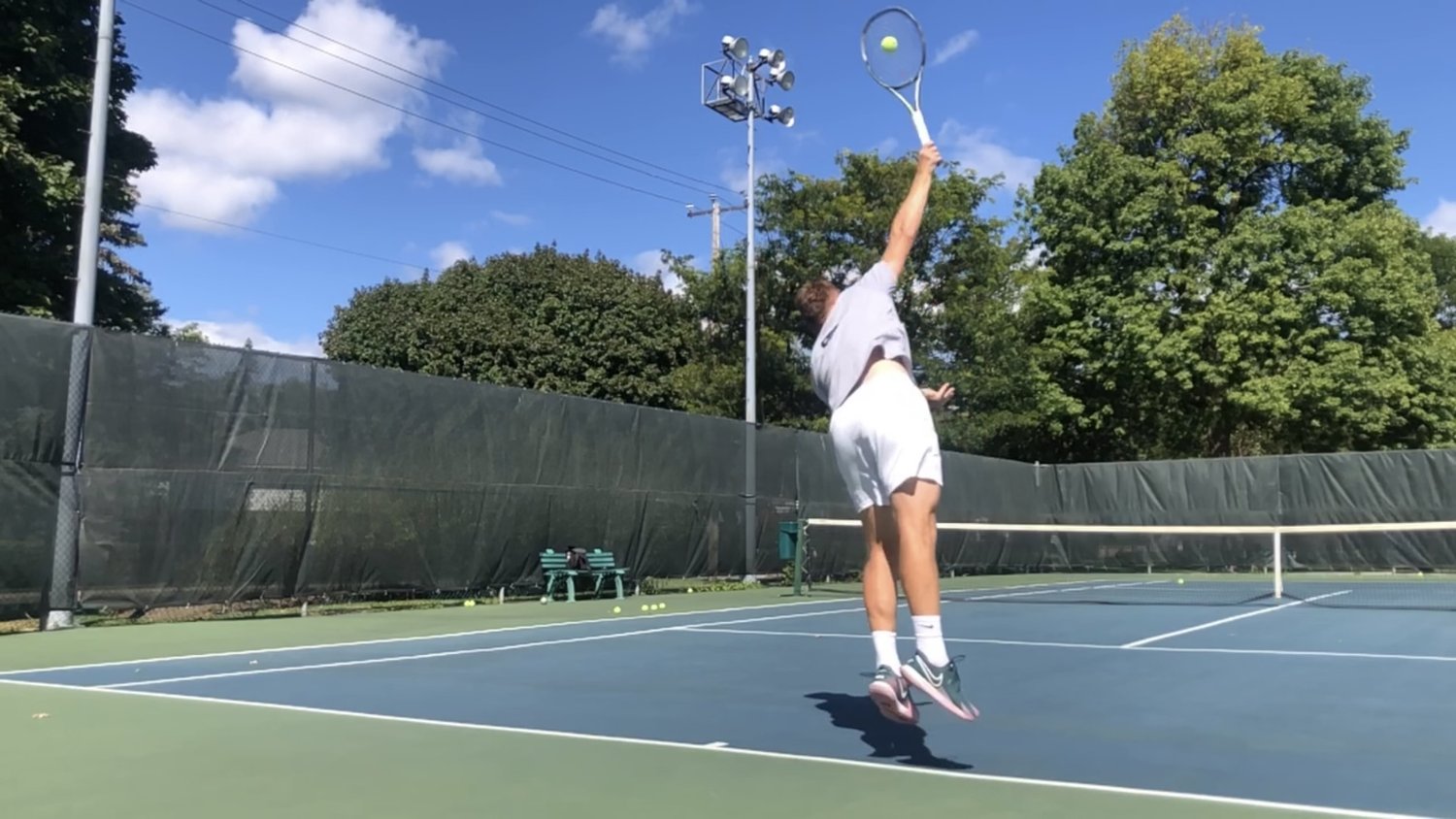
Finally, after more than 15 years, I can hit a powerful serve. I always wanted to hit a big serve. The problem was…my timing wasn’t great, I couldn’t generate any power and I often had an achy shoulder.
That’s all changed now. I went from a 100mph serve to consistently hitting between 110-120mph.
What’s also interesting is that I never intentionally altered my serve technique. But my mechanics got better. On top of all that, my shoulder doesn’t hurt anymore.
How did this happen? One thing is clear, I learned how to organize serve practices. When to practice for power and when to practice for targets or feel.
But beyond that – as many long-time readers would know – I have been dedicated to physical preparation since my early twenties (I’m now 36).
I can’t say for a fact that the positive changes in my game were solely a result of off-court training. But I’d argue that it’s played the largest role.
In this post, I’ll offer 3 ways off-court training can have a positive effect on your serve. Others surely exist, but these 3 top my list.
#1 – Teach Kinetic Chain Linkage + Transfer
As I mentioned in last week’s blog post, the serve is influenced by our ability to harness + transfer momentum from the ground up into the ball. Each link (body segment) plays a role in that transfer.
I have often found that players who aren’t timing this segmentation well, need a so called ‘reboot’ of their motor system.
What I mean is that they don’t initiate the movement of some body part, at the correct moment. Or, they don’t do so in the correct sequence. This becomes a very inefficient way to serve – especially if we’re applying a lot of force but losing it along the way.
For maximum energy transfer into the later links of the kinetic chain (shoulder, arm, racquet), this timing + sequencing is key.
How do we achieve this? Serve practice is one way of course. But serving can be quite technical and complex. Oftentimes, players need other inputs.
This is where off-court training can act as a tremendous tool. And a good way to tackle kinetic chain sequencing is through med ball training and olympic lifting.
The Oly Lifts
The olympic lifts teach athletes not only to use the ground to generate force, but also to transfer energy up the kinetic chain.
Contrary to what many believe, Olympic lifts are performed with a relatively relaxed upper-body (and upper-arms in general). The lower-body is what generates the force required to lift heavy loads. When athletes use too much of their arms, they end up ‘forcing’ the lift. Oftentimes, this results in failed attempts and incorrect usage of the body.
There’s also a high level of dynamic correspondence (DC) between certain tennis strokes and olympic lifts. The serve and the jerk (push or split) have relatively high DC. This is why the push jerk and split jerk are both integral exercises in my Serve Max program.
Medicine Ball (MB) Training
Med ball training is widely used in tennis; for good reason. The problem I encounter when working with players or mentoring coaches, is again, an over-reliance on arm engagement to power the throw, instead of legs, hips, trunk (in that order).
During med ball throws, the arms should act as a conduit to allow the expression of power in a certain direction. They are NOT the main facilitator of power.
The direction aspect is critical and is why learning to display power vertically, horizontally and diagonally, are all important. This is especially true for serve development because different body segments are moving through different planes of motion, and through 3 axes of rotation. This all happens in fractions of a second.