
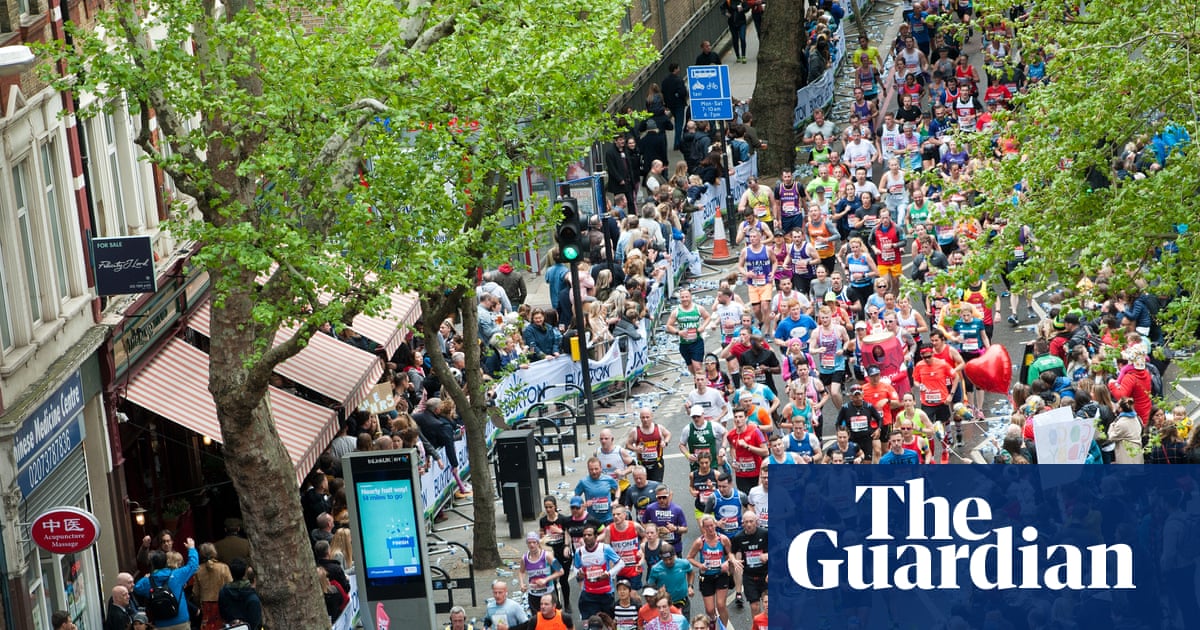
There is always magic in the air on a London Marathon morning. But this year the event promises to dazzle and soar more than ever. A world-record 59,000 people will take part in Sunday’s race, raising close to £100m for charity while swallowing 93,024 Lucozade gels from Greenwich to the Mall. There are also whispers of a men’s world record attempt. But the biggest noise of all is coming from those hailing a new golden era of running.
The numbers are astonishing. The facts indisputable. More than 1.1 million people entered the ballot for this year’s race – 750,000 more than four years ago. Notably, a third of those were in the 18-29 category, with female entrants making up the biggest percentage of those under 30.
The London Marathon is now so big that, as the Guardian revealed last month, organisers plan to split it over two days in 2027 so that 100,000 can take part. But the running boom, that has been fuelled by gen Z, women, and social media, is one that few people saw coming.
The BBC presenter Sophie Raworth remembers that when she started running, at 38, she didn’t bump into many other women on the roads. But when she began training for what will be her 13th London Marathon in January she was stunned by what she saw.
“I met with a group by a bike shop near the River Thames,” says Raworth, whose new book, Running on Air, is a love letter to the sport. “The first run we went on, 220 people turned up. The average age was 29 and most of them were women. It was 7.45am on a Sunday morning. I was thinking to myself: when I was that age I was still asleep. It’s amazing.”
The explosion in this new breed of running clubs or “crews” has been key to the boom. Unlike a traditional club, their emphasis isn’t usually on super-fast times but on being inclusive, enjoying a run and a chat, and a coffee afterwards.
And it is gen Z women who are embracing them most of all. According to Jenny Mannion, who founded the female-running group Runners and Stunners in 2023, it is because they are searching for different real-life experiences after the pandemic than millennials like her.
“I used to be such a party girl pre-lockdown,” says Mannion, who holds regular events for slower-paced joggers in London, Bristol, Brighton and Manchester. “Instead of finding human connection by going to the pub they are choosing to run.
“All this has also exploded massively because of social media. A lot of 18- to 30-year-olds use Tiktok and Instagram. When they give running a go, they find it’s so good for your mental health. It’s also so empowering to run in a group of 200 women on a Saturday morning.”
That is echoed by Lillie Bleasdale, who runs the online female coaching company, Passa. She also cites another factor: running in a group makes women feel safe, and makes newcomers more likely to stick with it even if they struggle at first.
“Women are actively seeking out spaces where they feel comfortable and safe – when that environment is provided, they don’t just participate, they stay and bring others with them,” she says. “Word of mouth has been a huge driver of our growth. For many women, feeling safe and supported is fundamental to staying consistent with exercise – and that’s something these groups are increasingly prioritising.”
Meanwhile the world’s biggest sports brands are increasingly making shoes that are plusher and more comfortable than traditional running attire – while also being fashionable.
Kevin Fitzpatrick, the vice-president of running at New Balance, says this approach has helped the company to record-breaking revenues.
“What we’ve seen happen since the pandemic is just a total rewrite of run culture and what it means to be a runner,” he says. “We’re seeing a lot more inclusivity. What’s really exciting is that the surge has been driven by younger runners. A lot of creatives have also come into running from music, art, fashion, that’s creating a much more creative and diverse community, and it’s a place now that people want to belong to.”
He points to New Balance’s recently-released Ellipse shoe, that he says has brought fresh customers to the company. “We’ve been a running brand since the early 1950s, but it’s really critical that we’re constantly keeping our pulse on how the culture is evolving, and make sure we maintain a two-way conversation with that culture,” he adds.
It is all a far cry from when the London Marathon started in 1981. Back then there were just 6,255 finishers, 95% of them men. Even 15 years ago the race was still overwhelmingly male.
The London Marathon race director, Hugh Brasher, says he is delighted by these developments and the huge growth in running generally. And in a world riven by conflict in the Middle East, fears over AI and so much economic uncertainty, he makes a final point about why Sunday’s race is so important.
“I think the one of the popularities of marathon running is it genuinely brings people together,” he says. “We know we are far more similar than we are different. I’ve travelled from London to Cape Town on a motorbike. You meet people, and you realise how kind they are, and that the vast majority of people are unbelievably welcoming. That’s what the London Marathon shows. And I think we need more of that community spirit and togetherness.”