
TL;DR: 1) Know the standard sand rate recommendations, which range from 6 to 11 mm per year at present 2) Measure the amount of sand you apply 3) Don’t apply the standard amount! Adjust amounts based on surface performance & OM246
I traveled around Japan in early 2026 with Dr. Frank Rossi, looking at monuments, riding trains, watching baseball, and talking about many things, including normal sand topdressing amounts.
As we talked about standard sand topdressing amounts for putting green turf, I realized that I’ve presented this information in many seminars, but I haven’t put them in a recent blog post. So here are the standard amounts, and then my recommendation for what turf managers should actually do for sand topdressing rate selection and adjustment.
1. The standard sand topdressing rate recommendations
Recommendations from the start of the 21st century were for 12 to 15 mm of sand per year. Moeller and Lowe in 2016 stated what those rates were.

In 2019, Whitlark and Thompson suggested a slightly lower standard range of 8 to 11 mm per year.

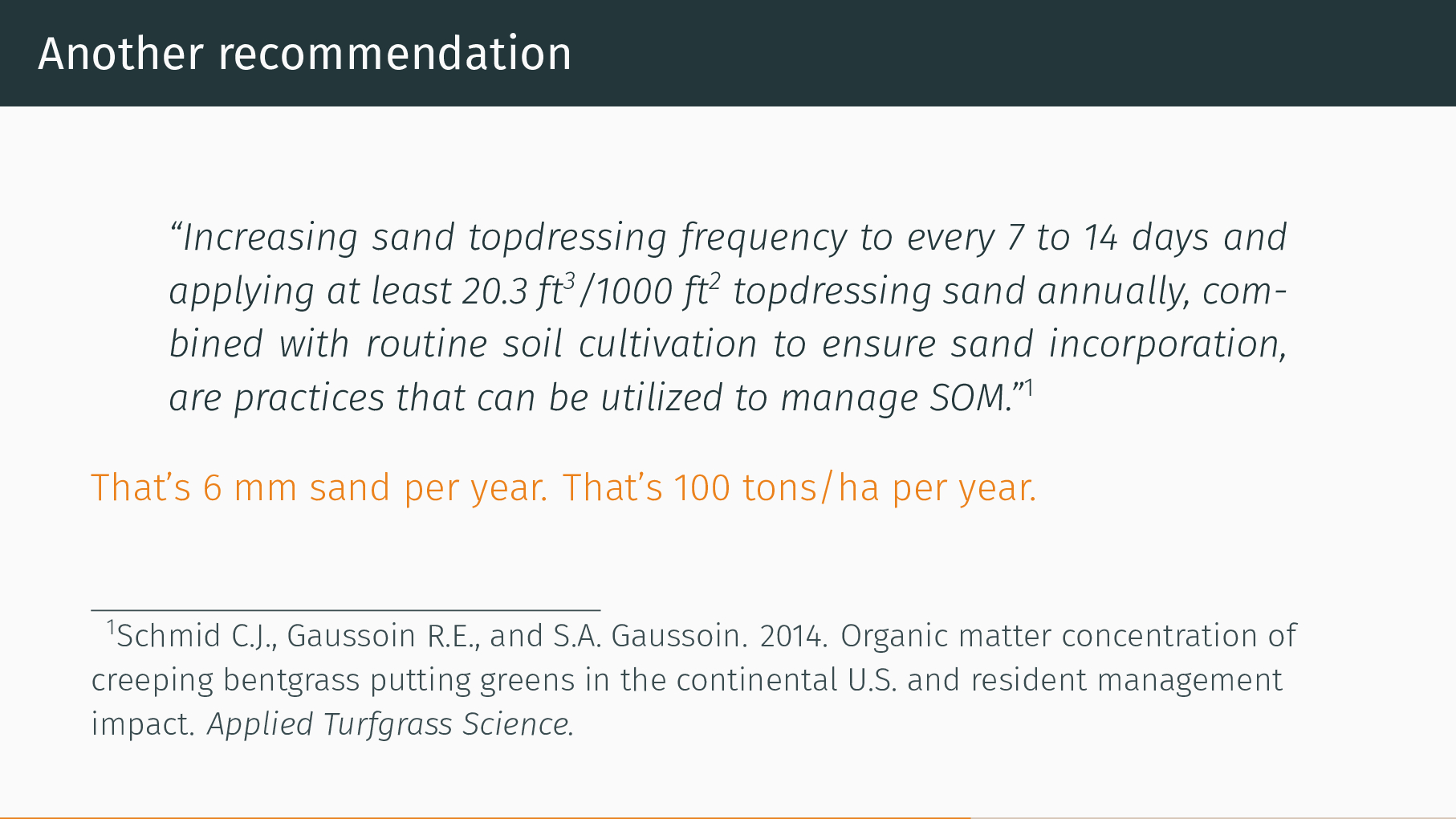
There is also a baseline value from Schmid et al. of 6 mm; that article suggests one should apply “at least 6 mm topdressing sand annually … to manage soil organic matter.”

In summary, rates from the early 2000s were recommended at 12 to 15 mm, and standard rates at present are in the 6 to 11 mm range.
PACE Turf has spreadsheets that provide some climate adjustments based on growing season length and intensity to adjust sand amounts by location.
2. You should know how much sand you apply
If you don’t know how much sand you apply, you should. Here are three easy ways to get the exact sand topdressing amount.
3. Here’s what I actually recommend
I don’t recommend the standard rates. I think it’s important to be aware of the standard rates, but to choose topdressing rates for your facility, the best way I know of is this.
Make adjustments to sand topdressing based on your site-specific organic matter accumulation rate, combined with assessment of your current and desired surface performance.