
NOTE: This is an opinion piece from guest-writer Anton Forbes-Roberts. His bio is below.
How national championship windows for 15s and 7s expand college rugby’s value further.
 PARK CITY , UT – In Part 1, we outlined a clear and credible opportunity: by 2031, college rugby in the United States could represent a platform worth approximately $10.3 million annually. That estimate was not theoretical. It was built from identifiable sources of value:
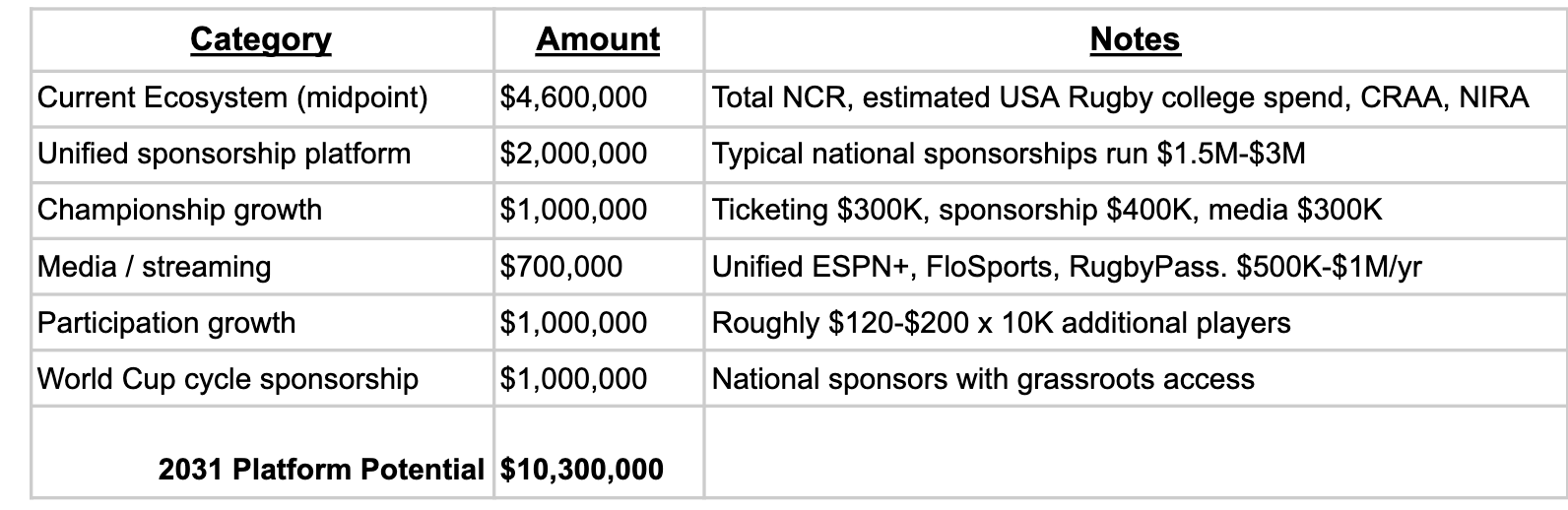
That model described the value of a stronger college rugby ecosystem. But there is a second
layer of value as well: marketable national championship windows for both 15s and 7s.
These are not competing valuations, and they are not additive. The first estimates the value of a stronger college rugby ecosystem. The second isolates the commercial value concentrated in properly structured championship windows.
This is not just about dollars. It is about building college rugby into a top-five college sport in participation, viewership, and revenue.
In the United States, college is where sports become visible, meaningful, and aspirational. It is where athletes are identified, teams are followed, and pathways to the next level become real.
For both High School and College rugby, that matters enormously.
The first and most obvious challenge is not governance, politics, or ideology. It is a viable
marketable competition calendar.
In America, College Is Where Performance Begins
The opportunity in college rugby is not limited by demand. It is limited by structure—because
college rugby is not simply another level of the sport. It is the bridge between a youth base of
more than 50,000 players and the highest levels of performance. In most rugby nations, that
bridge runs primarily through professional clubs or national academies. In the United States, we
have collegiate sports, in addition we have World Rugby investment in MLR’s Anthem Rugby
and USA Rugby age-grade squads. But those pathways are generally for established players,
many with international experience.
In the United States, athletic visibility and performance pathways are built through the college
sports system. The case for alignment in U.S. rugby—shared standards, crossover athletes, and
visible national pathways—is well established. But those outcomes and investments do not
primarily originate at the national-team level.
High school players in the United States typically realize their performance potential in college.
It is where:
•Athletes consolidate
•Competition standardizes
•Performance & potential become visible
•Identity—both team and individual—takes shape
College is also where American sports culture assigns meaning. Fans follow teams, rivalries,
conferences, stars, and tournaments. For rugby to scale in the United States, college is where
the pathway has to become visible: from youth participation to college stardom, and from
college stardom to the Olympic team, Major League Rugby, and overseas professional rugby.
A marketably structured college competition calendar does not just produce better athletes. It
produces recognizable teams, brands, assets, identifiable stars, and continuous narratives
across seasons. Those are the elements that drive sponsorship interest, media relevance, and
fan engagement. Without them, the sport lacks not just structure, but continuity—and misses
investment dollars as well.
So what stands in the way?
Any serious analysis of U.S. college rugby must begin with a basic reality: it is not one sport. It is
two.
15s, the traditional World Cup form of the game—depth-driven, regionally structured,
and analogous to other full-season team sports 7s, the Olympic form of the game—a faster, tournament-based format that is condensed and broadcast-friendly
Then there are two main college rugby orgs, NCR and CRAA (NIRA is an NCAA emerging
women’s sport only). NCR currently spans roughly 670 collegiate programs and runs a full
competition schedule, while CRAA’s publicly listed competitions are far smaller, totaling roughly
100 or so teams, but on the Men’s side at least are generally acknowledged to have the top D1
teams. So, two ‘competing’ orgs both playing two forms of rugby. But it doesn’t stop there, alas.
The orgs have conflicting and competitive competition calendars for both 15s and 7s:
• ~90% of US college teams compete for a fall 15s national championship in mid-December. This is NCR’s defined XVs National Championship competition window.
• ~10% of teams compete for a spring 15s national championship in early May. This is CRAA’s defined National Championship competition window.
• 95% of 7s teams compete for a spring 7s national championship in both orgs (CRAA does not have a D1A men’s 7s National Championship), while 5% play 7s in a west coast only fall competition.
This fragmentation produces a system where:
• Seasons lack clear national boundaries
• Audiences are split across competing timelines
• 15s has both a D1 NCR and a D1A CRAA Championship
• 7s has a marketable and successful college championship, but lacks full participation
Instead of two strong championship properties, college rugby produces multiple diluted
outcomes. The issue is not that there are too many champions. It is that there is no unified
marketable calendar that concentrates attention and drives revenue.
Timing Drives Value
In sports, value is not created evenly across a season. Regular seasons build
engagement—teams, rivalries, and audience. But value concentrates at the end: in defined,
time-bound championship moments where attention, narrative, and stakes converge.
Those moments are where sports become most commercially viable:
• Sponsorship pricing peaks
• Media interest intensifies
• Events become destination properties
Without them, even well-followed competitions struggle to aggregate value at scale.
College Rugby Championship Windows Must Align
Properly structured, college rugby does not present a single championship opportunity. It
presents three distinct national properties:
• A 15s national championship, positioned as a fall culmination—comparable to college football in all divisions. CRAA D1 would align with the NCR calendar.
• A College Nations Cup, positioned as a late-winter/spring elite 15s competition—comparable to an invitational international-style property built around top programs and concentrated match windows. This allows top CRAA D1 squads to also compete in the spring, in a marquee annual competition.
• A 7s national championship with champions in each division. NCR’s existing CRCs
competition is this – and already the largest college rugby event in the world.
Each of these, independently, is capable of generating meaningful commercial value. Together,
they form the foundation of a year-round collegiate rugby product.
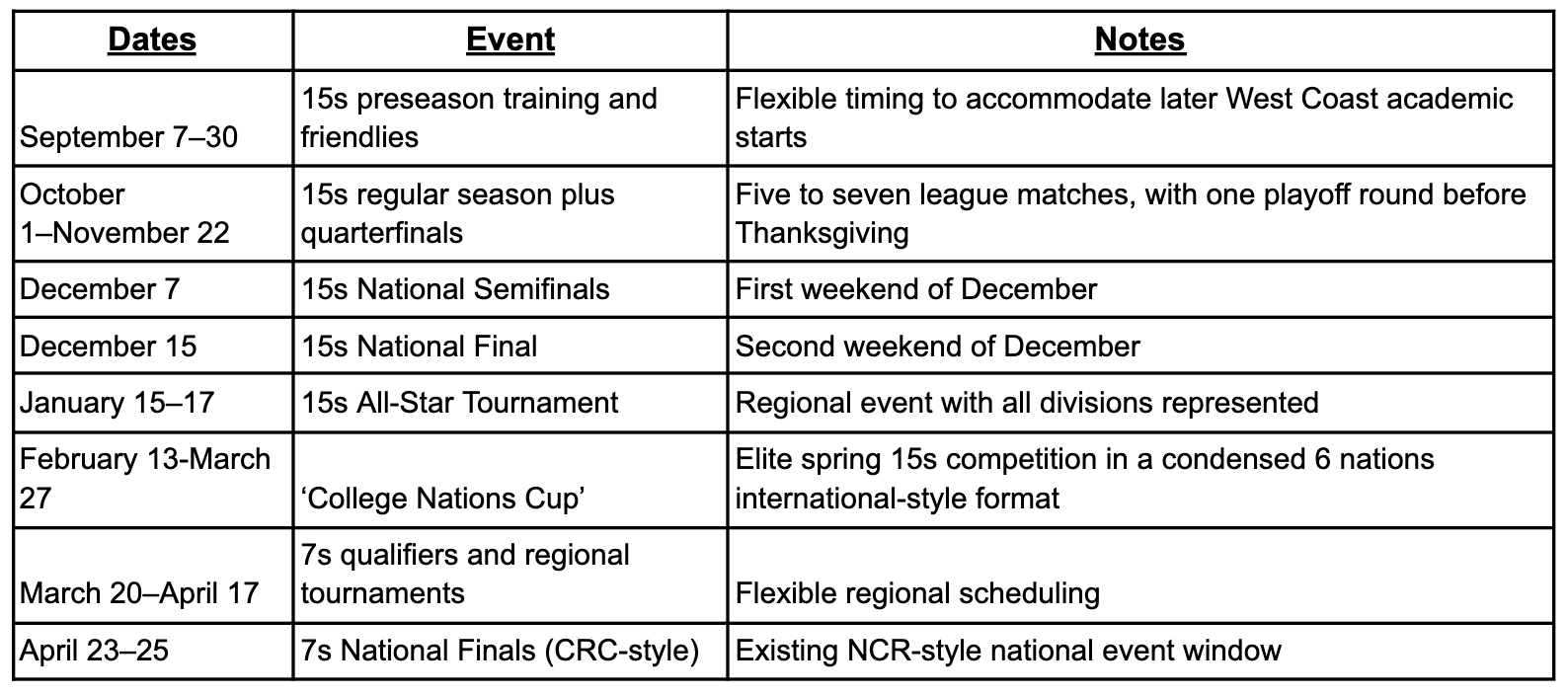
The ‘College Nations Cup’ would not replace the fall 15s championship. It would extend the
competitive and commercial life of elite college 15s into the spring, creating a second premium
property between the traditional season and the 7s championship window. In commercial terms,
that means more than additional matches. It means another defined block of inventory for
sponsors, broadcasters, host markets, and fans—one built around top programs, concentrated
stakes, and a format designed for visibility.
An Alternative Calendar Model
There is, however, more than one plausible way to create defined national windows. An
alternative model would keep the same core principle—clear championship properties in both
15s and 7s—but distribute them differently across the academic year. Reasonable stakeholders
may disagree on the ideal sequencing of 15s and 7s. What matters most is not a single
mandated calendar, but a shared structure capable of producing clear national championship
windows.
In this version, 7s would become primarily a fall property, while 15s would run across the full
school year and culminate in spring. That model would look something like this:
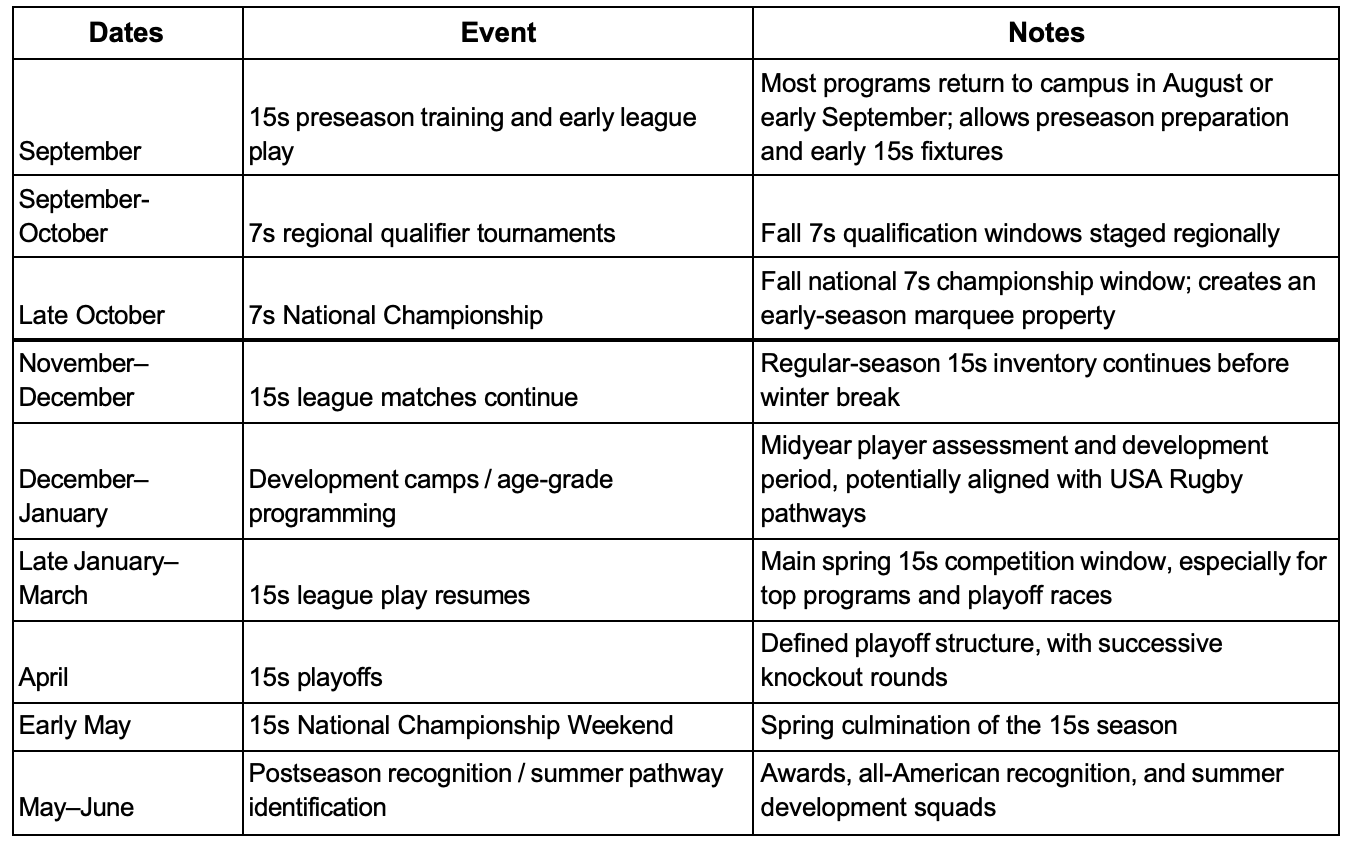
This model differs from the one above in important ways. It places the 7s championship in the
fall rather than the spring, extends 15s more fully across the academic year, and preserves
spring as the primary championship window for the traditional form of the game. But it serves
the same structural purpose: creating time-bound, marketable properties that sponsors,
broadcasters, host markets, and fans can actually follow.
The point is not that only one calendar can work. There may be others. It is that college rugby
must choose a coherent one.
$5M+ in College Championship Value
The model below, using the first schedule construct as an illustrative example, suggests that by
2031 college rugby could support ~$5 million in championship value annually. This complements the ecosystem potential outlined in Part 1 and reinvestment of the total truly puts college rugby on the road to a top 5 status.
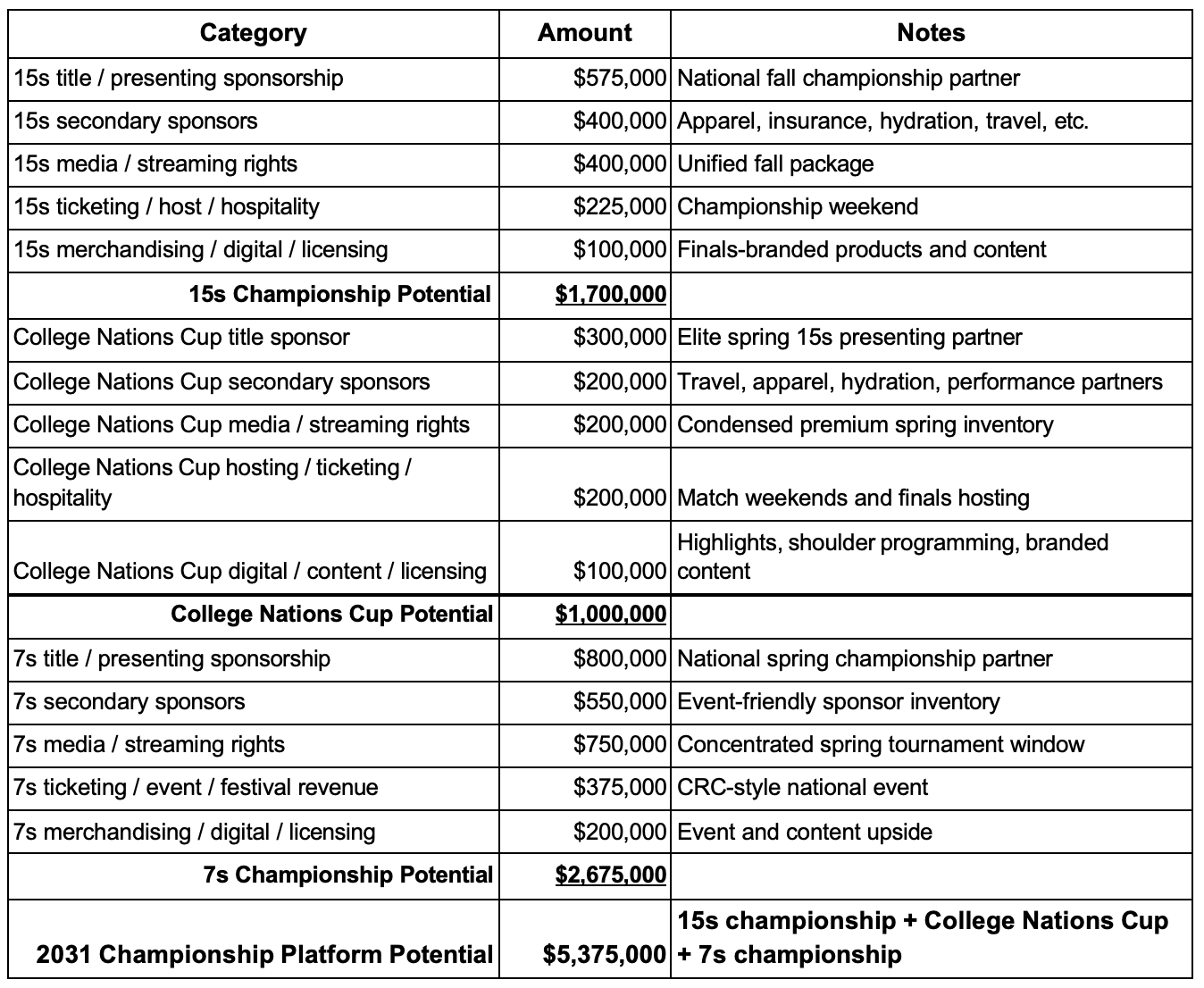
The important point is not simply that the two financial models produce significant revenue. It is
why they do. One reflects ecosystem-wide value creation. The other reflects championship-driven value capture. They are not two separate pots of money to be added mechanically. They are two ways of seeing how much value college rugby leaves unrealized under the current structure.
Both converge on the same conclusion: college rugby already has the ingredients of a national
property, but not the calendar or championship architecture required to behave like one.Two Pathways, One Constraint
At this point, the pattern becomes clear: both the ecosystem-wide upside described in Part 1 and the championship-driven upside described here depend on the same condition—the ability to aggregate competition into defined national windows.
Without that condition:
• Sponsorship fragments
• Media interest weakens
• Events lose pricing power
• Institutional and fan engagement is lesser
In other words, the sport does not fail to create value. It fails to capture it.
Why Has This Persisted?
The current U.S. college rugby structure reflects independent governance across multiple organizations, different competitive philosophies, and locally optimized schedules. Each of these decisions is rational in isolation. But collectively, they produce a system where no single calendar governs the sport and no single products can be sold at scale.
What Comes Next?
If Part 1 demonstrated that value exists, Part 2 shows why so much of that value remains unrealized. The problem is not a lack of participation. It is not a lack of interest. And it is not a
lack of plausible commercial upside. It is the absence of a highly marketable calendar and championship structure capable of turning college rugby’s underlying assets into defined national products.
That is the real consequence of fragmentation. Without aligned windows for 15s and 7s, the sport cannot fully monetize its championships, cannot clearly connect youth participation to elite performance, and cannot present fans, sponsors, or broadcasters with a coherent national pathway.
The next question, then, is no longer whether the opportunity is real. It is structural: What would it take to align the calendar, define the championship windows, and allow both 15s and 7s college rugby to function as true national assets?
That is the work of Part 3.
Anthony ‘Anton’ Forbes-Roberts is an NCR Board member and proud CRAA rugby parent/booster
(UCLA); past President of Rugby Georgia; past founder/coach/President of Atlanta Youth Rugby, and
coach at USA Rugby South Panther Academy.