
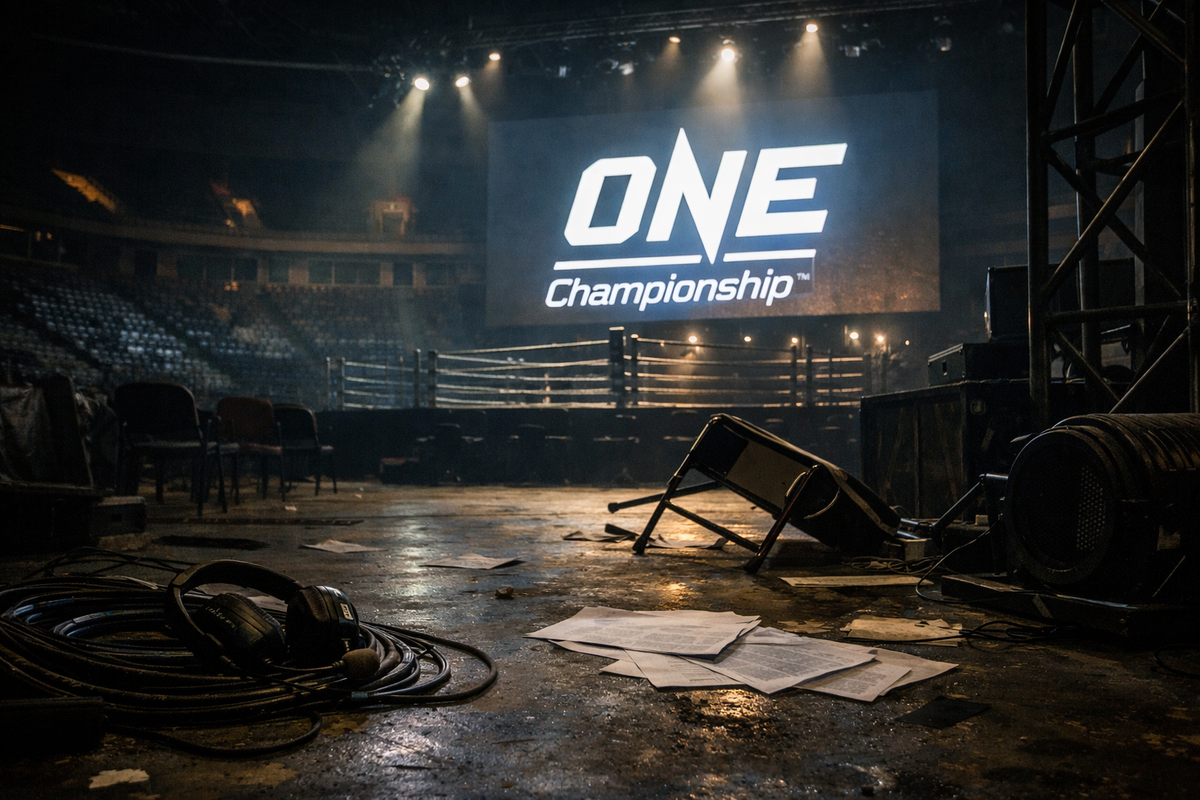
What is actually happening at ONE Championship?
Combat sports fans love an obituary almost as much as they love a knockout. Give them a layoff, a lawsuit, a canceled card, and a few executives heading for the exits, and half the internet will begin composing the eulogy before the body has even bothered to die.
That is where the conversation around ONE Championship has now landed. Depending on which corner of the fight world you wander into, ONE is either a misunderstood global powerhouse whose critics are just jealous provincials, or a Potemkin promotion held together with borrowed money, selective accounting, and motivational slogans. As usual, the loudest people are the least interested in the dull but necessary work of distinguishing story from structure.
So let us do that instead.
It is also impossible to discuss ONE’s present turbulence without discussing Chatri Sityodtong, the founder, chairman, and CEO who built the promotion in his own image and sold it not just as a fight company, but as a philosophy. ONE has always asked the world to see more than a business when it looks at the company. It has asked to be seen as a mission, a moral project, a superior vision of martial arts itself. That matters now, because when a company is built around a mythology this carefully managed, every crack in the structure becomes a crack in the story too.
The first thing worth saying is that this is not a simple collapse story. ONE is still alive, still operating, still promoting events, and still publicly advertising a record-breaking 72-event slate for 2026, including Prime Video cards in U.S. primetime and the Bangkok-heavy Friday Fights machine that has become the company’s weekly heartbeat. This is not a dead company wandering around in borrowed clothes. But it is also no longer serious to treat every criticism of ONE as jealous sniping from the cheap seats. The company is under visible strain, and the strain is no longer theoretical.
Start with the money, because in fight promotion the money is always where the theology goes to die. ONE’s 2024 numbers, as recently reported from regulatory filings, show genuine improvement. Revenue reportedly rose 37 percent to $93.2 million. Losses reportedly fell to $47.1 million from about $90 million the year before. If you are in the mood to build the optimistic case, this is where you begin. You say the company is tightening up, narrowing losses, and moving toward sustainability. You say the machine is learning discipline. You say progress is progress.
Fine. But progress is not the same thing as health, and this is where the incense starts to burn off.
The same reporting indicates that broadcasting rights accounted for about 81 percent of total revenue, while independent analysis of the filings argues that roughly 93 percent of that broadcast revenue was non-cash. In plain English, the top-line number may look impressive while the actual liquid reality beneath it looks considerably less majestic. ONE reportedly finished 2024 with only about $16 million in cash and cash equivalents while carrying roughly $576 million in accumulated losses. That is not the profile of a company lounging in financial comfort. That is the profile of a company still trying to persuade arithmetic to become branding.
Now, to be fair, companies do not have to be perfect to survive. Growth businesses often burn money. Sports properties especially can live for years on investor faith, future rights value, and strategic narrative. ONE has been unusually good at attracting belief. That is one reason it keeps surviving predictions of imminent death. But belief has had to do an extraordinary amount of heavy lifting for an extraordinary amount of time. At some point, if the business beneath the myth does not mature fast enough, investor confidence stops looking like validation and starts looking like life support.
Then came the layoffs. In October 2024, reporting said ONE cut “a few dozen” employees as part of a push toward profitability. This is where both the fanboy and the grave-dancer become useless. Layoffs do not automatically mean extinction. Nor are they meaningless. Companies cut staff because something needs fixing: cost structure, cash burn, operational sprawl, strategic overreach, or some impolite combination of all four. When a promotion that has spent years telling the world it is building the future starts quietly reducing headcount, adults should understand what they are looking at. This is not hate. It is a pressure signal.
The sporting decisions tell a similar story. In March, ONE shut down its women’s strawweight MMA division and released reigning champion Xiong Jing Nan. That is not routine roster maintenance. That is a promotion deciding that one entire lane of its product no longer justifies the space, money, or strategic attention required to keep it alive. You do not close a division because everything is going beautifully. You close a division because some combination of economics, planning, and confidence has narrowed. That does not make the company dead. It makes the company smaller than it keeps telling people it is.
Then there is the American story, which has become difficult to read without a dry laugh, though not for happy reasons. ONE has spent years flirting with the American market, speaking in the language of expansion and challenge, as though it were always one clean push away from a firmer U.S. foothold. Yet the Denver return, once part of that narrative, was later reported as quietly canceled. One canceled show is not fatal. Plenty of promotions survive that. But a promotion that keeps hinting at American breakthrough while retreating from American commitments does not get to keep calling that momentum. At some point the map must begin to resemble the brochure.
And now we arrive at Rodtang, which is where the story stops being merely financial and becomes institutional. ONE has publicly pursued legal action against one of its most marketable stars over alleged contractual breaches. Rodtang has pushed back publicly and cast doubt on the company’s account of the paperwork. There is a reason this matters beyond fan intrigue. Talent disputes are normal in combat sports. They happen everywhere. But once the argument becomes not simply “we disagree” but “what exactly is the status and integrity of the contract itself,” the issue moves from ordinary promoter-fighter friction into the realm of trust. A promotion can survive unhappy fighters. What becomes harder to survive is uncertainty about the paper.
Then came reports that Rich Franklin, Matt Hume, and COO John Scheler are out. Here again, precision matters. Executive departures can happen for many reasons. Companies restructure. Leaders move on. Not every exit is a five-alarm fire. But context is not optional. When senior names are reportedly leaving amid layoffs, division closures, canceled plans, and public litigation, it is no longer intellectually honest to shrug and say this is all just business as usual. Franklin and Hume are not decorative names. They are part of the recognizable managerial architecture of ONE’s MMA identity. If those reports are accurate, the company is not merely making tweaks. It is altering its internal structure in public view.
This is the point where ONE’s mythology becomes the real subject.
Because ONE has never sold itself merely as a promotion. Under Chatri Sityodtong, it has sold itself as a superior philosophy. A higher-minded alternative. A global mission dressed as a fight company. It has not just marketed events. It has marketed virtue, uplift, authenticity, and destiny. That is why moments like this land differently. When an ordinary promoter hits turbulence, people call it turbulence. When a promotion has spent years preaching that it is building the future of martial arts on purer principles, every contradiction is judged not merely as weakness but as hypocrisy. The higher the sermon, the uglier the paperwork looks when it starts to pile up on the floor.
And that is why the two laziest interpretations should both be discarded.
The first lazy interpretation is the funeral dirge. “It’s over.” Maybe. One day everything is over. That is not analysis; it is astrology for fight fans. ONE still has events, still has a platform, still has Bangkok, still has a combat-sports mix that can be attractive when properly staged. A narrower, leaner, more regionally concentrated ONE could still exist for years.
The second lazy interpretation is the believer’s hymn. “Nothing to see here.” That one is even worse. There is plenty to see here. There are losses, thin cash, dependence on revenue that critics say is flattered by non-cash accounting, layoffs, closed divisions, canceled plans, legal warfare with a star, and reported top-level exits. You do not need to be a hater to notice a house making strange sounds at night. You just need working ears.
So what is actually happening at ONE Championship?
Not extinction. Not stability. Something more uncomfortable than either.
A company that spent years narrating itself as inevitable, with Chatri Sityodtong as both impresario and chief evangelist, is now being forced to live inside its own contradictions. It can still produce spectacle, but spectacle is no longer enough to hide the stress fractures. It can still announce grand plans, but the grand plans now sit beside shrinking divisions, canceled ambitions, legal disputes, and executive exits. It can still speak in the language of destiny, but destiny looks rather less persuasive when it keeps needing a revised definition of what success was supposed to mean in the first place.
That, in the end, is the real story. Not that ONE is gone. Not yet. The real story is that the old myth is no longer strong enough to carry the weight being placed on it. And once a promotion loses control of that myth, once the public begins reading the company not as a grand project but as a stressed institution with an expensive talent for self-dramatization, the problem is no longer just financial. It is existential. The question becomes not whether the audience still believes the performance, but whether the people on stage do.
Source Sheet
- Chatri Sityodtong title and role, plus ONE’s public 2026 event claims
- 2024 revenue, losses, cash, and accumulated losses reporting
- Late-2024 layoffs and profitability push
- Women’s strawweight division closure and Xiong Jing Nan release
- Denver event move/cancellation context
- Rodtang contract dispute and lawsuit reporting
- Reported departures of Rich Franklin, Matt Hume, and John Scheler