
Body weight with kit
Bike + bottles, bags, tools
Labeled width on tire sidewall
Check your wheel specs or measure
Hookless is common on newer carbon wheels
Supple casings work best at lower pressures
Recommended Pressure
Front: — bar · — kPa
Rear: — bar · — kPa
Enter your road bike details and hit Calculate Pressure for a personalized recommendation.
Road bike tire pressure used to be simple. Pump to 120 PSI and go. But modern road bikes have wider tires, hookless rims, and tubeless setups that have completely changed the rules. Running the pressure your dad did on his 1998 Trek will make your bike feel slower and less comfortable on every ride.
This road bike tire pressure calculator uses a weight-based formula adjusted for tire width, internal rim width, rim type (hooked or hookless), tire casing, road surface, and riding style to deliver personalized front and rear PSI for clincher, tubeless, and tubular setups from 23mm to 35mm.
Below, I break down how the formula works, PSI ranges by tire width, the hookless 72.5 PSI ceiling, and why the pro peloton runs softer than you think.
How This Road Bicycle Tire Pressure Calculator Works
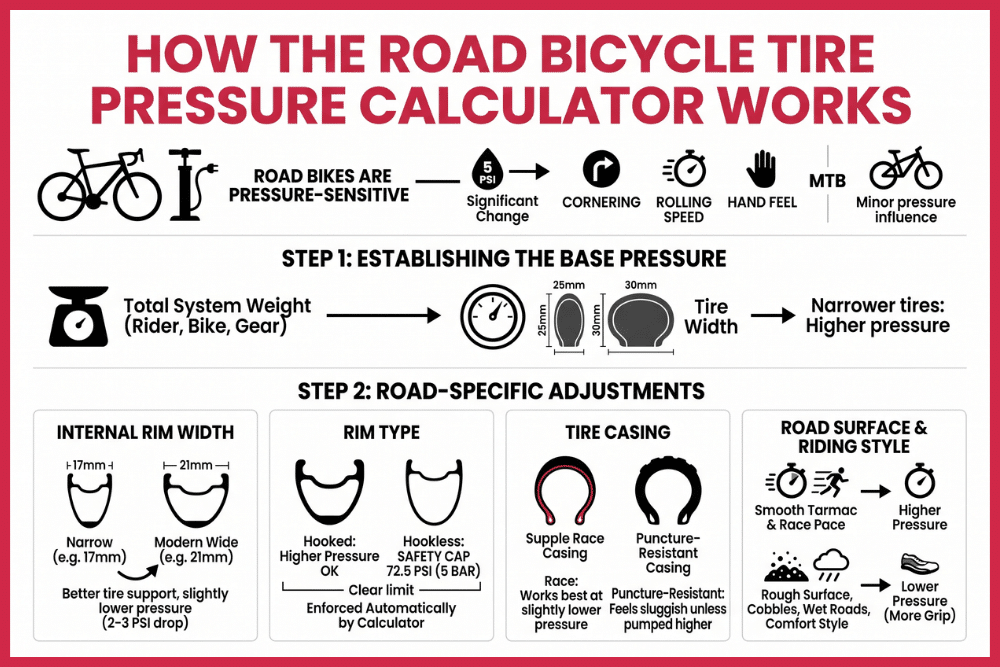
Road bikes are the most pressure-sensitive category of all. A 5 PSI swing on a mountain bike feels mild. The same 5 PSI on a 28mm road tire changes how the bike corners, how fast it rolls, and how your hands feel after two hours.
The calculator starts with your total system weight (rider + bike + bottles + any gear) and factors it against your tire width. Narrower tires hold less air, so they need higher pressure to support you. A 25mm tire needs more PSI than a 30mm tire at the same rider weight.
From there, it adjusts for four road-specific inputs:
Internal rim width. A modern 21mm rim supports the tire casing better than an older 17mm rim. Wider rims let you drop 2 to 3 PSI without the tire feeling mushy.
Rim type. Hooked rims can handle high pressures safely. Hookless rims cap out at 72.5 PSI (5 bar) per ETRTO standards. The calculator enforces this limit automatically.
Tire casing. A supple race casing like a Continental GP5000 works best at slightly lower pressure than a puncture-resistant casing like a Gatorskin, which feels sluggish unless pumped a bit higher.
Road surface and riding style. Smooth tarmac and race pace get the highest calculated pressure. Rough chipseal, cobbles, wet roads, or a comfort-first style drop it down for more grip.
Road Bike PSI Ranges by Tire Width
These ranges assume a 75 kg rider with a 9 kg bike on hooked rims. Lighter riders go lower. Heavier riders go higher. Use the calculator above for your exact numbers.
23-25mm Tires (Classic Race Setup)
Front: 85 to 100 PSI. Rear: 90 to 105 PSI.
These are the old-school race widths. You’ll still see them on older bikes and pure race setups. Narrow tires have less air volume, so they need higher pressure to avoid pinch flats and to hold their shape through corners.
If you’re on 23mm tires, you’re probably running them because your frame clearance won’t fit anything wider. Stick to the higher end of this range unless your roads are glass-smooth.
28mm Tires (The New Standard)
Front: 65 to 80 PSI. Rear: 70 to 85 PSI.
This is the width most modern road bikes now ship with, and for good reason. A 28mm tire at 70 PSI rolls just as fast as a 25mm tire at 90 PSI on real-world roads, with noticeably more comfort and better cornering grip.
If you bought a road bike in the last few years, this is almost certainly your width. The pro peloton races on 28s and 30s now, not 23s.
30-32mm Tires (Endurance and All-Road)
Front: 55 to 70 PSI. Rear: 60 to 75 PSI.
Endurance bikes, all-road setups, and anything designed for long days in the saddle live here. The extra air volume soaks up road chatter that would wear you down on narrower tires.
For rough chipseal or light gravel sections, drop 5 PSI from these numbers. You’ll get more grip and far less fatigue.
Hookless Rims: Why 72.5 PSI Is a Hard Ceiling
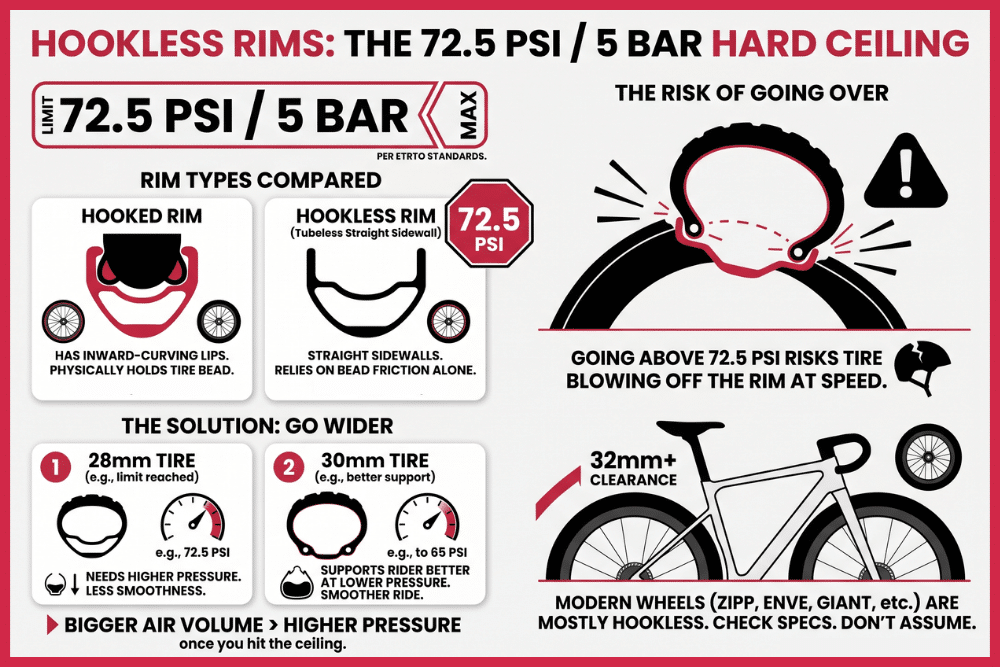
If your wheels are hookless (also called Tubeless Straight Sidewall), the maximum tire pressure is 72.5 PSI / 5 bar. Full stop. ETRTO, the European standards body that governs tire and rim dimensions, set this limit for a reason.
Hooked rims have small inward-curving lips at the rim edge that physically hold the tire bead in place. Hookless rims don’t. They rely on tire bead friction alone to keep the tire seated. Go above 72.5 PSI and you risk the tire blowing off the rim at speed. That’s a crash you really don’t want.
Modern carbon wheels from Zipp, Enve, Giant, and others are mostly hookless. Check your wheel specs before pumping. Don’t assume.
The fix if the calculator wants more pressure than 72.5 PSI: go wider. A 30mm tire at 65 PSI supports a heavier rider better than a 28mm tire at 72 PSI, and it feels smoother. Bigger air volume beats higher pressure every time once you hit that ceiling. Most modern endurance and all-road frames have clearance for 32mm or more, so you’ve got room to play with.
Why the Pro Peloton Dropped Pressure
Years ago, pros raced on 23mm tires at 120 PSI. Today they’re on 28mm and 30mm tires at 70 to 80 PSI. That’s a massive shift, and it wasn’t driven by comfort. It was driven by speed.
Lab tests on smooth steel drums always showed that higher pressure means less tire deformation and lower rolling resistance. The math checks out. But pros don’t race on steel drums. They race on real roads with cracks, chipseal, and imperfections.
At high pressures, the tire bounces over every tiny bump instead of absorbing it. Each bounce lifts the rider off the ground for a split second. That’s wasted energy. Engineers call it impedance loss, and it doesn’t show up in drum-based testing at all.
Wider tires at lower pressures conform to the road instead of fighting it. The result is the same rolling speed with way better comfort and grip. If the pros are running 75 PSI at the Tour de France, your weekend ride doesn’t need 100.
Common Road Bike Tire Pressure Mistakes
Pumping to the Sidewall Max
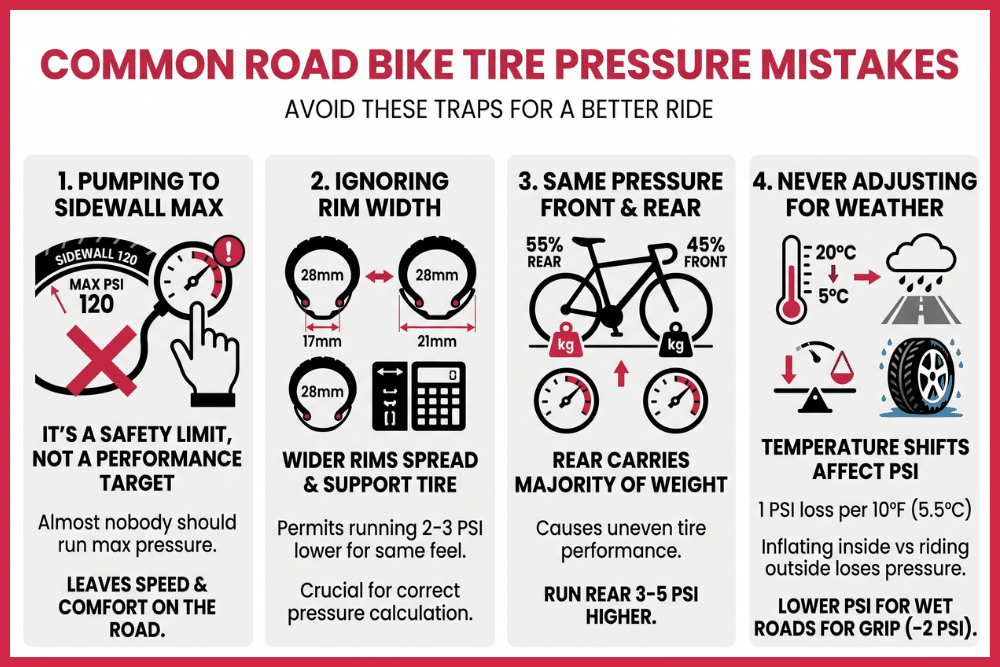
The number printed on your tire sidewall is a safety ceiling, not a target. It’s the maximum pressure the tire can legally handle, not what makes it ride best. Most modern road tires max out at 100 to 120 PSI. Almost nobody should actually run that. If you’re on 28mm tires at 110 PSI because “the sidewall says so,” you’re leaving real speed and comfort on the road.
Ignoring Your Rim Width
A 28mm tire behaves very differently on a 17mm internal rim than on a 21mm rim. Wider rims spread the tire out, give it more support, and let you run 2 to 3 PSI lower for the same feel. Most riders never check their rim width. The calculator asks for it because it genuinely changes the answer.
Running the Same Pressure Front and Rear
Your rear wheel carries about 55% of your weight. Your front carries 45%. If you’re pumping both tires to the same PSI, your rear tire is slightly underinflated and your front is slightly over. Run the rear 3 to 5 PSI higher.
Never Adjusting for Weather
Tire pressure changes roughly 1 PSI for every 10°F (5.5°C) of temperature shift. Inflate indoors at 20°C, ride outside at 5°C, and you’ve lost 3 PSI before you clip in. On wet roads, drop another 2 PSI for grip.
Frequently Asked Questions (FAQs) About Road Bike Tire Pressure
What PSI should a road bike tire be? For a typical 75 kg rider on 28mm tires, around 70 PSI front and 75 PSI rear on smooth roads. Narrower tires need more, wider tires need less. Use the calculator above for your exact number.
How do I know if my rims are hookless? Check your wheel manufacturer’s spec sheet. Most modern carbon wheels from Zipp, Enve, and Giant are hookless. If your wheels are hookless, you’re capped at 72.5 PSI regardless of tire width.
Should I run lower pressure tubeless? Slightly. On hooked rims, tubeless lets you drop about 5 PSI safely since there’s no tube to pinch. On hookless rims, the 72.5 PSI ceiling matters more than the tubeless discount.
How often should I check tire pressure? Before every ride. Road tires lose 2 to 3 PSI per day naturally, faster than MTB or gravel tires. A pre-ride squeeze isn’t accurate enough. Use a digital gauge.