
By Thierry Verviers
“Your opponent isn’t reading the ball. They’re reading you.” This fundamental truth highlights that most players focus on hitting harder or adding more spin, while overlooking the most powerful variable: the precise moment of contact.
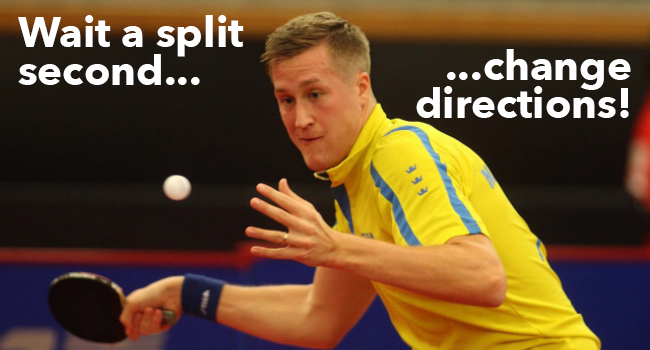
By making a tiny adjustment—waiting just a fraction of a second—you can effectively neutralize even the most prepared blockers.
How a Blocker’s Brain Works
Experienced blockers rely on “System 1” thinking—automatic, fast, and unconscious anticipation based on your elbow position, shoulder rotation, and hip axis. They aren’t reacting to the ball; they are reacting to the predictive signals you send before you even make contact.
The Technique: The “Synchronization Break”
The core principle is to set up a crosscourt topspin in a completely readable way.
- The Setup: Make no attempt to hide your crosscourt intentions.
- The Delay: At the moment you would normally strike, wait for the opponent to commit to the crosscourt move.
- The Execution: Let the ball travel an extra 15 to 25 centimeters, then redirect it down the line.
This delay creates a “synchronization break”. Your opponent’s brain has already sent the signal to move, and by the time they realize the direction has changed, it is too late to readjust.
Why Fake Crosscourt and not Down the Line?
Faking crosscourt to go down the line is strategically superior for two reasons:
- Statistical Habit: Most players play crosscourt more often, so blockers are already mentally and physically biased toward that direction.
- Distance and Time: The down-the-line path is shorter. Faking down the line to go crosscourt actually gives your opponent more time to recover.
Technical and Mental Requirements
This technique requires high confidence and the ability to override your own strike reflexes. Key technical points include:
- Identical Backswing: Do not change your racket position while waiting, or you will telegraph the move.
- Balanced Stance: Avoid leaning toward the line too early.
- Strategic Use: Use this sparingly to maintain the element of surprise.
READINGS THAT INSPIRED ME
Larry Hodges — “Wait a split second longer when looping a push, then change directions” (Tip of the Week, TableTennisCoaching.com, February 21, 2011)
tabletenniscoaching.com/node/260
Daniel Kahneman — Thinking, Fast and Slow (Farrar, Straus and Giroux, 2011) — Essential reading for understanding how the brain anticipates and how to exploit its cognitive shortcuts (System 1 vs. System 2).
Jean-Philippe Lachaux — Le cerveau attentif (Odile Jacob, 2011) — An essential reference on the mechanisms of attention and perceptual anticipation in competitive settings.
W. Timothy Gallwey — The Inner Game of Tennis (Random House, 1974) — A timeless classic on mastering timing and intention in racket sports.