
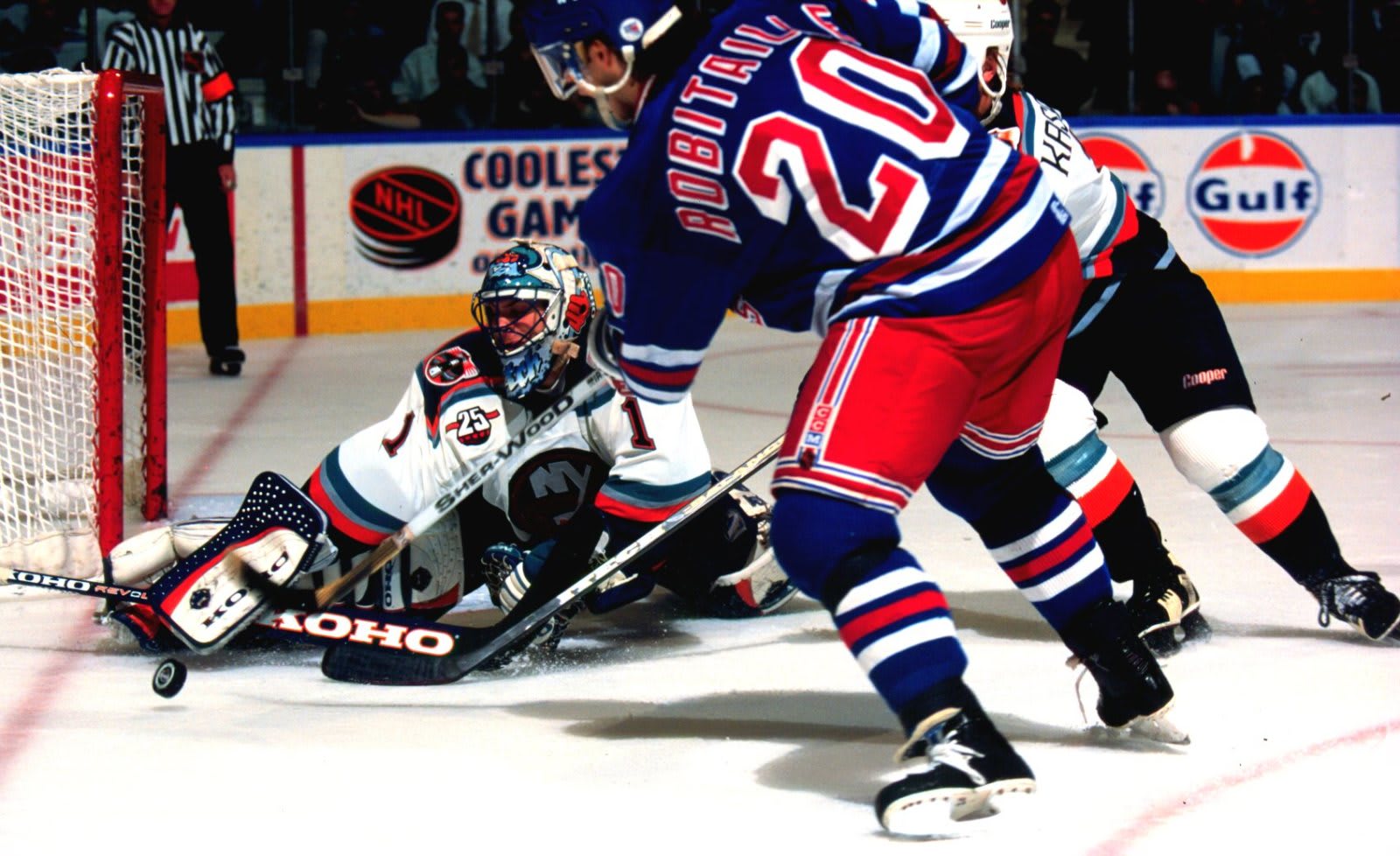
The New York Rangers of the mid-to-late nineties were a franchise constantly making moves, almost recklessly, like a loose cannon in a Kenny Rogers song. That might be a slight exaggeration, but the volume of trades and roster shakeups was striking. Even if the intent behind some of those decisions is understandable in hindsight, many of them missed the mark and helped set the stage for what became the Rangers’ “Dark Ages” from 1997 to 2006. One deal in particular that can be viewed as an early warning sign was the pair of Luc Robitaille trades, though none of the blame falls on Robitaille himself. Luc Robitaille as a Ranger was fine, but those trades were not.
It started on August 31, 1995, when the Rangers (and Mark Messier’s dislike of certain players) traded Sergei Zubov and Petr Nedved to the Pittsburgh Penguins in exchange for Robitaille and Ulf Samuelsson. Zubov had been instrumental in the Rangers’ 1994 Stanley Cup run, leading the team in scoring and following it up with 36 points in 38 games during the 1994–95 season. However, in the playoffs, he appeared physically overmatched by the Philadelphia Flyers’ “Legion of Doom,” prompting general manager Neil Smith to make a change.
In return, Smith got exactly what he thought the team needed: more size and edge on the blue line in Samuelsson, an aggressive, punishing defenseman, and an elite scoring winger in Robitaille. On paper, it addressed multiple needs. In reality, it didn’t quite play out that way.
Robitaille is one of the greatest scorers in NHL history, but but Luc Robitaille as a Ranger doesn’t reflect that legacy. With the Los Angeles Kings, he had scored at least 40 goals in eight non-lockout seasons, establishing himself as one of the league’s premier finishers. But with the Rangers, his production dipped. Over two seasons, he was good but not great, finishing with 117 points in 146 games while failing to reach even 25 goals in either year. Solid numbers, but far from the 30-to-40 goal scorer the Rangers expected.
With those results falling short, the Rangers decided to end the Luc Robitaille as a Ranger experiment, trading Robitaille back to Los Angeles in exchange for Kevin Stevens. The hope was that Stevens could rediscover the power-forward form he had shown with Pittsburgh. Instead, that move backfired as well. Stevens struggled both on and off the ice in New York, while Robitaille thrived again upon returning to the Kings. Back in Los Angeles, his scoring touch re-emerged, as he recorded three more 30-goal seasons before later winning the Stanley Cup with the Detroit Red Wings in 2002.
Maybe the Rangers were the issue…
It’s a fun piece of trivia that a Hall of Famer like Robitaille once wore a Rangers jersey, but Luc Robitaille as a Ranger ultimately feels underwhelming. Despite respectable production, he never replicated the elite scoring he displayed in Los Angeles or later in Detroit. In the end, this sequence of moves stands as another example of the Rangers taking big swings throughout the 1990s and missing. Looking back, it sometimes feels like they were emulating the chaos of the ’90s Mets rather than the sustained success of the ’90s Yankees. (I’m a Mets fan, I can make that joke).
Lucky Luc Robitaille as a Ranger wasn’t so lucky, and neither were the Rangers.