
By Peter Abraham — This week I attended my fifth Bicycle Leadership Conference, an annual gathering of the bike industry organized by People for Bikes. I’m currently in my third career, and I’ve attended events like this in every phase of my professional life. When I produced tv commercials, I attended the AICP Award Show in New York every year. After that I worked in the running event business, and I would go to Running USA and The Running Event.
BLC took place at the Marriott Resort in Dana Point, California. It’s an hour and a half from my house, so it’s easy for me to throw my bike in the car and drive down. BLC has alternated between Dana Point and Tucson, another nice location with great cycling. The event is essentially 2 and a half days of dinners, presentations, talking to new & old friends and early morning bike rides.
I find these kinds of events to be fun, informative and exhausting. But always worthwhile. Here’s what happened at BLC this year.
At dinner the first night awards were presented to both The White Line and Ride for your Life, inspiring organizations devoted to bicycle safety that started after people (Magnus White and Sarah Debbink Langenkamp) were tragically killed on their bikes by drivers of motor vehicles. The need for safe places to ride was a theme that came up over and over during the week.
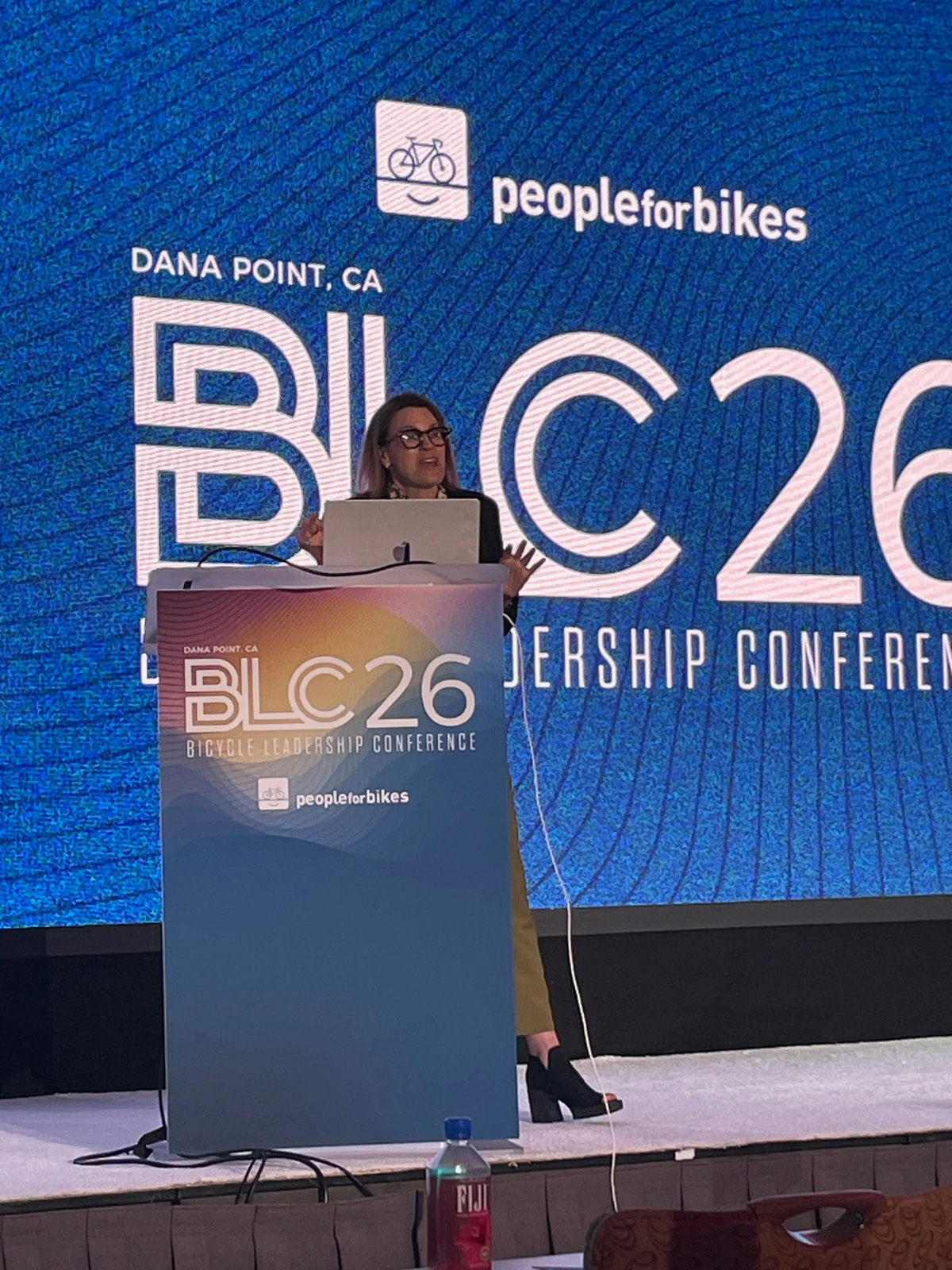
People for Bikes CEO Jenn Dice and her team do a great job putting on this event, and I thought this was the best one ever: great speakers, tight production and lots of opportunities to meet and talk to people. The bike industry is gradually coming out of (but still in) arguably its most challenging period ever: the COVID boom/bust in demand followed by massive trade tariffs and now the spike in energy costs. It’s an incredibly complicated time to be in any business, not only bikes. But in both presentations and informal conversations this week, I felt more focus and intention than I’d seen over the last few years from attendees. It would be easy, almost expected, to be pessimistic about the industry at this point in time. But I didn’t feel much of that.
One of the features of BLC is a few speakers who are not necessarily from the bike industry but have great ideas or insight that is relevant for all of us in the room. This year featured Chip Conley and Jon McNeill in those roles, and everyone I spoke with agreed that their presentations were exceptional. Chip talked about the way that successful companies are built and how businesses can identify “what business they’re in.” Which is a bigger and broader than, for example, “we make bicycles.” As an example, he referred to his time at Airbnb, where the leadership team identified that they’re actually in the business of BELONG ANYWHERE rather than “renting rooms.” And that has guided their business ever since. In the open Q&A at the end of his talk, I asked how he took that mission into implementation as it related to staff, product and marketing. He then gave details about Airbnb events for hosts they created that reflected this purpose, and how the mission can mean different things to different employees of the business. Chip’s presentation was a super informative and useful.
Jon McNeill is a longtime cycling enthusiast and business leader. He was the Tesla President, running sales and marketing, from 2015–2018, and he currently serves on the Board of Directors of both General Motors and lululemon. He shared so much wisdom from his time at Tesla about how they massively speeded up process, simplified manufacturing and sidestepped traditional practices. As an example, he talked about cutting down the available versions of the Model S from 380,000 choices to two choices. All of the ideas and strategies he presented felt directly relevant for the bicycle industry. I approached him after he walked off stage to ask a question. Jon immediately said, “Peter, I met you but you don’t remember. It was in Bentonville after you got your concussion. Tim Johnson and I went over to check on you the next day.” Wow! He was right, I had zero memory of his visit, but I really appreciate that he had done that.
The two most important themes that were talked about among attendees and on panels were 1) eBikes and 2) infrastructure. These two subjects dominated the conference.
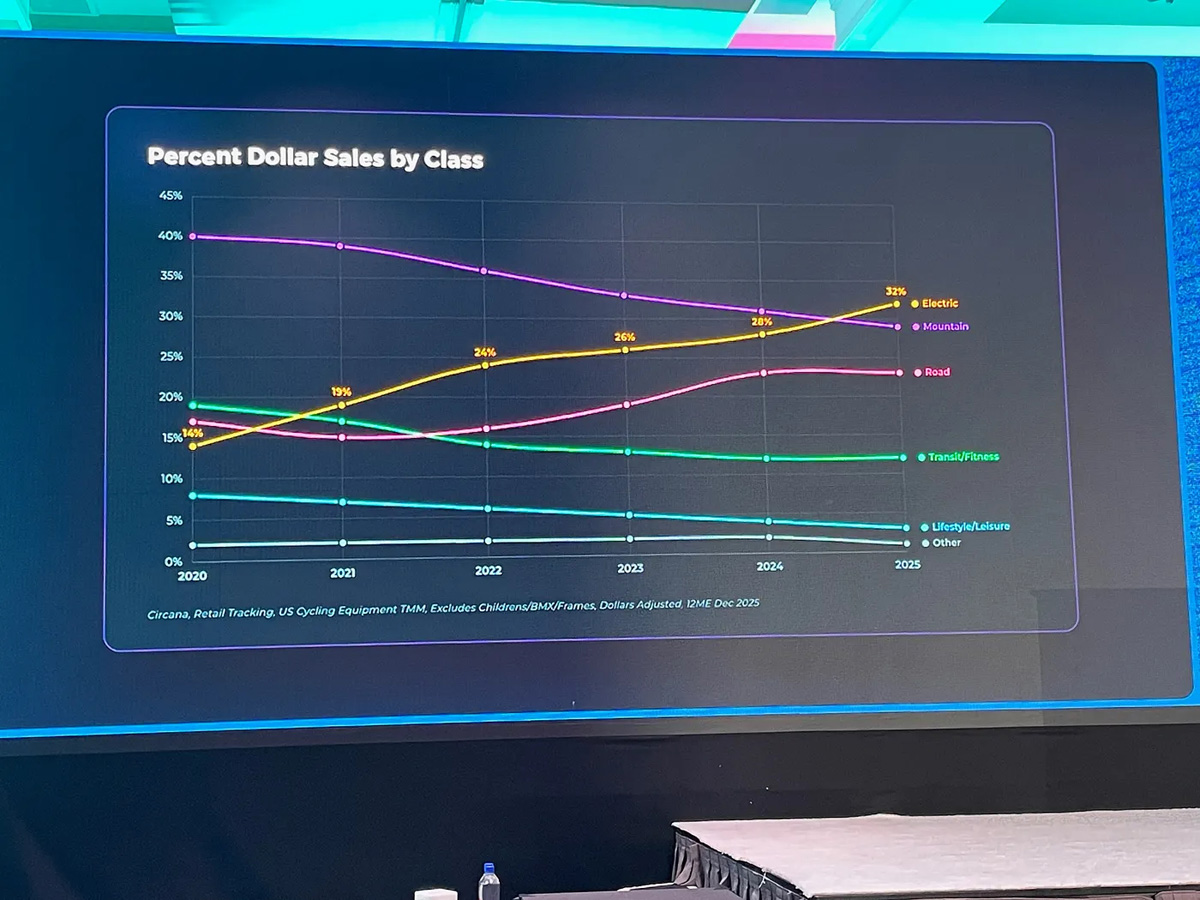
eBikes have exploded in popularity over the last few years. They are the biggest growth area of the bike industry. I asked one of the biggest bike retailers in the country if he could share any insights with me. What were the top three things he’s seeing right now that I might not be aware of? And basically his response was, “Numbers 1, 2 and 3 are related to eBikes.” Many of us spent a lot of time this week discussing the many angles to eBikes. How separate are those eBike riders from the traditional cycling customer? What about the emerging category of eMotos, which are actually motorcycles with an electric engine…should those be regulated differently? And how about the big bicycle brands — Specialized, Trek, Canyon, etc. — who are making electric commuter bikes…does that customer care about the bike racing tradition of these brands? Will that customer pay double for a bike from these brands that is almost exactly the same as a comparable eBike from Lectric or Aventon?
My friend Juliet Scott-Croxford of Brompton interviewed the Lectric eBike founders on stage, and it felt so refreshing. They approached bikes as young newcomers to the space thinking about transportation as a vehicle for having fun. One thing that is clear is that eBikes — the biggest growth area in the industry — are being dominated by outsiders like Lectric, Aventon and (until their recent demise) RadPower. Setting eMountain Bikes aside, the traditional bike brands have struggled in the mass eBike market. While these newer direct to consumer brands have quickly built big businesses with low cost product that solves customer problems (getting around on an eBike without spending too much).
As I mentioned, safe streets and infrastructure were another frequently discussed theme throughout the week. This is a foundational component of the bike industry: without safe places to ride, we can’t expect people to buy bicycles. I am part of a People for Bikes task force trying to get more bike infrastructure built in the period before and after the LA28 Olympics. And I was asked to share some of the early work we’re doing. So I spent five minutes taking everyone through our point of view on infrastructure in LA.
Here’s the text of my talk:
I’m part of a People for Bikes task force, Ride LA Together, getting more people on bikes around the LA28 Olympics. Bike infrastructure is one of the tangible benefits from an Olympic Games that lasts. That is durable.
I want to tell you about a number.
25. That’s the current People for Bikes city rating for LA. Out of 100. It’s a terrible rating, below bike hot spots like Orlando, Atlanta and Phoenix. No disrespect to those places, but we can do better.
Like me, you may have been inspired by the bike infrastructure Great Britain got built around the 2012 Games. Or what Paris did before and after 2024. Those positive changes–dozens of projects and hundreds of miles of bike lanes–are DURABLE. Almost permanent.
And in both places, biking continues to increase after the games. We’ve been in touch with people in the UK and France who worked on both of those initiatives, and one of the French team told me: “Peter, don’t underestimate the potential for the Olympics to change behavior at scale.”
The leverage we have right now to increase biking in a metropolitan area of 13 million people is 10x what it would have been 5–10 years ago. That’s because of the Olympics.
In fact, just an hour ago someone here at the conference told me about a potential BMX track near here that is getting closer to completion because the Olympics (and the BMX event) are coming to LA.
On top of that, the LA28 team feels that bikes are the great unlock for transportation at the Games. Many of the venues are going to be fenced off for security reasons. You’re not going to be able to drive your car down to, say, the Coliseum and park there. You’ll have to park 4 miles away and take an uber. But bikes and pedestrians can get through the fence.
We want to help deliver a lasting bike legacy in Los Angeles.
Of course, there are challenges here, like recovering from last year’s fires and a fragmented governance landscape. But we can make a difference if we all get involved.
Ride LA Together will align advocacy, industry partnerships and storytelling to create safer places to ride.
We’ll help unlock $600 million in infrastructure projects that are already at the 1 yard line. Great organizations like Festival Trail, Move LA, Ride LA, CicLAvia and Streets are for All are already doing amazing work on lots of infrastructure. And that goes along with billions in light rail and subways that are going in.
But we can help accelerate all of this.
We’ll help align all of the stakeholders, and there are many.
We’ll help arrange measurement of biking in LA. If we don’t do that, we can’t claim success later.
We’ll help put pilot programs in place.
And we’ll help bring in brands from both inside and outside of the bike industry.
But we need your help to do all of this. There is so much expertise and leadership in this room.
So we’re asking you to scan this QR code and sign up on our list. That sounds like an anti-climax, but the asks are going to come quickly.
For example, the Metro Board is about to take its final vote on the $430 million LA River Bikeway–that’s a 9-mile bike lane right through downtown LA–and as soon as it goes on the agenda, we’ll ask everyone on the list to write letters to the Board.
We need your help with four things:
-
-
- Advocacy (like this)
- Fundraising
- Marketing these projects & initiatives
- Building community
-
You’ll get to be part of the process that is creating the same change that happened in London and Paris. I guarantee you won’t regret that.
Overall it was a great week. I’m already looking forward to next year.
(Visited 26 times, 1 visits today)