
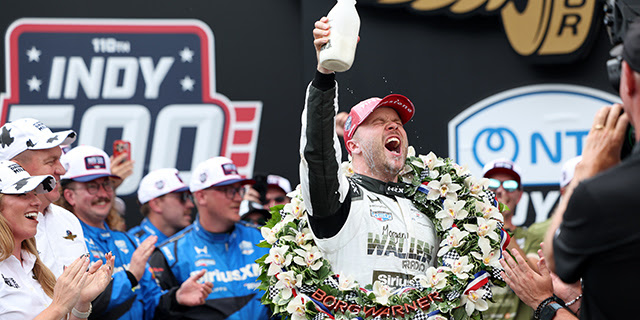
INDIANAPOLIS — Felix Rosenqvist created a heartwarming victory in Sunday’s 110th Indianapolis 500, while breaking David Malukas’ heart.
Rosenqvist drove the greatest final lap in Indianapolis 500 history, according to Indianapolis Motor Speedway historian and former reporter Curt Cavin.
It all began at the start of Lap 200 when Marcus Armstrong restarted the race with Team Penske’s David Malukas and Rosenqvist behind him coming to the white flag. When Malukas pulled out of line to slingshot past Armstrong, Rosenqvist tucked in behind and Pato O’Ward raced to the inside of Rosenqvist to make two rows of two-wide dash to the checkered flag.
But in Turn 1, Rosenqvist went for the victory. It didn’t matter that Armstrong is his teammate at Meyer Shank Racing. Rosenqvist was going to do something completely unconventional by taking the outside line and hope that was his path to victory lane.
Cavin timed the last lap as Rosenqvist and Armstrong went side by side for 23 seconds from the middle of Turn 1 to the entrance of Turn 4.
Rosenqvist had not won a n NTT IndyCar Series race since 2020 at Road America in Elkhart Lake, Wisconsin. He was determined to do whatever it took to win the Indianapolis 500.
He closed up behind Malukas as the race leader began to zig-zag down the frontstretch. Rosenqvist committed to the outside line and Malukas protected the preferred inside lane. According to Malukas, the two cars were, “really, really close.”
So close, it’s a wonder they didn’t crash.
But about one second before crossing the “Yard of Bricks” with the checkered flag waving, Rosenqvist made the race winning pass in the closest finish in Indianapolis 500 history.
Rosenqvist’s No. 60 Meyer Shank Honda defeated Malukas No. 12 Verizon Chevrolet by 0.023-of-a-second. The previous record was Al Unser, Jr.’s 1992 Indy 500 win over Scott Goodyear by 0.043 seconds. In 2014, Ryan Hunter-Reay defeated Helio Castroneves by 0.06-of-a-second.
“He just had a really good run,” Malukas said. “There’s nothing else I could have done. I’m trying to think back, maybe something different with deployment here or there. There’s just no way.
“In the car it looked a lot closer, which it was really, really close, but from the run I didn’t know he had that big of a run. Watching the replay and seeing the run that he had, it actually made me feel better because I was like; to be honest, I don’t think there’s anything I could have done. Maybe could have shortened it by a couple thousandths. I think that was the IMS gods telling me that it’s not my time.”
Rosenqvist became the third driver to win the “500” with a last-lap pass, the other being Josef Newgarden’s in a similar one-lap shootout with Marcus Ericsson in 2023. That separation at the finish line was 0.097 seconds, which now is the fifth closest.
Rosenqvist agreed it was the best lap of his career.
“I’ve never been flat around the high line for more than one corner (at IMS),” Rosenqvist said. “To do it a whole lap on the outside, that was pretty cool. It’s kind of unheard of at Indy.
“That’s just how much you want it — it’s hard to explain that feeling, that you want it so much and you have so much adrenaline that you literally don’t care if you’re going to crash. You’re just going all in. It was cool that that’s what it took to win it, as well.
“To win it like that makes it three times more special. I would have paid a lot of money to watch that race.”
It was a wild and crazy Indianapolis 500 from start to finish that included 70 lead change, an Indianapolis 500 record. It broke the previous record of 68 in the 2013 Indy 500. It was the third-most lead changes in IndyCar history.
Rosenqvist finally won his second NTT IndyCar Series race and celebrated with tears of joy.
Meantime on pit lane, Malukas openly cried tears of heartbreak after doing everything he possibly could do to win the race, only to fall short by the narrowest of margins.
“I just don’t know what else we could have done,” Malukas said. “We were driving 150 percent that whole race. The guys did a fantastic job getting the car where it needed to be. We had the fastest car out there that whole race. It was ours to win, and I knew that.
“I’ve never pushed that hard in my whole life. Just to finish, like — I can’t believe it. This whole season, even before, just keep getting a lot of seconds, but we just can’t get — now it’s like — I don’t know how much closer you can get to getting it. So yeah. Now we’re even P2 in the championship. It’s great, so many seconds.
“But on a high note, this team, everybody from Verizon and the whole crew and even outside the 12 crew, but the 2 car, the 3 car, everybody — I’ve been through many different teams, although I’m still young, 2024, from the wrist injury, been to so many different teams, and nobody is like Team Penske. Everybody here is just so closely connected and truly feels like family. Obviously coming from all of that, Roger was one of the first guys to come to me and tell me that he believes in me and told me to keep on pushing.
“Because of him, I can sit here and cry that I’m going for a P2 position. I think that’s why it’s really emotional for me because I wanted to get a win for this team and just wanted to be written across those history books. Everything happens for a reason. I think there’s a reasoning to this. We’re going to just use it as more motivation and just keep pushing forward, and someday maybe it’ll happen.”
Team Penske’s Scott McLaughlin finished third, giving Team Penske two positions in the top three.
Pato O’Ward of Arrow McLaren was fourth followed by Armstrong, who had a chance to win the race if not for the ill-fated yellow flag when Mick Schumcher brushed the wall on Lap 197. Although there was no debris on course, that set up a one-lap dash to decide the Indianapolis 500.
There was also a Red Flag stoppage prior to that on Lap 192 after rookie Caio Collet crashed in Turn 2. The Red Flag was to allow sufficient time to clean up the wreckage and ensure a green flag finish.
Whether that made the finish of the Indy 500 appear contrived was quickly forgotten by the thrilling finish.
It was the second Indy 500 victory for Meyer Shank Racing. The team has only won two IndyCar races and both have come in the Indy 500. Helio Castroneves won the team’s first in 2021 when he became the fourth four-time Indy 500 winner.
Alex Palou led the most laps with 59 followed by Chip Ganassi Racing teammate Scott Dixon’s 32. Malukas led 30 laps and Rosenqvist 25 in a race that 14 different leaders.
A sold-out crowd of more than 335,000 fans jammed the Indianapolis 500 on a day when it was expected to rain.
At 9 p.m. Eastern Time, IndyCar Officiating announced a post-race technical inspection penalty for the No. 10 Chip Ganassi Racing car driven by Alex Palou. During post-race inspection, the front wing of the car failed front wing height measurement.
Chip Ganassi Racing was in violation of the following rule involving the speedway front wing end plate – minimum and maximum heights:
- Rule 14.7.6.8. Front wing must adhere to the following Technical Inspection dimensions.
- Rule 14.7.6.7.1. For the purposes of technical inspection, the front wing must not measure less than 8.300 inches when set at any angle, while installed on the INDYCAR technical inspection fixture.
IndyCar Officiating has determined that the non-compliance was the result of an assembly error and not an intentional modification.
Palou’s entry has been penalized five championship driver and entrant points and the team has been fined $10,000.
Chip Ganassi Racing issued the following statement: “During technical inspection following Sunday’s Indianapolis 500, a part failure was discovered in the front wing assembly of the No. 10 car. The failure caused the wing to fall out of compliance with INDYCAR’s technical parameters post-race, resulting in a $10,000 fine and a 5-point penalty in the championship standings. Chip Ganassi Racing did not attempt to gain an unfair advantage in the race, and accepts this penalty.”
Unlike last year’s Indianapolis 500 that got off to a sloppy start, this year’s Indy 500 had a great start from the drop of the green flag from actor Brendan Fraser to ECR’s Alexander Rossi passing pole winner Alex Palou into Turn 1. But Palou retook the lead in Turn 3 before Rossi took it back at the start/finish line at the end of that lap.
That started a frenzy of swapping the lead, some by design to try to save fuel among teammates at the front including Scott Dixon and Palou. Over the first 10 laps, Palou and Rossi had swapped the lead seven times.
The first caution was for a multi-car crash in Turn 2 on Lap 18. Ryan Hunter-Reay of Arrow McLaren spun and hit the wall. Katherine Legge of HMD Motorsports/AJ Foyt Racing was following behind and crashed. Both drivers were able to get out of their cars with assistance from the AMR Safety Crew and were evaluated and released at the IU Health Infield Care Center.
Rinus VeeKay was the leader when the race restarted on Lap 26, but on the next lap, Ed Carpenter spun and crashed in Turn 1. He was also checked and released by INDYCAR Medical.
Hometown hero Conor Daly of nearby Noblesville, Indiana took the lead when rookie leader Caio Collet pitted on Lap 40. One lap later, Palou passed Daly as the frantic lead swapping continued.
On Lap 92, 2018 Indianapolis 500 winner Will Power spun on pit exit with fluid coming out of his car for another caution. Rossi’s No. 20 Chevrolet caught fire for the second Indy 500 in a row.

As the skies to the west getting darker, the pits were opened on Lap 98 setting up another battle for the lead. Dixon led the field onto pit road ahead of second-place teammate Palou. The race off pit road was Dixon, Palou and Malukas in that order.
The race was red flagged on Lap 105 at 2:23 p.m. for light rain, but the stoppage was for just 12 minutes before the engines were refired to return to racing.
The command to restart was at 2:35 p.m. The running order was Dixon, Palou, Malukas, Newgarden and O’Ward.
Graham Rahal was the only driver that topped off his fuel on Lap 109 as Dixon brought the field to the green flag for a restart. Malukas got a tremendous restart and took the lead heading into Turn 3. Another driver who had a fantastic restart was Daly, who went from ninth to fourth.
Palou regained the lead, but Malukas quickly drove the No. 12 Verizon back to the front.
Raindrops returned on Lap 115 and the caution light was turned on again.
During the caution, Romain Grosjean was penalized for passing under the yellow and would be sent to the back of the field.
“We told him to get going after that last stop and he did, he did exactly that, he took off,” Reinbold said. “We are trying to figure out when the optimal time is to stop and when the rain is going to hit and that’s it.”
Heading to the green flag for a Lap 125 restart, the field hit the throttle but Josef Newgarden, running fourth at the time, hit the curb on the bottom of Turn 4 and it disrupted the car, spun it around and slammed into the outside wall.
The light went from green back to yellow as Newgarden’s No. 2 Shell Chevrolet was put on the hook and towed off the track.
The pits opened on Lap 130.
The green flag waved the following lap, and Daly had the restart of the race, driving from third to the front into Turn 1. Malukas went from the lead to sixth place.
McLaughlin passed Daly for the lead and took Palou with him for second. It was the 50th lead change in the first 135 laps.
Palou took the lead one lap later and McLaughlin was the leader one lap later as the racing got wild. But on Lap 138, Daly went to the inside to regain the lead in some wild and spectacular racing.
Palou went from third to first in Turn 1 by taking the outside line, but Malukas was back in front one-lap later.
The top three cars continued to trace the lead until Palou was the leader on Lap 142. For several of the teams, Lap 150 was their magic number to hit to guarantee just one more pit stop before the end of the race.
But McLaughlin and Malukas both pitted after 147 laps for four tires and fuel. McLaughlin beat Malukas off pit lane. Palou pitted on lap later and he was quickly in and out of the pits.
Dixon was the leader on Lap 150 and stayed there until he pitted on Lap 151. Teammate Kyffin Simpson was the leader but had a different strategy than the other top runners at that point in the race.
Felix Rosenqvist took the lead on Lap 154 for the 63rd lead change of the race. Rosenqvist stayed in the lead with O’Ward and rookie Dennis Hauger the second and third in line.
O’Ward pitted with 37 laps to go after running 34 laps on his tank of fuel. He was in and out of the pits in 7.6 seconds. Hauger pitted next but was penalized by IndyCar Race Control for a pit speed violation. He had to serve a drive through penalty.
Rosenqvist continued to stay in front and was told by his crew to run stay on track. He pitted with 34 laps remaining for what Meyer Shank Racing was hoping would be his final stop.
When that sequence was completed, Malukas was the leader in front of Palou, McLaughlin and O’Ward. Palou passed McLaughlin with 31 laps remaining for the lead.
At that point, the only two cars on the track that did not have to make another pit stop were O’Ward and Rosenqvist. But Rosenqvist bobbled in Turn 2 but was able to save the car as the handling on this race car began to fade.
When Palou and McLaughlin pitted with 23 laps remaining, O’Ward was the leader. It was the 66th lead change of the race.
With 20 to go, O’Ward, Rosenqvist and Marcus Armstrong were the three drivers on the same fuel strategy and were within 3 seconds of first to third. Fourth-place Romain Grosjean was 24 seconds back.
The only question was if the top three had enough fuel to make it to the finish.
At that point, the final act in one of the most exciting races in Indianapolis 500 history had yet to play out, with an incredible finish for the ages between Rosenqvist and Malukas.
“What a race, what a race,” Rosenqvist radioed to his crew. “What a car, what a car.
“What a crew, what a crew.”
What a finish, what a race, what a month of May for Felix Rosenqvist who became a father, and an Indianapolis 500 winner.