
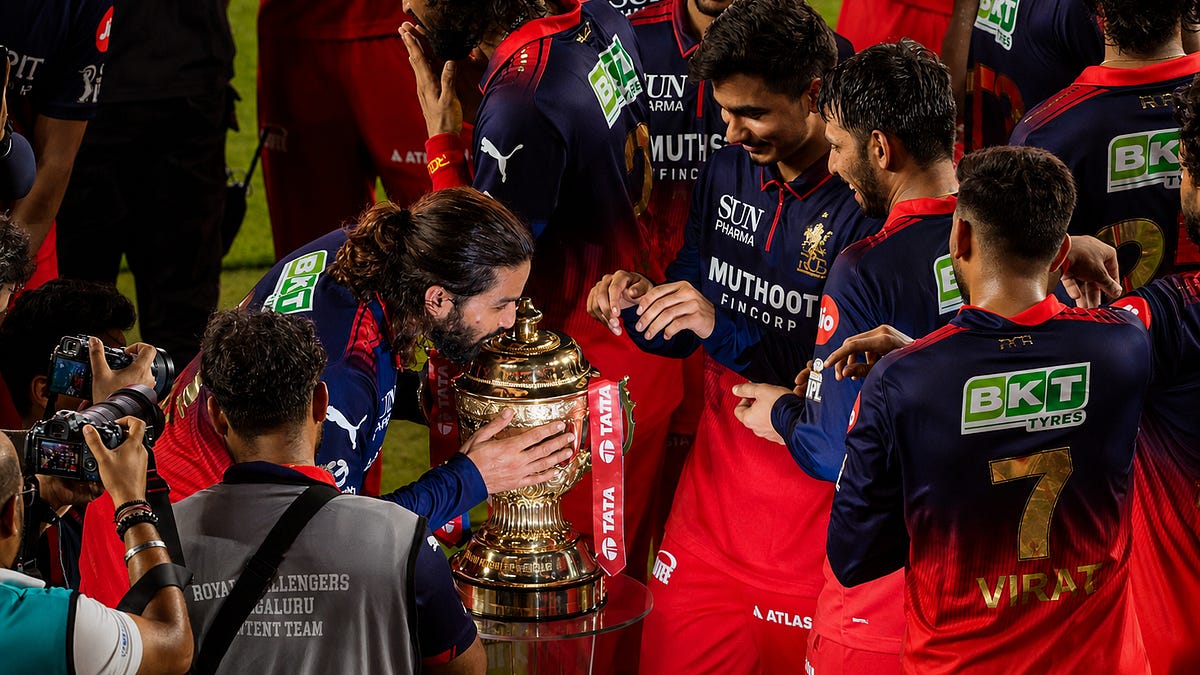
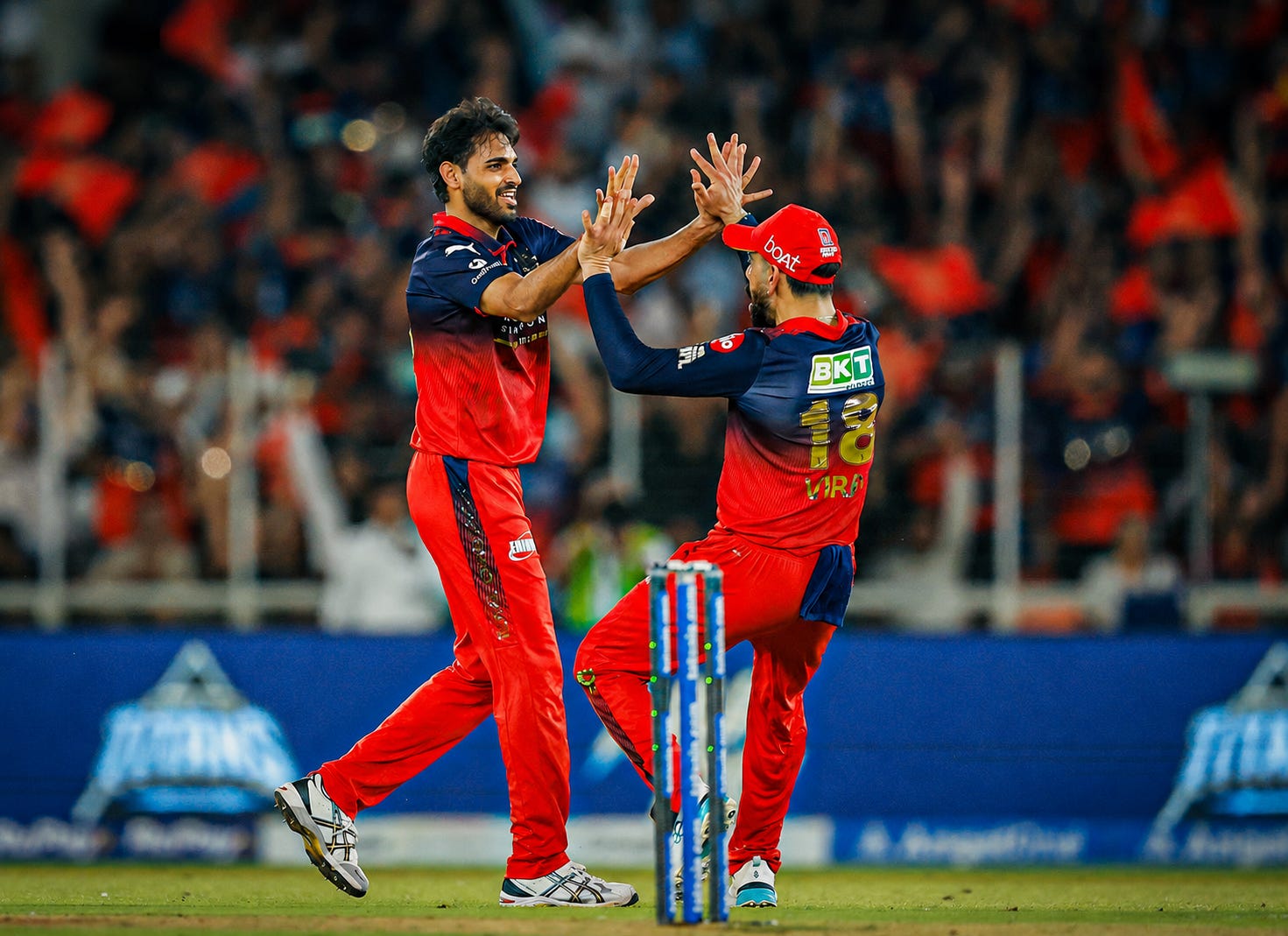
RCB win their second title in a row! The defending champions become just the third back-to-back champions, and fittingly they were led by their two oldest stalwarts; Bhuvneshwar Kumar (2-29) and Virat Kohli (75* off 42).
But, what happened beyond the headlines?
-
🦘 GT Innings; RCB used the short ball to decimate GT’s batting order.
-
🐐 RCB Innings; Virat Kohli rapidly punished GT’s one-dimensional bowling.
RCB make “short” work of GT’s batters
✍️ Written by Tarun Pratap, who runs The Rank Turner. Follow him on X.
Much of the Gujarat Titans’ success this season has rested on the shoulders of their top three. Shubman Gill, Sai Sudharsan and Jos Buttler came into the final having scored 1,939 runs between them, while GT had lost only 1.13 wickets per powerplay, the lowest among all teams. Their dominance at the top had also helped shield a vulnerable middle order.
RCB knew that if they could get through the top order, the game would change dramatically. Yet the first indication of how they would do it arrived before a wicket had even fallen.
In the opening over, Jacob Duffy banged a delivery into the pitch at Sudharsan. The left-hander got into a tangle and was initially adjudged caught behind, only for the decision to be overturned on review. The wicket did not stand, but it provided an early clue. The pitch appeared to offer more assistance to bowlers who hit the deck rather than those searching for fuller lengths.
Initially, RCB did not completely commit to that plan. Their first few overs contained a mixture of lengths, and Gujarat’s batters attempted to manipulate them. Gill, in particular, appeared to have arrived with a clear strategy against Bhuvneshwar Kumar.
Gill has historically struggled against Kumar, scoring only 85 runs against him at an average of 14.16 and a strike rate of 101.20. In Qualifier 1, the RCB pacer had bowled him through a wobble-seam delivery that jagged back in. Tonight, Gill repeatedly stepped forward in his crease, attempting to force Kumar into bowling shorter than his preferred length. The tactic worked. He was unable to consistently pitch the ball where he usually likes to.
However, the next over brought Josh Hazlewood. This season, Gill has enjoyed success against the Australian by charging him or staying deep in the crease, forcing him away from his preferred hard lengths. The first ball to the GT skipper was a short-of-good-length delivery at 137 kph that nipped back slightly. Gill charged and pulled it from the front foot for 4.
The next ball looked similar at first glance. Hazlewood again stayed short of a good length but increased his pace to 141 kph. This time, the ball held its line and was outside off stump instead of cutting back in. Seeing the shorter length, Gill once again attempted the short-arm jab. But because the ball was outside off stump, he had to fetch it with a cross-batted stroke and only managed to miscue it. The difference here was that Hazelwood did not change his length after the first ball, and Gill, who was probably expecting a comparatively fuller ball, stayed in the crease.
In the following over, Sudharsan – after seeing a length ball from Kumar – charged him on the third ball of the over. RCB’s leading wicket-taker saw it and dragged his length back. The delivery was bowled halfway down the track at 132 kph. This forced the GT opener to remain in his crease on the next ball. Kumar went short again, but quicker at 138.6 kph – his fastest delivery of the evening at that point. This was again outside off stump, forcing Sudharsan to chase it and causing the miscue that got his wicket.
From that point onwards, RCB doubled down on the tactic.
After Gill’s dismissal, 54 of RCB’s next 83 pace-bowling attempts – 65.1% – were either short or short of a good length. Those deliveries conceded only 52 runs, produced 6 wickets and yielded just 6 boundaries.
The plan extended well beyond the powerplay. Rasikh Dar’s 8th over consisted entirely of short or short-of-good-length deliveries and brought the wicket of Nishant Sindhu. Washington Sundar edged a similar delivery in the 10th over but survived after the catch was ruled to have touched the ground. Hazlewood later removed Arshad Khan using the same method, while Kumar and Rasikh picked up further wickets at the death.
Across the innings, RCB bowled 61 short or short-of-good-length pace deliveries, accounting for 61.6% of their 99 attempts. Those deliveries produced seven wickets while conceding only 58 runs. Dinesh Karthik mentioned in a mid-inning interview that they had discussed bowling short balls from time to time.
The key here, though, was RCB bowlers improvising their plans after assessing the pitch. They increased the number of short balls, and this is where the experience of Kumar and Hazlewood came in handy. By the time someone like Salam came to bowl, he knew what length to bowl, and in his first two overs, he bowled 10 short or short of good length balls.
The success of RCB in the last two seasons has hinged on bowling with a team plan rather than individual plans. Once the plan was set, every bowler followed. The only bowler who did not have success was Duffy, who did not get his line right. Fortunately for RCB, the execution from other bowlers meant that they could hide the Kiwi’s overs.
For a Gujarat side whose season had been built around the security provided by Gill, Sudharsan and Buttler, RCB’s willingness to repeatedly hit the deck exposed the weakness they had spent the season trying to hide. Once the top three were gone, the middle order was left to fend for itself and had little success trying to do so.
Data from IPL Match Centre.
Kohli took full advantage of GT’s one-dimensional pacers
✍️ Written by Tarun Pratap & Aarush Adil Khan.
Virat Kohli’s reputation as one of the greatest chasers in white-ball cricket was built long before tonight. His record for India in ODI cricket is extraordinary, while in T20 internationals, he has produced some of the format’s most memorable chases. Yet, contrary to popular perception, his IPL record while chasing was not always significantly better than his record batting first.
Across his first 15 IPL seasons, from 2008 to 2022, Kohli scored 3,070 runs while chasing at an average of 36.54 and a strike rate of 129.86. He crossed fifty 18 times and scored one century.
Since 2023, however, he has elevated his chasing to a different level altogether. In 27 chases, he has scored 1,294 runs at an average of 71.88 and a strike rate of 156.46, with 12 fifties and two centuries. The transformation is perhaps best reflected in his boundary frequency. Before 2023, Kohli hit a boundary every 6.14 balls while chasing. Since then, he has found one every 4.53 balls.
Against the GT tonight, that evolution was on full display. Chasing 156, RCB’s intent was obvious from the outset. Rather than pacing the chase, they wanted to end the contest before pressure could develop. Venkatesh Iyer took the aggressive role early, while Kohli barely saw any strike. He faced just one ball in the first two overs and only 12 deliveries in the entire powerplay. Yet by the end of the sixth over, he had already raced to 35 from those 12 balls.
The key battle was against Kagiso Rabada. Coming into the game, Rabada held the purple cap and had been bowling quicker. But, Kohli enjoys high pace. Rabada and Kohli’s IPL head-to-head reflected that tension. Before tonight, Kohli had scored 99 runs against Rabada at a strike rate of 157, well above his career strike rate, but Rabada had also dismissed him five times.
The contest was effectively settled in the fourth over. Rabada attempted to challenge Kohli with pace. Kohli responded with timing and wristwork reminiscent of his best years. The first two deliveries disappeared through square leg for four. The third ball, clocked at 155 kph, was flicked over midwicket for six. Rabada then went short and was pulled for four. On the final ball of the powerplay, another short delivery was dispatched for six.
Rabada never once bowled below 141 KPH tonight, while his powerplay partner Mohammad Siraj only once dipped below that number on a legal delivery tonight; on his last ball. Kohli, one of the finest players of pace in the history of cricket, has not been dismissed by a delivery over 140 KPH since the start of 2025, and strikes at 178 against those deliveries.
Much like he did in Qualifier 1, Kohli feasted on these deliveries. He scored 36 off 13 against Siraj and Rabada. He reached his half-century in just 25 deliveries, the fastest of Kohli’s IPL career.
Historically, the one criticism levelled at Kohli was that wickets falling around him could slow his scoring as he focused on batting deep. GT knew that as long as Kohli remained at the crease, their chances of defending 156 were slim. Every wicket at the other end offered them a potential route back into the game.
Kohli never allowed that opening to appear. Even as partners departed, he resisted the temptation to retreat into accumulation mode. Instead, he continued looking for boundaries, maintained the tempo he had established in the powerplay and ensured the required rate never became a factor. The innings combined the control that has defined Kohli’s chasing for more than a decade with the aggression that has characterised the latter phase of his IPL career.
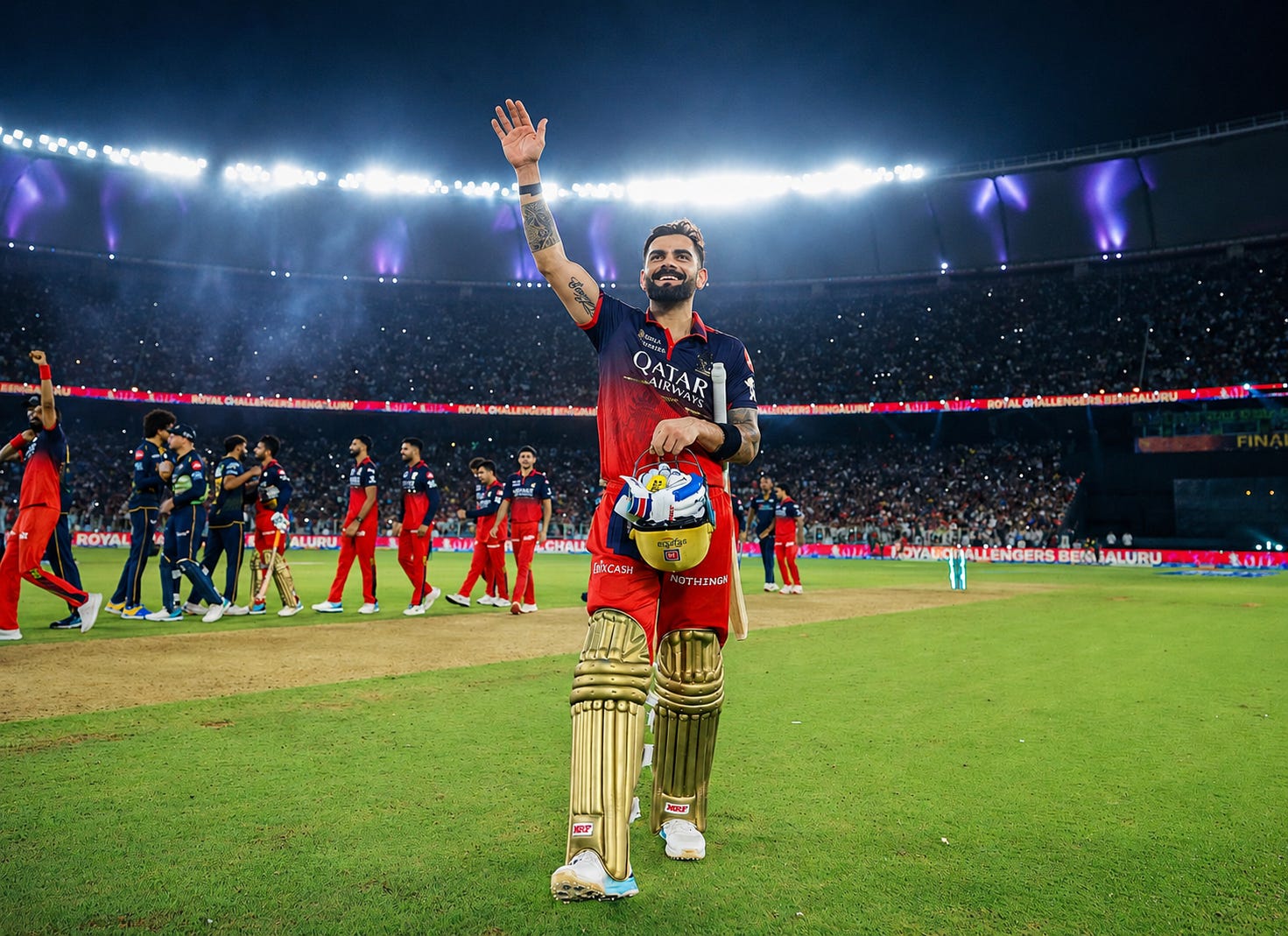
For years, Kohli’s greatness as a chaser was associated with his ability to absorb pressure. Increasingly, the modern version is one that focuses on preventing that pressure from existing in the first place. It was fitting in the end that Virat not only hit the winning run, but he also finished the tournament with a six.
Data from IPL Match Centre.