PARIS – So, will the 2026 French Open be a blip or a true fork in the road?
It was awash in breakthroughs and surprises, including Maja Chwalinska, the first qualifier to reach a Roland Garros final, and hard-to-fathom implosions from commanding positions by No. 1s Jannik Sinner and Aryna Sabalenka.
But the finals weekend was much more predictable, and in the end, singles champions Mirra Andreeva and Alexander Zverev were hardly outliers even if they were first-time major champions.
Andreeva, a Russian prodigy who had a fine clay season and conquered her temperament and the opposition in Paris, is now No.1 in the 2026 points race ahead of Sabalenka.
Zverev, the divisive German veteran who comes with so much baggage, is No. 2 in the ATP race and the only man to go deep at both majors this year. He is less than 1000 points behind Sinner despite Sinner’s all-conquering run from March to May.
The new Grand Slam champs are a decade apart: Andreeva is just 19 with perhaps 15 years of majors ahead of her; Zverev is 29 with a much tighter timeline. But both can move forward with new confidence and, at least for a little while, the profound satisfaction and in Zverev’s case, relief, that comes with joining the club.
For a player, tennis’s appeal and pitfall is that there is a new opportunity just about every week. The grasscourt season is underway. Serena Williams is already a much bigger story than either Andreeva or Zverev, and Wimbledon, where Zverev has long struggled despite his huge serve, begins on June 29th. The French Open buzz is fading very quickly.
Andre Agassi, working for TNT at Roland Garros, reached three major semifinals and three major finals before, in a big surprise, winning Wimbledon in 1992 (He beat Boris Becker, John McEnroe and Goran Ivanisevic in the final three rounds at a time when conditions were unfavorable on grass for baseliners).
“I finally got over the finish line, and I was let in on a dirty little secret: winning changes nothing,” Agassi said. “You are going to have that pressure again if you have more expectations from yourself.”
I wrote in depth about Andreeva on Sunday but want to look closely at Zverev here.
His case is particularly intriguing. Winning after such a long and often-bitter wait – this was his 41st Grand Slam tournament — could be liberating, allowing him to swing more freely on big points in majors.
“Now no matter what happens, I will always be a Grand Slam champion, and nobody can take that away from me,” he said. “Maybe that does give me some freedom…maybe my mind will just be a little bit calmer when I play a final, meaning that even if I lose it, I will still be a Grand Slam champion. I think this trophy for me is very important, because if I would have lost this one, the self-belief would have gone down a lot. But now that I’ve won it, I feel like I can do it again.”
Now for the reality check: Sinner has beaten him nine times in a row, the last six times without dropping a set. Alcaraz is a different matter. Zverev was agonizingly close in their crucible of an Australian Open semifinal in January, losing in five sets after five hours and 27 minutes. He has a 6-7 overall record against the Spaniard, whose future is cloudy because of his wrist injury.
Against Novak Djokovic, no longer a year-round competitor at age 39, Zverev has split the last six matches. Sinner is clearly Zverev’s biggest problem, and it seems unlikely that the relief of winning a major can change what has become a fundamental mismatch unless, heaven forbid, Sinner’s issues in the heat reflect some underlying and longer-term health problem.
There is also the chance that taking Roland Garros could leave Zverev short on purpose, with his obsessive quest now complete. Think Goran Ivanisevic after finally winning Wimbledon in 2001 or even Djokovic after finally winning the French Open in 2016 (his burnout did not last, however).
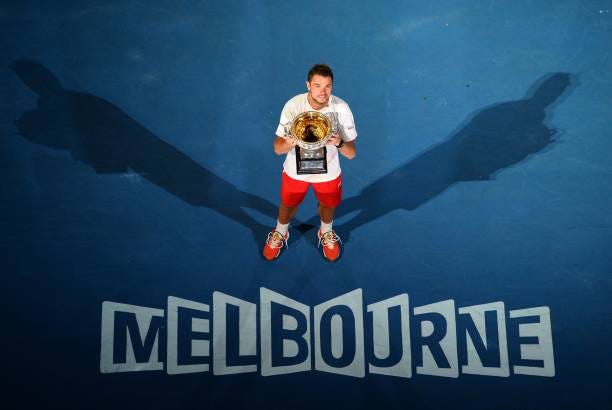
History is against Zverev settling into a new groove. In the Open era, he is the fifth man aged 29 or older to win his first major. None of the others — Andres Gimeno, Andres Gomez, Petr Korda and Ivanisevic – won another. Of the eleven oldest men to win a first major in the Open era, Stan Wawrinka is the only exception to the rule. Wawrinka won the 2014 Australian Open at age 28 and went on to win two more majors, and play on tour until this season. But unlike Zverev, Wawrinka, who was long relegated to a minor role in the Big Three era, was never a true major title contender until age 28, when he joined forces with coach Magnus Norman.
Consider this: Zverev won more Grand Slam men’s singles matches than anyone before winning a major: 125. That is well ahead of Ivanisevic’s 105 and Andy Murray’s 100. Wawrinka was at 75, which tells you just how late he started to peak.
The women’s game tells a similar story. The five oldest women to win their first singles major have not won another: Flavia Pennetta, who was 33; and Francesca Schiavone, Madison Keys, Jana Novotna and Kerry Reid, who were all 29. Only Keys still has a chance to go for more, and the odds, frankly, are against her.
It is not as if Zverev beat the best of the best and faced down his betes noires to end his drought. Alcaraz is sidelined. Sinner staggered out in the second round after blowing a two-set, 5-1 lead against Juan Manuel Cerundolo. Djokovic, the all-time men’s leader with 24 major singles titles, was beaten by Joao Fonseca, a Brazilian more than half his age, in a third-round classic.
But if you start handing out asterisks where do you stop? Roger Federer did not have to beat Rafael Nadal or Djokovic to win his lone French Open in 2009. Alcaraz did not have to face any of the Big Three or the defending champion Daniil Medvedev to win his first major at the 2022 US Open. Qualifier Emma Raducanu did not face a top 10 player when she won the US Open the year before.
Like it or not — and many were and remain deeply resistant — Zverev earned this major.
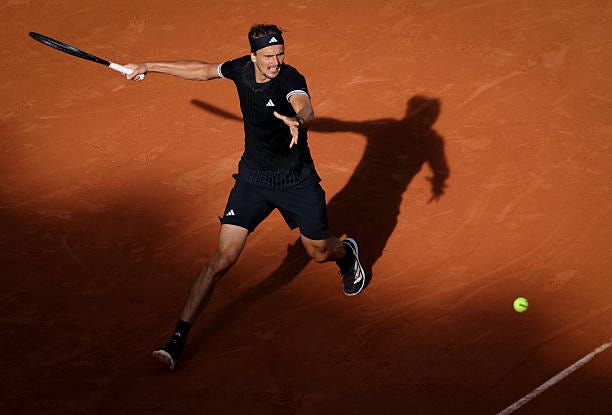
Staying healthy and handling the weather and the vagaries of Grand Slam scheduling are part of the package. Sinner collapsed in the heat against a lesser player. Zverev did not. Djokovic played only one match on clay before Roland Garros. Zverev played 13. Other contenders, like Casper Ruud, overtaxed themselves with too many first-week marathons. Zverev dropped just one set in the first five rounds and saved his lone five-setter for the final against outsider Flavio Cobelli, the No. 11 seed and not the Italian anyone was expecting to get that far.
The final was many, often contradictory things: mediocre tennis, inspiring tennis, suspenseful tennis and ultimately anticlimactic tennis as Zverev grabbed early command of an error-strewn fifth set and held on (with hands occasionally trembling). Cobolli was out of fuel, his legs gone by his own admission, but endurance, too, is part of the package. Zverev, who was cramping from nerves in the fourth set, knew this time how to muddle through the double faults and the tight swings and find a way to rise above.
It surely helped to look across the net and see Cobolli instead of Alcaraz, Sinner or Djokovic. It is hard to imagine any of those champions fading in the fifth quite like Cobolli. But then it was not just about the final, even though it surely felt like it to Zverev.
It is about all that comes before the final, and Zverev, a diabetic who has to inject himself with insulin on court to control his blood sugar, has overcome more than most.
I was watching from the press box on the Chatrier Court in 2022 when Zverev played Nadal, the king of kings of clay, to something close to a draw for two relentless sets in the semifinals before blowing out his right ankle and leaving the court in a wheelchair. It looked bad, and it was arguably worse. He had major surgery, needed a plate and screws put in the ankle and missed six months of action.
Two years after the injury, he became the last man to face Nadal at the French Open, defeating him in the opening round on the same court en route to the final, where he lost a two-sets-to-one lead against Alcaraz.
Two more years later, on the same rectangle of crushed red brick, Zverev finally won a major. Again, he led two sets to one and again he put himself in position to let it slip. His tennis demons resurfaced; the second serve, the conservative streak, the nerves. Cobolli, the newcomer, found something inside himself as the match peaked late in the fourth set. He served for it at 5-4, was down 0-30 and then was handed two unforced errors from an edgy Zverev. It was 30-all, and Zverev, out of the blue, ripped two of the best shots he has hit in any match: a forehand inside-in winner from what should have been his backhand corner. That got him a break point, which he converted with a backhand winner down the line out of the same corner.
It was 5-5 and evident that Zverev was trying to learn from the past, trying to seize the initiative when it mattered most, but was only intermittently capable of applying the lesson. It was just as clear that neither player had a clue what might happen next. The sublime? The ridiculous? Zverev experienced both as he held serve, missing an easy overhead in the net and then finishing with an ace. They ended up in a tiebreaker. A Zverev double fault at 3-4 opened the door. Cobolli hit an Alcarazian forehand drop shot winner to get to 6-4 and then moved in for the kill and the set after a great wide first serve, only to leap and miss his high forehand volley by a club-player margin.
There were groans in the stands on this day of deeply mixed emotions, but Cobolli bounced back, running wide on the next point to chase a firm forehand from Zverev and then, closing his eyes (or so he said), and smacking a forehand winner down the line.
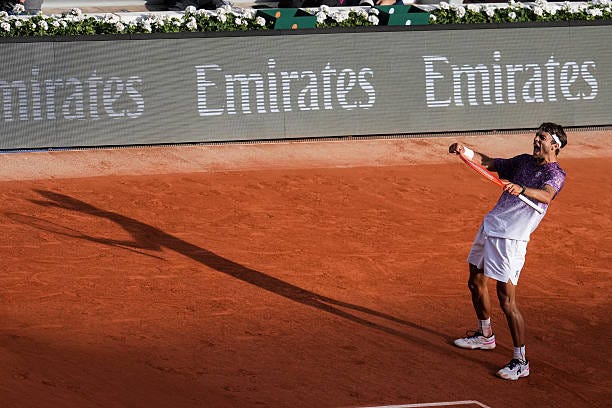
Both arms up. Two sets apiece. Viewers around the world were settling in for another nerve-jangling finish in a marathon men’s major final. But not this time, or at least not the way we have we come to expect in the eras of Big Three and New Two brilliance.
Cobolli took a long off-court break as Zverev paced on the clay, perhaps trying to avoid stiffening up or to avoid giving himself too much room to ponder the bigger questions. When the Italian returned he was out of adrenaline, inspiration and the leg drive required to deliver his serve and forehand. Zverev still struggled on his own service games in the fifth, serving back-to-back double faults to start his first. He had to save two break points to get to 4-0, but he got there, and it was soon triple championship point at 1-5, 0-40. Cobolli saved the first with a netcord winner. He tried to save the second with a drop shot. Zverev reached it. Cobolli hit a lob volley. Zverev sprinted back and threw up a high lob. What happened next was no surprise at this stage. Cobolli tried to elevate and failed, mistiming his overhead, which sailed well past the baseline.
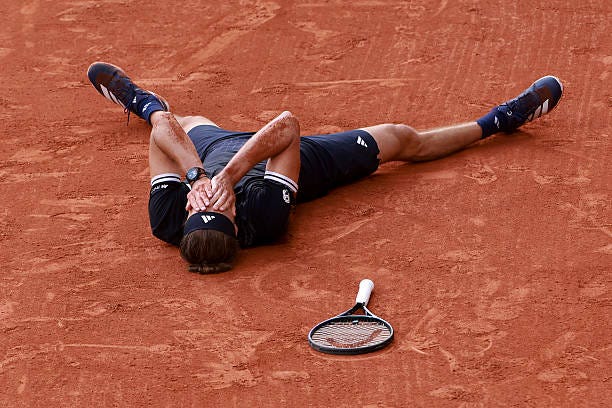
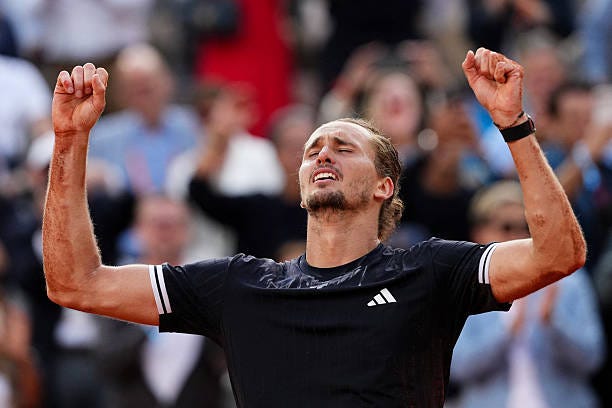
Zverev, flat on his back and in tears, was a Grand Slam champion at last, and the first German man to win Roland Garros since Henner Henkel in 1937.
“This court is so special to me in so many ways,” Zverev said after his 6-1, 4-6, 6-4, 6-7 (5), 6-1 victory. “I’ve had the best moments of my life on this court. I had the worst moment of my life on this court. I was laying in that corner over there four years ago with seven broken ligaments and two fractured bones. I lost a Grand Slam final here two years ago. But now finally it’s a happy end, and thank you very much to the crowd. I really felt the crowd was pushing me throughout the entire two weeks.”
It did not feel quite that way on site. Yes, there was support – and I heard no boos or jeers at matches I attended — but this was hardly Federer in 2009 after Nadal’s shock loss to Soderling had flung the door wide open to the people’s choice.
Zverev is a polarizing figure for good reason. Two of his former partners have made domestic abuse allegations that he has denied. One of those former partners, Brenda Patea, the mother of his child, pressed charges, leading to an initial penalty order from a German district court in October 2023 that would have required Zverev to pay 450,000 Euros. But in June 2024, shortly before Zverev played and won a French Open semifinal, the case was settled and criminal proceedings against Zverev were discontinued. The discontinuation was not a declaration of guilt or innocence and left Zverev with no criminal record. It nullified the penalty order, but Zverev was still required to pay court proceedings of 200,000 Euros (150,000 Euros to the state treasury and 50,000 Euros to non-profit organizations).
There has been no report of a direct out-of-court settlement between Zverev and Patea, whose wish to terminate the trial and end the case was fundamental to the decision, as a court spokesperson told The Athletic. In a statement, Zverev’s lawyers said Zverev’s agreement to discontinue the proceedings were, “above all in the interest of their child” and that “the discontinuation does not constitute a finding of guilt or an admission of guilt; the legal presumption of innocence remains unaffected.”
But the court of public opinion has not viewed the discontinuation as absolution. Social media was awash in posts from fans declaring that they were boycotting Sunday’s final and declining to use his name directly when he did win.
None of this should have been unexpected for Zverev. Spectators and even gamblers have tried to throw him off during matches by referring to the domestic abuse allegations. In April 2025, during a quarterfinal in Munich against Tallon Griekspoor, with Zverev serving in the second set, a heckler shouted “Let’s go, you…..wife-beater!” There were jeers toward the heckler, and Zverev later asked the chair umpire to have him removed from the court.
Zverev had to know that, if his time ever did come in a major, that the allegations would be referenced, and they were in written reports and by Alizé Cornet, a former French player who is now a French television commentator. There were no questions about the subject at his post-victory news conference, but the next day leading French sports publication L’Équipe interviewed him during a car ride with members of his family and team and eventually broached the topic, which he resisted.
What follows, to be clear, are excerpts from an interview that was translated into French by L’Équipe for its report (Zverev does not speak French) and that I am now translating back into English, which means the quotes are not verbatim:
“Do you find it unfair that the media continues to speak about it?” asked reporter Quentin Moynet.
Zverev’s agent Sergei Bubka Jr. interceded, saying “That’s a question about the accusations.”
“L’Équipe, for example, did not give you the full front page, which explains the question,” Moynet said.
“That’s not my decision,” Zverev answered. “I did all I could, and my innocence has been proven.”
Zverev shut down the interview shortly after that, and the last few minutes of the ride, according to Moynet, were spent in chilly silence.
L’Équipe was right to return to the subject. It is an integral part of Zverev’s story and career path, but it is also his right not to discuss it further. And though he is misguided to say that his innocence has been proven, what is clear is that his guilt has not been proven and that the presumption of innocence is a fundamental right. There is no legal basis for him not to compete on tour; no legal basis for him not to hold up a Grand Slam trophy after devoting the majority of his life to the quest.
Wishing it away will not mean it never happened, and Zverev, with all his complexities and baggage and phenomenal talent, is no longer the most successful men’s player without a major. However the rest of us might feel, it was now, not never.
CC