
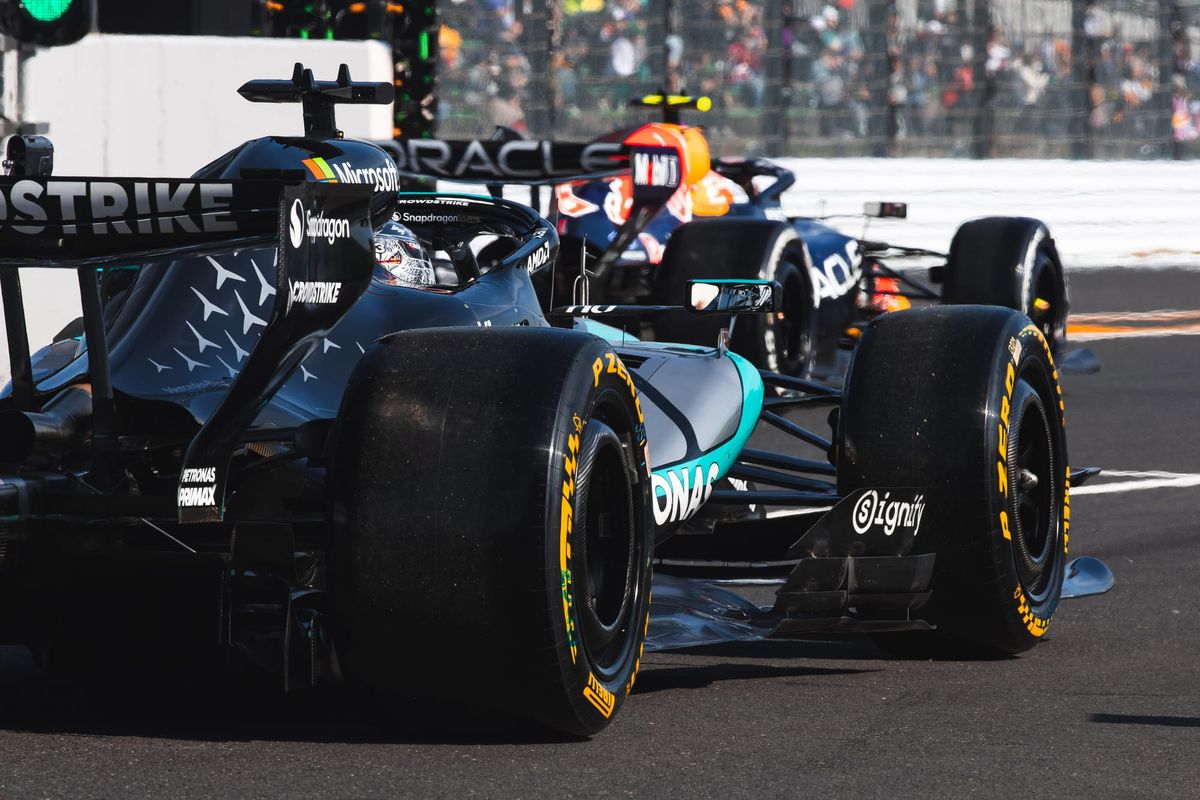
The FIA’s intervention in banning a Formula 1 qualifying trick used by Mercedes and Red Bull has been welcomed by one of the drivers who gained from it but also endured its “not so safe” side.
As revealed by The Race, Mercedes and Red Bull were informed ahead of the Miami Grand Prix that a clever loophole they had exploited to get around power reduction limits in qualifying would no longer be allowed.
The squads had managed to avoid needing to steadily ramp down energy deployment on the run to the timing line at the end of qualifying laps by activating an emergency mode that immediately cut off their MGU-K instead.
The consequence of doing this, however, was that it then put the MGU-K out of action – known as continuous offset mode – for 60 seconds. This meant no further battery power was available to the drivers.
While in normal circumstances for a post-qualifying cool down lap, this would not be a problem, there had been times when unexpected behaviour – like needing to slow suddenly to let drivers on push laps through – triggered unintended consequences that left cars limping around.
For Mercedes driver Kimi Antonelli, who experienced such problems in practice in Australia and Japan after some qualifying simulations, the FIA’s move to stop teams using the tactic from now on is welcome.
Asked by The Race about the sensation of hitting trouble on track because of a tactic used for lap time gain, Antonelli said: “Obviously, it wasn’t the nicest of feelings.
“Of course, we try to squeeze every bit of performance on one side. But it can come with facing some issues or some unexpected situations.
“I was aware that that could have happened, but obviously I didn’t really experience it up until obviously Melbourne and Suzuka.
“Obviously, first of all, it’s not so safe – especially in Suzuka. I was a sitting duck in the Esses, and knowing that the track is also not very wide, there’s not a lot of space.
“It was quite stressful, for sure, not being able to do anything, because obviously the car was not responding to any input. And I just was rolling very slowly on track. It was a stressful moment.”
While Mercedes will lose the benefit of a small time gain that came from the antic – believed to be worth a few hundredths of a second – Antonelli thinks the upsides of avoiding future risks are something to be happy about.
“It’s good to know that obviously, we probably won’t face this thing again,” he said.
“Also, in qualifying [with it], you can easily impede someone on a lap, and then you can easily get a penalty. That’s not what you want.
“Of course, this comes with giving up maybe a couple of hundredths of a second, so very little time, but at least it gives the confidence that this thing is not going to happen again.”
Antonelli has not been the only driver to experience the downside of temporarily having no MGU-K as a consequence of exploiting the loophole.
Mercedes-powered Williams driver Alex Albon stopped on track completely at Suzuka as a consequence of this, while Red Bull’s Max Verstappen has also had his own moment in Japan where he was left cruising around at low speed.
Speaking at thetime about being trapped in this mode for 60 seconds, Verstappen said: “It’s like an FIA setting that if you drop too low in RPM, you have no power. It happens sometimes with some cars.
“It mainly happens when you’re driving slowly and you try to let another car by when they are on a fast lap. You don’t downshift quick enough and your RPM then drops too low. You go into like a safety mode or whatever.
“Then it takes like 10, 15, 20 seconds before then suddenly you have power again. So it’s just a glitch or whatever you call it.”
Picture credit: Spacesuit Images