
By John Woeste — This story begins with two photographs taken 34 years apart—images that reveal how both bike technology and the rider have changed.
I started mountain biking in the spring of 1986 and quickly fell in love with Moab’s now-famous Slickrock Trail. As Slickrock’s popularity grew, my friends and I searched for another place to play. We found Bartlett Wash and rode it largely alone for several years. Riders also call it Rainbow Rocks, a nod to the colorful bands of smooth sandstone that ripple across the terrain.
In 1991, when I was 30, a friend snapped a photo of me riding a 1990 Gary Fisher Hoo Koo e Koo II (HKII) across Bartlett’s slickrock.
We still ride Moab often, but over time Bartlett slipped from our routine. It sits southwest of the Moab airport, and whenever I drive Highway 191 I glance toward it and think about those early days. I have no good explanation for waiting so long to return, but in October 2025 we finally did.
Bartlett has no trail, no painted dots, and no prescribed lines. The terrain limits you only by your imagination and skill. Riding there feels like pure freestyle joy. We didn’t have the place to ourselves, but over two hours we saw just four other riders and a couple of walkers—still quiet by Moab standards and far less crowded than Slickrock or most other trails. My wife, Shell, had never been there before. We spent the afternoon wandering happily across the rock on our modern bikes.
We display the 1991 photo in our home, so I remembered the composition clearly. After some searching, I found the exact spot where the original image was taken. We decided to do a now-familiar “before and after.” Shell stood where I believed the original photographer had stood and took a series of photos. When we got home, we were thrilled to see that she had captured me in almost the exact same position and riding posture as in the original shot.
That moment sparked long conversations about how bikes—and aging—have changed.
In the “Before” photo, the HKII has no suspension at all. I had added a Softride flex stem, which in hindsight was a terrible idea. It flexed downward when the bike hit an obstacle, making endos more likely, and it wagged side to side under load, reducing steering control. Bad on all counts.
Otherwise, the bike remained stock, running a Shimano Deore LX groupset with a 130 mm stem and 21-speed (3×7) gearing. It retailed for $1,500, weighed about 26 pounds, and used a chromoly steel frame built from True Temper Super Size tubing. The geometry was steep, and the seatpost lacked a quick release. At least the drivetrain had indexed shifting. Before indexing, riders used friction shifters, nudging levers until the chain ran quietly. Indexed shifting did that work for you, clicking into position—though you still sometimes had to fine-tune the adjustment.
The 3x drivetrain offered a wide gear range but came with heavy redundancy. Riders learned which combinations shifted fastest and most reliably. Front shifting required care: you had to ease off the pedals, which cost speed and momentum—especially frustrating on steep climbs. Cross-chaining stressed the drivetrain and demanded constant attention.
The rims measured 1.5 inches wide, paired with 1.9-inch tube tires inflated to more than 40 psi to avoid pinch flats. That pressure delivered a brutally harsh ride. At the time, narrow tires signaled speed and efficiency. The cantilever brakes worked, but only barely, and required frequent adjustment. Flat pedals used plastic toe clips with straps—no pins, no forgiveness. Many slow-motion falls ended in bloodied knees and elbows when feet failed to come free in time. Every technical climb carried a level of “appropriate concern,” which reduced commitment and success—and usually resulted in more blood.
The Selle Royal saddle felt acceptable but offered too much padding. Oversized saddles often reduce comfort by creating friction points. The Gary Fisher Bulge handlebar ran narrow, and I added forward-curving bar ends for leverage on technical climbs and an extra hand position. I still miss bar ends, though wider modern bars have largely replaced their function.
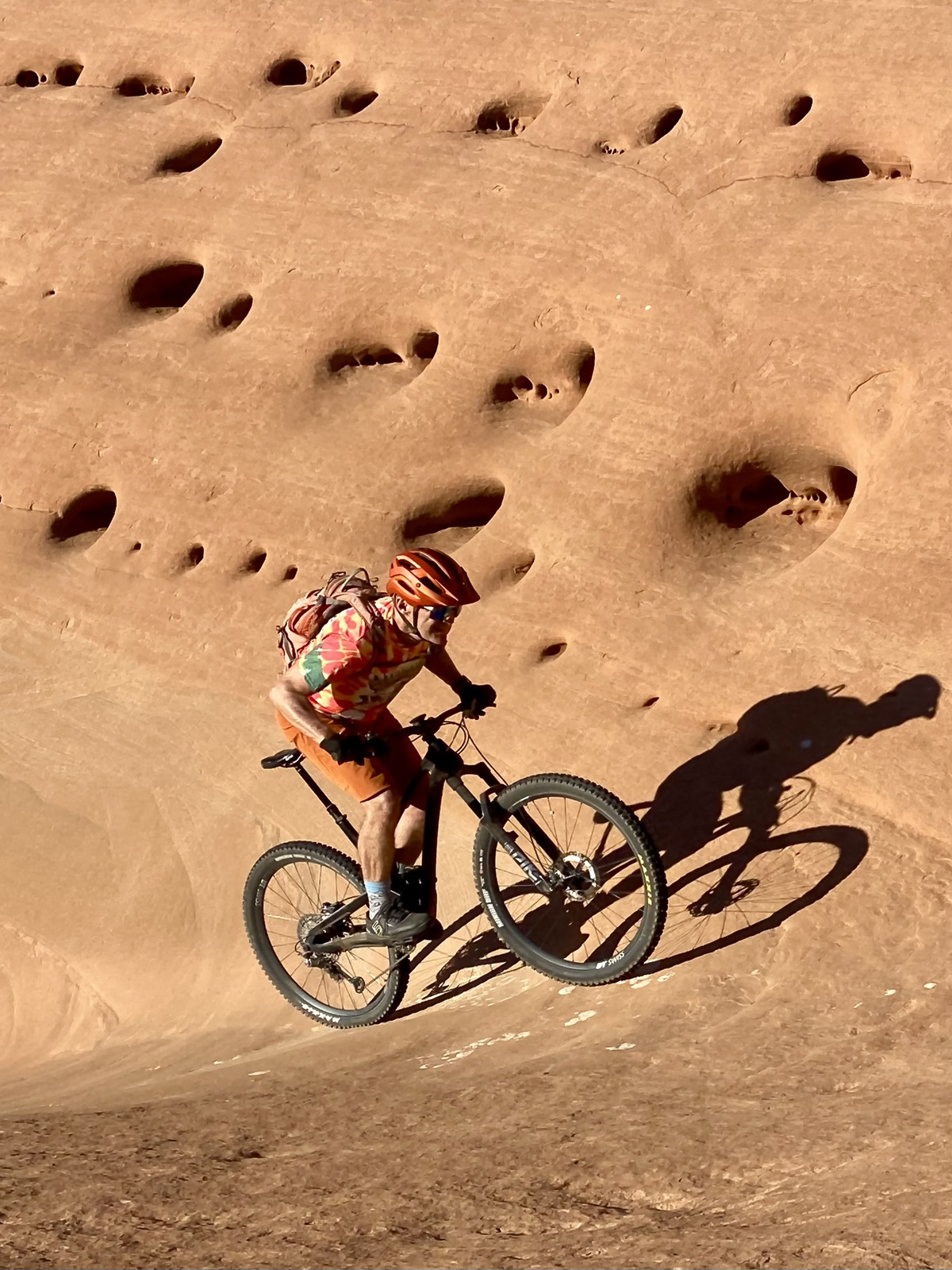
My current bike is a 2020 Evil Following, which retailed for about $7,200. It offers 120 mm of rear travel, 130 mm up front, and weighs roughly 29 pounds. It isn’t the most aggressive bike for Moab, but it represents a remarkable blend of design and technology. The carbon frame uses modern geometry and outstanding suspension. A 175 mm dropper post eliminates most of the “appropriate concern” for sensitive anatomy.
The drivetrain combines Shimano XT and XTR components with a 1x setup: a 32-tooth chainring and a 10–51, 12-speed cassette. Pedaling 29-inch wheels demands more power than 26-inch wheels in the same gear, so chainring choice matters. For those curious, the Sheldon Brown website offers a deep dive into gear ratios. Overall, 1x shifting surpasses the old systems in every way. It eliminates cross-chaining and redundancy, shifts quickly and accurately, and allows steady pedaling through gear changes.
The Evil runs hydraulic disc brakes, a 180 mm OneUp carbon handlebar, flat pedals, and tubeless tires sealed with Stan’s. I switched to tubeless in 2008 and haven’t had a flat since. The tires measure 2.5 inches in front and 2.4 in the rear, inflated to about 15 psi, with an insert in the rear. The HKII’s high-pressure tires offered terrible traction. Riders bounced off rocks and roots, losing control and speed. Modern tire setups provide tremendous grip, smoother handling, better impact absorption, and faster real-world performance. The WTB saddle also beats the old Selle Royal—partly because it isn’t oversized.
I started using a Camelbak shortly after they hit the market in 1989. Back then, it was just a bladder in a sleeve—no storage, no straps, no style. I’ve used one ever since. Once, my brother went over the bars and ruptured the bladder. That water cushion may have saved him from serious injury. I accept the extra weight and sweat for the added safety and convenience.
Adjusted for inflation, the $1,500 HKII would cost about $3,750 today. The Evil Following’s $7,200 price would approach $9,000. That’s more than twice the cost—but far more than twice the bike. Fully rigid bikes worked well on smooth slickrock and might still excel there. But nobody rides only smooth slickrock.
If I had to choose one modern improvement I wouldn’t give up at Bartlett, it would be the dropper post, followed closely by flat pedals. The terrain features many steep descents, and I no longer tolerate being pitched forward over a tall seatpost. Drop it. As for climbs, flats mean fewer injuries. You won’t clean every move, but you’ll bleed less.
The modern bike serves as a kind of reasonable accommodation for aging. New designs help riders of all ages, but the old bike taught valuable lessons. Clean line choice and precise technique mattered. The new bike encourages more “point and play” riding and treats the body more kindly.
I once had a strong motor—and still do, for my age. I rode the White Rim In A Day 16 times, 10 of them solo. My last solo ride came four years ago at age 60. I finished in my usual time and decided to stop while everything still felt good. I didn’t want to push my luck. My rides are shorter now, but I’m far from done.
Three years ago, after decades of riding, I attended a three-day mountain bike skills clinic. It transformed my technical riding. Before the clinic, fitness and speed carried me, while technical ability lagged behind. I could roll through Slickrock comfortably but hesitated on gnarlier terrain. Since then, I’ve loved learning and applying new skills. My fitness and technique now feel balanced.
About ten years ago, I attempted the Captain Ahab trail and walked large sections that felt sketchier than Slickrock. Last spring, I rode nearly all of it. The experience brought real joy—offsetting some of the downsides of aging with new skills and renewed stoke.
What bike designs and technologies do you love most? If you had to choose just two or three non-negotiables, what would they be? How do you plan to keep riding as you age?
Have one.
We’re incredibly fortunate to ride in this era, on bikes this capable. Keep on riding.
(Visited 25 times, 1 visits today)