
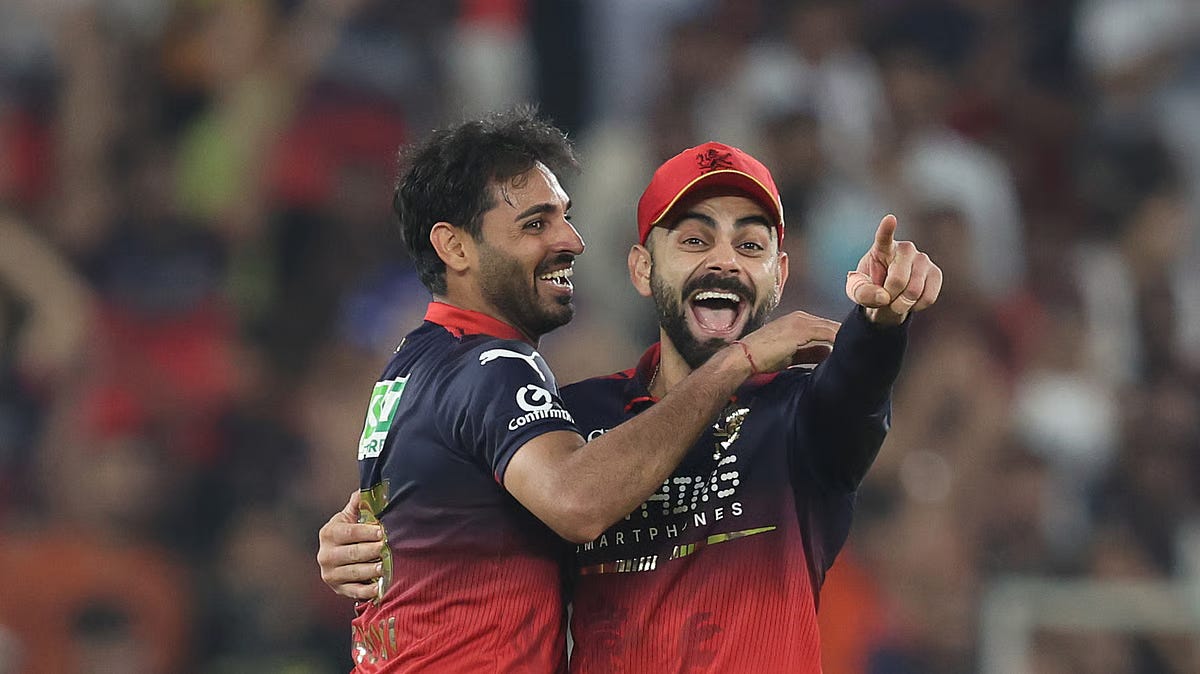
RCB beat MI by 2 wickets, as Bhuvneshwar Kumar was forced to pick up his bat after already bowling a match-winning 4-23. In other news, Krunal Pandya might just be the middle order glue RCB need, while MI have been eliminated after just 11 games.
But, what happened beyond the headlines?
🚨 If you’re an RCB fan, I’d love if you could fill out this 2-minute survey on how you feel about the franchise this year. I plan to create a graphic story of your answers soon! 🚨
✍️ Written by Aadityan Ganesh, who run Pacers with Pretty Feet.

Bhuvneshwar Kumar’s three wickets in the powerplay went a long way into pushing Mumbai Indians onto the backfoot. Yet, the three wickets were not from a man executing a single trick over and over again. This was Kumar getting three wickets in very different ways.
Ryan Rickelton and Rohit Sharma fell victims to the defensive version of Kumar that the IPL has seen since 2018. The powerplay specialist has been a defensive bowler in the second half of his career — going from a strike rate of just above 15 in 2014-17 (economy of 7.19) to just below 30 in 2018-23 (7.80).
However, the Impact Player era has rewired his value as batters are forced to hit out early in search of 70+ run powerplay starts. With an equally dangerous Josh Hazlewood on the other end, opposition batters can’t just play out Kumar’s overs with RCB since 2025. They need to attack him regardless of match situation, which has led to his defensive style picking up wickets at a strike rate of 12.29 this season.
Rickleton & Rohit were just the latest victims of this new dynamic.
Tonight, Kumar focussed his powerplay bowling on back-of-a-length deliveries, just outside the off-stump. They are the sort of deliveries that can cramp batters, forcing them to knock the ball backward to point for singles if they don’t want to risk their wicket. Rickleton and Rohit did just that in their first five balls, knocking Kumar around for 4 singles.
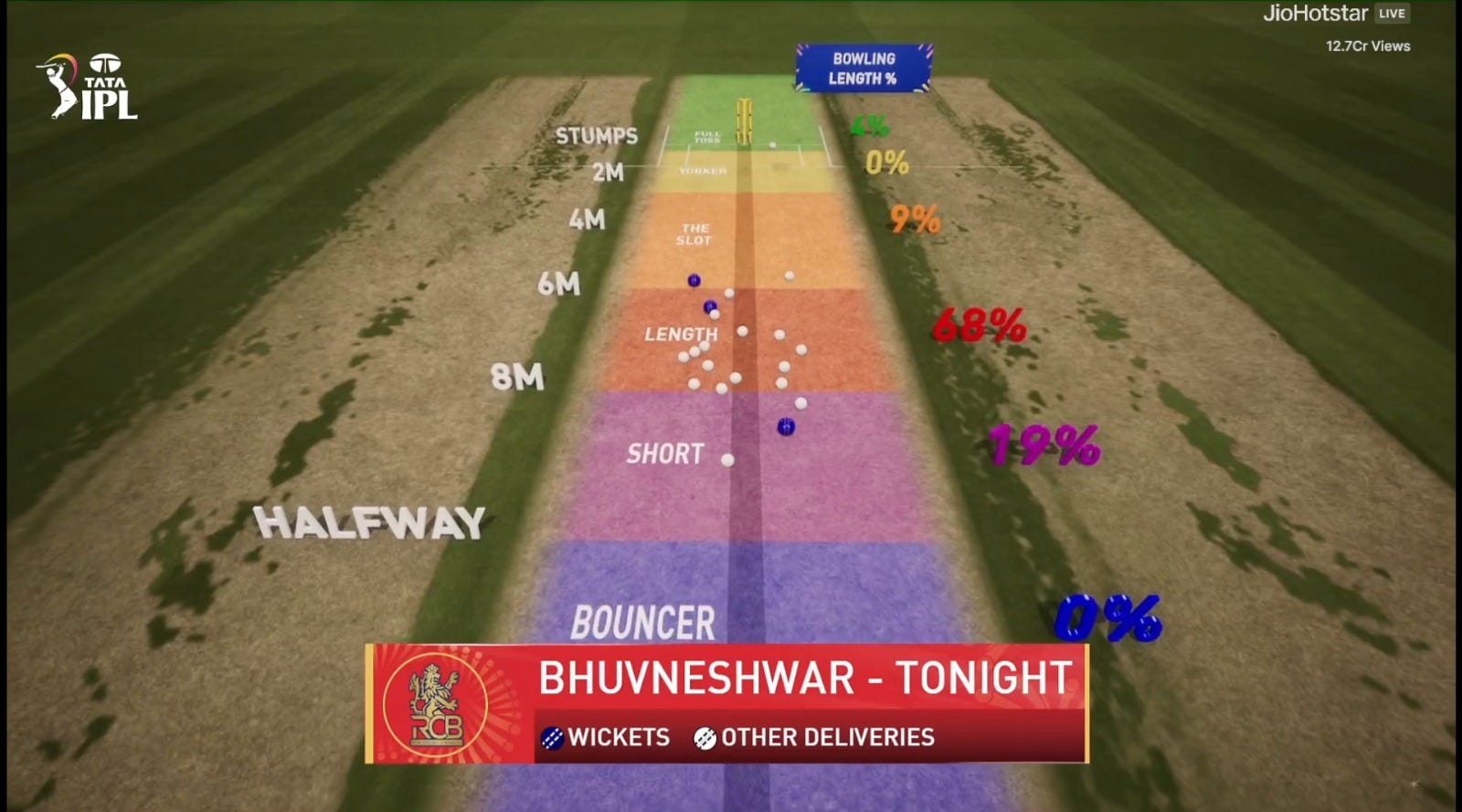
But, the modern IPL doesn’t abide an opener going at just 80 SR after five deliveries, and so Rickleton had to attack regardless of the situation. He wanted a boundary – as much for his team as for his own aggressive style of play – and Kumar knew this. He pulled his length back even further, with a short delivery outside off inducing a wild hack from the under-pressure Protea. The ball looped to the fielder at mid-off.
Against Rohit, Kumar was actually bowling a more defensive line. As the bowler mentioned in his mid-innings interview, he wanted to combat the MI opener’s tendency to step out with a knuckleball. Kumar expected a defensive shot for a single, Rohit went for the drive to double down on his boundary from the last ball.
The 20 KPH drop in speed combined with vicious away swing led to a false shot as Rohit tried to replicate his boundary from the previous ball. The ball nicked his edge and flew to the keeper.
However, Kumar’s brilliance is not limited to just picking up wickets when the batters make mistakes. He knows how to read a situation brilliantly, as witnessed by the next delivery to SKY.
“Sky was new into the crease. I wanted to bowl the normal length ball and that worked,” Kumar said at the break. A rarely-used powerplay wobbleball on length seamed away ever so slightly, and caught a nick of the MI captain’s bat and ran to Virat Kohli at first slip.
On a wicket with unpredictable bounce and swing, Kumar saw the advantage in using an unexpected variation against a veteran who understood that consolidation was the need of the hour. Instead, the RCB pacer had the MI skipper back in the pavilion for a golden duck, and had MI on the backfoot.
This wasn’t a batter-friendly pitch like we’re used to in the IPL. Both Corbin Bosch and Deepak Chahar found deadly swing in the second innings as well, while Rasikh Dar picked up Naman Dhir’s wicket through a ball that kept unnaturally low in the 13th over.
But, Kumar’s outing today was just the latest version of his new bowling style. He’s using the batter pressure in this post-Vaibhav Sooryavanshi era to turn his defensive bowling into an offensive weapon that has him comfortably leading the Purple Cap race – and keeping RCB in games when the rest of the team are struggling.
And that’s excluding his timely pinch-hitting 6 with the bat in the 20th over tonight!
Data from the IPL website & the Jio broadcast.
✍️ Written by Aarush Adil Khan.
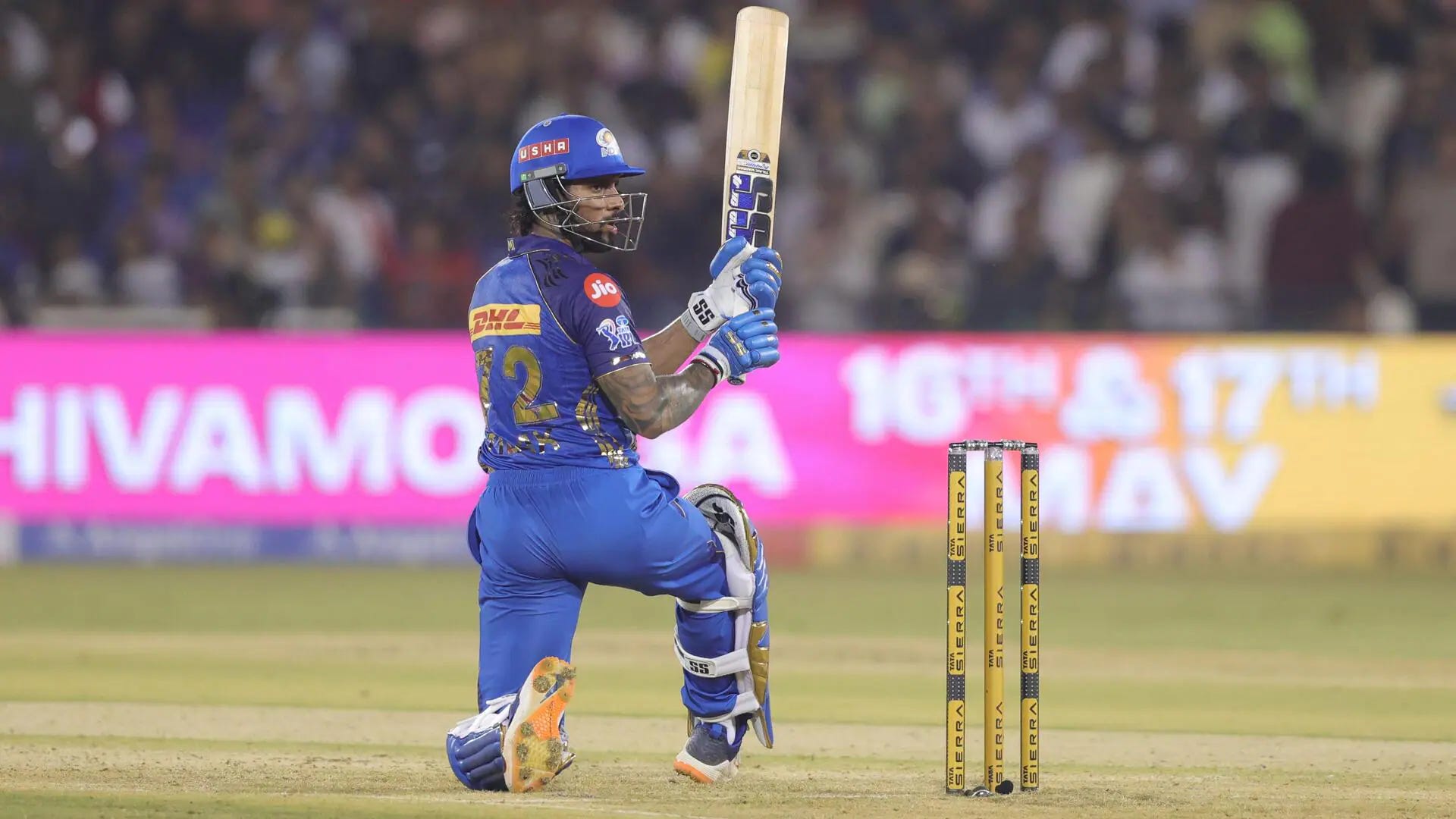
After Kumar reduced MI’s batting order to ashes in the powerplay, Dhir and Tilak Varma were tasked with the impossible; turn around a flailing innings on a tricky pitch without losing any more wickets.
Their strategy was simple; they kept it safe, and they kept running. Their partnership started on the first ball of the 4th over – for the next 42 balls until the midway mark of the innings, they hit just 5 boundaries but kept running. They ran 32 runs in 37 non-boundary balls in the period to keep the scoreboard ticking. They still needed a bit of luck to stay alive, as a higher bounce ball caught Varma by surprise in the 6th over. Luckily, Suyash Sharma dropped him.
Varma has struggled against spin this season. In 11 innings, he has struck just 124 against the type, with an average of 12. In particular, slow left-arm orthodox has been a pain point. He’s scored just 23 (21) against it, and been dismissed twice. So, of course, RCB threw their unorthodox SLA, Krunal, at him.
In response, Varma curbed his instincts. He scored just 10 off 8 against the spinner – including three 2s – and worked the gaps. On the other end, Dhir tried to take on the boundary-hitting burden with MI’s only two 6s from overs 7 to 12.
While Varma did eventually get into the act by launching both Krunal and Suyash for 6s in the second half of the innings, MI’s innings were derailed by the pitch again. On the first ball of the tenth over, Shephard sent down a 129.2 KPH, cross-seam, good length delivery on leg stump that Dhir pulled for 6.
Two overs later, Dhir was accelerating against Rasikh with multiple boundaries, when the RCB medium pacer sent down a 132.7 KPH, cross-seam, good length delivery on leg stump that stayed low and flattened the MI batters stumps. Raipur’s unpredictable bounce had struck again, and it wouldn’t let up.
MI attempted just 14 aerial shots in the second half of their innings, but lost 4 wickets to them for just 30 runs (including a wide). That’s a SR of 214 and an average of 7.5. For context, aerial shots this season have gone at a strike rate of 400+. On a new pitch that hasn’t been used in the IPL for 10 years, MI’s first innings batters were regularly punished for tactics that work elsewhere.
After Dhir’s wicket, Varma accelerated. He scored 25 off 23 in the first half of MI’s innings, before charging to 32 off 19 in the second half – even as his post-Dhir partners could only put up 36 (35). He ended up with 29 off 17 versus spin (170 SR) despite his season-long struggles, and slow start tonight.
Varma’s innings was not perfect, but he rode his luck to get MI to a competitive total on a tricky surface. If MI had found similar resilience from their players all season, they might still be in the hunt for a playoff place. Instead, the five-time champions now have to play three dead rubbers.
Data from Cricmetric & Opta.
✍️ Written by Tarutr Malhotra, who runs Best of Cricket.
Regular readers of our BtH analyses will know that I’ve spent too much of this season pulling my hair out about RCB’s batting order tactics. They have top order bats that like getting out, and finishers who like getting out. They all bat at 150+ SR so they tend to score a few runs before getting out, but they all eventually get out.
Today was (slightly) different. RCB don’t win games where they lose three powerplay wickets in 2026 (3 out of 3 before tonight). And yet, despite the last over tension, it wasn’t as tough a chase as the scorecard and the historical record would suggest.
Part of that is MI’s terrible play. Their understocked batting order without Hardik Pandya or Quinton de Kock struggled to an under-par score in the first innings. Their overuse of a rookie, their underuse of their spinners, and the poor timing of their Deepak Chahar overs gave RCB’s stuttering batting order a chance in the second innings.
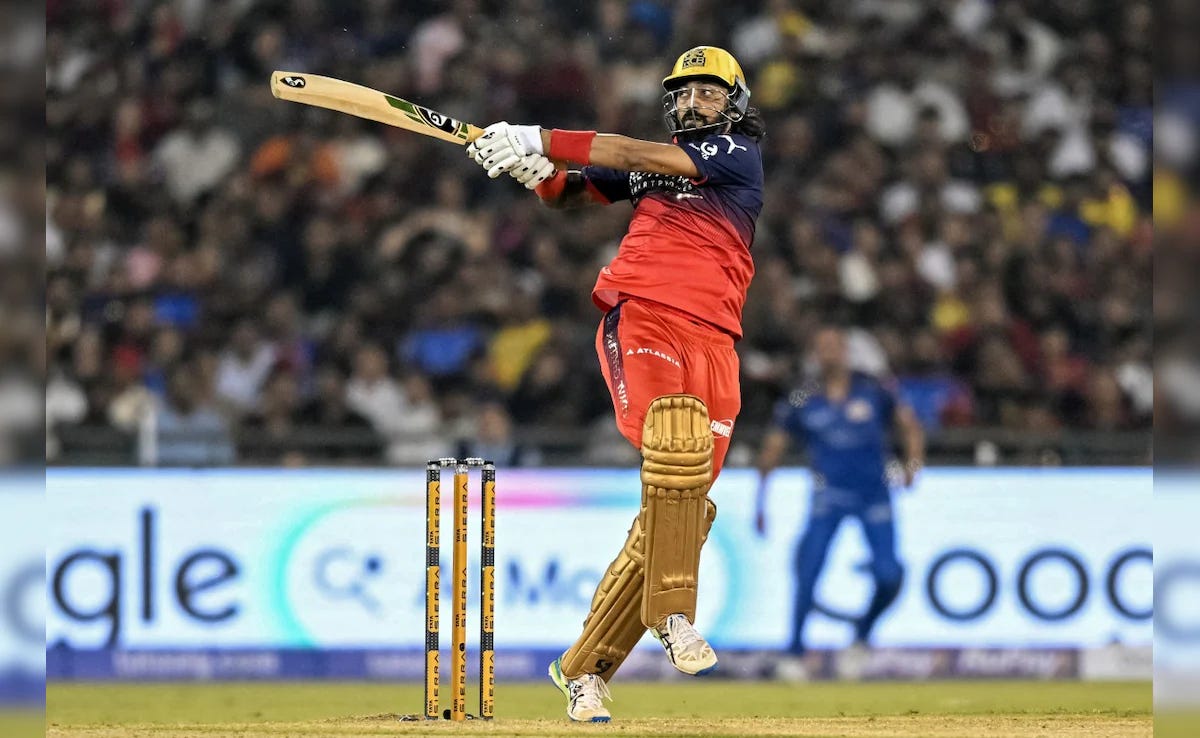
But, for the first time all season, RCB’s middle order actually kept their wits about them and took advantage of that chance. On a pitch with unpredictable bounce and lots of swing on offer, Krunal & Jacob Bethell put together a defiant 55 (42) that all but took RCB home.
They faced just 8 dots in their partnership (19% of balls faced), while rapidly running between the wickets at every given opportunity. They ran 30 runs in 36 non-boundary balls, giving them a blistering non-boundary strike rate (NBSR) of 83.3. For context, RCB’s middle overs NBSR all season has been 68.7 – meaning today’s partnership scored 15% more via running than usual.
Coupled with the low total to chase and the knowledge that RCB have multiple finishers who can score at 180+ SR at the death, this running put the pressure on MI to pick up wickets. Krunal has batted at 145.5 versus T20 spin in 2026, while Bethell has struck at 163.3 against the type in T20Is this year. So, MI couldn’t play spin.
Instead, they had to play Raj Bawa, a rookie medium pacer on debut. The son of a bowling coach, Bawa clearly has some talent and guts – his last over wicket of Shepherd is proof of that. However, he’s also a kid playing in a high pressure situation. He gave away 5 wides and a no ball in his 3 overs – that’s more than the rest of the MI bowlers and the entire RCB bowling unit tonight.
This is indicative of a larger problem that RCB exploited; Bawa and Allah Ghazanfar were responsible for releasing the pressure at the wrong moments. Krunal & Bethell could not have sustained themselves on runs alone, but multiple loose balls an over from MI’s 4th and 5th bowlers meant that a boundary an over kept the required run rate under 10.
The biggest culprit? Bawa’s 14th over against Jitesh Sharma. RCB’s keeper is in terrible form, and had just barely played out a wicket maiden against Corbin Bosch in the 13th. He was new to the crease after Bethell’s wicket, RCB needed to pick up the pace, he was under the cosh at 0 (5), and he’s averaged 8 a game at a tick over a run a ball this season before tonight. Bawa let him off the leash with a perfect slot ball that got hit for 6, and multiple wides to release all the pressure off RCB’s new partnership.
All of this sounds like a poor team letting a slightly better than poor batting order get away with a victory they didn’t deserve. And, in some ways, that’s true. However, for the first time today, we got a glimpse of RCB’s coaching think tank realising that they had to do something new. They couldn’t keep playing Jitesh at No.5, only to watch him get out at the first sign of trouble.
Tonight was the first time Krunal’s been sent out before the 10th over since the RR game a month ago. Regardless of how they finished the game – and that’s a different Shepherd-sized problem – they won the middle overs today without any of their established top order batters. It’s an important confidence boost for the defending champions. Games aren’t over if you get Kohli & Rajat Patidar out – they have other batters who can still chase you down.
Data from our new database.