
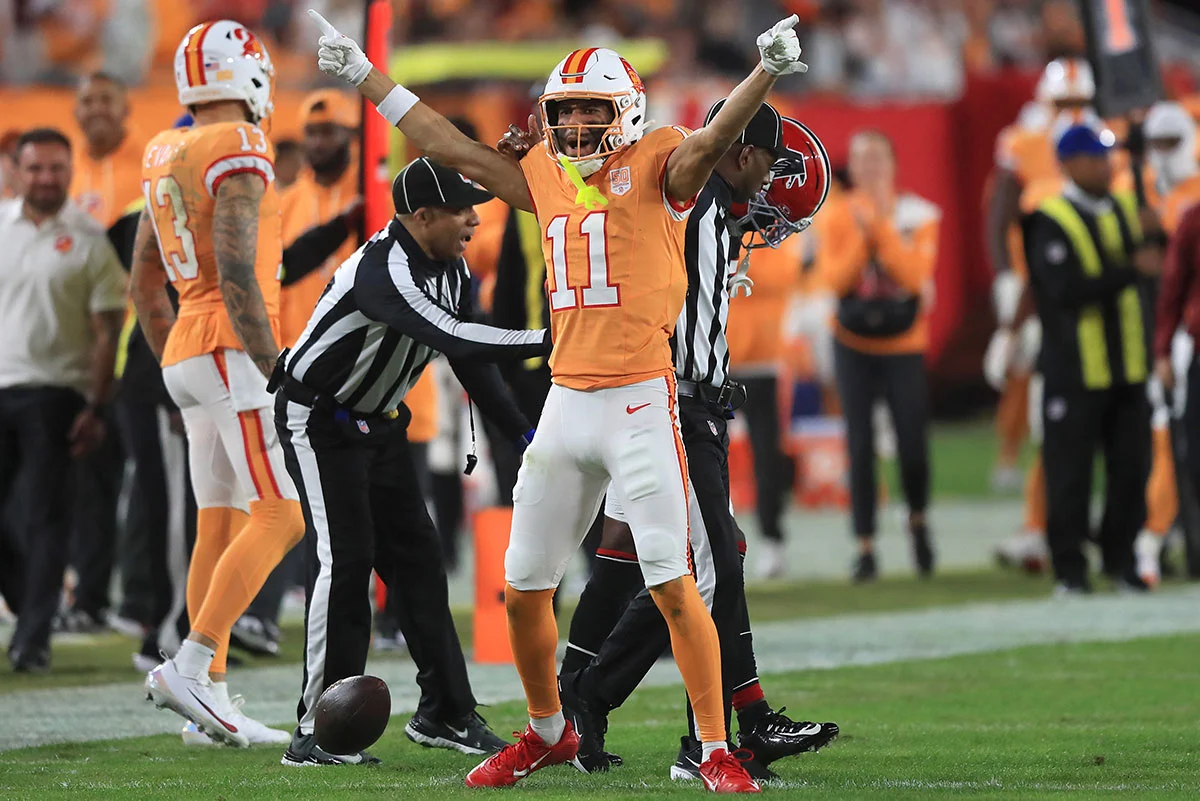
In the NFL, Cover 4 refers to a defensive coverage that aims to cover four deep zones on the field. Following that lead, I’m going to provide you with the same coverage of the Bucs – your favorite football team.
Each Wednesday morning I’ll cover four areas as they apply to Tampa Bay: 1. a short film breakdown, 2. a finance angle, 3. a look forward at what’s to come, and 4. a bit of fun.
This week I am centering all four areas on one of the biggest wild cards on the Bucs roster: wide receiver Jalen McMillan
Film: Jalen McMillan’s Burgeoning Breakout
Seventeen. That’s how many games Bucs wide receiver Jalen McMillan has played in his two-year career. Injuries have robbed him of half of the potential regular season games he could have played in. But over those 17 games he has put up a solid line for a No. 3 receiver just getting acclimated to the NFL with 73 targets, 49 catches, 639 yards and eight touchdowns. He has caught 67% of his targets, averaging 13 yards per catch and 1.35 yards per route run.
The end of his 2024 was promising when he went off for 24 catches, 316 yards and seven touchdowns over the final five weeks of the season. Then, after looking sharp in training camp and early in the preseason, a devastating neck injury put his entire 2025 in doubt.
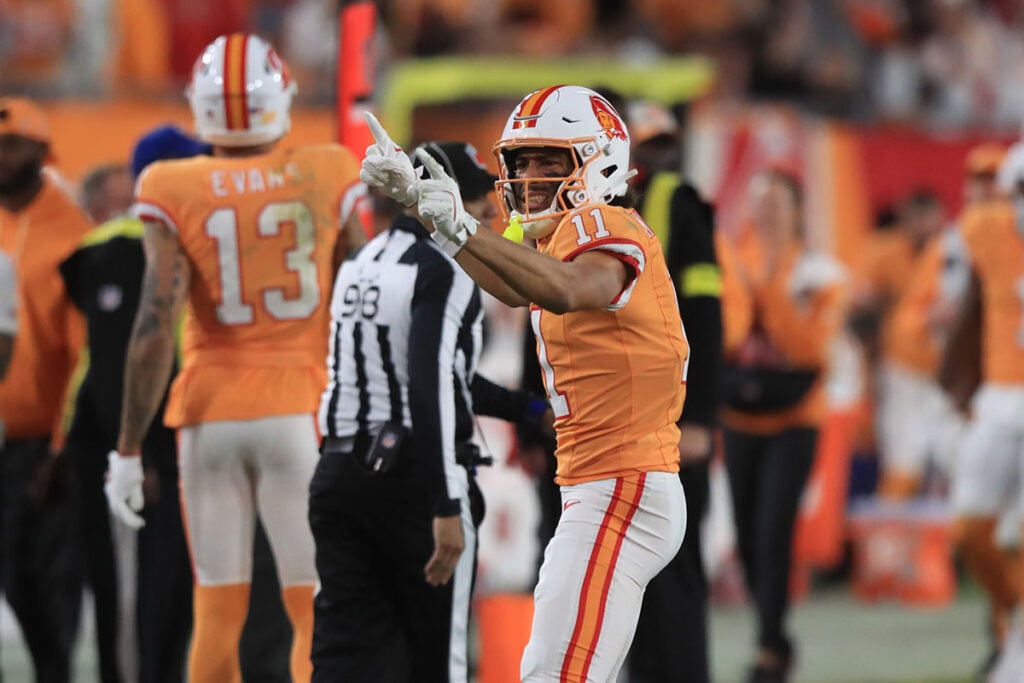
Bucs WR Jalen McMillan – Photo by: Cliff Welch/PR
But he was able to come back for the final four games of the season, and once again looked really good in a limited sample size.
Now entering his third year in the league, McMillan may be poised for a breakout. And it all comes down to a single skill that the Bucs are currently looking for in the wake of Mike Evans’ departure.
It’s a small sample size, but to this point in his Bucs career, McMillan has shown an ability to beat man coverage. Pro Football Focus has him tracked at 125 routes against man with 15 catches on 23 targets for 247 yards and 3 TD. His 1.98 yards per route run against man is nearly double his mark against zone, which sits at roughly 1.12.
It’s a zone-heavy league. Lots of receivers can succeed against it. But a man-beater is the rarer find that comes in handy during the highest leverage moments in a game.
McMillan’s wins in man coverage come at every level of the field. From screens to bombs, he has the speed and slipperiness to give corners fits no matter what part of the field he is attacking. With an average depth of target of 11.5 and a 140.8 passer rating when targeted in man coverage, he is a true weapon in an important part of the game.
That matters more than ever. Neither Chris Godwin Jr. nor Emeka Egbuka has shown of late they can win against man the way McMillan can. Egbuka, the breakout rookie, was swallowed up by man coverage in 2025, catching just seven of 27 targets at 0.91 yards per route run. That is the exact downfield man role Evans just vacated for San Francisco, and the roster has no obvious heir. McMillan is the closest thing to one, and he is sitting third on the depth chart.
It also puts him in a unique position within the concept of the play. Offensive coordinators like to build their route concepts with both a zone-beater and a man-beater built in. And if McMillan is the team’s most reliable man matchup, at least until rookie Ted Hurst gets up to speed, he may be featured more often than any of us think he will.
Three traits stick out to me when I watch McMillan. His footwork off the snap is incredible. He doesn’t have the footspeed and change of direction of Davante Adams, but it is Davante Adams-esque. Because of that, he is difficult to jam off the line. Then when he gets to his stem, he has a whole host of body twitches, fakes and nods that make it difficult for corners to know exactly where he is headed. Because of this he creates plenty of separation.
This is backed up by his average separation metric as tracked by Next Gen Stats, where he outpaced Godwin by 11% and Egbuka by 29%.
Add in his speed, which he slow-plays so often, sneaking up on and past safeties, and his improvements last year as a ball-winner who can win at the catch point through contact, and McMillan’s ceiling and profile has grown from a complementary Z receiver who wins in intermediate zones to a one-on-one winner who can make tough catches and play some X in Zac Robinson’s positionless scheme.
One area of McMillan’s game that I underestimated when he was a prospect was his ability to make difficult catches through contact. It started showing up late in ’24 and continued through his limited ’25.
It also substantially raises his ceiling. pic.twitter.com/zsOKOpKlTg
— Josh Queipo (@JoshQueipo_NFL) June 24, 2026
And while speed is fun to cite (just look at our infatuation with 40-yard times!), the more translatable trait for winning as a receiver is his ability to slow down rather than speed up. Deceleration is the fastest (pun intended) way to lose a defender and find space. And in that area, McMillan wins and wins often.
Finance: Jalen McMillan’s Early Valuation
As Jalen McMillan enters his third year in the league he has flashed some high-end traits, but each time he starts to trend up, the season has ended or injury has robbed him of stacking those flashes into sustained success.
As such, if he were available on the open market right now, he would command a rather modest contract due to modest production.
Using two-year production comps, the three recent contracts that fit McMillan’s career start are David Moore (2021), Devin Funchess (2020) and James Washington (2022). Each got paid off a two-year body of work much like his, and Moore grades as the closest match of the group. The average of those three deals, adjusted for 2026’s salary cap, is about $4.5 million per year.
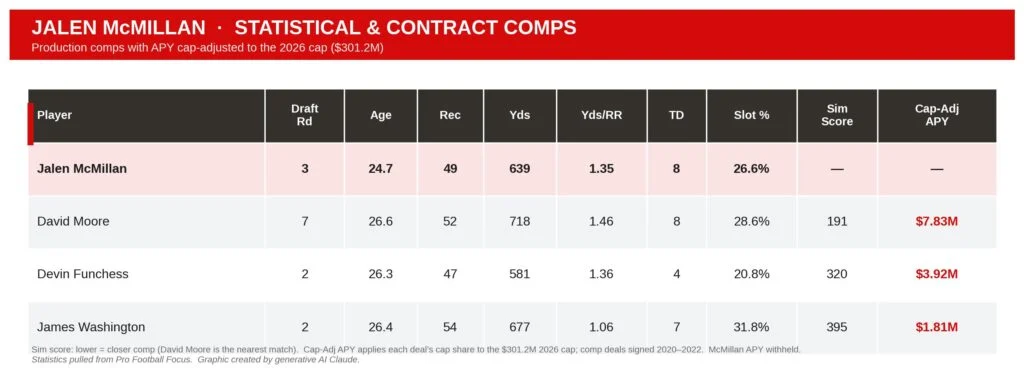
Within this group he ranks third in most categories, catches, yards and yards per route run, while tying for first in touchdowns. At $4.5 million in today’s market, it would make him the second-highest paid player in the group.
One factor the comps undersell is age. McMillan is 24.7. Every player in that group signed at 26 or older, so he would hit the market with two extra years of runway if he were a free agent now and an ascending traits profile while the receiver market is booming.
Detaching from the comps and looking at his metrics within a larger model, I can see a team paying a premium for his potential of up to $10 million per year. The man-coverage trait, the youth and the unfinished breakout are what drive that number. A two-year, $20 million contract is where I have his current market, with ample room to move that figure upward if the health finally cooperates. We’ll see how his final two seasons in Tampa Bay plays out.
Forecast: Jalen McMillan’s 2026 Production Line
Last week I took a stab at Emeka Egbuka’s 2026 stat line, looking at where he might be able to improve from his rookie year. The receiver room is one of the most intriguing position groups on the entire team. So, let’s keep the ball rolling by taking a stab at perhaps the biggest mystery in the room.
Taking his 17-game line and breaking it down to a per-game basis:
Routes – 27.9
Targets – 4.3
Receptions – 2.9
Yards – 37.6
TD – 0.47
I see some opportunity for improvement in two specific areas for Jalen McMillan headed into year three that leads me to believe he’s in store for a strong season (provided he remains healthy).
The most obvious is his volume, and volume is close to the whole ballgame here. Chart his 17 games and the production tracks his route count almost one for one. In his healthy full-time run to close 2024 McMillan pushed into the low 30s and produced like a WR2. A 27.9 routes per game is a low threshold that I think he is going to clear by a good margin.
As the most established man-beater, and entering the season as the clear No. 3 receiver, I think this should balloon to 35 routes per game. That is essentially a full-time workload, No. 3 label or not, and the Mike Evans departure is the reason it is on the table.
And McMillan’s 15.4% career target share should see a modest increase in 2026 as well. An increase to 18% would take his targets per game from 4.3 to 6.3. That’s an almost 50% increase in targets!
Holding his catch rate steady takes his receptions from 2.9 to 4.25 per game. I expect McMillan’s yards per catch to remain stable while his touchdown rate is bound to regress from the current unsustainable 16% mark. League average for a receiver sits closer to 8%, so I split the difference and landed near 12%.
That puts my forecast for his 2026 per game stats at:
Routes – 35.0
Targets – 6.3
Receptions – 4.25
Yards – 55.1
TD – 0.52
Over a full 17-game season, that is roughly 107 targets, 72 catches, 937 yards and nine touchdowns. A genuine WR2 line, and the best season of his career by a wide margin.
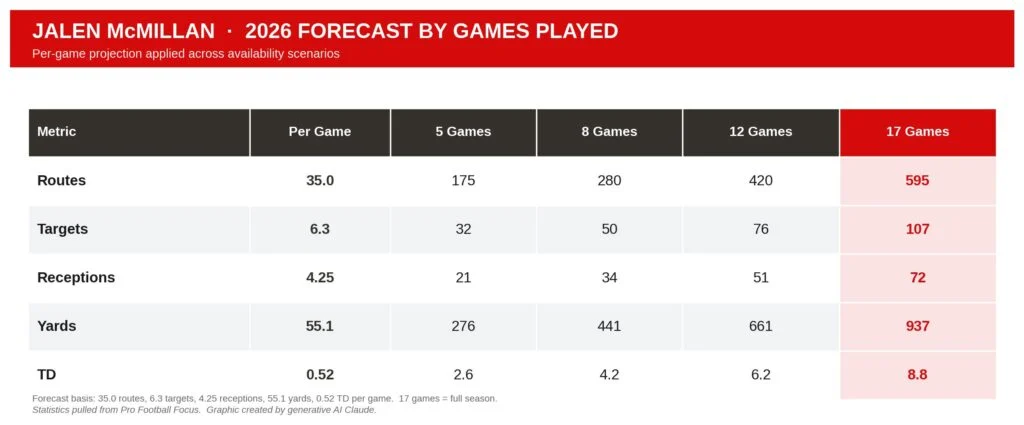
The catch is the word “full.” He played just four games last year.
Neck injuries are scary. And let’s not forget he missed a month in his rookie year due to injury. So read this projection on a sliding scale of availability.
At 12 games, the more realistic landing spot given his history, you are looking at roughly 661 yards and six scores. But the ceiling is tantalizing. Let’s hope McMillan can unleash that full year progression in 2026.
Fun Fourth Down: Jalen McMillan – Late Season Weapon
I’ve mentioned the flashes that Jalen McMillan has shown in his first two years with the Bucs. Most of those have come in the last month of the regular season. And because of that he has shown himself to be one of the better receivers in the entire league over the final four weeks of the year.
Take a look at where his production ranks among all 50 qualifying receivers from Weeks 15 through 18 over the past two seasons.
Targets – 39 (28th)
Receptions – 32 (24th)
Yards – 435 (18th)
TD – 5 (4th)
Yards Per Route Run – 1.98 (14th)
QB Rating – 131.4 (5th)
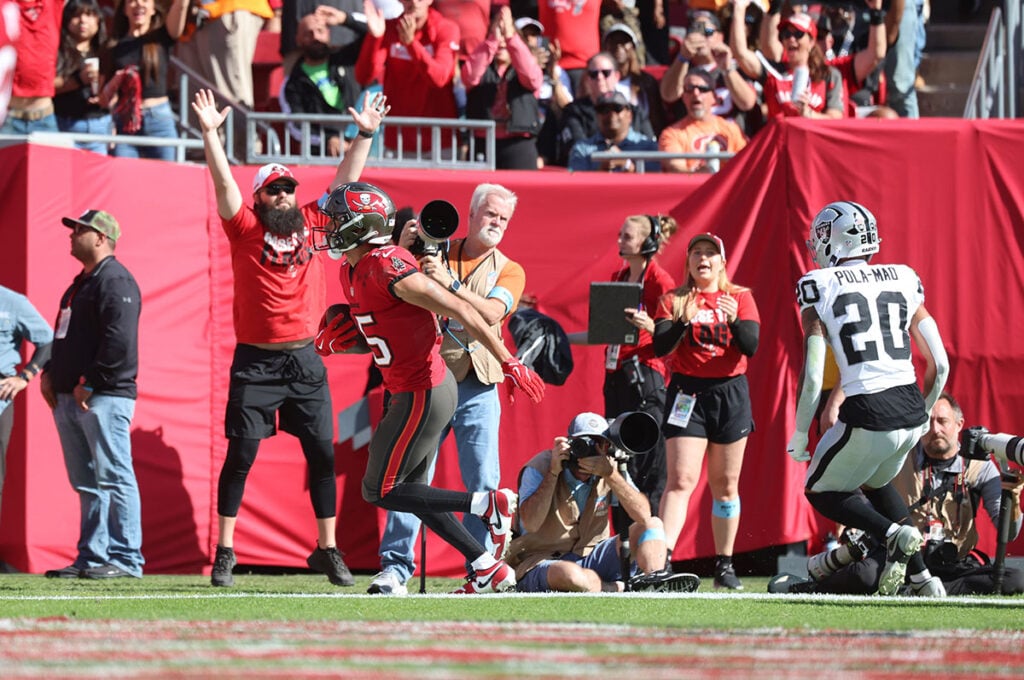
Bucs WR Jalen McMillan – Photo by: USA Today
Look at the gap between those volume ranks and those efficiency ranks. He was targeted like a third option in the passing game, but he finished like an alpha. His five touchdowns tie him with the likes of Ja’Marr Chase, Amon-Ra St. Brown, Nico Collins and Terry McLaurin, and he got there on barely half their targets. Those are bona fide No. 1 receivers.
McMillan’s 131.4 passer rating when targeted ranks fifth, and is in a cluster with DeVonta Smith and Tee Higgins – two of the top No. 2 receivers in the game.
The volume shows he was still being used like a third receiver. The efficiency shows how much room to grow is left on the table.
And I wouldn’t put it past new Bucs offensive coordinator Zac Robinson to help McMillan’s growth in 2026 with even more opportunities.