

After a long day in the saddle, sit bone soreness and lower back fatigue are common, especially on rough terrain. Suspension seatposts like the Cane Creek eeSilk+ are one of the simplest ways to improve bike comfort, reducing strain by smoothing out bumps and road chatter before they reach your body.
A few years ago, I tested the original Cane Creek eeSilk, which offered 20 mm of travel. I appreciated its firm, performance-focussed feel, but the limited travel meant it struggled to match other suspension seatposts on the gravel roads I typically ride.
The updated eeSilk+ tackles this by boosting travel to 35 mm. With that extra movement, it promises better comfort without the “pogo-stick” sensation that plagues many suspension posts. And for the most part, it delivers.
In this review, I’ll take a detailed look at the Cane Creek eeSilk+ ride quality, from smooth tarmac to rough gravel. I’ll also compare it directly in a vibration test against the Redshift ShockStop PRO Endurance, one of the most refined suspension seatposts currently available.
Let’s dive in.
The Cane Creek eeSilk+ Suspension Seatpost
The eeSilk+ is ideal for riders looking for a seatpost that delivers high levels of comfort while remaining unobtrusive beneath you.
US $219 (MSRP)
The Cane Creek eeSilk+ is an elastomer-based suspension seatpost that uses a compact parallel linkage design, delivering 35 mm of travel. This is on par with most competitors in this category.
It carries over the same core architecture as the original 20 mm eeSilk, featuring an 8 mm offset aluminium two-bolt head, dual aluminium links, and a replaceable elastomer insert.
One of its standout features is its weight. It adds just 100 to 150 grams over a rigid aluminium post, barely anything in real-world terms. It’s also around 30–40% lighter than most other suspension seatposts offering similar travel. And for those chasing even more weight savings, a carbon fibre version is available that trims a further 50 grams.
As with other Cane Creek components, the build quality is excellent. The updated design replaces the previous hollow aluminium axles with solid stainless steel axles, which should enhance longevity. It also relocates the solid bushings from inside the links to the seatpost head. And should you need it, bushing replacement is now super easy using a small screwdriver.
The eeSilk+ is available in 27.2 mm and 31.6 mm diameters, covering the majority of gravel, endurance road, and MTBs. If your frame uses a 30.9 mm seat tube, you can pair the 27.2 mm version with a shim. In my experience, this works perfectly well in practice without noticeable drawbacks.
In terms of sizing, the post measures 387 mm in total length, with a minimum extension of 80 mm to accommodate the linkage and elastomer system. The maximum rider weight is rated at 113 kg (250 lb).
At US $219, it’s certainly not cheap. But considering the comfort gains, it’s likely to feel like good value over the long run.
The Cane Creek eeSilk+ Design

The eeSilk+ moves both downward and rearward, a motion that does an excellent job of smoothing out impacts. This rearward arc is especially effective because, after the rear wheel hits an obstacle, the force travels from the axle toward your centre of mass. That alignment between direction of force and seatpost movement helps the post absorb bumps better. It’s something we’ve actually seen in our vibration tests – telescoping seatposts generally don’t match this level of damping.
While the seatpost maintains saddle angle, it also slightly changes the effective saddle height, as well as the reach to the bars through the travel arc. If you’re looking to replicate your saddle position, you will need to run your saddle slightly forward on the rails, and adjust the saddle height so that it’s at the right height once the seatpost has sagged 10 mm under your body weight.
In my opinion, the eeSilk+ isn’t the most discreet-looking option. The external elastomer and four pivot axles are quite visible. From a purely aesthetic standpoint, I don’t think it’s as clean or streamlined as telescoping designs like the USE VYBE or the Redshift ShockStop, which hide their mechanisms internally.
Some riders have reported side-to-side play developing in earlier eeSilk models over time, but I didn’t encounter any noticeable movement with the eeSilk+ during my testing. In any case, Cane Creek backs the post with a two-year warranty, and a rebuild kit is available, which should help address any long-term bushing wear concerns.
In addition, some riders have noted that the post can develop noise in dusty conditions. Again, I didn’t encounter this in my testing.
The saddle clamp is another potential downside. Adjusting saddle tilt requires both a wrench and an Allen key, which isn’t ideal for on-the-road tweaks since most riders won’t carry both tools. On the plus side, once it’s set up properly, the clamp holds the saddle firmly in place without slipping.
Tuning the Cane Creek eeSilk+ Seatpost

Like most elastomer-based designs, the eeSilk+ can be tuned using interchangeable elastomers. This lets you match the suspension feel to your body weight and riding style. Softer elastomers prioritise comfort and compliance, while firmer options offer better support and improved pedalling efficiency.
The seatpost comes fitted with a medium elastomer as standard, designed for riders between 68 and 95 kg (150–210 lb), which will suit the majority of users. If you fall outside this range, Cane Creek offers additional elastomer options for around US $15 each:
Extra Soft #1: <110lb (<50kg)
Soft #3: 100-160lb (45-73kg)
Medium #5: 150-210lb (68-95kg)
Firm #7: 200-250lb (90-113kg)
Extra Firm #9: 200-250lb (90-113kg)
I tested both the Medium (#5) and Firm (#7) elastomers under my 87 kg body weight, but the latter limited access to the full range of motion. If you’re toward the lower end of the recommended weight ranges and you’re looking for maximum compliance, I’d suggest opting for a softer elastomer rather than a firmer one.
Swapping elastomers is straightforward and can be done without removing the seatpost or saddle from the bike. You’ll need a 3 mm and 4 mm Allen key to undo the lower pivot axle bolts, then use the included pin tool to push out the axle. Once removed, the saddle and linkage can be rotated forward to access and replace the elastomer.
Reinstalling is simply the reverse process. Use the pin tool to guide the axle back into place, and you’re good to go. If you’re interested, here’s a video of the process.

Suspension seatposts typically use one of two spring types: elastomers or metal coil springs.
Coil springs are very active and highly responsive to bumps. In our vibration testing, fast-reacting coil systems consistently perform well across the full range of impacts, from tiny chatter to large hits. This makes them especially effective at smoothing rough terrain.
However, coil springs also lack inherent damping. As a result, they can introduce a subtle bouncing sensation while pedalling. You won’t notice this much on rough dirt roads, but it becomes more apparent on smoother surfaces or when riding at a high cadence.
Elastomer-based seatposts, like the Cane Creek eeSilk+, behave quite differently. The material naturally damps movement, which helps suppress unwanted motion from pedalling. The result is a more composed, stable ride where the seatpost tends to “disappear” beneath you.
A downside of elastomers is that they can stiffen in cold conditions. If you’re riding mostly in colder weather, a coil-spring seatpost may be a better option.
Riding The Cane Creek eeSilk+ Suspension Seatpost

The Cane Creek eeSilk+ feels noticeably more composed and controlled than most suspension seatposts I’ve tested. Its firm, sporty character makes it especially well-suited to riders spending a lot of time on smoother surfaces rather than rough dirt roads.
For a 35 mm travel seatpost, the pedalling efficiency remains impressively high. The usual “bouncy” sensation found in many suspension posts is kept to a minimum, and under steady seated efforts, it never feels like it’s wasting energy.
Compared to the original 20 mm eeSilk, the added travel brings a clear boost in comfort. The standard eeSilk feels more like a compliant carbon post, whereas the eeSilk+ is capable of absorbing much bigger impacts without harshness. I found it to do particularly good job of reducing shock and vibration over my long gravel rides.
Like any suspension seatpost, the eeSilk+ means you no longer need to unweight the saddle as much over bumps. You can simply stay seated and pedal through them. This is an underrated benefit compared to a rigid seatpost, and one that many riders don’t fully appreciate until they’ve tried a suspension setup.
While larger hits at faster speeds are still better handled by coil-spring designs, I think the eeSilk+ is an excellent fatigue-reduction tool for gravel roads and light off-road riding, taking the edge off constant small-to-medium impacts.
Right, let’s now find out how well the eeSilk+ damps vibration.
Test Bike and Comfort Test Method

I conducted this vibration test using my Mondraker Dusty gravel bike, fitted with a carbon fork and Lauf Smoothie 44 cm wide carbon handlebars.
The bike was running Bontrager Girona Pro 42 mm tyres (41 mm measured) on Spank Flare 24 Vibrocore wheels. Tyre pressures were set to 34.5 PSI at the rear and 33 PSI up front, based on the Silca tyre pressure calculator. These pressure values are what I typically use for my 87 kg body weight on gravel roads.
For the test, I compared three seatpost setups: a standard alloy rigid seatpost, the Cane Creek eeSilk+ suspension seatpost, and the Redshift ShockStop PRO Endurance suspension seatpost. The spring rates were tuned to suit my weight and preferred riding style.
I then performed a high-frequency chatter test over a controlled obstacle at 25 km/h, designed to replicate the repeated impacts you’d encounter on an uneven gravel road.
You can read more about my vibration measurement procedure HERE.
Vibration Test Results

| Stem | Average Acceleration (G) | Vibration Reduction Compared To Rigid Seatpost |
|---|---|---|
| Cane Creek eeSilk+ Suspension Seatpost | 1.51 | 14.7% Less Vibration |
| Redshift ShockStop PRO Endurance Seatpost | 1.51 | 14.7% Less Vibration |
| Alloy Rigid Seatpost | 1.77 | – |
In my high-frequency chatter test, the eeSilk+ delivered outstanding results. It reduced vibration by nearly 15% compared to a rigid seatpost, matching the damping performance of the Redshift ShockStop PRO Endurance, which is widely regarded as a benchmark in this category.
This can be attributed to Cane Creek’s elastomer proving highly effective at damping rapid, repetitive impacts. The elastomer also helps keep unwanted “bounciness” in check, which also likely contributes to these impressive results.
How Does It Compare?
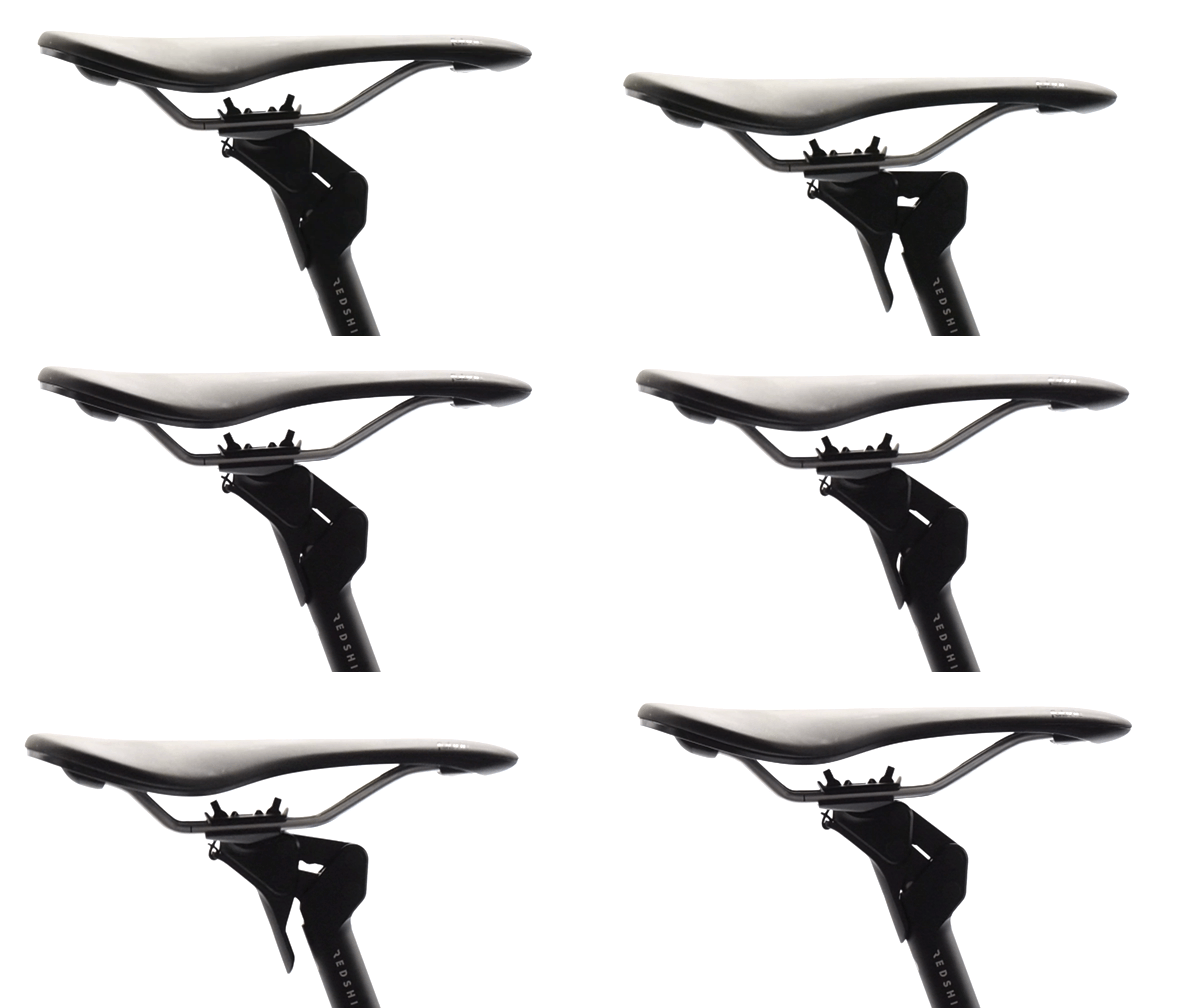
So, we’ve seen the eeSilk+ match the Redshift ShockStop PRO Endurance in my high-frequency vibration test. But how do they compare overall?
To start, the eeSilk+ has a clear weight advantage. It’s around 130 grams lighter than the Redshift, and up to 180 grams lighter if you opt for the carbon version. That’s a significant difference, especially considering both offer 35 mm of travel.
On the bike, the eeSilk+ keeps pedal bob to an absolute minimum, which makes it particularly well suited to smoother roads and gravel surfaces. The Redshift, by contrast, is more active, so it tends to perform better on faster and rougher terrain where that extra movement is beneficial.
For my own fast riding on bumpier roads, I find the Redshift to be the more comfortable seatpost option, as does Alee, who is currently using this seatpost on his five-year journey through Africa.
Price-wise, both seatposts sit in a similarly high price range, but the eeSilk+ comes in about US $80 cheaper, giving it a big edge in value.
Summary

If you ride mostly on smoother roads, or you’re after a lighter, more subtle suspension seatpost than most, the Cane Creek eeSilk+ is an easy recommendation.
With 35 mm of travel, it builds on the strengths of the original design while keeping drawbacks to a minimum. The extra travel boosts comfort, and the elastomer keeps unwanted bounce nicely under control.
In my testing, it performed impressively on both tarmac and gravel, noticeably reducing fatigue and easing lower back strain. It even matched the vibration-damping of a Redshift seatpost. As a result, this is a very easy to recommend product.
You can support the CYCLINGABOUT Comfort Lab by purchasing a Cane Creek eeSilk+ seatpost on Amazon. Simply click HERE to make your purchase, and a small commission will come our way.