
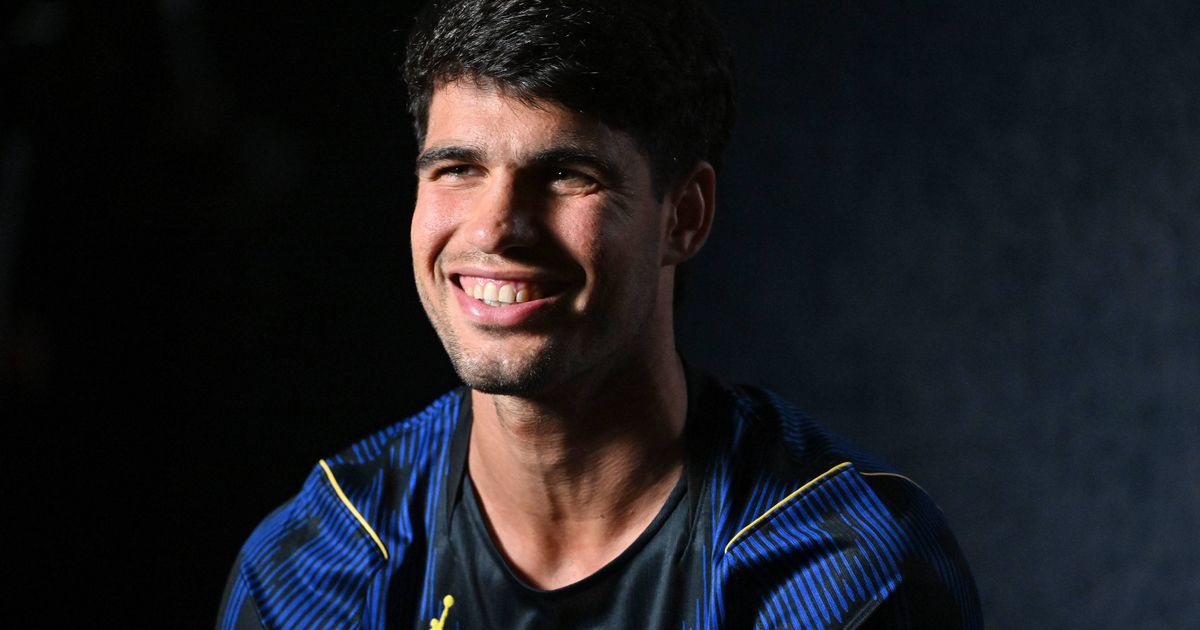
The setback interrupts a season in which Alcaraz had been positioned as one of the primary contenders across the clay circuit and alongside Jannik Sinner at the top of the ATP hierarchy. His rivalry with Sinner has become a defining feature of the current tour, frequently deciding major titles and shaping the competitive structure of men’s tennis in the post-Big Three era.
In this context, his interview takes on added weight. While still one of the dominant players of his generation, Alcaraz questions the sustainability of a calendar that offers limited recovery time and increasingly compresses peak physical performance into continuous cycles of competition.
“Slave to tennis” and the strain of repetition
Alcaraz’s central theme is not short-term performance, but long-term sustainability. He describes a career rhythm shaped by constant travel, competition and expectation, and the psychological effect of having little separation between professional and personal life. “I don’t want to say vertigo,” he answers when asked about everything he has already achieved.
“I’m aware that I have so much ahead of me, and I try not to think that I have 12 or 15 years left of my career because I get overwhelmed,” Alcaraz says, laughing. What he does not want is to end up leading a monotonous life that makes him “a slave to tennis.”
He connects his physical setbacks directly to periods without adequate rest, framing recovery as a structural requirement rather than a tactical choice. The timing of his wrist injury, which now removes him from Roland Garros and the entire clay season, has intensified attention on his comments about workload and fatigue.
“There’s been times in which I didn’t stop to take a break,” he says, “and that led to me not playing well, or becoming injured, or…” he pauses. “Let’s just leave it at that, that it didn’t end well.”
Sinner rivalry and competitive boundaries
The rivalry with Jannik Sinner continues to define the competitive direction of men’s tennis, with both players consistently meeting in later stages of major tournaments and setting the benchmark for the new generation.
Alcaraz insists the rivalry is strictly competitive and contained within matches. Off court, he describes a professional respect that avoids hostility, even if maintaining close friendship is complicated by repeated high-stakes encounters.
“We’re showing the world that we can be on court and give our best, and try to do the most possible damage to the other while playing, try to beat each other, and then, off court, just be two guys who get along really well,” he says. “We help each other give our best.”
“We are fighting for the same goal, but there’s no need to hate each other because we want the same thing.”
He also addresses external comparisons to figures such as Novak Djokovic, acknowledging the praise but rejecting the idea that his game should be framed through historical templates, instead emphasising the development of his own identity.
Fame, exposure and the modern athlete
Beyond results, Alcaraz’s profile has expanded into global visibility driven by social media and cultural crossover. His presence is shaped not only by performance but also by image, personality and the speed at which content circulates online.
“Look, I’m a sports fan and a New Yorker, so I’m going to be loud and cheer for my guy,” Lee laughs. “And as it got tighter, I got louder.”
He accepts that this visibility carries both opportunity and risk. While it increases reach and relevance, it also exposes athletes to immediate public feedback that can affect perception and, at times, performance. “Now, anyone can easily leave a comment, you can harm an athlete with just one comment,” he says, admitting that negative comments have at times affected his game.